
A few summers ago, multiple anglers reported having their reels completely spooled while fluke fishing off the South Shore of Long Island. Some local fishermen theorized that the line-depleting nemeses might be one of the Northeast’s apex predators—sharks.
With these reports in mind, I summoned a friend who owns a Grady White, and suggested we specifically target large sharks inshore on Long Island’s South Shore. On a late-June morning we drove out to a public ramp at dawn and launched his 20-foot Overnighter. We prepared as if we were going to make the normal drifts for sharks in 20 to 25 fathoms, but planned to set up in shallow water. We’d saved some bluefish from an earlier outing on the North Shore and brought three cans of ground menhaden chum to spice up the waters and attract any sharks in the area to our baits.

When we arrived at the last buoy from the inlet in a depth of about 40 feet, we noticed that the water was teeming with menhaden. These schools of baitfish gave us hope that there might just be some sharks in the area.
After snagging plenty of fresh bunker, we set up our first line with two filets of bluefish and two filets of menhaden no more than 20 feet down and let it out about 125 feet behind the boat. While preparing our second rig the first setup started to scream out line. Within seconds, a 150-pound thresher shark leapt completely out of the water. The fisherman on a neighboring boat looked with awed disbelief, and then the hooked thresher bull-rushed the neighboring boat. The captain could hardly get the boat in gear fast enough in order to keep his distance. Over the next 45 minutes, the thresher fought with a series of runs and jumps. In fact, the shark went completely airborne a couple more times—it seems that in the shallows that there is nowhere to go but up.
When we finally got the thresher boatside, we made sure that it was fully exhausted because its whiptail can be dangerous if the fish is still green when it’s brought to the boat. After carefully removing the hook and making sure that the shark would be okay, we released him to fight another day.

Since it was only 6:45 a.m., we decided to try again. This time we got two of the lines out before we had our next hit. This fish was considerably larger and we experienced the same exciting jumps and charges as with the first fish. We did not land that one, but throughout the course of the day, we hooked five more sharks and got two of them boatside.
We would start in about 35 to 40 feet of water and drift offshore with the prevailing winds. When we reached about 50 to 55 feet of water, the bunker would become scarce and we would reset our drift in the shallower water. It felt like fluke-drifting with a twist.
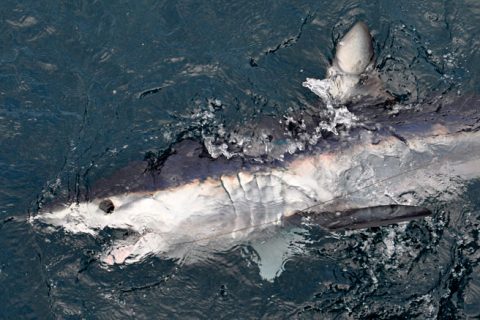
We tried our luck at inshore sharking again in 2012. Fishing around bunker schools, we caught a 150-pound mako. On our second attempt, we caught no sharks, but striped bass up to 50 pounds and multiple large bluefish made for a fine consolation prize.
Bunker-Loving Sharks

Thresher Sharks – Thresher sharks move inshore to feed on large concentra- tions of adult menhaden, but primarily feed over humps and wrecks 10 to 50 miles offshore. Threshers can weigh as much as 500 pounds, but most inshore specimens range from 150 to 250 pounds. Threshers are very aggressive and can occasionally be spotted rip- ping through the bunker schools. They have also been known to attack bunker spoons or other lures being trolled for striped bass.

Brown Sharks– Brown or sandbar sharks are the most common inshore shark around long island . They average between 3 and 4 feet long and will feed around bunker schools, in the surf, or even in bays and estuaries.

Mako Sharks– While primarily a pelagic species, on rare occasions mako sharks will move inshore to feed.
This season, when fishing around bunker schools off the South Shore of Long Island, why not give inshore sharking a try? Make sure you pack the appropriate gear, or you’re likely to lose a lot of line and tackle. Even when targeting stripers and blues, it won’t hurt to have a shark outfit rigged and ready in case you see something larger harassing the bunker. You might be surprised what finds your bait in the shallow waters off the South Shore.