
Neil Young once sang, “It’s better to burn out than to fade away.” I recited that as a boy from the back seat of Dad’s car on long road trips, during which we cycled through at least half of Young’s decades-long discography. And while Young referenced the lives of rock stars with impactful legacies who left us too soon, those lyrics also relate to our dwindling saltwater season. Don’t let it slowly slip away. Make the most of the few opportunities we have left to bend a rod and close out 2025 in a blaze of glory.
(Note: On The Water is reader-supported. When you buy through links on our site, we may earn an affiliate commission.)
Late-Season Stripers
Come November, as migratory striped bass press south and west, the search for gold in the form of a silver, seven-striped fish seems futile. For anglers north of Cape Cod, the hunt should begin in one of the many river systems along Massachusetts’ coast. Resident stripers populate these urban and suburban waters year-round, and the final waves of migrators use them as pit stops to fuel up for a long swim ahead. Young-of-the-year river herring and perhaps a few errant pods of bunker will drop out of our estuaries as water temperatures continue to fall, and stripers that have yet to leave will be there to feed alongside their overwintering counterparts.
At this point in the season, striped bass are getting lethargic, so our presentations must be slow and our chosen locations precise in order to find success. Creeping a floating minnow plug over a hole in a narrow river bend, patiently twitching a slow-sinking glidebait in a salt marsh, or jigging a 5-inch soft plastic through a pinch point or inlet are all good ways to entice cold-water migrators on their way out. Meanwhile, a short drive south may reveal schoolies pinning baitfish like sand eels tight to Cape Cod shorelines.
Last year, stripers stuck around in the outer Cape surf into the second week of November to feed on sand eels. These slender, burrowing baitfish tend to produce lengthy, albeit hit-or- miss action on sand beaches late in the season, so I made several trips to the outer Cape in search of such a bite. On each excursion, hickory shad danced in the shallow wash and gingerly tapped my teasers, only to pop free when I set the hook far too hard to hold purchase in their delicate, paper-thin mouths. Then, after skunking three times, my efforts finally paid off. A low 20-inch bass hit my Ava-style diamond jig in the white water as it dragged through a nearshore trough. Alone on the beach, I celebrated having struck silver gold. Cape Codders should keep their eyes and ears on the outer beaches during the eleventh hour, as there is a good chance that bite will develop again this fall.
Each season is different, though. Two years back, the sand eel bite never really materialized. However, one November morning I discovered packs of tiny stripers racing west along the south side of Cape Cod. Metals, epoxy jigs, bucktail jigs and teasers, and small topwaters like the Rebel Jumpin’ Minnow and 3.75-inch Monomoy Tackle Z-Step brought “diaper stripers” to hand for almost a week as they fed on bait too tiny for me to distinguish. They ate so close to shore that casting was not even necessary. A backhanded pitch of the plug or jig just 20 feet off the beach was all it took to tempt those hungry schoolies, and although it wasn’t the most exciting fishing, it was reliable light-tackle action. Once they disappeared, I ventured to a marsh opposite the beach and conjured up a few larger, mid-20-inch fish from a muddy-bottomed pond. This sort of late-fall fishing is not unique to Cape Cod; it happens all along the coasts of Rhode Island and Connecticut as stripers sprint for Chesapeake Bay and wintering grounds around the Delaware and Hudson rivers.
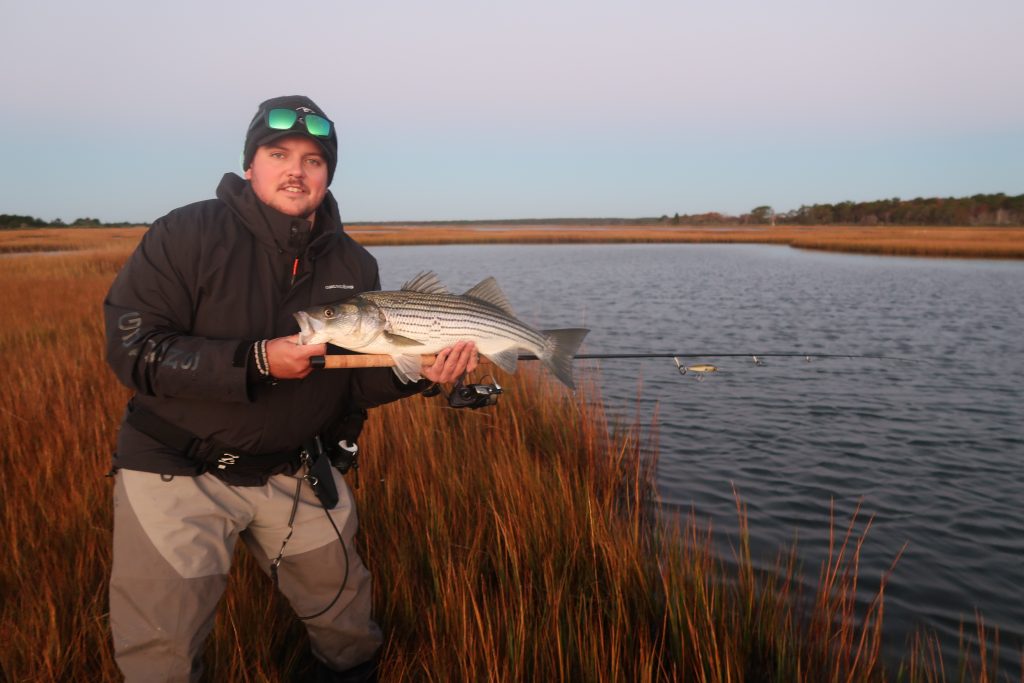
As the last migratory bass join “snowbirds” in search of more comfortable conditions, places like the Cape Cod Canal, Elizabeth Islands, South County beaches in Rhode Island, and Eastern Long Island Sound may hold fish as late as Thanksgiving. Most of them tend to fall in the schoolie- to slot-size class, but a late-season cow encounter is still a possibility—especially if hickory shad are abundantly present.
November Bones
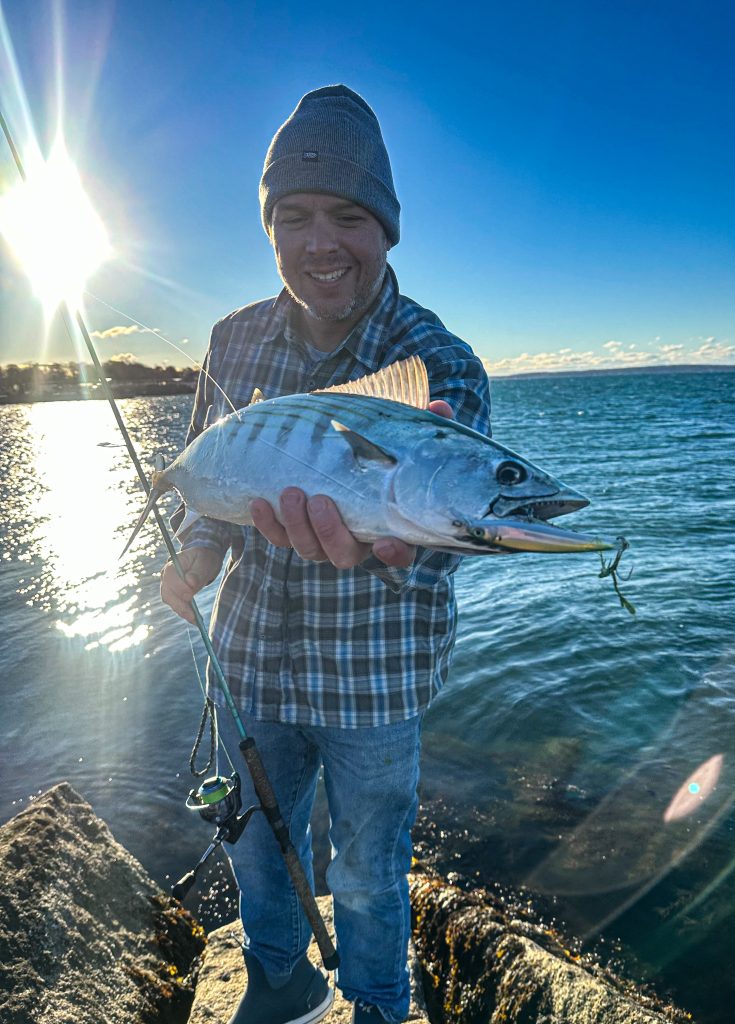
Bonito returned in numbers yet again this year, and if there is enough bait available, they may stick around into November. As juvenile river herring drop out of the estuaries across southern New England, the south side of Cape Cod, Rhode Island, and Long Island Sound can potentially yield a few late-fall hardtails. This time last year, the remaining bonito off Cape Cod showed preference for small minnow plugs like the Rapala X-Rap and 15F SP Minnow over epoxy jigs. Like the stripers I encountered in Nantucket Sound, they fed close to shore, so casting distance became less of a concern. Keep a few jerkbaits and small minnow plugs handy in case bones make another late exit in 2025.
Crab Crunchers
As the weather gets colder and stripers grow scarce, some will spend their final days on the water dropping crabs into deep, craggy structure. Tautog, blackfish, white chinners, boulder bulldogs—whatever you call them—their cult following seems to grow year after year, and for good reason. They fight hard, they chew in cold water, and they are excellent table fare. It is chowder season, after all.
From Cape Cod to Connecticut, tautog fishermen are often the last ones to pull their boats. In Rhode Island and Massachusetts, the season remains open until New Year’s Eve, while Connecticut’s season wraps on Friday, November 28. Anglers in the Constitution State should skip the shopping mall this year and instead head to a local tackle shop to secure bait and observe Black(fish) Friday the right way.

Green crabs are a readily available bait, and they work just fine when tautog are in 60 to 80 feet of water. In those depths, you may even be able to pull a few fish on the jig, depending on the tide and current speed. But, eventually, with dropping temperatures, tog slide deeper, and rigs tipped with halved white-legger crabs begin to outproduce invasive greenies. They’re bigger and hardier baits, so don’t be too quick to swing at those little pecks. Let them eat, and when you feel sudden slack or a heavy thump, drive the hook home and pick up as much line as possible to winch the fish away from the structure.
A Fresh Start
While there is still some time before we flip the calendar to 2026, once the saltwater gear gets put away, I consider early winter freshwater fishing to be the start of a new season. The usual suspects—largemouth and smallmouth bass, chain pickerel, panfish, and trout—will carry us into the new year. By mid-December, it’s time to break out the ultralight setups and get to casting spoons and spinners, suspending jerkbaits, micro jigs, and float-and-fly rigs in lakes and ponds.
Before you start swapping out corroded hooks and split rings on your striper plugs, take some time to enjoy what late-fall fishing has to offer in southern New England. After all, it’s better to burn out than it is to rust.
READ MORE


