

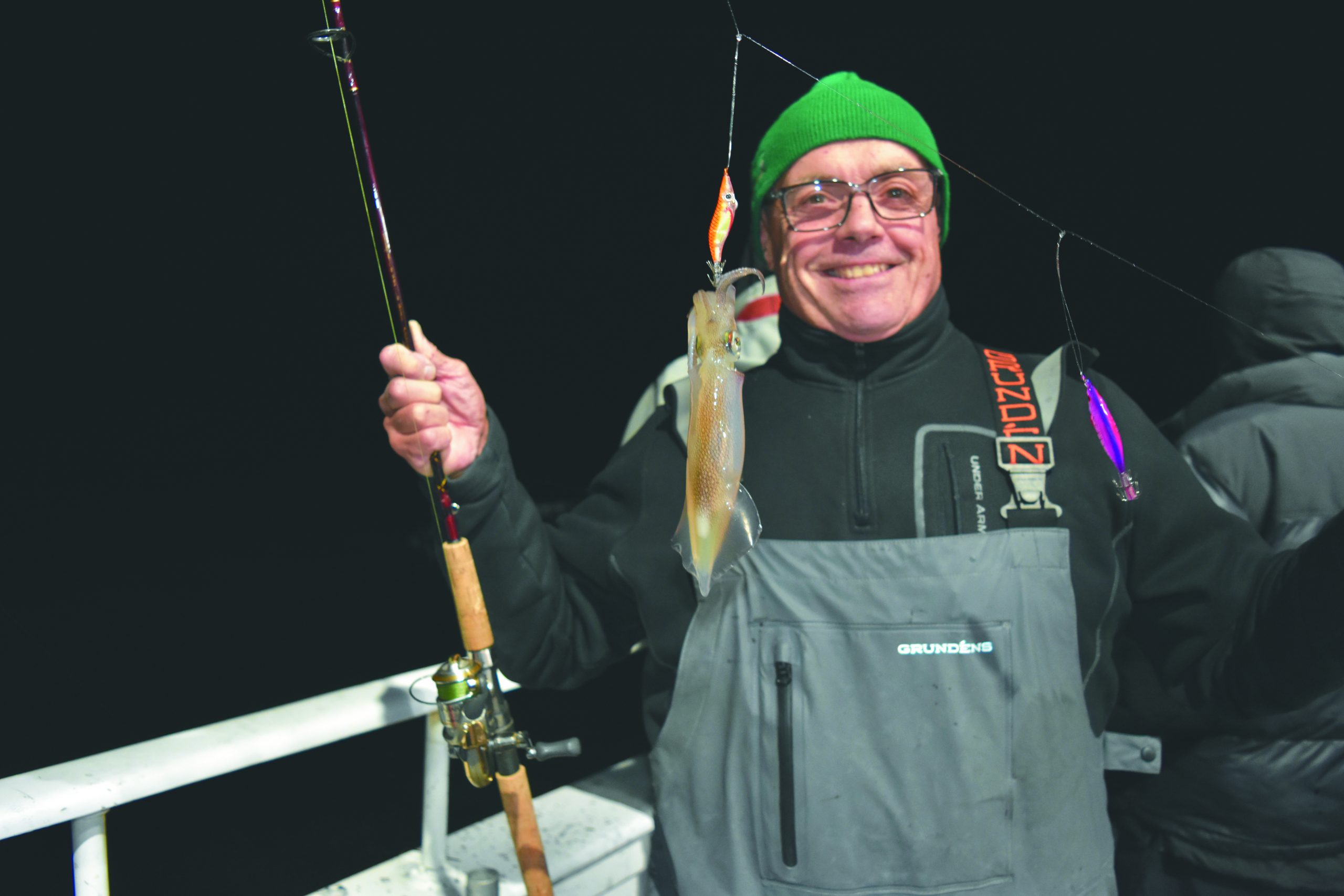
October 19, 2025—I’m leaving Montauk inlet for an afternoon of fly casting and diamond jigging. However, as I clear the breakwater, something possesses me to veer left into Gardiner’s Bay, away from the rips that promise striped bass and false albacore. I can’t explain why I’m doing this, but I’m about to burn the afternoon on a research project. There was great squid jigging reported the previous night in the bay. Could I locate these critters and get them to swipe at my squid jigs under a bright sun?
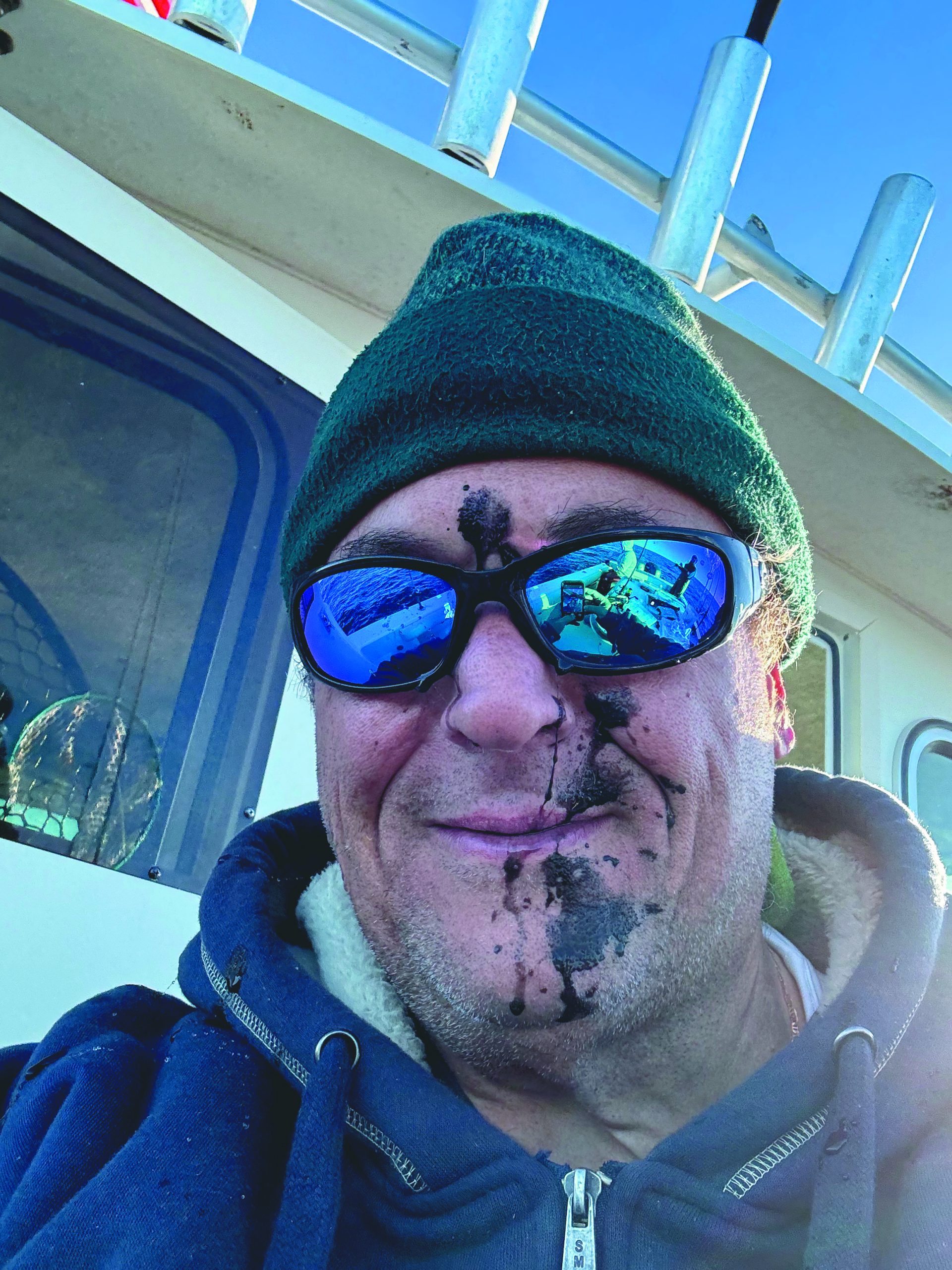
How a fly fisherman and a surfcaster can be pulled into the world of the cephalopod is a tale sometimes described as “getting inked.” The term has at least two meanings. The first describes a rookie mistake, letting the shooting part of the squid aim in the wrong direction. The result is a blast of seawater and ink, often in the face. On a deeper level, “getting inked” signifies a rite of passage. It’s a symbol of acceptance into a fishery that now has a cult-like following.
My ink timeline is rooted in fishing trips going back to at least 2000. It was during this era that my surfcasting partner, Mike Arma, and I would slip into wetsuits in Montauk and swim out to rocks at night for striped bass. To me, the shape and movement of the Montauk zig-zag darter always suggested a squid. The plot thickened when I began swimming out to these rocks with a fly rod, throwing more accurate bait imitations, including surf candies and 4- to 6-inch deceivers. There were a few nights where I hooked more squid than bass, and some of the squid were huge!
Marriage, kids, and jobs sent me and Mike in different directions. With limited free time, we found other types of fishing to fill in for surfcasting and extreme wetsuiting. By 2017, we were still in regular contact, though. I was about to be guilty of the ultimate surfcasting sin—buying another boat. Mike was already charting a course even further away from surfcasting. How much different? It’s not every striper sharpie who invests months of research (and thousands of dollars) to pull dredges for bay scallops. I didn’t hold it against him. On the contrary, I enjoyed freezing my tail off on some very productive late-fall trips, once Mike had the whole scallop dredging thing figured out.
It was through local scallop research that Mike Arma came upon squid, though. “I just clicked on a squid-jigging video. There was footage of people catching squid on a pier at night on Long Island,” he explained.
“Small world, but from this video I had a very good idea of what pier they were fishing from. I was fascinated! I took a ride over to see it for myself. From that very first night on the pier, I was hooked.”
“I was amazed as I watched online videos of squid-fishing techniques from all over the world—Australia, Japan, Italy. Much of it seemed to be applicable to our squid here,” he observed.
My own squid journey was far more measured, but I was happy to follow Mike’s “go big or go home” approach to see where it might lead. First, he had to identify and purchase those hard-to-get squid jigs from overseas (An important disclaimer: It’s getting better, but few local shops carry the full range of jigs used by the best local squidders.) Next came the purchase of a generator and lights, then the regular trip reports. Mike texted reports of driving to various piers on the East End, sometimes pulling all-nighters and jigging until first light.
You might recognize these behaviors as those of a compulsive surfcaster. At one time, Mike Arma was the top surfcaster in the Farragut Striper Club. He still holds the club record for the most striped bass in a single season. But this level of intensity … for squid?
Most of Mike’s trip reports, particularly the good ones, ended with a tease. “What are you waiting for, Johnny?”
I pulled together about a dozen squid jigs of various shapes and sizes, most acquired from local flea markets. In hindsight, it made perfect sense that my earliest visits to the lighted piers of Montauk rarely yielded more than a dozen tubes. They were much less productive than those nights catching squid by accident with flies, and way off the numbers of squid that Arma was regularly reporting (some trips yielded over 100).
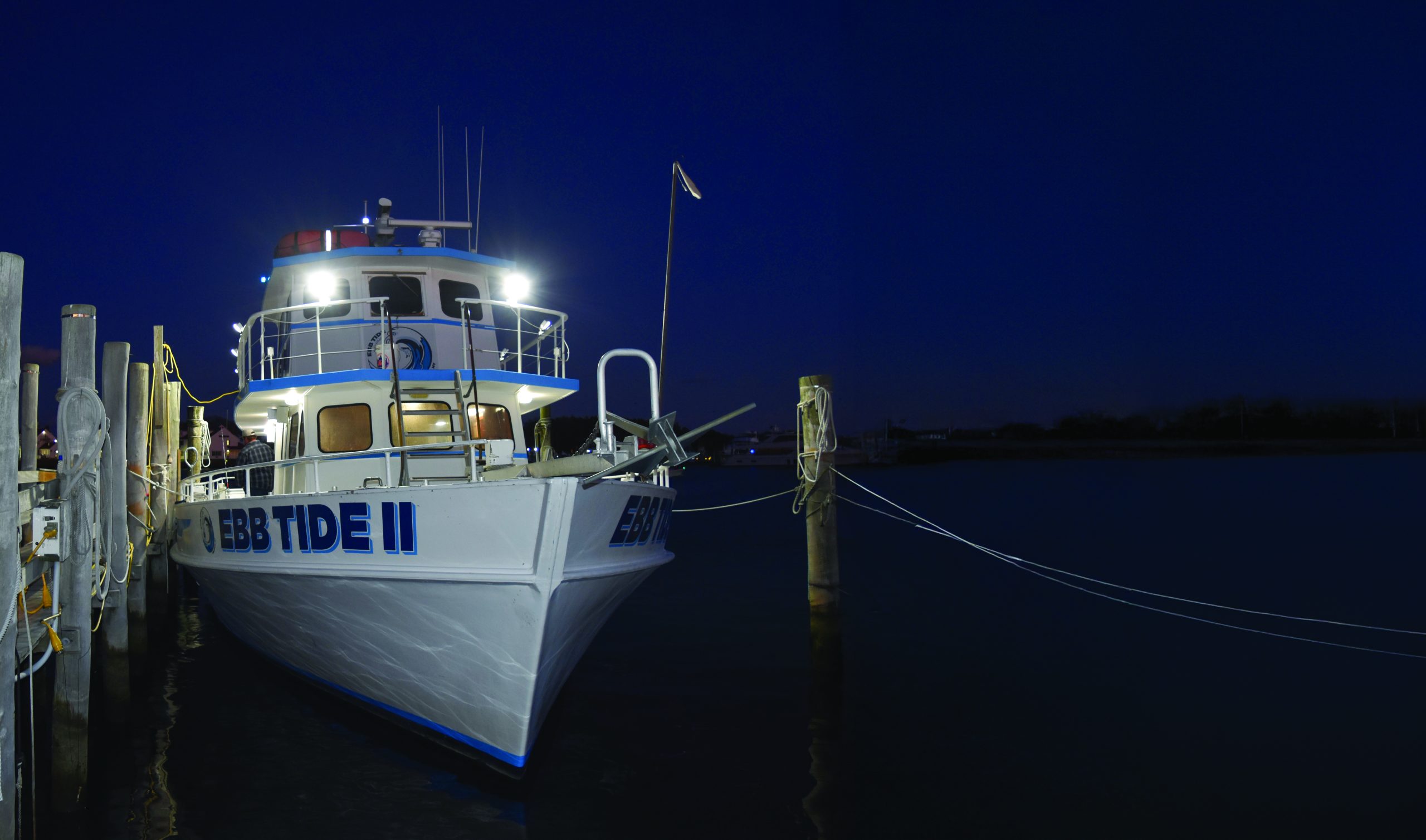
The following fall I broke down and reserved a spot on the Montauk open boat Ebb Tide II. By now, the Ebb Tide operation was running nightly “Squidinator” trips to a dedicated fan base. To say that party boat squidding was marketing genius—among a fleet that prides itself in traditions—would be an understatement.
On a cold October night, I arrived for a reservation-only trip to find at least 30 people in line. The greetings and chatter were electrifying. Some jiggers offered that they had been waiting in line for over an hour. I was introduced to squid fans from as far away as Philadelphia, though a substantial portion of the night’s fares drove a much shorter 3 hours (one way) from Queens.
“There is no squid fishing like this near us, Montauk is one of our closest options,” explained one of them.
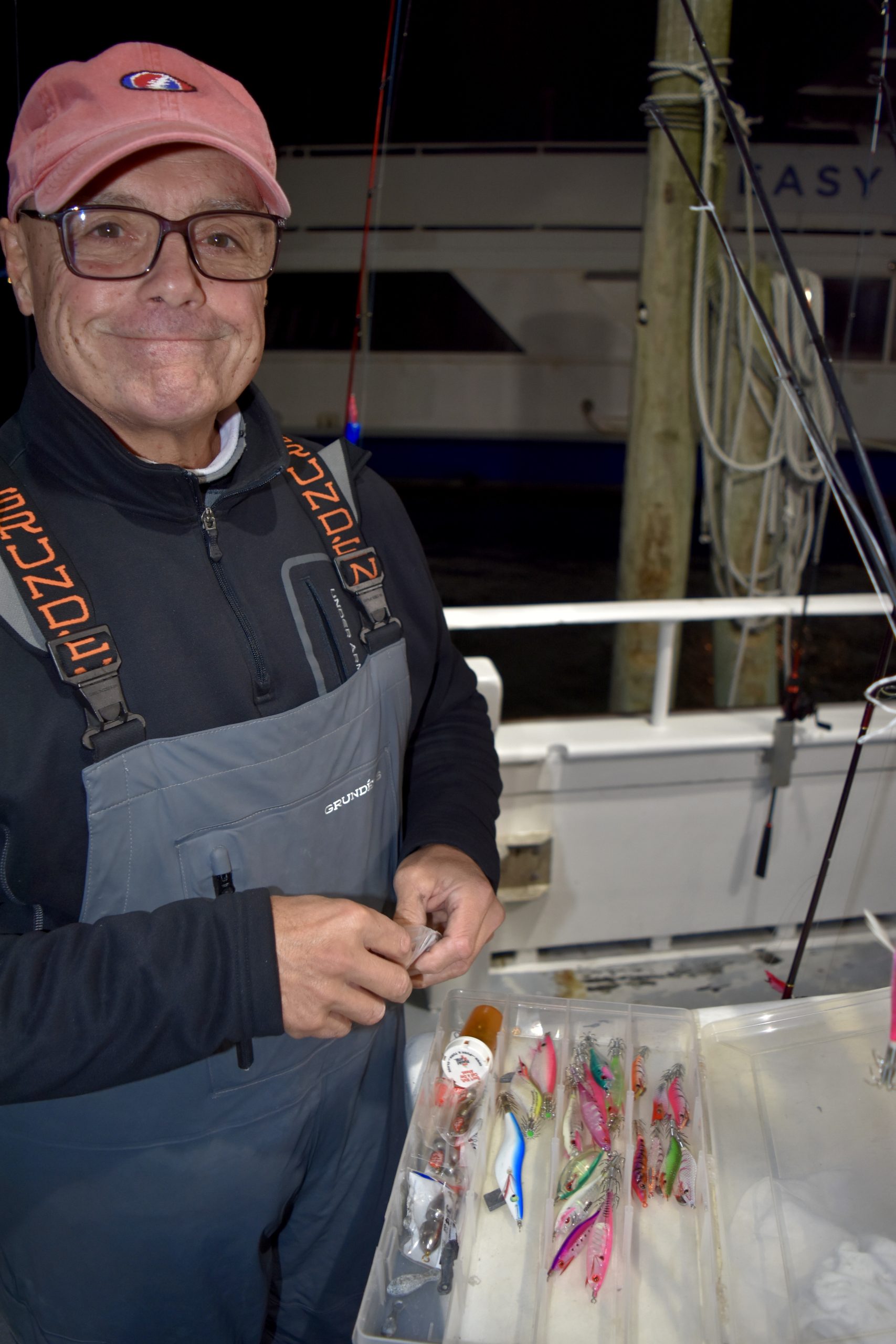
These were not striped bass fishermen. They were not bottom fishermen. They came primarily with freshwater rods. Reels were spooled with very light braid, others with mono. Quite a few anglers revealed multiple boxes of jigs—some had packed 50 to 100 for this trip. I listened to them debate about weight and color. Many had prepared several rods with different leader lengths and jig configurations. Clearly, the expectation was to change color and technique as the night went on.
But there was more. Several parties came with plates and serving trays, complete with chopsticks or utensils. With a bit of luck, some squid would be prepared and eaten right in the cabin! Conversations on fishing mixed with culinary pursuits, and it was clear that squidding meant something more than a headboat trip as I knew it. These people were foodies, some of them anyway, and while the catching would be fun, a bucket of fresh squid was the prize, well worth having to drive back to Queens at 1 a.m.
There was, however, a major catch to all this squid anticipation: my first 40 minutes at the rail was an exercise in humility. Picture 50 people tossing out squid jigs of all makes and sizes. Some rods were rigged with 3 or 4 jigs, opting for a quick trip to the bottom with a 1-ounce bank sinker. A few anglers worked a very simple rig, with only one small squid jig and just enough lead for negative buoyancy. Then, picture a guy in the corner of the stern working a jig in a series of quick lifts and pauses, pulling 15 squid over the rail before anyone close to him had a touch. Next, a guy on the port side developed the hot hand, adding 8 to 10. I finally had to put my rod down. I twisted open a bottle of iced tea and leaned against the rail to watch. Whatever I was doing was pointless anyway.
I later learned that, on this night, at this particular stage of the tide, with light seas and some moonlight, the simplest of jigs and a fraction of an ounce of lead was the ticket. I never would have understood the disparity in catch success without seeing it live. By the end of the 6-hour trip, the hot hands on the boat had close to 100 tubes, while others had barely 15. I finished with close to 40, but only because I did everything within my ability to copy the rigging and jigging techniques that were working. As the night wore on, a small pink EGI-style jig became the hot lure. I was lucky to have grabbed the last few off the rack at a local tackle shop earlier that afternoon.
Squid mania has definitely increased. In 2024 and 2025, additional Montauk charters and headboats added squid trips. Today, one can drive to any of the Gardiner’s Bay overlooks on a spring or fall night to see a fleet of boats spread out over some of the favorite corners and drop-offs where bait is known to gather.
The science tells us that our local variety of squid (most likely longfin inshore squid, Doryteuthis pealeii) are aggressive hunters, capable of attacking fish as large as they are. As much as it is important to downsize squid jigs to match local bait, this does help explain why a much larger jig can sometimes cull a beast. More importantly, these marine invertebrates are regarded as highly intelligent with well-developed senses and advanced vision.
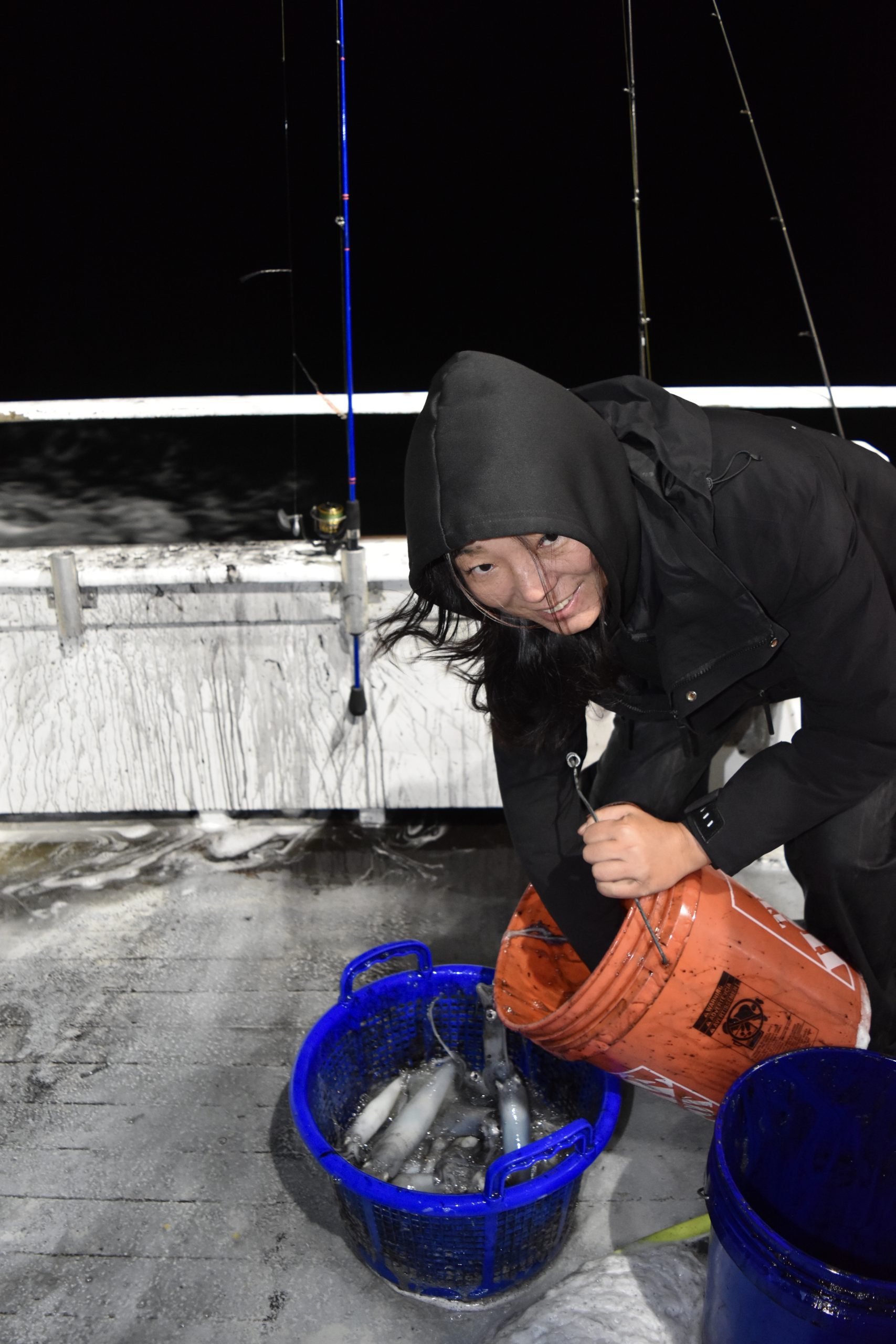
“Oh, they are down there. I’m constantly marking them on the recorder,” noted Captain Anthony D’Arrigo after a recent fall trip
“But if we have too much light, or if it’s too calm, they might not be so fast to go after the jigs.”
“On one pier trip, my buddy attached a camera above the jigs. We just had to see what was going on under the lights,” added Arma.
“Picture hundreds of squid down there, but only some were interested in the jigs—only the jigs in the right size that were moving perfectly. Then one squid moved toward one of our jigs, but another one got to it first.”
All observations reinforce the idea that rigging and technique matter far more than the casual observer would appreciate, though the most experienced squidders see the steep learning curve and the need to frequently change colors and techniques as part of the appeal.
Neither Arma nor the mates on the Ebb Tide II (who have probably coached hundreds of jiggers over the last couple of years) suggested that there is anything close to a standard squid set-up for all conditions.
“I usually start out with three outfits,” explained Arma.
“One rod will have three jigs in the mini size. The jigs will be pink, orange, and blue, though green sometimes matters as well. A second rod will have three slightly larger jigs in the Aurora size, which might be needed in wind or current. The third rod will have a single mini EGI jig. My preference, if conditions allow, is to use the rod with the single EGI set-up. The EGI style jig has the weight under the chin, making it nicely balanced for light jigging action.”
“It’s better if I’m on a pier or have room on a boat. If I can get away with less weight working the EGI jigs, that’s what I will do. With a light rod and a six- to eight-pound fluorocarbon leader, I’m in better contact with the EGI jig. Strikes tend to come on the way down, but with a heavier rod, I might miss it. Jigging technique is important, but I always try to dead-stick another rod. So, often I’ll be working the main rod and see the unattended rod tip bending.”
And while most squid fishing happens at night under generator-powered lights, it is still possible to jig for squid during the day. The approach for consistent daytime squidding is still a work in progress, though there is much evidence of success.
“I’ve followed some of the commercial squid boats out on one of my vessels (a new, larger boat appropriately named Kraken) and I’ve also jigged squid on structure,” reports Arma.
“One of the local party boat captains complained that he didn’t want to fluke fish in the ocean—too much bait, too many squid. Well, that’s exactly what I wanted to hear! On one of our first ocean trips in the daylight, we boated over two hundred squid in a few hours.”
In my own case, I have since invested a part of my trips to assess the viability of squid jigging by day. On the afternoon referenced in the opening paragraph, I was able to locate squid along drop-offs in slightly deeper water, though it did take some drifting and lure changes before I found a pod of aggressive takers—and then it was lights out. I finally stopped when I realized the boat was a complete mess from all the ink. I was looking at a solid hour of cleaning the squid and then another hour of trying to clean the boat.
On the way in Captain D’Arrigo’s observations about my solo squid trips were ringing in my ears: “Leave your own boat at the dock. For $60 you walk off my boat with your squid, and you leave the ink and the cleanup to me.”