

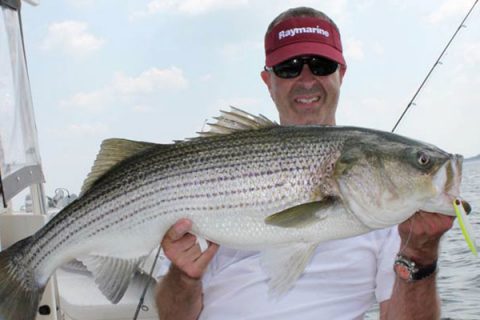
Unleash this versatile bottom-bouncing technique on cod, pollock, stripers, sea bass and more!
There is nothing subtle about the way a striped bass takes a “squidded” jig. So I was not surprised by the impact of the bass as it slammed the Crippled Herring and did its best to bend my rod into the letter “C.” And I was hardly shocked when my accomplished deckmates, Captain Jason Colby and his daughter Wendy, also hooked up – how sweet, a triple! But what really flummoxed me was that we had just made two pre-dawn drifts over the same area with live eels – the “king” of striper baits – without so much as a sniff!

As much as we love to glorify the thrill of the topwater strike or wax about the wallop of a gamester on a sub-surface swimmer, the simple fact is that, regardless of where you fish, from cod to black sea bass to fluke to stripers, most of our favorite fish feed pretty close to the bottom. And that goes double for the trophy specimens we aspire to catch. While fish are nothing if not opportunists and won’t hesitate to break from their comfort zones to pursue prey, they are most content with their pectoral fins within a tick or two of the seabed.
To that end, I have found that one of the most effective means of goading those bottom-loving gamefish to strike is with an old school, seldom-practiced and often misunderstood method called squidding. In its most basic format, squidding consists of rapidly free-spooling a lure, usually a jig (commonly called a “squid” in old-time groundfishing circles, hence the term “squidding”), to the bottom, quickly cranking it up, and then repeating the process. This rudimentary description of squidding is akin to saying that in order to build a house, you’ll need is a hammer and nails – the devil truly is in the details.
TECHNIQUE
Squidding is spot-on effective because it puts your jig in front of the fish and then snatches it away quickly – the fish impulsively launch into attack mode because they believe it is fleeing forage. Coordination and fluency with your conventional reel is the most important aspect of squidding. Open-faced conventional reels are a must in order to affect a controlled drop. Fluidity of motion is tantamount so that the fish does not get too good of a look at food that is obviously not real. The goal is to swiftly drop your jig to the bottom and in one quick motion “pop” that jig back up without delay. A jig must be just heavy enough to drop vertically and reach bottom rapidly yet not so dense that it plummets like an anchor.

Once the lure is being cranked upward, make 4 or 5 revolutions of the handle and then, without hesitation, free-spool and repeat the process. Here’s where familiarity of gear pays handsome dividends. Hand placement and smooth operation of your conventional reel is essential for squidding to work. A pause in lift-off from the bottom can be a deal-breaker, as can a pause at the peak. Imagine a fish eyeballing that jig. It comes into view and has her curious, when suddenly its movement dies on the bottom – you just blew it, the fish is spooked. Now envision it done correctly: the interested predator follows the jig on its descent or during its ascent, when suddenly the prey appears to panic and change direction. BAM! That killer instinct takes over and the predator pounces on its prey.
Right-handed anglers should place the butt of the rod under their left armpit and secure that side of the reel in the palm of their left hand. Picture a big “thumbs up” placement of your hand before you grip the reel, with your left thumb near the spool. I prefer a spool release button or lever on the right side plate of the reel as opposed to a thumb bar, which is more suited to casting reels. With your right hand, learn to cradle the handle between your index finger, the palm of your hand and your thumb. Always have that thumb at the ready so that as soon as you reach the height of your retrieve, you are punching that free-spool lever and the jig is once again plummeting to the bottom.
When in the hands of a skilled squidder, the jig is manipulated with all the aplomb of a puppeteer. Once accustomed to your gear and comfortable with the motion, you should be able to do it blindfolded; your eyes should be reserved for looking at your chart plotter or reading the water, not glued to your reel. The tricky part is maintaining proper tension with your thumb on the spool to prevent backlashes when the jig hits the bottom; only through trial and error will you become proficient at this.

Squidding is best accomplished while drifting over fish-holding bottom, although if you find a pile of fish you can squid over, anchor. Most methods, such as conventional drifting, trolling or casting, involve some time spent with your bait movign through “dead” water. This is not so with squidding – because you are continually feeling for the bottom and placing your offering there, you are combing the most productive stretch of water.
Squidding is the catalyst of the reaction or impulse strike. Because the lure comes into the fish’s view for a split second and then is snatched away, instinct compels the predator to attack or go hungry – squidding taps into those predatory synapses in a fish’s brain, and they just can’t resist striking the jig. No matter your target’s disposition, whether it is passive, neutral or aggressive, they can’t pass up a fleeing “squid” once it is dangled in front of their faces.
PROPER GEAR
In order to squid effectively and efficiently, proper gear is everything. Conventional gear is a must-have for squidding; control of the downward trajectory of the jig can only be accomplished by feathering the spool, which is the sole domain of the revolving spool. A generation ago, the old salts that squidded had no choice but to opt for heavy, 35-ounce reels laden with 50- to 60-pound-test Dacron or monofilament, clamped to rods with the dimensions of a cue stick and about the same level of sensitivity. No wonder squidding fell out of favor!

| Model | Weight (oz.) | Line Capacity – mono (yards/lb.-test) | Inches per Crank (high/low) | Max. Drag (lb.) | Price |
| Daiwa Saltist LD-30 | 15 | 290/20 | 36.6/18 | 22 | $300 |
| Okuma Andros A5-II | 15.2 | 340/20 | 42.1/24.8 | 24 | $400 |
| Shimano Talica 10-II | 18.6 | 270/20 | 38/25 | 20 | $420 |
| Avet Raptor SX 6/4 | 17 | 270/20 | 39/24 | 26 | $440 |
With the advent of palm-sized conventional reels that often weigh in at less than 20 ounces yet have drags powerful enough to unseat a mooring, squidding is easier and more enjoyable than ever before. Specialized reels will give you an edge. I’m partial to two-speed, open-faced reels because of their versatility. Examples include the Daiwa Saltist LD-30 and the Shimano Talica 10-II. Having the capability to switch quickly from slow-speed to hyper-speed at the touch of a button is a huge advantage that allows a fisherman to match the level of the fish’s activity on a given outing. Some days they prefer the squid speedy, other times slow.
Rods too have hit the health club. Technology such as what is available on Shimano’s TC4 blanks has brought to bear rods that can whip a tuna yet have the dimensions and weight of a flounder stick. Braided line such as Power Pro has made the transition possible, with its inherent strength coupled with its micro-diameter permitting a downsizing of everything but fun.
SQUIDS
Now let’s look at some of the “players” that you should pack with you to help your squidding success. The first lure that opened my eyes to the effectiveness of squidding was the Luhr Jensen Crippled Herring. There’s nothing fancy about this classic lure, but it sure catches fish. Its hydrodynamic design drops straight through the water column, making it one of the quickest lures to reach bottom. Standard squidding methods apply with the Crippled Herring – simply “drop and pop,” and the lure it will do the rest. It comes complete with a single Siwash hook, so odds of it snagging up are slim. Take a hone to that hook now and then; the bottom will most definitely dull the point.
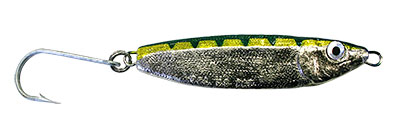

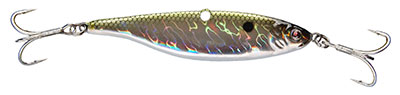

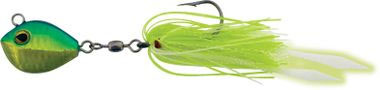
Favorite colors of mine are the pearl fluorescent blueback, neon greenback, and my most cherished Crippled Herring color, firetiger. Another neat thing about the Crippled Herring is that it is affordable; you won’t have to break the bank to bust some fish. An alternative lure which works similarly is Acme’s Trophy Spoon. One of the noteworthy aspects of this jigging spoon is its hammered finish reflects ambient light and gets noticed in less than ideal conditions. I’m partial to the bunker finish and blue/chrome.
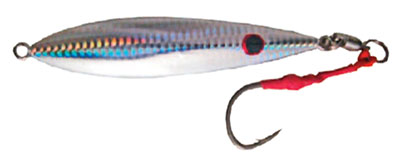
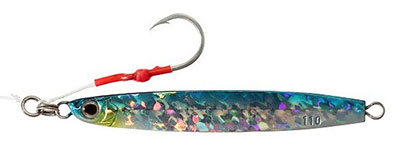
Butterfly jigs have been the rage throughout the seven seas for the better part of a decade now, and it seems as if every time you blink, Shimano comes out with a different model that does different things. It is no exaggeration that there is a Butterfly jig that can handle every squidding situation you are faced with. It’s a real plus to have a variety of different styles of Butterfly jigs on hand to see which action the fish prefer that day. I’ve done very well with the original flat-sided Butterfly jig in pink/blue, gold/red and brown/aji. A friend of mine, Captain Tom Ciulla of TSea Charters, is a Butterfly-jigging maestro; he showed me how well he could cull out the cows from schoolies by squidding a chartreuse/white Centervortex Butterfly jig below obvious blitzes.
It was a watershed moment for me as bass busted on sea herring and mackerel. I was picking away with soft plastics at what appeared to be a school of 12-pounders when Tom tugged in a 25-pounder with the Centervortex. When fish are on the feed, rather than join the boats that a re giving chase to the bird show, lag behind the chaos, pick a good drift line and squid a Butterfly jig into their domain – you’ll often catch the biggest fish in the school! Most anglers outfit the Butterfly jig with assist hooks attached to the eye of the lure. This works really well in most applications, but I’ve found that black sea bass and fluke are inclined to inhale the lure from the rear, so you’ll sometimes increase your hook-up rate by swapping out the top-assist hooks for a rear-placed Mustad Siwash.

Any fish that feeds on crustaceans or cephalopods will show love toward the Lucanus jig. Last year in Boston we had an invasion of black sea bass in the harbor. While we knew we could coax them to hit on bait, the challenge became how to dupe them with an artificial. Having croaked scup and sea bass south of the Cape with the Lucanus, Captain Colby suggested we outfit ourselves aboard the Little Sister with a variety of sizes and colors of Shimano’s bug. It proved to be our number one squidding lure for black sea bass, and it caught more than its share of striped bass as well.
The Lucanus is also a cod killer when squidded for cod in the spring when they are on shallow shelves such as Stellwagen Bank. Colors that worked for me were blue/silver, green/gold and Dungeness crab. The assist hooks that come with the lure appear to be small, but they grab like the tentacles of a squid. When you feel the bite on a Lucanus, do not rear back until you feel the fish on the line, you have to let the fish “set itself,” similar to how you would let a circle hook find purchase.
A dark horse last season was the Sebile Vibrato, which proved to be a killer squidding lure that could be fished two distinct ways. This jig behaves somewhat like a blade bait, which are all the rage in many freshwater bass fishing circles. As implied by the name, the Vibrato vibrates vigorously. These signals are picked up by a fish’s lateral line, and I’ve noticed that this lure is especially hot when the water is turbid or I’m fishing in low light conditions. It inherently has a lot of flash as well. It is intended to be hung horizontally in the water and flutter on the drop as the attachment slot is in the middle of the “back” of the lure.
On a hunch, I tried attaching my line to the eye at the nose of the lure and it still caught fish. This more orthodox squidding connection allows the jig to drop more quickly and behave similarly to a Crippled Herring. The Vibrato comes complete with fore and aft treble hooks, but you may opt to swap out the trebles with single Siwash hooks – they make for a much easier catch and release and are not as prone to hooking bottom. Preferred hues for me have been the holo-greenie and orange/gold/black.
Last summer I was out with my friend Captain Russ Burgess, who is a perennial member of one of the most coveted fraternities – the fifty-pound striper club. After a shallow-water pass over one of his favorite rip lines, we soon found ourselves in deep water, depths which render his favorite lures, diving wooden plugs, useless. He pointed to his chart plotter and said, “Look at those big stripers staged in deep water… if I only knew how to catch them.” For me, the light bulb went off. I replied, “So, have you ever heard of squidding?”
We’ll give it a try this spring as soon as we can…….
Happy fishing!
What shimano rod are you recommending, Trevala jigging or Teramar. What weight, MH?
any signs of squid in cape cod area yet ?
Nothing yet – keep an eye on the Cape Cod Fishing Forecast.
Ron, great article! I have a new Daiwa Saltist 50 I can’t wait to break in. Pink has been my go-to color for jigging for BSB and I’m hoping my technique will improve this year. Had a great time with you on the Little Sister, and hope to clean up on Flounder later this month with Capt. Jason – love it!