


By William A. Muller
Twilight is known as the golden hour, and for good reason. Sometimes, the sunrise or sunset paints the horizon a rich goldenyellow. On most occasions there’s only a hint of gold, but sometimes it may be as deep as gold metal and cover half the sky.
These exceptional twilights occur due to a confluence of atmospheric factors that must be “just right.” They include humidity, temperature, pollution, and even the types of clouds in the sky—low, scattered clouds are more instrumental in this phenomenon than thin higher clouds. Regardless of the science involved, these golden twilights can be so spectacular that even grey clouds exude the glow of Midas.

Although I’m not a color fanatic when it comes to fishing lures, there are special moments when a specific color or color combination can have a significant impact on angling success. When it comes to gold, I’ve learned about its effectiveness several times over, but none of these experiences was more powerful than a certain sunrise at Gilgo Beach, a long time ago.
That fall, local surf rats had enjoyed an unusually consistent run of fish feeding on migrating mullet, and Gilgo Beach was one of the hotspots. I set the alarm for 4 a.m. and headed for the beach. It was false dawn as I aired down and urged my four-wheel drive vehicle onto the sand. I headed three-quarters of a mile east to a spot that had produced quite a few nice stripers for me, and I was awed by the beauty of the sunrise as a thin yellow layer at the horizon began to glow. I had no idea whether I’d catch a fish or two, but I did notice the five-foot waves that rose enticingly on the outer bar and then collapsed in white water into the trough. This could be good, I thought.

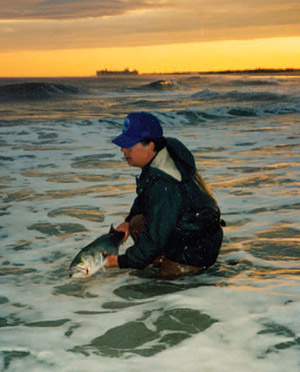
I donned my waders, top and belt, grabbed the rod off the rack and secured a blue-and-white popper to the snap. When I turned around, I saw that the sky had changed and the eastern half was completely aglow in gold. It struck me that it looked a lot like religious paintings from the Renaissance intended to impress and awe the viewer. Hell, I was impressed, all right!
Most of the regulars were lined up as I made my first cast. They subtly nodded greetings as I spotted their poppers splashing water on both sides of me, and I nodded my reply. No fish rose to the lures, including mine. I saw nervous mullet pass, a clear indication that stripers were prowling nearby, but still no takers. Then, I remembered the connection between gold and twilight as taught to me by my elder mentors. I raced a dozen feet to my truck, removed my blue-and-white popper, and replaced it with a gold 2 3/8-ounce Super Strike Little Neck popper.
I sent that plug toward the outer bar and began to slosh it back, perhaps too quickly, as anticipation got the best of me. I slowed the pace, and although the plug was behind the crest of a wave, I still saw the white water spray, and I set the hook on a good fish.
There are times when lure colors need to be subtle, such as in the fall when young-of-the-year snapper blues, weakfish, porgies, and other baits cast purple, pink and pale yellow from their flanks. On these occasions a few strands of pink, yellow or lavender Krystal Flash on a white bucktail can make a big difference.
But, there are also times when a hint of color isn’t enough. For example, a hint of yellow just isn’t enough at Montauk. Those beaches are renowned for the use of yellow and chartreuse plugs and bucktails because the colors of rock minerals and seaweeds seem to impose their will on the bait along the beach. Standing on a rock and peering down, everything looks yellow or yellow-chartreuse. Regulars understand and don’t leave home without an array of yellow and green lures.
A similar thing happens during mega-golden dawns and dusks. The amount of gold in the sky, the light reflecting off cloud bottoms and the golden rays of the peek-a-boo sun stains the white water gold. The fish, I believe, become riveted to the color and see nothing else. There’s no magic here, but gold lures simply allow an angler to make presentations that are consistent with a special set of conditions. I’m all for giving the fish what they want because I know I’ll often lose the battle if I try to make them eat something they have no interest in.
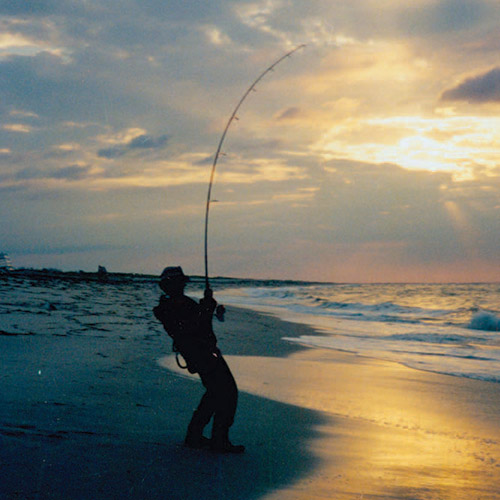
Fortunately for today’s surf anglers, there are so many plug brands to choose from and the painting technology is so high-powered, that gold isn’t a rare color on the pegboards of tackle shops. During the time of the Gilgo episode I just related, true metallic gold lures weren’t a widespread option.
Gold lures were actually dull gunmetal gold. Don Musso at Super Strike made a better gold, but few other manufacturers could effectively achieve the rich gold color I wanted. Today, although I’m not familiar with every lure company out there, I do know that true gold is widely available. For example, I own gold plugs from Bomber, Yo- Zuri, Tactical Anglers, Storm, RedFin, and Super Strike, to mention a few. Of course, if I need a gold lure and it isn’t available, two coats from a spray can of metallic gold paint quickly converts any color to gold.
Short-Lived:
The golden hour of twilight is shortlived. Pity too, because when the fish and I get into a golden magic groove, success can be amazing and I hate to see the spell end. With timing in mind, don’t leave the gold plug on too long. During a mullet run, for example, there is a tipping point in the progress of the sun as it rises in the sky, after which gold fails and a blue-and-white plug is better. It may be difficult to switch plug color if one is rapt with the magic of gold in its brief glory at sunrise, but do it anyway.

It has been my experience that those of us who fish at dawn make an effort to be on the beach before the golden hour sets in. That often means it’s dark, so bring along a darter, bottle plug, or metal lip—in gold of course—to cover the interlude between false dawn and true dawn. Don’t worry, gold also works in darkness.
Poppers and pencil poppers are great lures to use during a mullet run, or when any large bait migrates through the trough next to the beach. However, what to do when sand eels are the dominant bait and tins and bucktails are most successful? You might think since bait and fish are cruising near the bottom that the color is unimportant. In many cases you’d be absolutely right, but in others, not so much.
During the last widespread fall run on Long Island, 5- to 7-inch sand eels were abundant in the surf. As one might expect, diamond jigs with tubes, large tins and bucktails were the most successful lures. In fact, the power of word-of-mouth and peer pressure took over and diamond jigs, I was told, “need to have green tubes, fella.” Tackle shops told me that they couldn’t keep up with the demand for diamond jigs with green tubes. I’m thinking there must be a ton of diamond jigs with green tubes festooning the sea bottom to create an intense demand like that. Oh well, let them use green. I’ve never really been one to succumb to peer pressure so I fished with green, red, and black tubes and caught just as many fish as anyone else. I also apparently committed a cardinal sin by casting bucktails as the guy next to me said, “bucktails won’t work, fella.” Sorry to disappoint those who bought into the “green magic,” but I caught lots of stripers on white bucktails including some of my largest ones. I hate to buck the tide, but…
But, I find myself off topic. Now, I’ve never found gold tubes or bucktails in stores, so how does an angler handle a sand-eel-filled surf and golden sunrises? Although I thought about buying some type of gold-dyed bucktail hair or gold Krystal Flash and tie my own bucktail, I realized there was an easier solution. Happily, I already owned some gold diamond jigs, but needed help with my tins. I went to a craft store looking for gold paint and found crystal gloss enamel gold that’s intended for use on glass and metal. Whoopee!

I painted one side of a West End Tackle J-8 tin with two coats of the enamel. It worked perfectly, and this gold gleamed almost as bright as that on gold diamond jigs. I used these lures whenever I fished during a golden twilight, and they worked great for me, but I noticed the productivity for the “green tube people” dropped off as the sky became painted in gold.
To quote Sheldon from The Big Bang Theory television show, “I’m not crazy, my mother had me tested.” I’ve argued that color is overrated in surf fishing, and now look at me preaching about the use of gold. In my defense, I never said color was irrelevant, I said overrated. All baits have white bellies, so white is an excellent choice and works most of the time. Also, gamefish rarely see the top of baitfish, but instead they most often glimpse the flanks and bottoms. Ah, there’s the rub. The word most creeps into the narrative. I’m not stubborn, contrary to the opinion of some, and when the evidence suggests the use of one color or the other, I’ll use it.
Does the dominance of white in my bag put me in a pickle sometimes and leave me short? Yes, but not often, and it occurs so infrequently that I’m willing to absorb the penalty. In addition, I have a lot of confidence in my presentations, so with only a few exceptions I have been able to compensate for the lack of a color with good technique. Unlike those who stuff far too many lures in the surf bag that do nothing but tangle, I’d rather have easy access to my lures instead of fighting to get them out of the bag. As a result of my self-imposed rules, I shun the necessity for green tubes or “chicken scratch” Bombers when there’s no compelling reason why they should be more effective than the colors I’ve toted along in my surf bag. In my view, much of this so-called necessity is actually self-fulfilling prophecy.
Yet, there are always exceptions. So, rather than carry every color of every lure I use, I’m more of a situational color user. I always carry blue-and-white poppers during a mullet run, black lures at night and when the water is murky, and gold lures when I set out to fish at dawn or dusk. It isn’t a big deal, really. I simply pull out a chrome pencil popper and add a gold one, or whatever lure I think I might need, given the bait, the water depth, and the weather.
You can follow my lead, or go your own way. If you enjoy the suitcase around your neck and the 3-foot-long string of lures you end up with as you try to select one, then by all means go right ahead. However, if you’re fed up with weight, frustrated by trying to select a single lure from the maze of wood, hair and plastic, then perhaps you should become a situational color user, too. Start by limiting your color pallet and Find us on improving your presentations.