
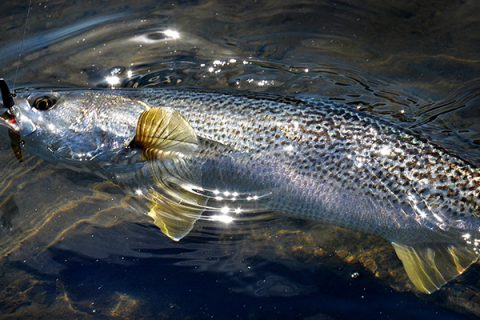
pictured above: Spring weakfish offer the best clues to summer weakfish hot spots.
Late summer offers a second shot at tiderunner weakfish
I could see the glow of the deck lights getting closer and hear the rumbling of the diesels growing louder. It was a dark, new moon night and the marsh island was still 50 yards away from me. Greg Lindholm had been the first to make the 250-yard paddle in Tony’s leaky one-man wooden duck boat. He paddled across, then Tony pulled the boat back with the rope. I was last, so the rope was in the boat with me.
The big sportfishing boat missed me only by a couple of feet. Its wake actually helped me out, pushing me perfectly onto the sod bank. I wasn’t as concerned about my close call as I was about my friends getting the jump on me at Uncle Wayne’s summer weakfish spot.
We were kids at the time, maybe 15 years old, when Uncle Wayne told us about his summer fishing hole. He leaned his head back, took a long drag of his Benson & Hedges cigarette and said, “Do you boys want to catch some weakfish today?”
He told us all the details about his spot, including a long story about the big one that got away. I was opening the kitchen window as he was reaching for the ash tray. When he said, “Do not tell anyone about this spot, especially Joe Rodia from the tackle shop.”
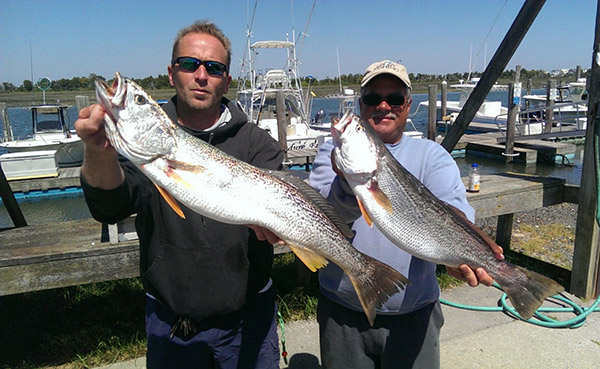
The spot turned out to be incredible, even better than Uncle Wayne’s big fish story. We were so fascinated with our catch that we lined up our fish on the porch. We then grabbed our biggest ones and pedaled them over to the scale at Rodia’s Bait and Tackle. The fish weighed 9.8, 9.6, and the biggest pulled the scale down to 10.5 pounds. All true tiderunner weakfish, and they were caught in August. A crowd had formed around the scale when the question was asked. “Where did you boys catch the fish?”
I was stuck for an answer. I could hear Uncle Wayne swearing us to silence and smell his Benson and Hedges. After a moment of silence, Joe Rodia answered for us, “Right in the jaw,” he said. Then he turned around and said to us, “Never tell anybody where you catch your fish!”
Most of the weakfish caught during the summer are 1- to 2-pound “spikes.” If the weakfish at Uncle Wayne’s had been that size, we’d have been ecstatic to catch them, but those fish were in a different class. Those fish were tiderunners.
Summer Days: The White Heron Connection
The water clarity spooked me as I cut across the flats. The water was so clear that the depth appeared much shallower than it was. I could see all the marine life and every contour of the bottom. I let the tide push the boat the last 200 yards, then very gingerly eased the anchor over the side. It grabbed, and swung the boat into perfect position, giving me a clear shot at the sweet spot.
All the weakfish on the tournament leaderboard had been caught in April, May, and June. I had released all the roe-filled ones I’d caught in the spring, but with the spawn long over, I looked to enter a midsummer tiderunner into the tournament.
I was anchored above an area where fish laid in wait to ambush their pray. Large pods of peanut bunker and mullet darkened the water as they passed the boat. I could hear, but not see, striped bass exploding on the baitfish. The mullet and peanut bunker sought refuge from the stripers in the tide-covered marsh grass, where white herons (great egrets) also stalked them.

The conditions looked great for summer weakfish. The water temperature was 70 degrees on top of the flat, but I thought it would be a little cooler in the slough I intended to fish. I planned on fishing the spot for one hour, and if it didn’t produce, I would move on. The cast and retrieve put the Riptide Mullet right on target, sweeping just above the bottom at the same speed as the tide. The hit came as a light bump, but quickly turned into a drag-screaming run. Metallic purple and yellow hues were lit up by the summer sun, reflecting through the crystal clear water with its every turn against a backdrop of oyster shells.
With a spectacular sunset to watch and a tournament-contending weakfish on board for the ride home, I was thankful for the time I spent learning the ways of the weakfish from Uncle Wayne.
Summer weakfish are usually found within a few miles of their spring haunts. They will remain in the general area until the first nor’easter or hurricane of the early fall, then move within the area as the conditions dictate. Knowing how to identify the conditions is paramount to catching weakfish. Water clarity, wind speed, wind direction, water temperature, baitfish and predators all come into play.
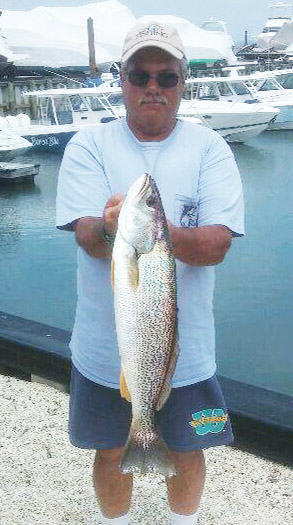
I used this method to catch the first-place weakfish in the 2014 Grassy Sound Marine Summer Flounder Tournament, third heaviest weakfish in the 2014 Beach and Boat Tournament, first place weak in the Jim’s Bait and Tackle weakfish tournament, first place weakfish in the Cape May County Fishing Tournament, and first place speckled sea trout in the Cape May County Fishing Tournament.
White herons can be seen from a great distance so I start fishing exactly where the birds are feeding. Many times the first cast brings a striped bass or summer flounder. I have caught keeper stripers at noon in August, and then a weakfish on the following cast.
I begin with a slow and steady retrieve that sweeps just above the bottom. If that doesn’t produce, I will jig, lifting the lure a few inches and letting it fall, adding in a high lift every 10 seconds. I will fish the entire area, usually finding the weakfish on the first ledge from the feeding white heron.
I begin with the 10 percent of the lures in my tackle bag that catch 90 percent of my weakfish—the 4-inch Riptide Mullet in white, a white bucktail with a purple worm, a 4-inch Bass Assassin and a pink Zoom Super Fluke. I follow with an assortment of other lures and colors before moving on. I use a ¼-ounce jighead and then move to heavier ones.
Summer Nights: Dock Lights And Mud Flats
I studied the marsh creek bank, lining myself up with the trail on the opposite side. I hesitated, as if I was about to jump off a cliff in Costa Rica. However, this was much worse. The creek bottom was covered in two feet of black silt on the trail and four feet of silt on either side. Ed’s text message with the pictures of tiderunner weakfish finally pushed me into the creek; the feeding striped bass and baitfish also had a hand in it.
The weakfish were stacked up in a small eddy just off a mud flat. I shuffled into knee-deep water to get into position and it wasn’t long before the weakfish bite turned red hot. The first one was about 5 pounds, and for the next thirty minutes the action was wild. Once the short window closed, the bites stopped.
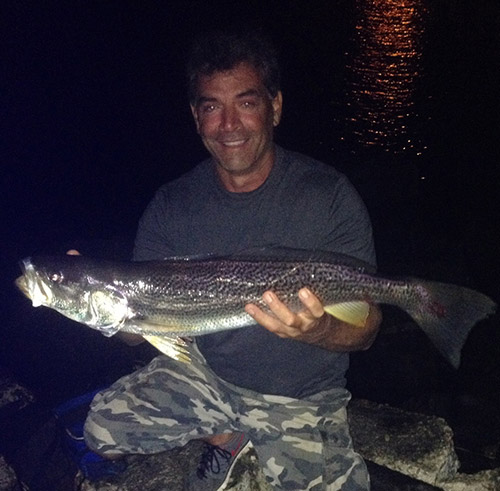
At night, dock and bridge lights take the place of the white herons. Fishing directly under the lights produces a lot of summer weakfish.
That first summer, we fished Uncle Wayne’s spot just about every day until school started, carrying a lot of weakfish by bicycle to Rodia’s Bait and Tackle. The following summer, after talking about weakfish all year, we went right back to that spot. We didn’t catch any during our first trip out. Completely unfazed, we went right back the next morning; again, nothing. We continued to fish the area so many times that we wore a mud path across the marsh island. We tried every weakfish bait and lure they sold at Rodia’s, but the results remained the same as the first trip—no weakfish. It wasn’t until we were willing to try new spots that we once again found these wonderful gamefish. It was then we learned that Uncle Wayne’s gift wasn’t the secret weakfish spot at all … it was the inspiration and motivation he gave us to go fishing for them in the heat of summer.
Really enjoyed this article. I do not hear much about weakfish being caught. I would like to hear more about them. Thanks
Love these articles. I used to get to Sandy Point in Warwick. Light tackle and lots of fun.