

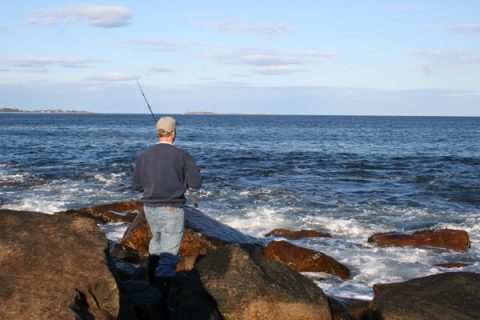
Pictured: Areas of white water and suds will draw feeding stripers even in the middle of the day.
Fish the foam where summer stripers feed.
There’s a reason that the low-light hours just before sunrise and at dusk are known to fishermen as the “magic hours.” In the summer, the best time to target stripers is in the very early morning and after sunset, or even in the dark of night. But what about when the sun is high in the sky, when most of us are actually out on the water, enjoying beautiful summer weather?
There are a number of surefire methods for catching stripers during this time, but it usually comes down to finding the fish in deeper water and feeding them a lively mackerel or pogy; or perhaps anchoring up and chumming with cut bait. If you enjoy fishing that way, you’ll no doubt be content. But what if you can’t get live mackerel, pogies or fresh bait? What if you what you really want to do is enjoy some light-tackle action with artificial baits on spinning or fly-fishing gear?

Then hit the suds! Even on bright sunny days, stripers will seek structure in the form of currents and breaking surf. The white water shades the water, giving the stripers a sense of overhead cover, and attracts baitfish that seek refuge in the foam. In the churning water created by waves and current crashing over and around structure, baitfish are churned up and disoriented, and stripers will be waiting to swoop in and take advantage.
White-Water Baits

Like most striper anglers, I sure do enjoy hooking a large striper any way that I can, but what I really enjoy is finding and catching a striper of any size with light gear, whether it’s a fly rod, light spinning setup or light conventional gear. Luckily for me, the Cape Ann coastline in Massachusetts where I do most of my fishing has an abundance of rough, rocky shoreline and exposed beaches, and the summer’s prevailing south winds produce significant wave action against these structures. This is where the white suds of tide wash provide some of the best striper structure anywhere. Stripers can be found hanging in these areas, waiting in ambush for an opportunity to eat, and learning how to fool them with an artificial bait becomes the ticket to consistent daytime success.

When fishing the surf wash in the middle of the day, the best tactic is to use highly visible baits. My favorite artificials are soft-plastic baits, both weighed and unweighted, in white or bubblegum (pink), ranging between 5 and 9 inches. For topwater twitchbaits, I’ll use brightly colored lures in sizes that range from 4 to 6 inches. For flies, I’ll choose large-profile patterns with considerable flash, tied in contrasting colors that match (or come close) the food that might be present in the suds. Crustacean, squid and baitfish patterns are your best bets for fly patterns.
When I am using spinning or conventional gear, I generally spool up with 8- to 12-pound-test, hi-vis monofilament on spinning reels and 14-pound-test hi-vis braided line for conventional reels. I always use a 3-foot or longer fluorocarbon leader attached with a small barrel swivel at the main line and a loop knot to attach the bait to the leader. If you like to change lures often, use a small, plain snap. For the fly-anglers, I generally have three types of line at the ready: A weight-forward floating line for surface action; an all-purpose weight-forward, slow-sinking intermediate line for casting into surf wash that is less than six feet deep; and for deeper water off breaking waves, I’ll use a full-sink, 400-grain line to quickly get down in water deeper than 6 feet. In all line choices, I’ll use a 10-foot tapered fluorocarbon leader terminating at 12-pound-test.
Suds From Shore
There are a number of considerations that may affect your success and safety while targeting stripers in the suds from the beach or rocks. When fishing from slippery coastal rocks, it is absolutely necessary to strap on a pair of spiked sandals, such as the popular cleats made by Korkers. When scrambling to and from the water’s edge or chasing after a striper, you’ll be stepping on the incredibly slippery, dark-green seaweed that covers most rocks below the high-water line. The last thing you want is to sustain a serious injury, lose your gear, or fall into the water, where the huge waves will slam you back into the rocks.
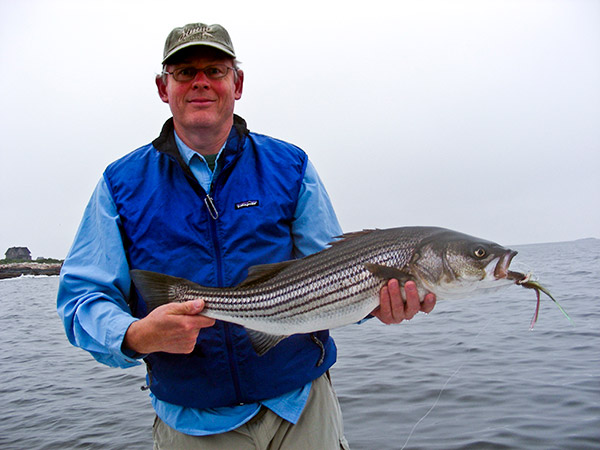
Shore fishing can limit your ability to reach some popular reef areas because access is difficult, so you need to learn how to discern between the suds that you can reach, and those you can’t. Reading the suds where waves crash shoreward can tell you a great deal about the structure that lies below the surface. The first thing you’ll want to take notice of is the amount of suds that form where the wave meets the shore and how far away from the shore the suds extend. If you find an area that has a greater width and breadth of suds, that usually means that the subsurface structure is a shallow reef or rock field, which creates an ideal ambush zone for stripers. This type of structure should be fished with topwater or subsurface baits or flies. Work the baits moderately fast with extra movement, but throw in an occasional pause to help stripers zero in on the bait. Remember that the foam in the suds will decrease visibility, and often the stripers will completely miss the bait.
If, on the other hand, the suds are no farther than 10 feet or so from shore, then it’s likely that there’s a quick drop-off or a pocket of deeper water not far from shore. In the deeper pocket water, work your bait slower but with more movement to entice a waiting striper to strike. In this type of structure, I prefer fishing a weighted soft-plastic bait to get down to the strike zone.
Beach-going stripers can often be spotted cruising just behind the first breaking wave, and it is not unusual to find them feeding along the beach in the middle of the day, especially when the surf is up. This structure should be fished with baits or flies that will work on the surface or just below. Work the bait slowly and allow the wave action to help you move the bait into the strike zone. Any good topwater plug, like twitch-baits and pencil poppers, can produce some savage strikes. The same rules apply for the fly-angler when working stripers in the surf. I normally use a 9- or 10-weight rod and a reel spooled with a slow-sink intermediate line. My fly choice is usually a large-profile, flashy baitfish pattern that I can work in the wave or strip at a rate that will trigger aggressive strikes. A stripping basket is necessary when fly-casting in the breaking surf to keep your line from being dragged away in the wave action.
One last point to keep in mind when fishing the suds from the shoreline is that most of the active stripers will be holed up in the structure close to shore and not in the deeper water away from shore, unless they are actively feeding on schooled bait, so focus your efforts in close. In addition, a good pair of polarized sunglasses is absolutely necessary in the bright sun for spotting cruising fish.
Suds From A Boat
Pursuing stripers along the coastline from a boat will require tactics and gear similar to those used for fishing suds and surf along the shore, but for safety’s sake, you’ll need to be comfortable with your boat-handling skills and familiar with the area’s submerged hazards and wave action. Summer’s prevailing winds produce a moderate ocean swell that produces excellent suds as these waves come crashing ashore on the beaches and rocky coastline. However, these large waves present some risk because fishing the suds from a boat requires getting the boat within casting range of reefs and rocks. I often scout the south and southeast-facing shorelines for suds and coordinate my boat handling with wind and tide directions to enable a favorable drift in close proximity to the structure. Anytime you fish tight to reefs or rocky shore structure, you must remain vigilant with an eye out for those larger-than-average waves that can literally pick the boat up like a surfboard and propel you shoreward. For this reason, I always keep the engine running at idle while drifting so that I can escape a problem quickly. Once I feel confident that the area can be fished safely, I’ll set the boat in position to work along a drift track, presenting baits into the most promising structure.
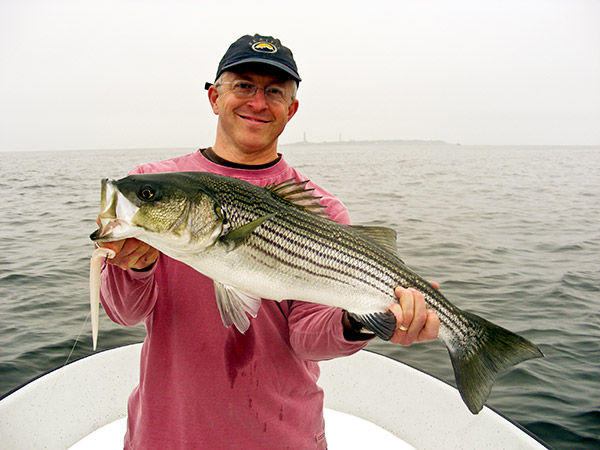
My choice of tackle is predominantly determined by water depth, wind strength and direction, and wave heights. If conditions are just right – light winds, small waves and water depth less than 8 feet – I’ll choose my fly rod tipped with a large-profile baitfish pattern and try to place the fly at the merge of water and shoreline. A good tactic is to allow the fly to “settle in” or slowly sink down for few seconds before moving it. Oftentimes a large striper will spot the fly and focus on it, and as soon as I make the first hard strip, the striper will instinctively strike it.
When conditions dictate, I’ll switch over to spinning or conventional gear and work large soft-plastic baits. I prefer fishing pre-rigged 7- or 9-inch white Slug-Gos. The presentation is identical to the fly cast, landing the bait tight to the reef and allowing the bait to settle in before working it slowly with significant rod tip action, keeping the bait at or just below the water surface and moving in a zigzag pattern, in “walk-the-dog” fashion. This style of soft-plastic jerkbait is not only a hoot to fish, but it has accounted for its fair share of keeper-sized stripers.

If I spot any baitfish or feeding stripers, I’ll change out my bait and go to a topwater hard bait, such as the Rebel Jumping Minnow or the Rapala X-Rap Walk 13. Again I’ll work these baits by casting in to the edge of the structure or foam line and work them back to the boat. In a situation where the water depth drops off to more than 10 feet, the only change I’ll make is to fish deeper in the water column by changing to weighted soft-plastic bait, such as a white or bubblegum Tufcore Lance on a jighead. On the fly rod, I’ll shift to a full-sinking head. In any case, make the presentation to the edge of the structure and allow the bait to sink deeper before working it.
These sun-and-suds tactics work well on bright days, but they can also work miracles on overcast days and in low-light conditions. Just remember to think safety first when surfcasting or fishing in a boat tight to hazardous structure. Stay alert, read the water, and be prepared to change up your bait or gear options to match the conditions.
very nice***