

Take three guys whose combined time on the beaches of Cape Cod totals more than 90 years and put them in one place. What you’ll get are stories of fish caught and fish lost, some local gossip, a fair amount of good-natured ribbing, and opinions – plenty of opinions. Which plug has been working, and why? Which one needs to be tweaked? When will the fish eat tonight?
Sometimes there will be agreement, sometimes not. In all cases, though, the opinions are based on experience, both short and long term.
Dave Manzi, Steve Shiraka, and Mike Burke met me at Dave’s workshop, a veritable plug factory in West Yarmouth. Hundreds, maybe thousands of wooden (and a few plastic) plugs in every imaginable color and combination of colors hung every-where. Boxes of unfinished swimmers and surface plugs were heaped on the workbench and the smell of freshly turned wood hung in the air. All three of these fishermen turn and finish their own plugs (Mike makes a spectacular handmade version of a Bomber-type swimmer, complete with carved lip) but it was clear that we were in Plug Central.
The plan was to head out on Nauset Beach for the evening, but first I wanted to throw out a few questions.
When you talk with these guys individually, you can end up pretty confused. Now multiply the potential for confusion by three. The challenge would be to sift through jiving, innuendo, and secret code, and come up with some definitive answers. But I was pretty sure it could be done, and I wasn’t concerned about having to deal with the tight-lipped tendencies of the typical surfman. All three of them had fished the night before, all three had found some very nice fish, and they were pumped.

Dave: I’m going to give you an idea of how it was last night. I was fishing a popping plug. Don’t let anybody tell you that big fish won’t take a popper. The trick was to give it back to them. I had a few follows and kept it moving like you’re “supposed” to, but they wouldn’t hit. Then one fish, it was a little better than twenty pounds, swirled on it and turned away. I stopped cranking and the fish turned right around and smacked it. That was the key.
There were some good waves – this was in a hole on the outer beach – so it wasn’t like the plug was just sitting; the waves were moving it a little bit. The popping got their attention but letting it sit made them hit.
Steve: You have to vary the way you pop it, too. I see guys doing it the same way with no variation, over and over, and they can’t understand why they only get a few passes but no pick ups. The swirls tell them the fish are there and they’re interested, but you have to figure out how they want it to move.
Dave: When I use a popper, I like to start with two of three short pops, then let it sit for a few seconds. I don’t always pop it right away, either. Sometimes I’ll leave it sitting there for a few seconds before I start the retrieve. This works really well when the water is very calm and the splash of the plug can be heard by fish that might be a good distance away. The other problem I see with guys who fish poppers is they don’t fish them all the way to the beach. I get lots of hits in the last ten feet, right in the first curl. Sometimes I even let it hang in the wash a while before I pick it up
Steve: One time, I was fishing a surface swimmer and the wash had pushed it just onto the beach. I don’t know why I didn’t pick it up right away, but when the next wave came in I saw a bulge in the foam coming up the sand. That fish ate the plug as the foam washed over it and then slid back into the doeper water as the wave washed back down. Those fish are just amazing! It must have followed the plug all the way in and knew it had to be somewhere, and went looking for it in the foam with the next wave. How can they see stuff like that? I’ll also let a big white and pink Danny hang just on the back of that first wave.
Gene: How about surface swimmers? When do you start using them and how do you fish them?
Dave: I start around the third week of May. As soon as I know there are lots of herring in the runs. Sometimes I use Dannys early, but I usually use Pikies. They have a different action than Dannys. I like to work them right on top. They have a nice wag in the tail; you can short pop it. What that does is force the nose of the plug down and the tail up. That way it pushes a lot of water and just the tail waves back and forth. It looks just like a herring on the surface. It’s one of the hottest plugs to use at sun-up. I make one that’s pearl white with a pink stripe that’s killer. A solid yellow Danny will work too, if it’s overcast. Yellow is my number one color.
Steve: The only time I use yellow is on a sandy beach at night under a full moon, but ninety-nine percent of the time I’m fishing white. If it’s overcast and drizzly, I go to gold and black.
Dave: This tan-colored Danny looks just like a herring underwater.
Gene: So you want to drag those under the water some of the time? We’re talking Dannys now. I’ve always fished them on top and thought that they should be just on the surface.
Dave: Boiling a wake, that’s how you want ’em. Making a wave.
Steve: It has to be calm, too. The correct Danny motion is not a roll, it’s a snake. A really well-made Danny will swim in a tight ‘S’.
Dave: I don’t like rolls; you don’t want rolling plugs. That’s why I go with a really wide body on my Dannys. Now some plugs, like the P-40 style, you can get away with some roll, but they have to be solid-colored, not something with three colors.
Gene: So when you get that snaking motion, is that inherent in the plug or does that come from rod action?
Steve: It’s inherent in the plug. And if I need to adjust them to get that, I put a little downward bend on the eye. That makes the back end kick up just a little but it still has the swim I want. But I don’t use Dannys much on the beach; I use them most of the time around the rocks along the Elizabeth Islands. I throw it to within a couple of feet of the shore, but I don’t start reeling until I can’t see the rings in the water anymore from when it splashed down. I do the same thing that Dave was doing with the popper on the beach. I let it stop for a second. Just yesterday it was that way. Sometimes, I’ll give it good pop right at the beginning, but what worked yesterday was moving it slowly a little way, then stopping just for a second.
Gene: So we’re talking about calm conditions, all the time, with Dannys?
Dave: No! I fish in rough surf with Dannys. I think they’re very effective in the surf.
Steve: I’ll tell you, I do a lot better with a big Gibbs Danny in rough water than any other. Last year at Race Point, we had clear water but the waves were up eight or ten feet. We were getting fish right on top the waves. You’d see the Danny go up and get hit right up top. The little Dannys wouldn’t hold but that bigger one would, and that’s where the fish wanted it to be.
Dave: Oh yeah! I’ve been fishing my Pikies right in the faces of the waves and had the fish go vertical after them. You’d see them come up from below and Boom!
Gene: But overall, if you’re not fishing them in rough conditions you want Dannys and other surface swimmers to move slowly?
Dave: It’s all about control. Sometimes it’s almost painful how slow you have to go.
Steve: And you have to play the waves. As I move a surface swimmer along, the wave, the swell, wants to speed up and slow down the plug I’m constantly adjusting my retrieve rate to keep the speed of the plug steady.
Gene: Let’s keep on this surface thing a little longer. How about pencil poppers?
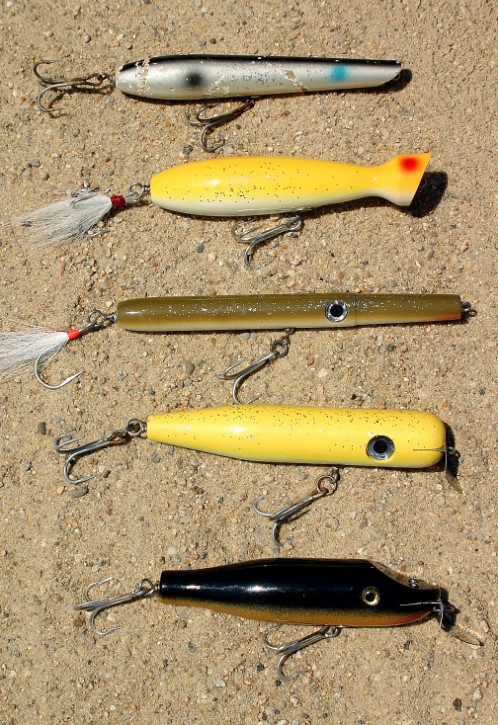
Steve: I use pencil poppers on the beach, I love them at daybreak. Especially at this time of the year, the early season. A white two-ouncer or a white one-and-a-half on the edge of a bar where you have moving water and some white water coming in with the swell. Swing it right on the edge, almost where you’d fish a Needlefish after dark.
Dave: I like white with blue or purple around the eyes. And I like reverse-type lures, with the eyes in the rear.
Gene: I was going to ask you about that, Mike. You make a lot of pencils with eyes in the rear, kind of like what you’d expect with a plug made to imitate a squid, bur yours aren’t necessarily squid-colored.
Mike: Oh yeah, I think it makes a big difference. I think fish key on the eyes when they’re going to hit. In fact, I’ve started gluing on doll eyes that stick out on some of my plugs, some in the front and on some in the rear and I’ve seen the results. I am sure that those outfish the ones with the flat stick-on eyes.
Steve: I don’t know. On some plugs you need eyes, on some you don’t. I have a Beachmaster Danny that has just started being made with eyes. In the thirty years that the guy who makes these has been turning plugs, this is the first year that he’s made them with eyes and the only reason he did it was because that’s what the competition is doing. And guys said they wanted eyes. But his plugs have been catching fish for almost thirty years without them. On a Yo-Zuri or other swimming plugs that go deeper, yes. I debated this with Dave for years. On needlefish I absolutely do believe that it can make all the difference in the world. Why, I have no idea.
Dave: Just like Mike said, doll eyes work great and I use them on a lot of my Needles.
Gene: How about Polaris-type poppers?
Dave: Oh yeah, I chug ’em along, they make a lot of noise and sometimes that’s what you need.
Steve: You know, I don’t use them on the beach as much as I do from the boat. And the Canal. I used to use them exclusively at the Canal. Slack water with a three and one-half-ounce Polars. The two biggest fish I ever took out of the Canal, they both weighed forty-five pounds, one came on an eel and the other on a yellow Polaris. And I’ve caught some very nice fish along the Elizabeths with the Polaris. Sometimes the only way you could reach the fish in those rocks was with one. They can work on the beach too; we caught some great fish along Monomoy with them years ago.
Dave: How would you work them?
Steve: Just like I was taught by Stan Gibbs. Three short pops, then a good one, then let it sit, and repeat that pattern.
Dave: Because I use more of a chug-chug-chug then stop, not a real pop. If I’m somewhere with current, I’ll just hold the plug in the rip and move the rod side to side and try not to move it forward for a little while. But when I do start it forward, that’s when I usually get the hit.
Gene: OK, let’s get to needles. There sure has been a rediscovery of these things in the last few years and there are more on the market all the time.
Dave: The three best ones made as far as I’m concerned are Super Strike, Gibbs, and Habs. That’s all you need when you fish the beach.
Steve: Except for Bassmaster.
(Editor’s Note: Dave markets a few of his plugs under the name Bassmaster.)
Dave: As far as colors, you can’t go wrong with black.
Steve: Dave’s black Needle with the red eyes is one of the most deadly nighttime plugs I’ve ever used on the beach.
Gene: Here’s the thing. For years I bought ’em, I’d fish ’em for ten minutes, then put ’em back in the bag. If you accept the idea that bass see very well, and a Needlefish lure goes through the water like a stick with no action to speak of, with three big gangs of treble hooks hanging down, well..
Steve: Well, first of all, I’ve never caught a fish on a needle anywhere but on the beach. It’s all about the bait. Big, big sand eels. That’s what they look like.
Gene: Dave, you were telling me that sometimes you don’t even retrieve them, you just let them tumble off the edges of the bars with the waves.
Mike: If you watch sand eels in the water, lots of times they just sit there, just hang in one spot, that’s why giving it very little movement is the best idea.
Dave: It’s what I call a ‘confidence plug.’ Most people when they start fishing them are just like you. They try one for ten minutes and then put it away, But you have to believe in it. There’s no way to get that confidence, though, if you don’t know how to work it and it doesn’t catch. But once you learn, they are deadly. See that plug up there with the red eyes? I took a 45-pound fish on it last year. There are times when they will out-fish eels. I don’t even buy eels anymore.
Steve: I learned to fish them from Dave. First I cast out and count to ten before I do anything. Then it’s the slowest of slow retrieves. But you have to have different kinds of needles from different people. Some sink, some kind of suspend, some float. The ones I like the best float and, when you have the right conditions like the very end of the tide and the beginning of the tide when there’s just a little wash around the troughs, the fish can’t resist them. You can use any color as long as it’s black.
Dave: I like different colors.
Steve: The main thing to understand is that Needles from different manufacturers perform differently. Gibbs Needles float, I like that, but the Super Strike, which is not wood, has to be fished a certain way that is nothing like the wooden ones. It has that little cut that makes it move a little more on the retrieve. When the sand eels are dimpling on the surface, the Super Strike slays the fish.
Dave: That thing darts! It is really the only Needlefish that has any kind of action and swims. So I started making one out of wood with an angled cut on the front. It is not the one I go to very often, but when the sand eels are moving around a lot, it is the one I always use.
Gene: Dave, what is a typical game plan when you’re using Needlefish?
Dave: Well, first I want to ‘discover the water.’ I have a pretty good idea of what is going to work in terms of retrieve and color, but I want to make sure that the fish aren’t looking for something else. I might start with just slowly cranking it in on the top. I’ll do that for a half-hour…you have to give it a chance. Then I’ll add a twitch for a while, then maybe a pause. Sometimes I’ll even rip it through the water by swinging the rod hard to the side, reel back toward the plug, then do it again. Then it’s time to swap out. You can cycle the same plug through various retrieves, then do the same thing with a totally different color. All these would be floaters. Then I’ll do the same cycle with intermediate sinkers, then the sinkers. If the fish are there, you’ll find them. Tell me that colors don’t matter. See the hues in those different Needles? They make a difference; I’ve seen it again and again.
Gene: How about somewhere that has some good tidal movement, like Nauset Inlet?
Dave: An hour before slack; slack; then get the hell out of there.
Mike: I don’t know about that. I think it’s more tide specific from spot to spot. But the only way you’re going to figure that out is by spending a lot of time at one spot and fish it all the way through both ends of the tide.
Gene: How about conditions? ‘Fire’ in the water?
(Editor’s Note: ‘Fire’ is the micro bioluminescence that is present in the summer and glows when it is distrubed, such as when a lure is retrieved through it.)
Dave: I don’t care!
Mike: No big deal.
Steve: Hate it!
And so the conversation went until it was time to hit the beach. On the way down, Mike told me of growing up on the beach and learning to surfcast from his dad, who once landed a 63-pound striper on a plug.
“I still have that plug, too!” he said.
After a bumpy ride down the back trail in Mike’s beat up Chevy truck, with Dave’s even rustier truck following, we took one of the trails to the outer beach. The three fishermen found their spot, a bowl that had produced a half dozen or so 15- to 30-pound fish for Mike the night before. The big bass had moved on, or hadn’t yet put on the feedbag, and the best they could do were eight stripers in the mid-30-inch class and many more schoolies. Not a bad night for the casual striper fisherman, but barely worth noting by these guys. But it’s a good bet that they were back on the beach the next night.
From the July 2004 Issue of On The Water Magazine
I’ve fished with Bassmaster and he is a wealth of knowledge. Happy to teach others what to do. And his plugs are amazing. If you ever meet Dave on the beach, it’s worth your time to talk with him and ask questions and take his advice.