
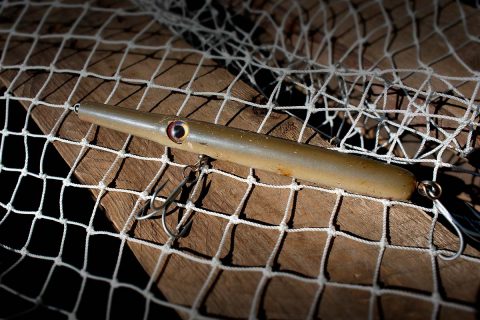
Pictured above: From Turf to Surf: This Hab’s Jr. Needlefish had roots in the woods of Northern Vermont.
If you fished a Gibbs lure from the mid-1980s to late 1990s, there’s a good chance that Hugh Schultz cut down the tree it came from.
Hugh Schultz discovered a love of fishing after moving to Avalon, New Jersey, from Philadelphia as a child. As an adult, he tried for a time to make a living out of his passion, running a charter boat through most of the 1970s and opening his own tackle shop in 1975. When business tanked during the 1979 Oil Crisis, Schultz left the shore and moved to Sutton, Vermont.
His love of the surf and of striped bass fishing continued to draw him back to the coast. Through the 1980s, Schultz traveled to Nantucket during the striper run, where he became friends with Jimmy Griecci, who, not long after they met, purchased Gibbs Lures.
When Stan Gibbs first started making his lures, he used white pine, but as the price of white pine went up, he switched to sugar pine from out West. Sugar pine was similar to white pine, and suitable for plug building because it was a knot-free, straight grain wood. When Griecci bought the company in the early 1980s, sugar pine had become expensive. Schultz, whose father was a machinist, had been making the stainless-steel through-wires for Griecci, and when he heard of the expense of sugar pine, he suggested they try out white pine, which grew in abundance on his Vermont property. Schultz then walked into his woods, chopped down a tree, cut it into boards and then squares, and sent them to a nearby kiln to dry before turning them into what was the most popular Gibbs lure at the time, the Skipper.
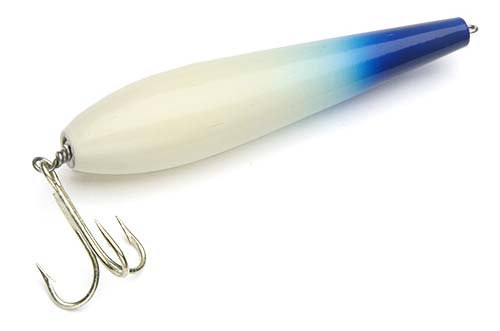

From then until Griecci sold Gibbs in 1998, Schultz provided the wood for the plugs from white birch and white pine trees on his property. Early on, he used his friend’s horse to drag the logs out of the woods, but soon switched over to a John Deere tractor. After cutting a tree into reasonably sized logs, he loaded it into his truck and took it to his friend’s shop, where they used a bandsaw to cut it into planks and then squares.
For turning on a lathe, a piece of wood must first be dried. Though kilns offer a fast way to dry the wood, Schultz preferred to allow it to dry naturally in his shop. He allows the wood to dry for two years before cutting it into dowels and turning the dowels into plugs.

Just after Gibbs Lures changed hands in ‘98, Schultz began working with John Habarek, Sr. At that time, the popularity of Habarek’s plugs—particularly the Hab’s Needlefish—was becoming too much to handle on his own. Schultz provided the wood and turned some of the plugs, as Habarek through-wired, rigged and painted them.
“We were great friends,” Schultz said. “He would call me, and we would sit down and have a drink—him in Rhode Island sipping vodka and me in Vermont with a glass of Crown Royal—and we’d talk stripers.”
When Habarek, Sr. passed away in 2007, Schultz continued to provide the wood for John Habarek, Jr. who carried on the business for a few years. When John Jr. stepped away from plug building, Schultz decided to make his own line of lures.
“One of my favorite parts of making plugs is taking a look at the tree after we cut it down, and wondering if perhaps somewhere in there is a plug that will catch someone a fifty-pounder,” Schultz said.
You can find Schultz Lures in a number of tackle shops on Nantucket and online at SchultzLures.com.
Thanks Jimmy, I’m still at it. Just finished a new Needle modeled after the late George Carlzon Needles.
Wow! How did I miss this on the lure packaging! About five years ago my wife convinced me it was a good idea to spend a few weeks of the summer away from Plum Island and the Cape and take the kids up to Sutton, VT (near Calendar Brook). A tradition we continued for four years until we bought a small place over in Westmore. Although we now spend the entire summer with the kids in the NEK, be sure I’m tossing your plugs from the time the stripers show up on our shores in May and all fall long. Cheers!
Stop by the shop or give me a call. the number is on the web site
Great article Hugh; and great plugs!
Thanks Stephen
Thanks for all the encouragement over the years.
Great Job, and good reading, we are heading to the lure show tomorrow in Albany region 1 for the NFLCC, stay safe and tight lines my friend
Norm
Thanks Norman
I grew up with Hugh and fished many times with him. I have been to his home and shop. All great times
Thanks Joe hope to see you soon
Hugh, did you use to teach drafting at LI? I believe I was one of your students in the early 2000’s. I moved to CT after high school and fished these lures wondering if they were the lures you told me about. I am now back to lyndonville and miss the salt!!
Yes I taught Drafting at LI and yes you were one of my students. Give me a call and visit at the shop.