
When bluefish act like bonefish, it’s time to break out the topwaters.
I think summertime is the best time for bluefishing. Not only can you catch extra-large, hard-fighting bluefish, but you can have nonstop action with them, on light tackle and the fly rod, often right on the surface! When you factor in that the fishing takes place in the middle of the day in beautiful warm weather, the summer bluefish bite just might be one of the best fisheries we have in the Northeast.

When the water reaches its summer peak, usually somewhere in the mid- to high 70s, inshore bluefish will start behaving in a peculiar way. Now, I’m not talking about the 2- to 4-pound bluefish that are omni-present in the summer time, but bluefish from 8 to 14 pounds, some pushing 18 or even 20 pounds. I’m talking about trophy-sized bluefish, acting in a manner totally contradictory to their reputation for recklessness.
During the middle of the day, especially under hot, sunny and flat-calm conditions, these big blues will be right up near the top, swimming slowly in schools with their forked tails breaking the surface. The schools often number between 50 and 100 fish, but it’s within the realm of possibility to happen upon a school with numbers in the thousands.
If you don’t know what you’re looking at, the first sight of these schools may have you scratching your head. Instead of the splashing and slashing most anglers associate with a bluefish school on the surface, the presence of these bluefish will be betrayed by small black triangles (the upper lobes of their caudal fins) slowly sliding across the surface. This behavior primarily takes place in western Long Island Sound in shallow water, 2 to 10 feet in depth, inside and at the mouth of harbors and rivers.
Bluefish “finning” is most often noted near schools of adult menhaden. This big baitfish draws the bluefish to an area and keeps them around. When the bluefish are finning, they will not be feeding on the menhaden, however. In fact, they aren’t even feeding at all. Despite this, they are still very catchable.

-photo by Jim Levison

Though this unusual activity looks like spawning behavior, scientists say it is not. The best explanation I’ve heard came from Captain Ian Devlin of Rowayton, Connecticut. Ian holds the IGFA 20-pound tippet record for bluefish with a 16-pound, 13-ounce fish pulled out of a school of finning blues in Norwalk. He believes the bluefish are holding in the warmest water they can find because it aids digestion of a big bunker meal. It’s the same thing swordfish do after an all-night feeding binge in the depths.
I’ve been fishing this finning “phenomenon” for 25 years, and each season I can’t wait for it to happen. It’s not only my favorite bluefishing, but some of my favorite fishing in general. The action lasts from 4 to 6 weeks during the height of summer when water temperatures are at their highest.
This fishery offers exciting sight and surface fishing, with a wonderful opportunity to catch big blues fishing light and fly tackle. Although these fish will hit a subsurface lure or fly, it’s really the most ideal time to use a popper or spook-style lure or surface fly because of the tremendously explosive strikes these baits draw. Under these conditions, the surface baits draw more strikes than subsurface baits anyway.
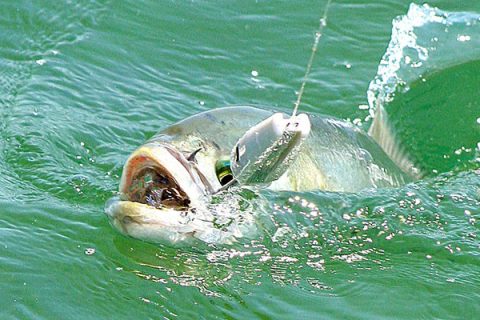
If you find the phenomenon happening in 12 feet of water or less, as is usually the case, you are in for a special treat! The shallow water forces these brutes to run farther and jump more frequently – sometimes repeatedly, like tarpon – than they do under any other conditions. But this fishing still takes a fair amount of skill to make accurate casts and, of course, subdue the hard-fighting blues. It all adds up to some incredible and unique bluefishing. The best there is.
How to Fish It
Finning bluefish can be targeted with medium spinning or baitcasting gear spooled with 12- to 20-pound-test monofilament or fluorocarbon or 20- to 30-pound-test braided line. Also be sure to use 12 or so inches of wire bite leader. Top lures include splashy poppers like the Creek Chub Striper Strike and Gibbs Pencil Popper as well as spook-style plugs with a “walk-the-dog” action.
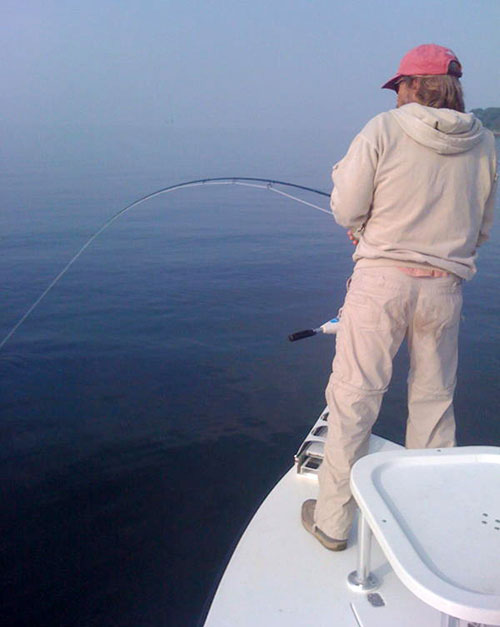
Eight- to ten-weight rods are recommended for fly fishermen. Use a floating line, a 9-foot leader and 12-to 20-pound test tippet with 6 inches of wire bite tippet in front of the fly.
When it comes to fly selection, all I’ve ever used for finning bluefish is some form of popper fly. Deceivers, Clousers, or surface sliders will all work as well, but the popper always seems to work, so I stick with it. For easiest casting, use a small popper with a wide-cupped mouth. This design will make a lot of commotion without greatly hindering casting distance or accuracy.
The fish can be very “spooky” while finning on the surface, so you will often have to make a careful approach with your craft to keep the fish from fleeing. At times you can’t get closer than 70 feet. Other times you can get within 40 or 50 feet. It depends on the mood the fish are in that day. Sometimes the blues in the school will randomly swim toward you, especially if you don’t have your engine running. Make sure you turn off your engine before beginning to fish. It’s a good idea to use that engine as little as possible while near these surface schools. You can make a much closer approach by using an electric trolling motor, or even, if your boat is small enough, a paddle. You can often get very close, sometimes just a few feet away, with kayaks and canoes. These can be wonderful crafts for this type of fishing. In some areas, wading anglers can catch these fish as well.
On certain days, you’ll be able to cast right into the schools of fish without spooking them. On others, careless casting will spook them. These days require precision casting. Cast your lure or fly ahead of the school or even to the nose of an individual fish. When fly fishing, be careful not to land the fly line over top of the fish, as this will spook them. Start casting to the edges of the school to gauge the “mood” of the school and figure out the best presentation.

Trophy fish often come at random in any school, but there are times where you can search out the bigger fish in the area. Sometimes you’ll be able to cherry pick the largest bluefish from the school. Look for the bigger tails, wider backs and longer fish, and place your offering right in front of them. Usually these magnum specimens will be at the heads of the schools because they have a tendency to swim faster than their smaller brethren. Another thing you can do is keep up to date with fishing reports to see where any giant blues have been caught or spotted recently so you can search that general area and hopefully put yourself in the right place at the right time.
So go out and look for the big “finning blues” when the weather really starts heating up. When you find them, you’re in for something special, possibly the best bluefishing of your life. There’s nothing like it!
This article is spot on, the last few years in CT where I fish Ive been seeing this in late July and was wondering what caused the Blues shift in behavior and feeding patterns. Last night at sunset the Blues did the same thing and showed this finning behavior. They would only hit pencil poppers and when they did it was a vicious hit.
Can’t wait..
Fishing Gloucester was only blue fish when I grow up..
80-90’s