

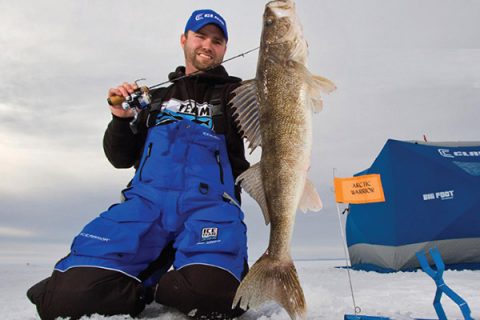
Handlines were once the method de rigueur of open-water fishing; that is, until the rod and reel marginalized them to obsolescence. When it comes to ice fishing, as much as we treasure our traps and tip-ups, if we’re honest they are little more than glorified handlines with strike indicators. While there will always be a place for the conventional ice-fishing trap, the evolution of ice-fishing rods and reels might result in “rod traps” becoming first choice among hardwater junkies.
There was once a great divide in ice-fishing tackle; traps were deployed for “real” fish and jigging rods used for panfifish or small trout. One look at what passed for an ice-fishing rod or jigging stick said it all—the things were wispy, and if you had the misfortune of actually hooking a fish that could fight, the end result was another “one that got away.”
A virtual tsunami of tackle improvements has swept through the industry in recent years, and ice fishing has not been immune. But little has trickled down to the ice fishing trap. Most of what you find in traps today is nearly identical to what your grandfather fished with. The “pike’s share” of these developments have been in rod crafting, which has benefited from modern materials and manufacturing processes. The result is rods that are light as a feather and transmit the slightest bite, yet are powerful enough to yank a determined denizen from out of its comfort hole under the ice. Reels have improved as well, and along with braided and copolymer lines, can pack enough punch and capacity to outlast all but the most determined gamesters.

But, the rub against the rod has always been that you can only use one at a time and are therefore limited in the amount of water you can cover. Conversely, the trap has always emancipated the angler and allowed him to spread out his offerings and cover as much water as possible. Some wished for a hardwater hybrid! The answer arrived with Clamcorp’s Artic Warrior.
As Nick Chiodo, Clamcorp’s Director of Marketing put it, “The advantage of the Arctic Warrior was and is the ability to fight fish with rod and reel, and having a drag system to help land those fish.” Ice anglers finally had the capability to cover more water with multiple lines and still had the benefits of playing out a fish with a rod and reel.

The Arctic Warrior is a simple, rugged design that is pretty fail-safe. It deploys a harness that attaches a lightweight metal pinion to the rod, which in turn fits into grooves on top of the Artic Warrior. The reel is rigged open-bail or free-spool, and when the line is tugged, the rod is tipped and the flag flies. The angler then lifts the rod away from the Arctic Warrior and fights the fish. It is a no-frills, affordable tool for ice fishing that retails for less than 15 dollars. As evidence that this classic is still in demand, when I researched the Arctic Warrior on Clamcorp’s website, I noticed that it was temporarily out of stock!
In recent years, a local alternative has sprung from the hills of Worcester, Massachusetts called the Nor’easter. The Nor’easter is the brainchild of Mike DeVillers of Indian Hill Ice Traps. Mike has quickly blazed a path in ice-fishing circles as an innovator, and his Nor’easters sport a number of features which make them fully capable of tackling big fish. With a base of 20 inches by 5 inches, the Nor’easter has a wide footprint, making it nearly impossible for a fish to pull it into the hole regardless of the circumstances. In fact, Mike has a video on his website of a 34-inch, 13-pound pike that has the rod tip completely buried into the hole—yet the Nor’easter holds true!
For those aiming for bigger game still, Mike has just unleashed the NE78, which was named after New England’s legendary blizzard of ’78. This rod trap has all the features of the Nor’easter, plus a longer rod holder and taller upright that can hold larger reels and rods up to 48 inches long.

-photo courtesy Clam Corp.
The advantages of rod traps are numerous and range from their light-bite detection to the luxury of battling a fish with a rod and reel. The rod and reel allow the angler to put modern blank technology and today’s smooth-as-silk drags to good use to tire a fish—even a big pike or laker—in a controlled, precise manner. In fact, once you get familiar with rod traps, you’ll find that you will lose fewer fish since a properly-set drag is a lot more reliable than your gut and the “feel” of line through ice-numbed fingers. How many times have you meant to set the hook properly on a toothy adversary and sheared the line on impact because you pulled too hard? That nuisance is significantly mitigated with a rod trap.
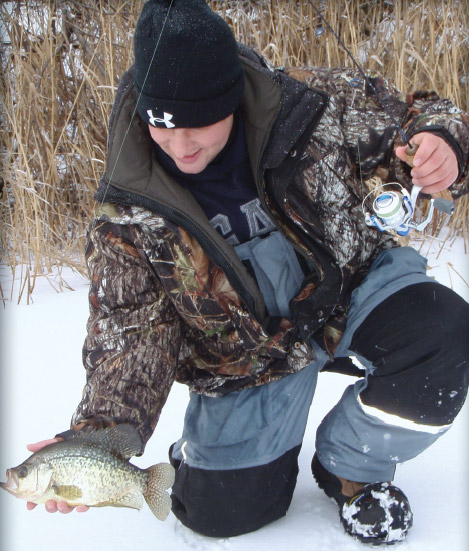
Another advantage of these rod holders is that the combination of a more sensitive trigger mechanism with an open bail makes them ideal for fussy biters such as crappie and bluegills. Crappie are notorious for mouthing a baitfish, setting off the strike indicator flag of a conventional trap, and then spitting the bait when it feels resistance—leaving a flying flag and frustrated angler. If you’re targeting maddening nibblers, opt for a rod trap and you’ll catch those thieves.
 Ice Fishing Electronics
For more information about electronics check out our Ice Fishing Electronics guide
Those who tote electronics onto the ice will also reap the benefits of a rod trap. During a bluebird afternoon, I had a regular trap in the middle of a sunny cove and was being tormented by some unseen adversary that seemed to revel in popping the flag as soon as I walked away. Since I was jigging a red-hot perch spot, I didn’t want to leave my honey hole to focus on that spot, so I drilled an adjacent hole and dropped my underwater camera down to see if I could spy my antagonist—what I saw was a school of slab crappies swimming around my hapless shiner. Out of the hole came the conventional trap and into that hole went a rod trap with a tiny shiner. Thanks to its delicate release, I soon caught a bunch of those mischievous crappies!
Since rod holders do not have a spool hanging below the ice, they present your offering in a stealthier manner. “Salmon and trout are notorious for cruising just below the ice,” explained DeVillers. “What we discovered was that the strike rate increased since the Nor’easter does not have a spool hanging below the ice.” Pressured water bodies or spooky quarry are more inclined to be duped by a baitfish when it is not obviously tied to a foreign object such as a trap spool. Brook trout fanciers can appreciate the advantage of a spool-less presentation since brookies are notorious for hugging the shoreline just below the ice in mere inches of water. This sometimes makes it difficult, if not impossible, to plunge and hang the spool of a trap below the ice. A rod trap has no such complications as there is no spool that gets in the way.

The originator, Clam’s Arctic Warrior is a no-frills nobrainer at $14.99. clamoutdoors.com
2.JAWJACKER
The JawJacker uses the fl ex of the rod tip to set the hook for you. $37.99, jawjackerfishing.com
3. INDIAN HILL NE78
Indian Hill’s new NE78 is bigger version of the Nor’easter designed for larger rods and reels. $44.00 indianhillicetraps.com
And, there’s the fun factor and the practical aspect, which makes rod traps in many ways more user-friendly than conventional traps. Most would agree that it is simply more fun playing out a fish while holding a rod and keeping one’s digits nice and toasty in a pair of gloves. You’ll be saying goodbye to scattered, frozen loops of trap line strewn all about, and instead of untangling, you’ll have your bait back in the water within minutes.
Now I’m not advocating that you hock your stick-and-spool traps and go all-in on rod traps. There will always be a place among the runny-nosed brigade for conventional traps, especially in the teeth of a major freeze when an underwater spool will require less ice-freeing attention. Rather, if you supplement your traditional traps with these tools, you’ll become a more effective and complete ice fisherman.
Finally, rod traps are just the ticket to igniting the ice-fishing flame for the uninitiated as well as the younger generation. Mike DeVillers mentioned how it is a tough sell to coax his 5-year-old son Anthony to handline fish on a blustery day, but once the flag flies from his Nor’easter and Anthony picks up that pulsing rod, often the toughest thing is often getting him off the ice.