

There are so many reasons to pack a particular lure for any day or night of fishing. Frankly, many anglers pick a plug simply because it’s worked in the past, they like fishing it (which is usually because it caught in the past), or they heard it’s a good choice. They don’t think any further about why they should or shouldn’t be carrying it. The worst offenders are anglers who pack a dozen of the same plugs, just in different colors. Don’t do that. Instead, carrying a variety of presentations, profiles, and actions will help you be prepared for a variety of scenarios that could develop on any given outing.
I think presentation is the single most important factor when packing a specific lure, followed by profile. Having plugs that represent a diversity of sizes and shapes has been effective for me, especially on nights when fish are fussy or keyed in on a specific forage. This may seem straightforward, but it’s more complex than what the plug looks like. While we can’t get inside the brain of a fish, I believe that the action of your plug can dramatically alter the profile being advertised to the striper. This is because stripers don’t exclusively use their eyes to determine what is going on in their environment—at night, sight might not matter at all.
(Note: On The Water is reader-supported. When you buy through links on our site, we may earn an affiliate commission.)
Striped bass are very dependent on their vibrational senses—hearing and their lateral lines—as well as scent. They use their vibrational senses to build a map of what is going on in their world. They may not know what a crab is, but they know what its vibrational pattern “feels” like in the water and use the pulse waves coming off the crab as it scuttles along to track it down. They follow the vibrational waves like a scent trail, moving toward the source.

So, if stripers know what a crab “feels” or sounds like, and the same is true of other prey species like bunker, squid, cinder worms, and eels, then it makes sense that the profile they’re actually chasing is not the visual one at all. They know how a bunker feels, and that’s why, when they sense it in the water, they head in that direction—from experience and instinct, they “know” it means food. They also know how big or small something is, based on how much vibration the bait puts out. They don’t have to visually see it at all.
Knowing this, I want to create different vibrational profiles that represent various meals to stripers. That’s part of my thought process when packing plugs with different actions. Yes, sometimes it’s as simple as packing larger or smaller lures, but that’s only one way to create different vibrational profiles. The other way is with the action of the lure. The way it moves in the water may inform what the striper thinks it is.
Let’s use an example. Many times, I try to present something very natural that represents a bait calmly trying to blend into its environment. Most life underwater doesn’t make much commotion, even when it’s moving quickly. So, I might first reach for a slow-sink 9-inch needlefish like a 24/7 Needle that has a subtle back-and-forth swim. This style of lure gives off just a small amount of long-wave vibration. I like fishing plugs that blend in and are natural, as I think it is more appealing to larger stripers because they can’t tell if they’re artificial. It’s also likely putting off vibration that is indicative of something of its visual size which, at 9 inches, is a pretty good meal.
Now, take that same 9-inch length and slender shape, then put a lip on it. Imagine it thumping back and forth slowly on the retrieve and putting out a lot of vibration. The action of the plug has completely changed and is potentially creating a vibrational profile of something much larger because that wood is pushing a lot of water as it moves back and forth. Something alive with similar physical dimensions would never put out that much vibration because creatures that move through the water do so fluidly and with little movement of their bodies. Something that was creating that much water movement would have to be pretty big—at least, that’s what I theorize. So, now the striper is trying to match this hard-thumping baitfish to something in its memory, and it might do the math and come up with “huge, tasty meal.”
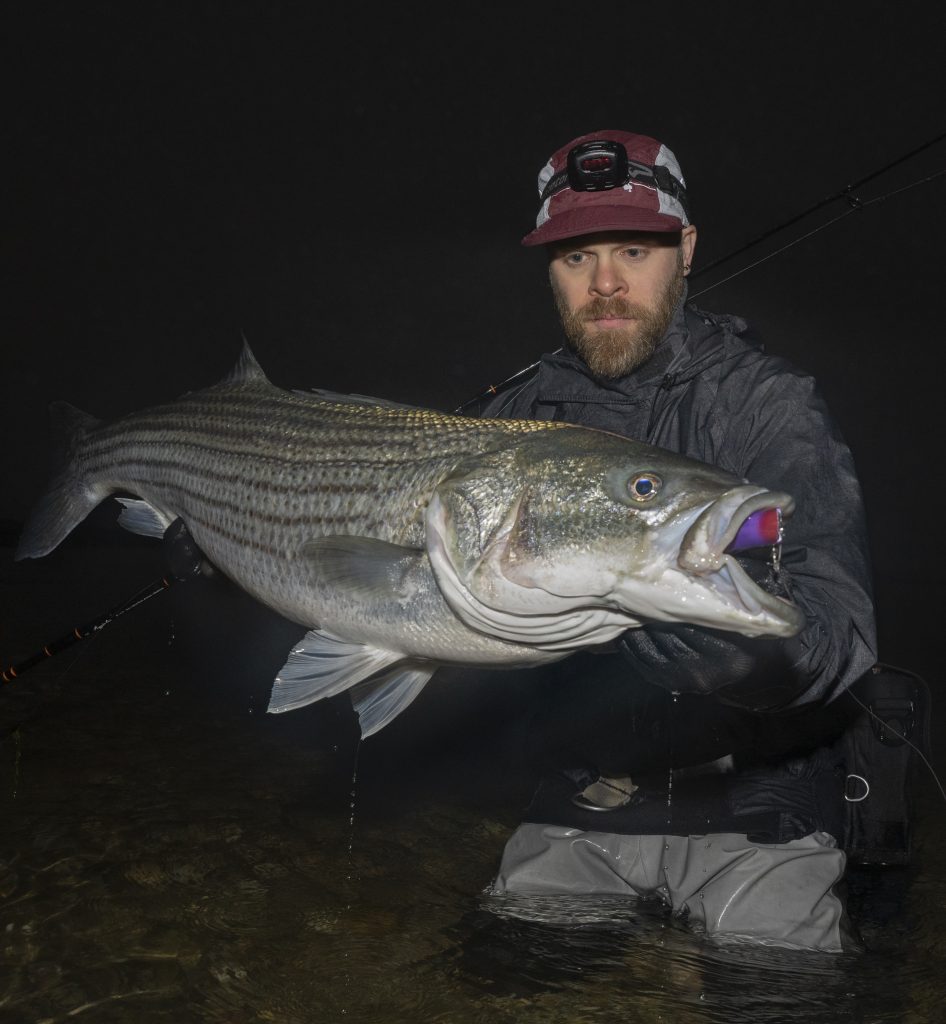
Even more clear for me is a big soft plastic, like an Al Gags Twitch-it Eel or Joe Baggs Block Island Eel. These might all have “eel” in the name, but to me they are big bait mimics, not just eel imitators. Because the way they move in the water, they produce large pulse waves that must “feel” similar to a large fish moving through the water column, especially at night when many bigger baits are trying to stay still. You can almost envision the soft plastic as the horizontal line of a large baitfish body, from snout to tail. When the soft plastic flexes and a vibrational pulse comes off it, it’s akin to the fish fluidly working its body to move through the water. It’s an extreme example about how action can build a vibrational profile that has nothing to do with what the lure looks like.
Every plug in my bag is viewed in this light. When I pack it, I mix in as many presentations and profiles as possible, and when I consider a profile, I think hard about how action can influence that vibrational profile, not just what the plug looks like. While two plugs might look similar, they may present a profile that is markedly different, based on their action. A darter and a bottle plug might be almost exactly the same dimensions, but I have a hard time thinking that the striper sees them as two similarly sized creatures in the water.

Some of my favorite examples are surface metal lips, like Dannys and Pikies. These plugs have actions that undoubtedly help increase their perceived size. The first is their exaggerated “wag and wobble” action. When a big Danny plug, like the classic 3.5-ounce Gibbs, is wagging its tail back and forth while simultaneously rolling, it creates a ton of pulse waves (aka vibration). But because it also has a relatively slow wobble and a physically large size, the pulse waves being produced from this plug are longer, like something big in the water.
This is likely further exaggerated by the fact that this big surface plug is plowing through the surface film. The extra amount of pulse it gets from displacing water on the surface further breaks up its physical dimensions, making it seem even larger. The action of the lure on the surface is also going to disrupt the light coming from above, especially in high light-pollution areas and under a full moon. This will create even more illusion and break up its overall physical profile. It has nothing to do with how action affects profile, but I’ll point out it’s also why I like white surface swimmers (or at least a white belly) because the white against a lighter sky means the fish is even more likely to be unable to put together what that “thing” is on the surface. In the end, the combination of those long, dramatic sound waves coming off the plug in combination with its disruption of the surface and breaking up the light from above means that your Danny almost certainly feels like something massive.
Peanut Profiles
If we go all the way in the opposite direction, consider the bucktail. In the fall, I have great luck getting fish to attack a 1-ounce bucktail when there are juvenile menhaden (“peanut bunker”) in the water. You might think a small swimmer, metal lip, or walk-the-dog lure would work, but you’d be wrong. The only lure I have consistent luck with is the bucktail. This has nothing to do with casting distance or ability to hold in big waves. Stripers are extremely aggressive, explode on the bait, and push it into mere inches of water that is relatively calm. However, I think they are particularly keyed in on bait that is of a certain physical size and acts in a specific way.
» Read Up: Peanut Swimmers
The peanuts in this spot usually come in pods, not mega schools like you see elsewhere. They slide through the surf, making very little commotion. Individually, I imagine they put out an exceedingly small amount of vibration, though the school in totality might put out a good amount. They swim straight, not darting, which is what I do with a bucktail. The profile it presents is a perfect match—not its physical dimensions, but rather its action-induced profile. Since it has no lip, no paddle tail, and no rattles, it is quiet and the sound profile it leaves in the water is so similar to a peanut that it doesn’t matter if the visual profile is too round and full. It’s the complete lack of commotion, wiggling, or darting that is so crucial to getting stripers to feed as they target individual peanuts at the edges of small schools. You would think a small swim shad would work even better, but that pulsing tail ruins the illusion. The only other lure I’ve had as much luck with is a tin like a Kastmaster, but that’s only when the fish are being even more aggressive and are often in blitz mode. The Kastmaster’s profile is a bit more “noisy,” since it wiggles side to side, but it’s still relatively benign compared to something like a swimming plug, which I’ve had almost no luck with at all.
Consider that the plug’s amount of body roll is intense, given the speed at which it’s actually moving through the water. A minnow or small fish of that size could swim through the water with markedly less body roll or wiggle; a spearing or sand eel can quickly dart away with very little body movement and, hence, very little vibration. A swimmer, like an SP Minnow or Mag Darter, reads like something moderately sized going “all out” to escape. The frequency of its body movements are much higher than with the Danny or soft plastic, so I imagine it comes across as something middling in profile. However, the intensity of the vibration—the amplitude and wavelength—has to seem like something fleeing for its life. This would then naturally trigger a striped bass to pursue out of curiosity, out of aggression, out of competition, or out of feeding efficiency, depending on the specific situation. Then, once the striper locks onto the plug, it comes to find that the lure is in fact not going that fast. So, the striper comes charging into the attack zone, ready to go all-out in attacking a moderately sized fish that’s fleeing and made itself vulnerable. Instead, it finds this bait simply chugging along at a relatively slow speed (for a fish). It does not consider or use logic; it just senses an easy meal and jumps on it.
These are just a few examples, but they’re all simply designed to point out that it’s important to think about how a plug’s action—simply how it wiggles or swims—can influence what a striper is perceiving or feeling in the water; that is, what it thinks it’s hunting down. The profile of a plug is much more complicated than simply what it looks like in your hand. So, the next outing when you’re packing your bag, try including a spectrum of lures based on how they move, not just their size or dimensions. Like so many things in angling, it’s hard to break away from our own senses and instead think like a fish. But if you ever figure out exactly how to do that, look me up. I’d love to buy you a beer.
READ MORE


