

As soon as I turned the corner at the bottom of the basement steps, I was no longer in the rural Pocono Mountains. I was whisked away to the Capitol Records building in L.A. I’d hung out in a few recording studios during my punk days, but nothing this professional. The mixing board spanned an entire wall. A custom-cut window gave a glimpse into the next room where a piano was set up and high-end amplifiers were ready to hum at a moment’s notice. Every cord, guitar case, and mic stand were meticulously organized. Jeff Cammerino built this space in his Hawley, Pennsylvania, home because music has always been his true passion. Had it not, he may have become one of the biggest names in bass fishing.
It’s not a stretch to suggest that Cammerino is the godfather of modern wacky rigging, a technique that—love it or hate it—every bass fisherman knows well. Since Gary Yamamoto unleashed his mighty Senko on the masses in the mid-1990s, the soft plastic has been sneakily rounding out winning bags for tournament pros and openly helping recreational anglers at every skill level score hawgs. But Cammerino figured all of this out decades before Yamamoto. His creation, the Jersey Rigg, was blowing minds on bass lakes across the country years before anyone ever heard of a Senko. The only reason you’ve never heard of a Jersey Rigg is because Cammerino marches to the beat of a different drum.
Rats and Cigarettes
Cammerino, now 68, is one of those guys who’s all over the map. He’s toured with the Four Seasons; he did a stint as a Pennsylvania state game warden; he’s jammed with members of Springsteen’s E Street Band; and he’s written and recorded songs for commercials. As for becoming a successful lure maker? That happened accidentally.

Raised in Lyndhurst, New Jersey, Cammerino didn’t come from a fishy family. When he was nine, he got his first guitar. That same year, a teacher asked if anyone was interested in learning about fishing. Cammerino raised his hand and together they went to Sheppard Pond on the New York border. The quiet woods were a stark contrast to the hustle and flow of Lyndhurst in the shadow of Manhattan, but the trip ignited his fire for angling. Most of his earliest fishing buddies were fellow musicians and bandmates, but stoking the flames close to home wasn’t easy.
“There was Lake Hopatcong, but all we really had locally were a few little lakes and ponds and the Passaic River,” Cammerino told me. “I used to wade in the Passaic and there would be rats walking around my legs. I remember in high school I used to cover all my books with road maps, and then take a pencil and mark all the places I wanted to fish.”
By the mid-1970s, Cammerino had become quite serious about his fishing. He was observant, as most good anglers are, and it was a chance occurrence on New Jersey’s Mountain Lake that would thrust him into lure making.
“I was watching butterfly larva, caterpillars, falling out of trees,” Cammerino said. “I was just learning and coming into my own about this stuff at the time. Fish were just hammering these things by the shoreline, so I said, ‘Well, wait a minute. Let me start trimming and cutting a worm down to the size of a cigarette. Maybe I can put a hook in the middle and maybe I can emulate what they’re eating.’ So, I did. I haphazardly caught a couple of fish and thought, ‘This is pretty neat.’”
It worked well enough that Cammerino began tinkering. He figured out how to cut an existing soft plastic to exactly the right size, about three-and-a-half inches. Through trial and error, he learned that a size 1 short-shank baitholder pinned right through the middle provided just the right amount of weight to achieve his desired fall rate. He also saw how the creation jackknifed and twitched if he wanted it to, or just undulated subtly in place if he needed to keep it in the strike zone for a long time. Even Cammerino admits, however, that he didn’t pull this idea out of thin air.
This Ain’t Texas
If you ask Cammerino if he invented wacky rigging, his answer is a hard-and-fast “no.” According to him, the term had been coined by the Creme Lure Company back in 1949 when it introduced what is largely hailed as the first mass-produced plastic worm.
“If you look at the back of one of their old packages, it showed you different ways to rig the worm,” he said. “One of them was what they called ‘wacky style.’ There was a hook right through the middle and a finishing nail in the nose.”
Like many anglers in the 1960s and 70s, it appears, Cammerino paid the rigging suggestion little mind, largely because it seemed like an awkward way to feed a fish a 6-inch worm. Years later, though, Cammerino saw that with a shorter bait that was naturally heavy enough to be cast without added lead or nails, that central hook point provided life. In the late 1970s, after hand-making molds and pouring baits in his mother’s kitchen, he had a prototype. In a twist of fate, he got invited to fish with a gentleman he’d only recently met. Cammerino stuck a four-pounder at the ramp before the boat was ever launched. He went on to put up 30 bass in two hours using one of his prototypes in black.
“This guy eventually put his rod down and was just watching me,” Cammerino recalled. “I’m just beating up the lake. It was one of those days where I just couldn’t do anything wrong. He’s like, ‘Why aren’t you in business?’ And I said something like, ‘You got $30,000 you’re not doing anything with?’ And he said, ‘Yeah.’ I went to his office a few days later and he cut me a check for $5,000 to start figuring out how to get my lures manufactured.”
The bass world already had the Texas rig and the Carolina rig, so, given Cammerino’s roots, the Jersey Rigg was born.

Talk the Talk
The Jersey Rigg didn’t have a stoke reel. There was no rocket to the top via boosting posts and greasing influencers. Its early reputation was earned purely via results and word of mouth.
“I was winning tournaments all over New Jersey with my lure,” said Cammerino. “Before I knew it, people were saying, ‘Who’s this kid with the long hair and the earring beating everybody?’”
Now that he had an investor who expected a return, Cammerino put boots to the ground hard. He spoke at seminars and outdoor shows across the Northeast. Little by little, articles in everything from local papers to regional magazines to Bass Masters were being written. Appearances on a few TV shows followed. It all fueled a cult following for a lure that—much like the Senko years later—was viewed as a secret weapon. They were favorites of tournament OGs like Larry Davidson, Harvey Knight, and Lee Baily, Jr., who, according to Cammerino, went on to win a B.A.S.S.-sanctioned event in Connecticut using a gold Jersey Rigg.
There were a lot more big-name pros in the late 80s and 90s routinely using his lures, Cammerino says. He was constantly getting calls from Texas, Tennessee, and Missouri. However, just as it goes today, you may never hear about the lure that won a tournament if its maker doesn’t have the cash to put its name on a boat or jersey. The lack of funds to sponsor big-time tournament pros was a barrier to Jersey Riggs leveling up marketing beyond some sporadic press, boat ramp and bass club chatter, and tackle shop sales pitches. The funny thing is, Cammerino never cared because he had no personal desire to see Jersey Riggs become the next big thing. If enough lures sold to pay his bills so he could spend more time writing and playing music, he was happy.

Take it Personally
By the time I tracked Cammerino down in 2024, Jersey Riggs had become steeped in lore. With some effort, I could find a few references on ancient bass forum threads, many of which concluded with something like “Whatever happened to these baits?” The answer was nothing. The 3.5-inch ribbed soft plastics have never gone out of production despite widespread assumptions, but as the world became accustomed to online shopping, Cammerino chose not to adapt. There was a Jersey Rigg website, but it did little more than provide an email and number to reach Cammerino if you wanted to order.
“I just didn’t want to be bothered,” he told me. “I don’t want to sit in front of a computer half the day and ship piles of orders. I want to get out of my friggin’ house. When online shopping was taking over, I was still loyal to the stores that sold my lures or people who called to place orders. It was the personal connection. It’s so cold today. You can’t talk to anybody, but if I was talking to you, I could suggest different colors and ask questions. I have some customers who have been calling me for 40 years. I formed relationships with them.”
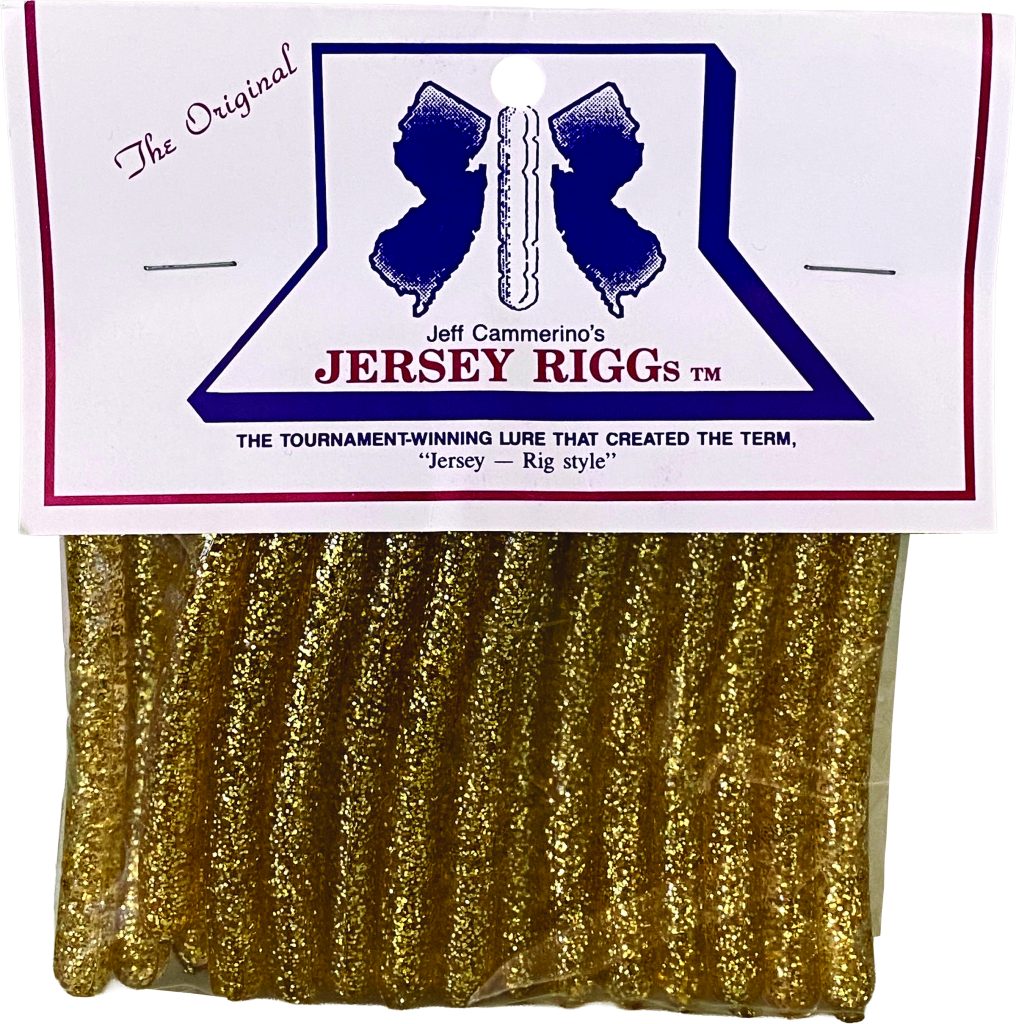
So important were mom-and-pop shops to the success of Jersey Riggs that Cammerino never pursued big-box retailers out of respect for the little guys. Even today, if you surf to jerseyriggs.com it will kick you over to signal11lures.com—a New Jersey-based retailer—the only place online where you can, in fact, buy Jersey Riggs. The packaging has barely changed since inception—the graphics scream 1980s. There’s a simple rigging diagram, some fishing instructions, and Cammerino’s address and phone number. A pack will set you back $8, but you’ll get 20 baits and Cammerino prides himself on their durability compared to the Senko. It was always important for him to give anglers their money’s worth.
For the record, nobody has ever suggested Yamamoto blatantly ripped off the Jersey Rigg, least of all Cammerino. Had he chosen to push the lures harder in the early 90s, he may have been the king of the soft-plastic stickbait, but his heart laid in music and simply having freedom to live his life without being beholden to growing a lure business 24/7. So, did the Jersey Rigg inspire the Senko? Perhaps we’ll never know for certain. Still, Cammerino is convinced there’s potential for the Jersey Rigg to explode, but he’s not the person who will depress the handle on the detonator.
“This brand needs a younger guy in his 20s who’s hungry,” he told me. “He could make millions if he really goes after it because the name and history are already out there. I’ve passed on a few offers to sell, but for the right one, I would.”
When I asked if it would be hard to let go, if he would worry about a new owner changing or doing a disservice to what he spent years building, he chuckled.
“No,” he said. “Life is so fast and precious, you know? I don’t care about that kind of stuff. If I ever sell, I’ll just move on.”
Stay Gold
A few weeks after meeting Cammerino, I was knee-deep in the Raritan River piercing a glistening, gold Jersey Rigg right through the center. I was always more of a green pumpkin man, but Cammerino told me gold has always been one of his top-selling and top-producing colors. I’m not sure what I expected, but I felt like I was about to cast something that had been stashed in a CIA vault for decades because it was simply too powerful. Even though I now had the whole story, I still looked at the Jersey Rigg as something mythical that I couldn’t believe I’d gotten my hands on.
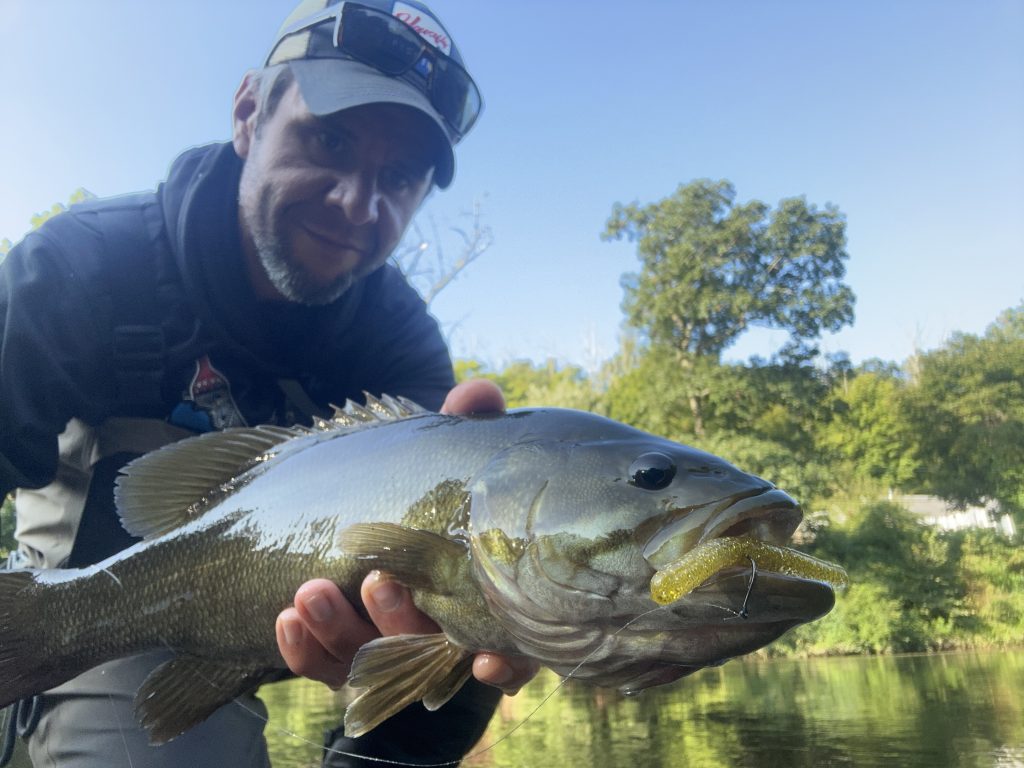
To be honest, my initial reaction was disappointment—it sank slower than a Senko, possibly a product of hooks becoming much lighter than what Cammerino used in the early days. It was also a bit stiffer than a Senko, though its wobble mirrored one closely. I wondered if I was comparing a CD player to Spotify—the former was different and revolutionary at the time, but we’ve come a long way since. I sent the glittering worm to the top of a riffle and let it drift into the bucket below. The first two passes went untouched, but on the third, I felt the line tick and swung. A fat smallmouth took to the air, the gold Jersey Rigg gleaming in the summer sun. I hit another half-dozen fish that day on that single bait.
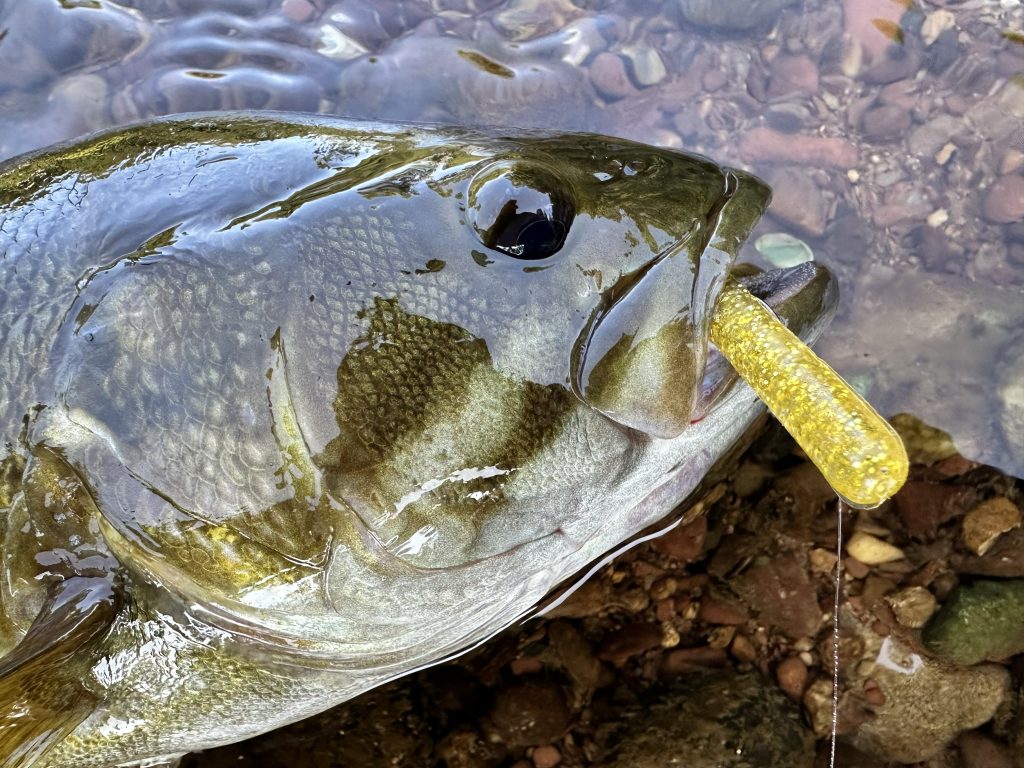
What I’ve learned after a season with the Jersey Rigg is that much like Cammerino, it does its own thing. I might rig it and fish it like a Senko, but it has its own personality. A Jersey Rigg splashes down more quietly and moves more subtly. It requires a hair more patience to fish, but these traits have made it an indispensable part of my arsenal for fooling smallmouths in low, clear, moving water where gentle finesse makes the play. It’s the kind of lure, I believe, that will find its niche in your home-water program as it has in mine. While it might seem silly, I left one of the packages Cammerino gave me unopened. It hangs on the corkboard in my office as an homage to fishing history in my home state and as proof to any non-believers that modern-style wacky rigging is as much a Jersey thing as pork roll and Bon Jovi.
RELATED CONTENT


