

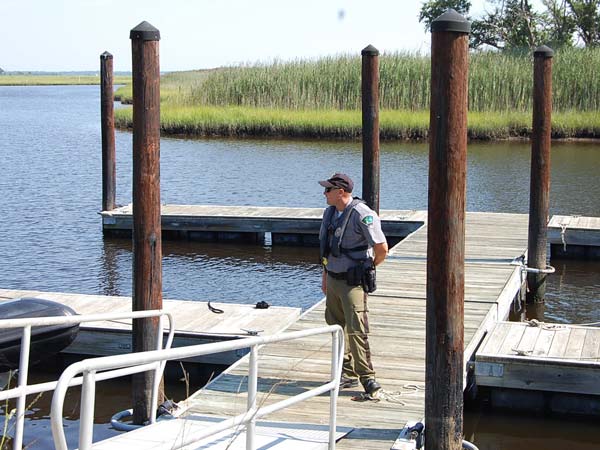
Pictured above: To guard against disease for both the consumer and oyster beds, farmers must comply with both ambient temperature and harvest limits for their operation in Little Egg Harbor. Officer Nicklow conducts random testing to insure compliance.
Growing up in the city, I learned how to fish and hunt along the Delaware River up the street from our row home. Nothing too exotic – catfish, carp and eels were the most common catches of the day. Back then, the Delaware wasn’t as “fish friendly” as it has become today. We learned to fish through trial and error since our fathers were often too busy working long hours at their blue-collar jobs. No complaints, mind you. That’s just the way it was. Things were different back then.
I don’t think I had my first encounter with a fish and game official until much later in life, when I started hunting. Even then, if my memory’s correct, it was just casual happenstance, the checking of licenses and catches. I never really gave a second thought about the jobs these officials do and how rewarding, or difficult, their work must be. I simply accepted them as a part of the pastime.
When I got out of college, the economy was much like it is these days – tough to get a job. So I accepted a position as an Internal Revenue agent and relocated to Pittsburgh. Though working for the IRS certainly isn’t a popular job, it definitely has a role to play in society. In some respects, the conservation officer faces a dilemma comparable to the IRS agent. As part of an enforcement arm of the government, they are often saddled with the job of administering laws made by other governing bodies and, as such, are often the faces that we, the end users, associate with the laws we must adhere to in our pursuits.
According to the NJDEP website, the requirements for becoming a conservation officer (CO) include possession of a bachelor’s degree in one of the biological sciences, natural resources management or environmental studies/science. In addition, the degree must be supplemented by 24 credits in any combination of the following areas: fisheries science, wildlife science, ecology, natural resource management or the biological sciences. One year of experience in law enforcement, environmental enforcement activities, wildlife science, fisheries science, or environmental science is also a requirement. By contrast, all that was needed to become an officer in the Department of Treasury was a bachelor’s degree with at least 24 credits in accounting.
Becoming a Conservation Officer
Requirements to become a Conservation Officer include:
- Bachelors Degree in Biology, Natural Resources Management, or Environmental Studies/Science.
- 24 credits in fisheries science, wildlife science, ecology, natural resource management, or the biological sciences.
- One year of experience in law enforcement, environmental enforcement activities, wildlife science, fisheries science, or environmental science.
- Completion of a 12-week bureau training course in fish and wildlife regulations.
- Residency in the state.
And, it doesn’t end there. Once hired, each CO candidate must successfully complete a police training commission-certified basic police officer’s course and a 12-week bureau training course in fish and wildlife regulations. They must also be a resident of the state when appointed as a CO and must establish residency in a specific geographic location within nine months.

During the course of my research for this piece, I had the opportunity to chat with officers in positions ranging from top administrative positions to a front-line conservation officer. With more than 40 years of fishing experience, some years spent as a tackle manufacturer’s rep and experience writing for several local fishing publications, I assumed I was well versed with the industry’s rules and regulations. Five minutes into a conversation with Captain Dominick Fresco of the Marine Enforcement Division, I discovered that I basically knew nothing.
The most visible aspect of the CO’s job occurs in the summer months when anglers take advantage of the fair weather in pursuit of their quarry, and most would assume that this is the foundation of a CO’s job. In fact, as the primary enforcement agency responsible for all the coastal fisheries in the state, the unit focuses a good deal of its attention on the commercial side of fishing. Considering that New Jersey has the sixth-largest commercial port (Cape May) in the country along with five other major ports and various intermediate ports, you would assume there is a cast of hundreds assigned to monitoring the catch. However, the actual number is well south of 20 individuals actually patrolling the field. The latest estimates I could find put sales related to New Jersey’s marine industry (boating, fishing equipment, etc.) anywhere from $450 million to more than $1.6 billion dollars. Factor in employment, sales and special excise taxes and it’s easy to see that fishing is one hell of a revenue generator for the state. Comparatively speaking, the budget for the entire Marine Unit of the Fish and Wildlife Division is roughly around $1 million dollars. According to Captain Fresco, that amount is augmented by some matching federal funds for their work on highly migratory species. But even with that, it’s this writer’s opinion that the budgeted amount is woefully low for a division responsible for such an enormous segment of generated income. And just to ease your mind, I could find no incentive for field officers to issue citations as a form of expanding their funding. Yes, fish are sold to one of three authorized merchants when seized from a commercial fisherman. However, this is done as a hedge against the possibility that the seizure turns out to be unwarranted, in which case the commercial fisherman can be made whole with funds for the fish seized.
When I was offered the chance for a ride-along with one of the officers as part of my research, I leapt at the opportunity. After all, who wouldn’t want to be on the other side of the table for a change? Just like my experiences when I was an IRS agent about to perform an audit, I assumed that even the most conscientious angler must have concerns when approached by a law enforcement officer. I know I always have.
After a preliminary briefing with Captain Dominick Fresco, I was paired with Conservation Officer Brett Nicklow for my tour as an observer. One thing very obvious from the beginning was that from the top down, those serving in Marine Unit do not consider it a 9-to-5 job. With so few people to cover the coastal areas, these officers know it takes a 24-7 commitment to get the job done. It also became apparent to me that there were two sides of the house and each had a separate entrance to be approached from a different direction. On the recreational fishing side, it was more about educating anglers. With yearly variations of the saltwater limits and seasons, it’s a wonder even the professionals can keep track of the rules and regulations. Take, for example the tautog season (or should I say seasons?), of which there are five different deviations. Factor in size and creel limits, which seem to change every year, and it’s a small wonder that Valium isn’t a mandatory part of every tackle box – and that’s just for a single species! Multiply that by 20 or more, and the spectrum gets infinitely more complex.
On the commercial side of the house, the approach is much different. I have long known that virtually every fish landed in a commercial outlet in New Jersey is accounted for in one way or another by one agency or another. But numbers without some sort of verification are essentially meaningless. That’s where the F&W Marine Unit comes in. Obviously, given the number of commercial operations, every landing cannot be physically inspected. By employing a protocol similar to one used by the IRS, the Fish and Wildlife Marine Unit focuses its attention on areas or handlers with the highest probability for a deviation from the regulations. Once again, like the IRS, the specifics of how they determine which boats or processors to inspect is a closely guarded formula. Publicizing them would obviously allow the bad guys the opportunity to adjust their tactics to avoid detection. In the 20-plus years I spent in accounting and taxation, I had the opportunity to work in many different industries. None, except for the medical industry, is as heavily monitored and regulated as the commercial fishing industry. I know this seems to be a bone of contention with many recreational fishermen, but I stand by my observations.
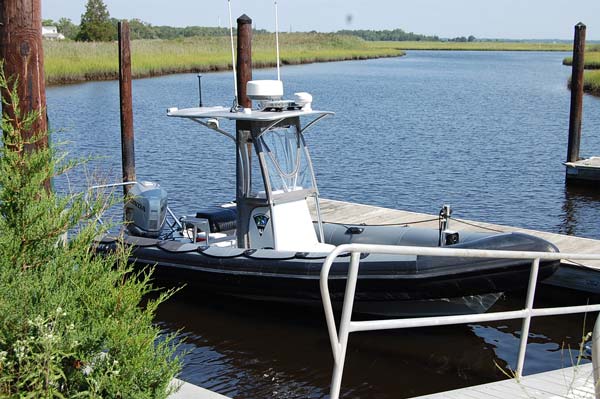
Our tour of duty started from the docks at the Nacote Creek station on a hard-bottom 22-foot inflatable powered with a 200hp Honda (standard electronics package, no super-secret detection equipment or computerized stealth packages). The first stop of the day was an oysterman working his farm beds. Officer Nicklow informed me that shellfish are one of their more critical areas of concern during water patrols. Because of the possibility of contamination from a variety of sources, ensuring shellfish (especially oysters) are properly harvested is an important step in monitoring the industry. Oysters must be maintained in certain conditions to limit spoilage and can only be dredged up until 11 a.m. each day. For wild species of shellfish, closed harvesting areas are definitely the primary concern. However, once shellfish hit the market, the harvesting method is virtually impossible to verify.
The recreational anglers we inspected during our shift were for the most part respectful but obviously a little nervous – probably no different than a motorist pulled over on the street. But Officer Nicklow’s inspections were not prompted by any glaring violations. All were completely random. Of the 8 to 10 anglers we approached, half had fish in their lockers and, of those, some had flounder a little below the minimum standard of 17.5 inches. This surprised me. In each case, it was quite obvious the anglers had made honest mistakes. In one instance, I suspect poor vision played a role; in another, a faulty measuring tape. Each was issued a written warning and the fish returned to the water. There was no animosity on the part of CO Nicklow. Contrary to that, he went out of his way to explain how the rules worked and ways to avoid similar issues down the road. I got the distinct impression that the educational process he used would pay dividends in the future.
Other areas of interest during our ride were illegal baits, of which fluke belly seems to be a big concern. Officer Nicklow told me it is a common problem as few have the required fluke rack with them if they are using belly; further, most will admit they knew they were outside the regulations. Sadly for the anglers we encountered, none had limit totals even close to the thresholds.
As the saying goes, “It’s a tough job but someone has to do it.” And make no mistake about it, conservation officers are as much a law enforcement official as any other. One of the toughest duties is patrol or undercover work in some of the tougher urban environments. Unfortunately, some highly productive fishing areas are also adjacent to high crime areas. I know this because I have fished them. Some I wouldn’t return to in full sunlight, let alone in the middle of the night when many violators seem to ply their trade; as a result, COs often work hand in hand with other local, state and federal law enforcement agencies.
Being a marine conservation officer is definitely a labor of love. I doubt that Officer Nicklow has earned more than one percent of his lifetime earnings farther than 10 feet from saltwater. Before his appointment to the service, he spent time charter fishing, clamming and crabbing, among other things. Based on my observation, his background is the norm rather than the exception in the field.
All too often, people have a tendency to assign blame to the wrong person when they perceive an inconvenience in their routines. This article barely touches on the complexities that a CO must deal with on a daily basis. If you take anything away from this reading, I hope it is the fact that the guys and gals out there protecting the environment for all of us sportsman have little or no say about the laws they are sworn to enforce. Nor do they judge you. Such decisions are often the responsibility of those in higher positions of authority who rarely have to deal with the ire of John Q Public the way conservation officers do on an almost daily basis. The conservation officer’s job is to protect, serve and, might I add, educate. In my opinion, the CO does one hell of a job against almost insurmountable odds.
So, the next time you are boarded for an inspection or are stopped on the jetty for a routine check, take a minute to thank the officer for his or her service. Remember, conservation officers are working for you, not against you.
What is the salary for these positions?
Excellent Article!! Nj is Blessed with the Finest CO’s and biologist in the Country!! Hands down!! Not so with the politicians that are elected to run our once Great State !!
What are the age limits for this career and how can i find out more information
I am the CFO and Compliance Officer of Marine Conservation Network, a 501(c)(3) based in Santa Barbara California. I was once a police officer in Miami Dade County years ago, but decided to work with my CEO/wife establishing our nonprofit. Our mission and goal is education and protection of all marine mammals and enforcement of 16 US Code Chapt 31. We have made great headway in educating our local community and all along the California coast on the importance of our ocean world. We even have badges granted by our bylaws to wear when we are in the field keeping tourists at least 150 feet away from a stranded pinniped or dolphin, and when John Q Public sees someone with a badge, they generally obey. We are not peace officers nor do we pretend to be, however, Officer Lombardi of the Santa Barbara Harbor patrol has taken it upon himself to strip us of our badges and authority and may press charges because we “look like” police officers. That is not our mission, but it is apparently his. According to 16 US Code chapt 31 ss 1377 (b), we, as an agency and officers of a non profit, can enforce the laws of the marine mammal protection act, but we must be designated to do so first by the secretary. Instead of becoming a CO, does anyone know how we can be designated by the secretary to enforce marine mammal protection act?