
Every slow fishing trip reaches a point when the conversation becomes little more than a series of empty affirmations about how the fishing is bound to improve.
“The bite will pick up after slack tide.”
“We’ll find them on the way back to the ramp.”
“If the wind starts blowing, they’ll start feeding.”
Before it got too far out of control, I reminded everyone that a half-dozen albies would have been a perfectly good day back home. No one responded. At Cape Lookout, North Carolina, six albies in a half-day’s fishing are rookie numbers.
Albie Extension
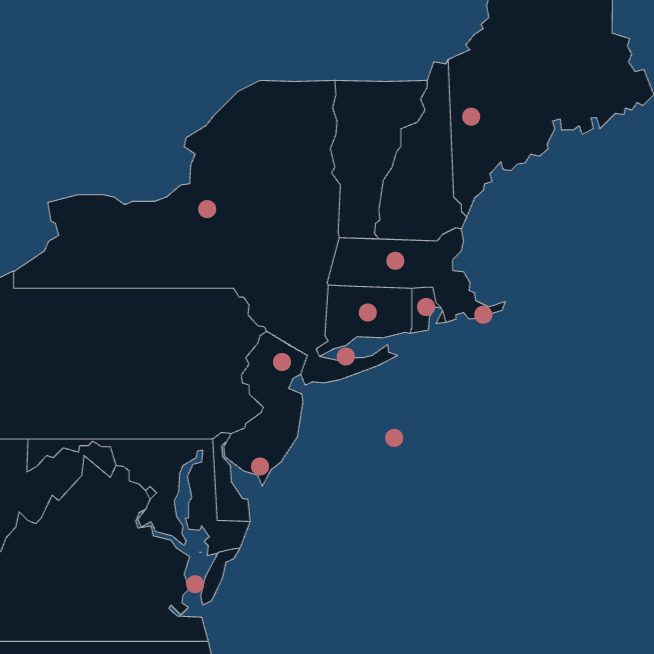
Two weeks earlier, raging against the dying of the local saltwater fishing season, Chris Megan called his longtime friend, Captain Terry Nugent, to ask about openings in his schedule. After chasing stripers, tuna, and albies on Cape Cod in the spring and summer, Terry moves his charter operation south to Morehead City, North Carolina, a fishing town with a culture that he says “blends the best parts of Cape Cod and the best parts of Florida.” Terry had two days open in the week before Thanksgiving that we took without hesitation.
We flew into Raleigh, North Carolina, renting a car and driving the two-and-a-half hours to Morehead City. We arrived as Terry’s last crew was leaving with sore arms and tired smiles. The albie fishing had been fantastic near the beaches, and the amberjack were relentless at the wrecks. After unpacking, we walked the Morehead City waterfront, which, on a mid-November Sunday evening, was mostly deserted save for a group of party-boat customers huddled around the Carolina Princess cleaning table, waiting for their share of the fillets.
At a dockside bar overlooking Sugarloaf Island, Terry laid out the plan for the next two days. On Monday, we’d fill the livewell with “tailor” bluefish—North Carolina speak for 1- to 2-pounders—and take them to the shipwrecks to live-line for amberjack. On Tuesday, we’d chase the albies.
Morehead City has a wide-ranging fishing pedigree. It’s the home of the prestigious Big Rock Tournament in the summer, a world-class giant bluefin fishery in the winter, and in the fall, Morehead City, along with nearby Harker’s Island, is the jumping-off point for some of the most fantastic false albacore fishing on the East Coast.
In October and November, light tackle and fly anglers in North Carolina experience an albie run of both quantity and quality. As we wrapped up our meal, Terry spun stories of days when his crew’s final albie tally numbered in the triple digits and fish that weighed more than 20 pounds. After the disappointing 2024 albie run in New England, some “easy” albie fishing sounded amazing.
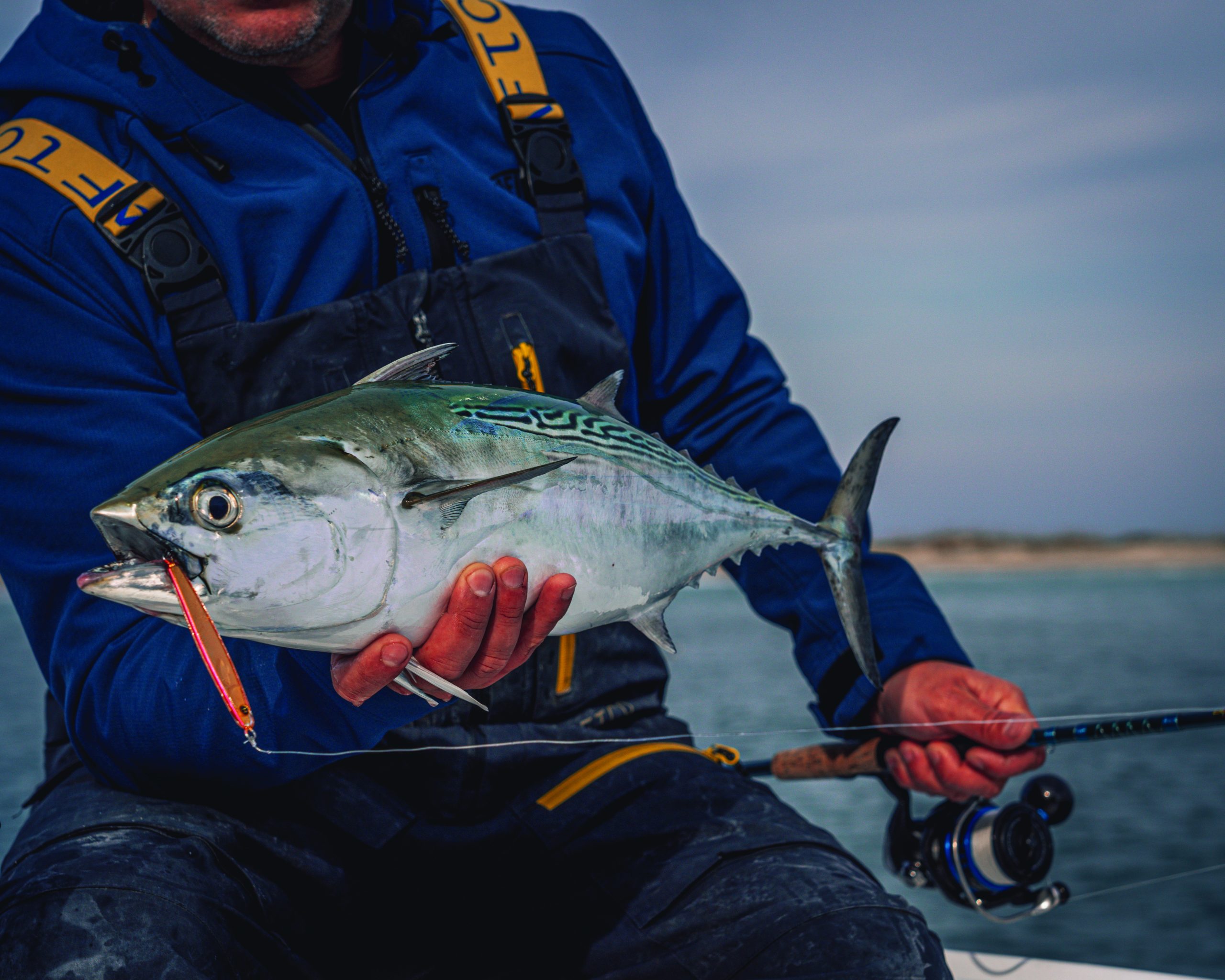
The glass-calm seas that Tuesday made getting to the albie grounds easy, but it made the fishing difficult. North Carolina albies like a little chop, and without it, the feeds had been scattered and short-lived. Still, the morning had some highlights. On several occasions, Terry conjured up albie blitzes by flushing out a group of sitting gulls and pelicans, clearing the way for the albies to tear through the schools of anchovies that the birds had pinned down. Each time, the resulting feeding frenzy lasted just long enough to get one or two casts into the melee.
By mid-morning, the birds and bait dispersed, giving Terry the excuse to do what he does best—cover water. We ran from Beaufort Inlet to Cape Lookout, keeping one eye on the water for fish and the other on the beach for the wild horses of Shackleford Banks. Like the albies, the horses stampeded somewhere beyond our view.
We continued north-northeast 20 miles to Drum Inlet, where the last gasp of outgoing tide produced the day’s final flurry of albie activity. While the fishing had been, by Terry’s Morehead City standards, a bit of a bust, Chris and I were still riding high from the previous day’s fishing on the wrecks southwest of Beaufort Inlet.
Automatic AJs
Greater amberjack are one of those B-list southern gamefish that would have a devoted cult following if they existed in the Northeast. What’s not to like? They get big, they eat jigs, and they fight hard enough to have earned themselves the nickname “reef donkeys.” However, because most southern captains consider catching them too much work, Terry has the wrecks mainly to himself. In his years fishing off Morehead City, his largest amberjack weighed more than 80 pounds, and the state record, caught in these same waters in 2008, weighed 40 pounds more than that.

By our second drift, we had amberjack fighting each other for our bluefish at the surface. The amberjack were more beautiful than I expected. In photos, they’re a dull brown color, but in the water, they appear silver and teal, with big golden eyes set in handsome black stripes. When hooked, an amberjack kicks like a mule and stubbornly refuses to yield ground. My biggest weighed 40 pounds and left my forearms burning. The biggest Terry has ever caught was more than twice that size at 92 pounds, and the North Carolina state record, caught from these same waters, weighed 34 pounds more than that.
Muddy Water Drumbeats
With so much catching the day before, Chris and I weren’t discouraged by the tough albie fishing. But Terry, like all guides on slow days, was feeling antsy. As we idled through slack tide at Drum Inlet, he shared one more affirmation to keep our hopes afloat.
“On the ride back, keep an eye out for muddy water. That’s where the red drum will be.”
Red drum. Be still, my heart.

As the striped bass is to the Northeast, the red drum is to the Mid-Atlantic. A prized gamefish. A conservation success story. An icon.
A red drum shares many of the striper’s best attributes. The fish grow large, school up by the hundreds, and can be caught in both back bays and open ocean. Smaller “puppy drum” fill the same niche as schoolies, delighting fly and light-tackle anglers in shallow backwaters and the surf; larger “bulls” inspire the same mania as cow stripers, drawing big crowds by land and sea when the bite is on.
In the days leading up to the trip, Terry had mentioned drum as a remote possibility, but far from a sure thing. That had been enough for me to pack several medium-weight inshore rods and 5000-size reels, along with a box full of soft plastics and jigheads.
The drum fishing off Cape Lookout is less consistent than for albies and amberjack. Fishermen willing to dedicate a day to soaking live or cut bait catch the reds on a somewhat regular basis, but Terry lives for the run and gun. He’d rather cover a hundred miles looking for fish than sit in one place and hope the fish find him. His approach has proven highly effective in the past. He once found an acre of massive red drum on the surface, thick enough that the water appeared bright orange—a sight that Mid-Atlantic drum fishermen call “the pumpkin patch.”
At first, I misunderstood the significance of the muddy water. I thought the drum sought out the dirty water, but it turns out that they make it themselves. When a school of big red drum encounters a school of bunker along the shore, the beating of hundreds of broom-like tails and the panicked fleeing of thousands of baitfish stirs up enough silt and sand to reduce the visibility to a foot or less. So, after a lifetime spent searching for clean water, I scanned the pristine expanse of the ocean off South Core Banks looking for mud.
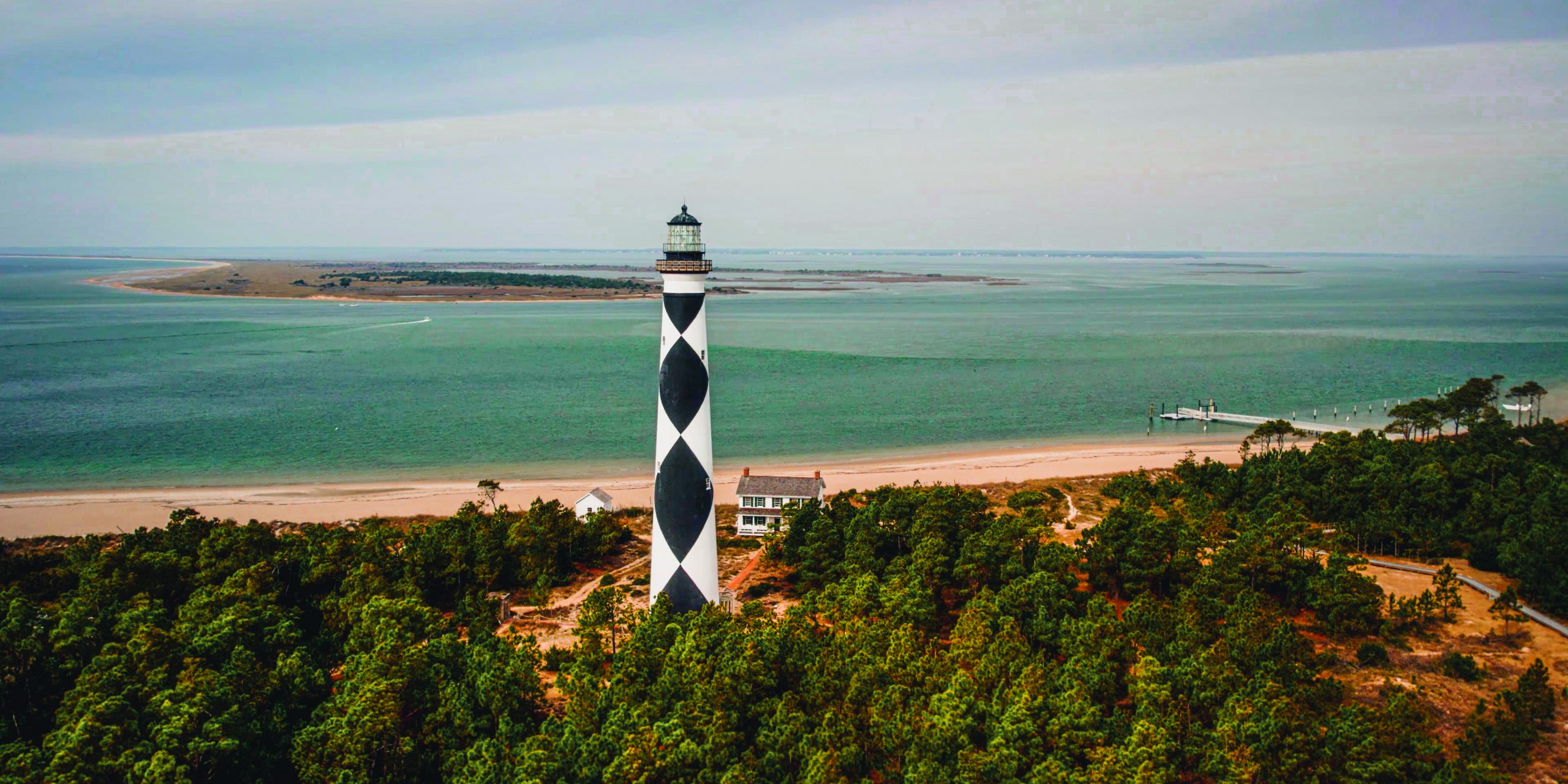
As the black-and-white diamonds of the Cape Lookout Lighthouse came back into view, like many wayward mariners before me, my spirits lifted. Lighthouses guard all the best fishing grounds. At 163 feet—50 feet taller than Montauk Light—the southernmost beacon in North Carolina warns vessels of Cape Lookout Shoals, an area as dangerous to boaters as it is to the baitfish that get trapped in its confused currents and shifting depths.
I’d begun daydreaming of past fall blitzes in the shadows of lighthouses when a diving pelican pulled my gaze to a patch of brown water. I turned to alert Terry at the helm, but he was already adjusting his course.
Plumes of mud billowed up through the otherwise clean ocean over an area the size of a baseball diamond. When we drifted into it, the fishfinder read false bottom six feet down as menhaden swarmed below the boat.
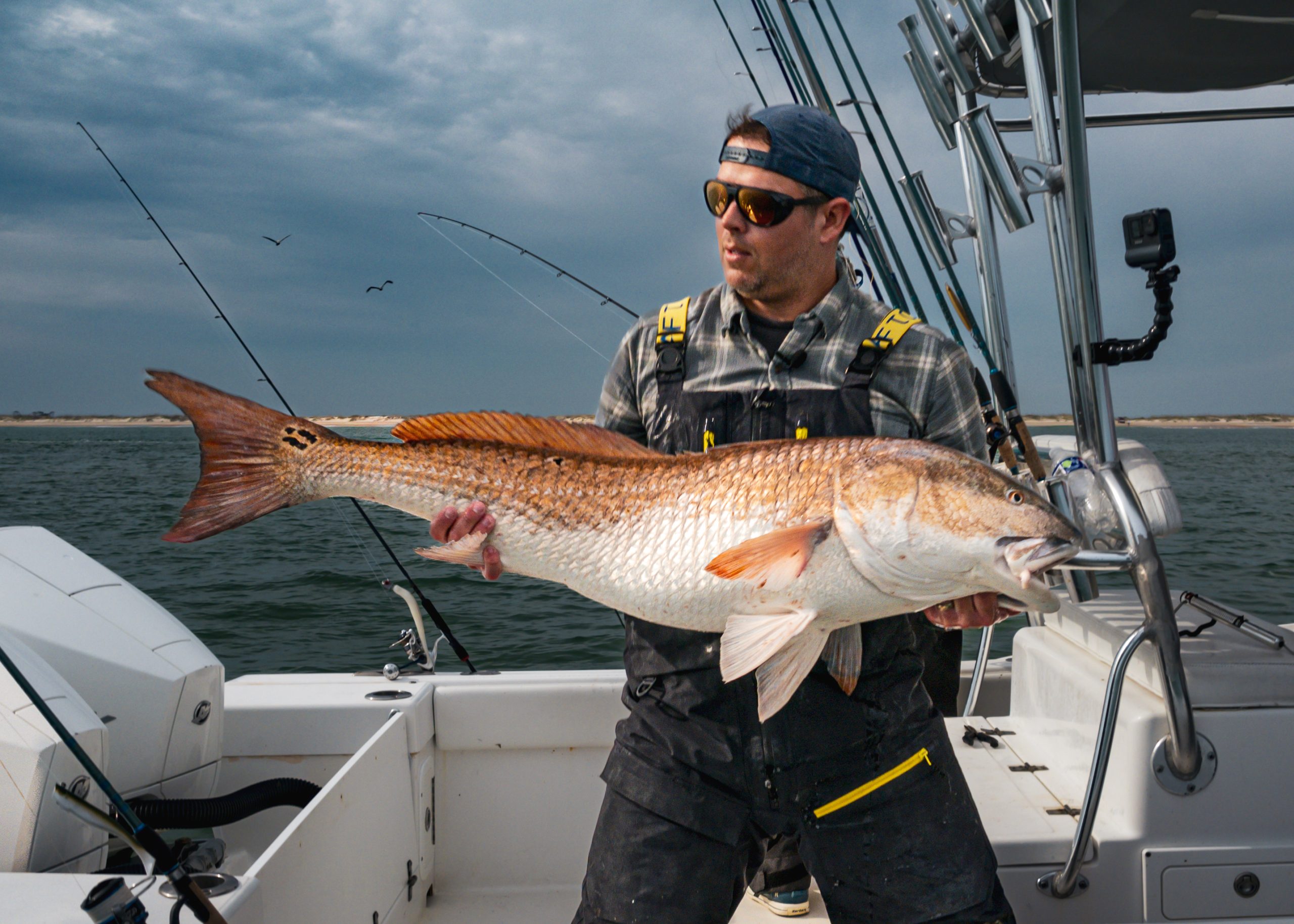
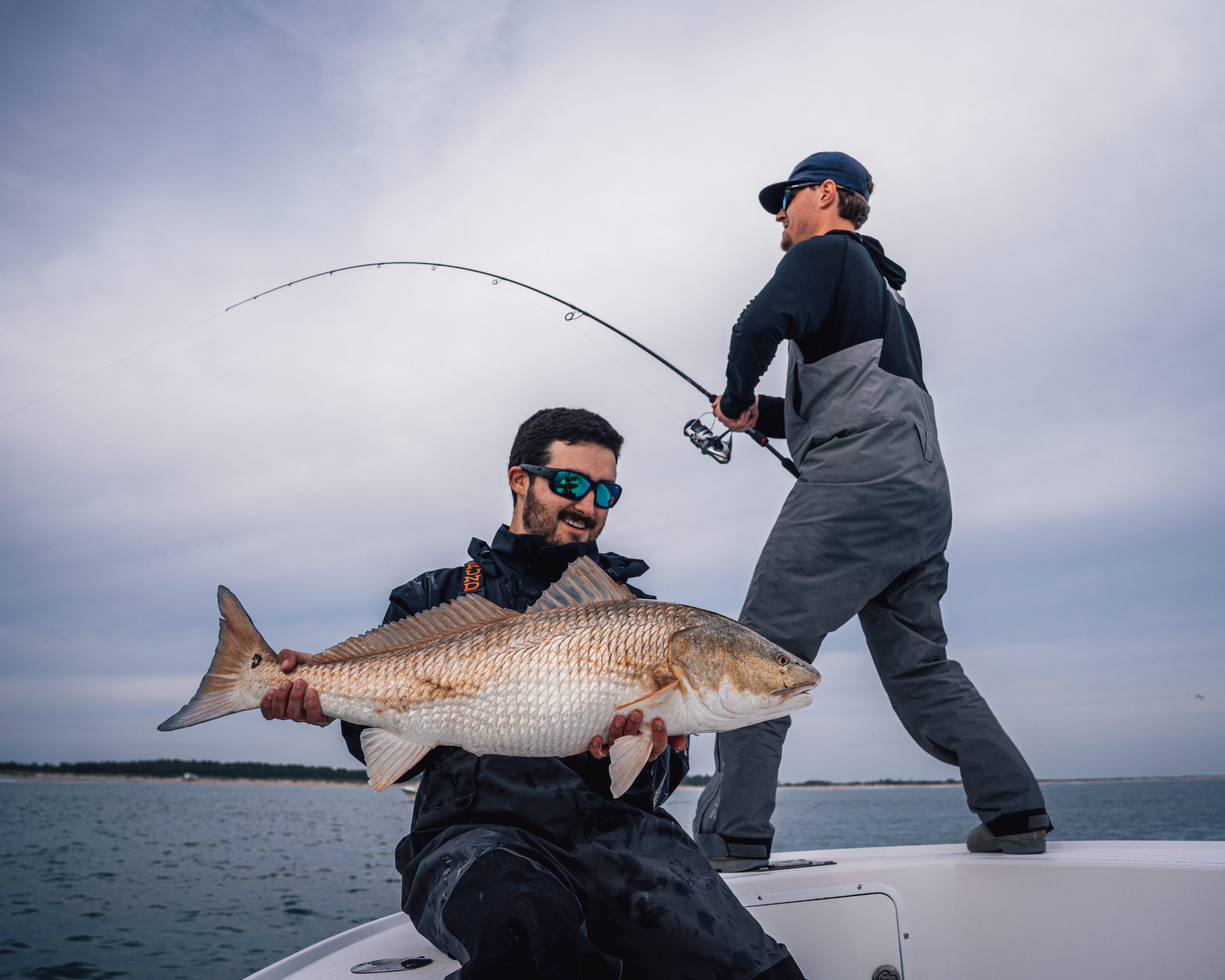
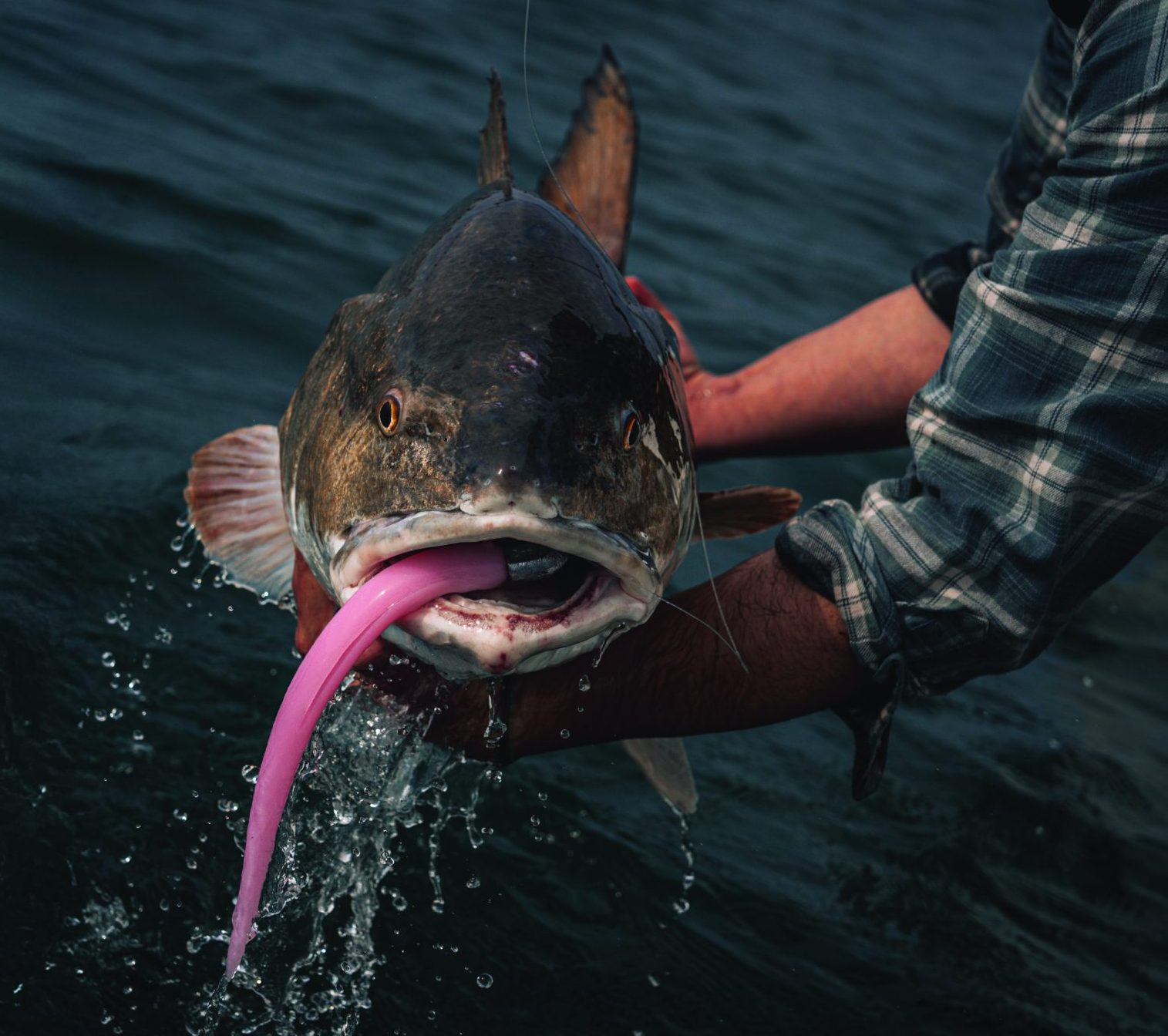
I cast a 10-inch soft plastic on a 2-ounce jighead, and felt the lure Plinko through the thick school of bait before finally touching down on the sand. I twitched the jig once, and before it could settle to the bottom a second time, a dull thud sent a jolt through me. After thunderous headshakes, an unstoppable run, and a stubborn stalemate, the copper scales of a 45-inch drum broke through the muddy water. With that, our false albacore trip to North Carolina changed to a red drum trip.
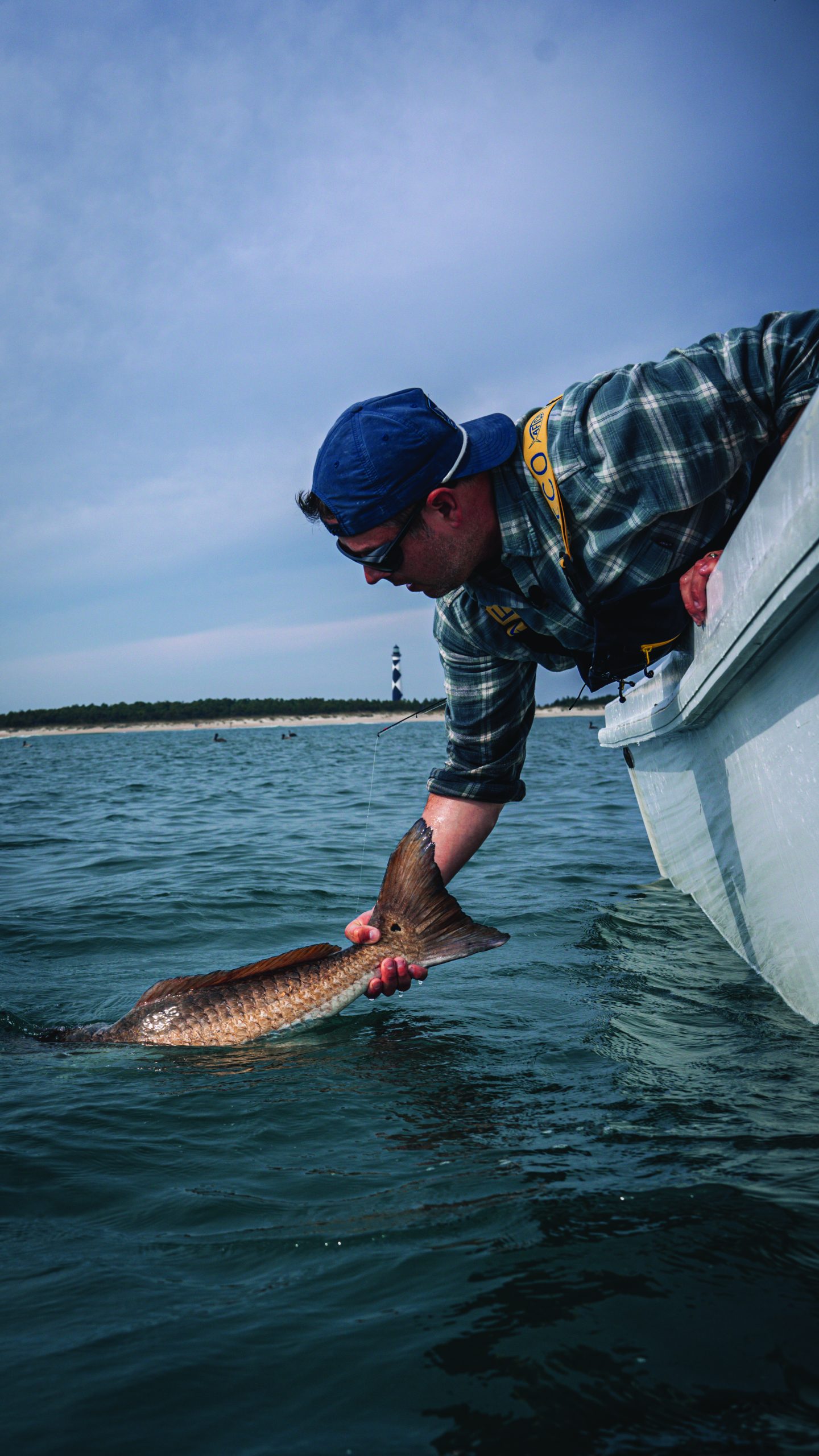
My next cast yielded another drum. A few minutes later, we tripled up. Over the next two hours, we lost count as fish from 35 to 45 inches scarfed our jigs off the bottom on nearly every cast. At one point, I hooked a fish that ran further and fought harder than all the others. It refused to come within 20 feet of the boat for several minutes until, finally, it rolled onto its side, and I grabbed its tail. In wide-open bites, whether with stripers, tuna, albies, or drum, the catches can all blend together if you aren’t careful. On the lucky occasions when I experience fishing that good, I try to slow down a little and fully appreciate the moment rather than rushing to make the next cast. After removing the jig from the fish, I leaned over the gunwale for a moment, watching the golden late-fall light ignite the scales of the 50-inch drum catching its breath next to the boat. The fish kicked free of my grip, breaking the spell as it splashed back toward the shore, where the Cape Lookout Lighthouse was keeping a steady watch over the drum, the bunker, and the fishermen as it had for the past 170 years.
To book a trip with Captain Terry Nugent out of Morehead City, NC, visit riptidecharters.com
Gearing Up for Drum Albies and AJs in North Carolina
Amberjack
Reel: 8000 Daiwa FreeSwimmer
Rod: Saltiga Jigging
Line: 50-pound Sufix 832
Leader: 50-Pound Sufix Wind-On
Red Drum
Rod: 7’6” Jigging World Nexus 2.0 MH
Reel: Shimano Saragosa 5000
Line: 30-pound-test Seaguar TactX
Leader: 40-pound-test Seaguar Inshore fluorocarbon
Lure: 10” Z-Man HeroZ Pink, 2-Ounce TT Lures HeadlockZ Jighead
False Albacore
Rod: 7’6” St. Croix Avid Inshore
Reel: Penn Spinfisher VII 3500
Line: 20-pound-test Seaguar Smackdown
Leader: 15-pound-test Seaguar Gold Label
Lure: 7/8 Hogy Lures Epoxy Jig, Shrimp
Watch the Video:
Listen to the OTW Podcast with Captain Terry Nugent
