

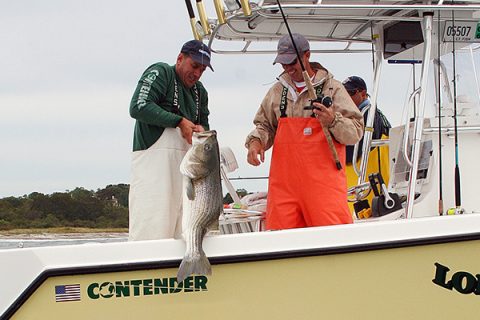
The miraculous menhaden may just be the most important fish in the sea when it comes to catching big bass.
It was one big bluefish, possibly pushing 15 pounds, and the puff of crimson that stained the water was a sure sign that it had found its mark and there would be no escape for that pogy. But what happened next burned an image in my mind that I’ll never forget. As the blue began to shake the pogy, a broad-backed linesider that appeared to be at least 40 pounds bumped the bluefish and took the now-punctuated pogy away from it. With trembling hands I reached for a pogy from the livewell.
Pogy, mossbunker, menhaden, bunker – whatever you want to call them, these hyper members of the herring clan are consistently the king of striper baits. And while numbers of these baitfish might fluctuate from year to year, if you can regularly find the pogies, procure some for bait and present them properly to the predators, the odds are favorable that you are going to tally some “cow” stripers. But to steadily succeed in the world of the striped bass, you need to be adept at more than the proverbial “snag and drop” technique.
A trained eye will spot pogies earlier than most. In fact, from one of my favorite North Shore honey holes, I usually sink the tines of a weighted treble hook into my first pogy in the early days of May, often no later than the third or fourth of the month, and sometimes even in late April. But other than topping off the cooler for chunking episodes later in the season, the pogies will do you no good this early, as there is simply nothing big enough yet to eat them, other than the occasional gray seal. The big bass are usually about three weeks away at this time of year.
Pinpoint the Pogies

The first places to look for pogies are in estuaries and bays. Look for scouts (the first few pogies to show their fins) to flash in the rivers, bays and harbors. Duxbury Bay, Green Harbor, Hingham Harbor, the Fore River, Winthrop Bay, Lynn Harbor and Salem Harbor are all likely places to find pogies along the Massachusetts shore. Again, don’t waste your time live-lining or chunking pogies until later in the month. But should you find pogies around Memorial Day, the odds are pretty good that there will be big bass among them, and you may score your first memorable striper outing of the season. Around this time, I would definitely not leave a place full of pogies until I fished the area thoroughly.
While I recommend fishing hard around the pogy schools early in the season, I would not recommend loading up the livewell with pogies and then looking elsewhere for stripers. Yes, you may find them, but strangely, they may not be very interested in your offering. A bizarre phenomenon happens when mackerel are present; the bass seem to develop a specific taste for this delicacy and will actually shun other baits. Macks are usually around the Massachusetts coast for the period from Mother’s Day to Fathers Day, and they can’t be counted on to become “residents” like the pogy, which will stay well into October. However, when present, mackerel are the preferred prey for linesiders, and the bass get fussy to the point that they will slap and bump pogies but not actually eat them. Boy, will that change later in the season!
Simply put, when the bass are feeding on the green-barred speedsters, the pogies take a back seat, and I would concentrate more on matching that hatch. But again, I want to emphasize that this is not the case in bays and estuaries where you find early-season pogies; if bass are present with the pogies, they are there to prey on them, and it is a whole different matter!

Pogy Procurement
There are several ways to capture your own pogies. For years, when the bays of the Bay State teemed with them, all you ever really needed was a 7/0 weighted treble snagging hook. The snagging treble is simplicity personified, you just cast it out ahead of the school, reel in to what you approximate to be the edge of the school, and then proceed to drop your rod and quickly snap back until the tines of that treble find a pogy.
Of course, you can’t snag pogies unless you find the pogies. The fish will be displaying their characteristic “flipping” right around first light and will be easy to spot as they splash on the surface of the water. As the morning progresses and boat traffic builds, they will become surface-shy and will often sound from view. But don’t panic if suddenly you can’t find them, as they aren’t likely to disappear. Once pogy schools set up shop in an area, they usually will remain until environmental forces trigger their migration in the fall. So, if you found them in a particular bay last weekend, odds are good they’ll be close by this weekend. Dark patches that seem out of place with the surrounding sea are often an indicator of the baitfish, but sometimes they will sulk in water as deep as 30 feet, oblivious to the surface-seekers but apparent to those paying attention to their fishfinders.

But if you’re serious about procuring pogies, it might behoove you to consider a net. Cast nets will do the trick, but you have to get very close to the school to make a successful throw and you’ll need plenty of practice on the dock before anyone mistakes you for Jose Wejebe. A better idea might to be to invest in a gillnet. Check with your state’s marine fisheries department get the regulations on gillnetting baitfish. In Massachusetts, you don’t need a permit for a net that is smaller than 250 square feet, which usually translates to a net of 25 feet long by 10 feet deep.
You can also purchase a Commercial Fishing Permit and endorsement for gillnets from the Division of Marine Fisheries in Massachusetts. With this permit, you can use a gillnet up to 300 linear feet long! The fee is a stipend for all the free bait you can get. Just make sure that you familiarize yourself with all the fishery rules such as flotation/marking requirements and bay restrictions. Most bays in the Bay State are off limits to any gillnetting until May 31 to prohibit the bycatch of spawning winter flounder.
Now that you have that livewell topped off with pogies, what’s the next step? It all depends on whether the striper’s swimming “partners” are around – bluefish. If this year is at all like last year, blues will not even be a factor until late in the summer. If you are fishing in a bunker-and-bass-filled bay with no toothies around, then I suggest you live-line your bait. Bass will not be as conditioned to search for chunks as they will when the blues arrive in force. That’s not to say that they won’t take a chunk – they will – but your odds are better for besting that big bass with a live pogy since that’s what the linesiders will have on their brain.
Pogy Rigging
The hackneyed expression for snagging a pogy with a weighted treble and then letting it swim until it is eaten is “snag and drop,” which is a euphemism for “gut hook a bass.” If your goal is to harvest a fish or two, then snagging and dropping is a perfectly acceptable means of fishing, but if you intend to release your catch, you should consider a more conservative approach. I stick with 8/0 Gamakatsu Octopus Circle hooks, which will almost always gain purchase in the corner of a bass’s jaw if used properly.

Success with circle hooks depends on a number of factors, specifically how you hook the baitfish and how you then apply the pressure to a running fish. It is no secret that you don’t set a circle as you would a conventional J-hook, there’s none of that break-the-jaw, turn-the-fish-inside-out stuff, but if done right you’ll be rewarded with a convenient corner-of-the-mouth hookset and an uneventful release.
Stripers will usually inhale the pogy headfirst, and what usually foils any single-hook application is that the hook turns back into the bait, and then all you have for your troubles is a sorry-looking baitfish with the point and barb of your hook buried firmly in its flesh.
Rather than just randomly impaling the pogy, I run the point of the circle hook (or J-hook) through the back of the baitfish at an angle between the dorsal fin and the head, back to front, so that when the business end of the hook – the bend, point and barb – protrudes, it is facing the head of the pogy. This way when the bass swallows the pogy headfirst, the point rides up and seldom buries in the body of the bait. The result: better odds of the point gaining purchase and a lesser chance of a foul-hooked baitfish and a blown opportunity. It’s a little point you may have never considered, but it can make a big difference.
Another important consideration with circles is the hookset. An erratic motion, like a traditional hookset, is what usually causes a circle hook to pull before it is firmly in place. You have to slow the whole process down, which is contrary to setting the hook conventionally. When a fish mouths the bait, I usually count out five “Mississippis” before I set up, and when I do, I’ll point the rod away from the fish and let the steaming fish gradually pull my rod toward its direction, and I won’t make a move until that rod is bent over to the point where it looks as if it is ready to start howling in pain. By now, the drag should be buzzing like a hive full of bees and that hook should be stuck securely. Try to keep rod-pumping to a minimum, and if you must pump, make short strokes. If all goes as planned, you should soon have that fish boatside with the circle hook winking at you from the corner of the bass’s mouth.
Everything changes when the blues show up, however. When this happens, the chunk will be your best friend. Often, the blues will perform the surgery on a whole one for you, but why wait? The head is the best selection for big bass. Make a diagonal slice from just behind the head to just past the pectoral fin, slicing open the entrails and creating that special scent trail that is intoxicating to stripers.
I hook a chunk the same way I hook a whole pogy, except in those instances when I want to weigh the head down so that it sinks quickly. In deep water or fast current, or if I want to limit detection by bluefish as it settles in the water column, I’ll change the position of the hook to the lips, running it from under the lower jaw through the upper jaw. But before I push the point through the upper jaw, I’ll slip a drop-shot style sinker, similar to what the black-bass brigade use in sweetwater, into the pogy’s mouth, thread the hook point through the eye of the sinker, and then continue it through the upper jaw. The sinker will rarely shake free of the hook, and it’ll add just enough weight to sink the bait down to the bottom. An additional benefit to this technique is that when “yo-yoed” up and down, which I’ll do occasionally if I’m not getting any action, the drop-shot weight gives the pogy head an alluring motion that is a magnet to moby bass. Dipsy or bass-style sinkers won’t work, because the eye opening is not large enough to accommodate the barb of a big saltwater hook.
For gear, I’m using a Shimano Calcutta 700 that, when spooled with phantom-red 50-pound-test Power Pro, multi-tasks to the tune of Cape Cod Canal duty as well as jigging sessions for cod on Stellwagen Bank. My rod is a G. Loomis Pro Blue 7-footer that is rated for line up to 30-pound-test. Leader material consists of 60-pound-test Yo-Zuri Disappearing Pink Fluorocarbon, which is bargain-priced and used by more than a few charter captains who specialize in taming tuna, and when it’s coupled with the mouth-jamming circle hooks, it usually survives a tryst with a toothie bluefish.
Place Your Pogy
Now, for the most important piece of the pogy puzzle: where do you find the stripers? My opening paragraph illustrated an exception rather than the rule; if blues are present and you live-line among the bedlam, odds are that the speedy blues are going to beat the bass to the pogies every time. That’s all fine and dandy if you want to target choppers, but if cow stripers are on your agenda, you should switch venues. You shouldn’t have to go far, just remember that bass are more likely to take advantage of scenarios that allow them to ambush prey, whereas bluefish have no qualms about feeding in open water. If you can extract your eyes from the blitz for a bit and look for nearby structure, you’d be better off chasing bass there. Prime pogy areas to consider are boulder fields, islands, lighthouses, mussel beds and channel edges.

Stripers, especially the calorie-conscious big babies, will not be galloping in stride with the posse, as this simply uses up too much energy. Rather, they will be shadowing the massacre but sticking to structure and making occasional sorties out to the mayhem to pick up scraps. I can’t begin to tell you how often we’ve left behind dozens of boats hauling blues and an errant bass to discreetly slip away toward a nearby upwelling, channel edge or other piece of structure and found the stripers stacked like the proverbial cordwood. Often, you can even get away with live-lining a pogy here without it being noticed by the toothies. It’s a simple lesson in ichthyology: bass aren’t built for competing with blues in open water for big baitfish such as pogies, but they are opportunistic and will prowl along nearby structure, and it is there that you’ll find more bass and fewer bluefish.
The spectacle of a massive pogy blitz is one of the finest adrenaline-fueled angling rushes that we have in the Northeast. But to really wring out the linesiders, remain composed and adopt some of these techniques I mentioned and see if you don’t catch more cows.
Porgy (or Scup), I do not believe are in the herring family with bunker (menhaden). Porgy are in the sea bream family (sparidae). Maybe I am unaware of the lingo used further north, but porgy and menhaden are different species, while this article makes them seem interchangeable.
From Connecticut north, menhaden are regularly referred to as “pogies” (no ‘r’), while porgies are called “scup”.
Nk needs to do his homework
Pogy not porgy . Pogy is another name for bunker
The articule calls them pogeys not porgies
Hi Ron,
Thanks for the informative article on Pogies. I was wondering if you’ve ever used bridles like the “Ultimate Bait Bridle”, and if so, what was your experience.
Thanks,
Rick
Hey jimmy, big fan of yours
Great Article Ron! Understanding what the importance of what the bass are eating is the key
to being a better angler. Nothing beats live lining a Pogy and having a giant bass inhale it before your eyes! Remember though, NO BUNKER = NO BASS!
If the Pogy, Bunker (Atlantic Menhaden) decline further, our sport and the East coast ecosystem is doomed. Gotta remember that from sunup to sundown, Monday thru Friday, these key fish are being vacuumed out of the sea, ground up and reduced into Fish meal for use in overseas fish farms and other uses.
Yes, we have been fighting hard to start the rebuilding process and back in 2012 we finally implemented catch limits coast wide and just now we are beginning to see the results of our efforts.
Know that only ONE company is profiting BIG from these fish is fighting catch limits and is going to attempt to increase them, again this fall. ALL anglers need to stand up and fight against this and hold the quota where it is right now so that the Pogy can rebuild from Maine to Florida. Our organization, Menhaden Defenders, is going to need all the help we can get to succeed. Please follow us on social media and take action when we call out to FIGHT.
Take a look and follow asmfc.org as they are the governing body that is managing these vital fish. A healthy food chain is the key to great fishing and a healthy ecosystem.
Thanks in advance for stepping up and joining the battle for the Bunker!
Great article. Keep up the good work OTW.
Great article. Thank you!
You mentioned “mouthed” the poly. I was live lining a pogy behind the boat as I slowly went to my destination at about 2mph. I didn’t catch anything but there were tiny incisions/bleeding in my pogy that could have been teeth marks(spacing about half-inch apart). Did I miss a potential catch? Location south shore Massachusetts. What should I have done differently?