

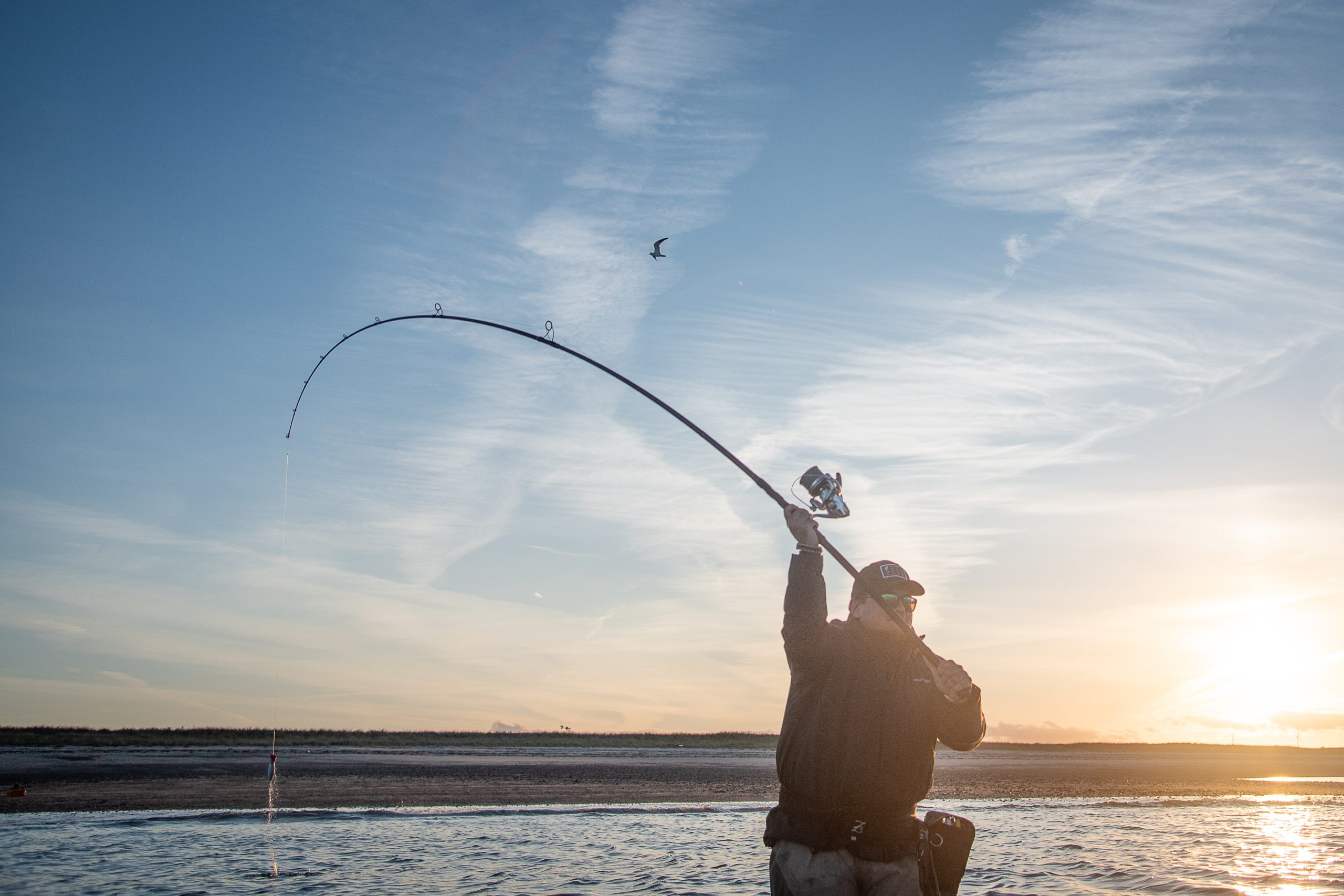
In 2018, I broke my favorite surf fishing rod, a Lamiglas Infinity Surf, and have spent the intervening years looking for its replacement. It’s been a Goldilocks-like journey as I tried out rods that were too fast, and rods that were too slow. I tried rods that could withstand a nuclear blast, but couldn’t bring a bucktail to life, and rods that performed beautifully, but didn’t survive a full season. Without a favorite rod these last few years, I’ve felt adrift.
While boat fishermen rotate through several rods over the course of a trip, a surfcaster brings only one, and it only leaves his hands to be briefly, and gently, propped against a rock or leaned on the twisted wire between the wooden slats of a sand fence. As a season wears on, a surf rod begins to feel like an extension of one’s body—the relationship being similar to that of a baseball player and a perfectly broken-in mitt.
This feeling isn’t exclusive to custom-built rods, though it’s certainly heightened when the rod was built to your own specifications. I stopped making and buying custom rods in 2019 after my last one, painstakingly built, shattered when another angler’s errant cast sent a needlefish through the blank with the exit velocity of a Kyle Schwarber long ball. Even off-the-shelf surf rods begin to fit their angler over time. I have a factory model Lamiglas Surf Pro that has a groove in the cork tape right where my thumb sits during the retrieve. There’s a spiral of electrical tape right where I grab the blank when using the rod to help my balance, and I know exactly how the rod is going to respond when attached to a large striped bass.
Seven years since its last, last cast, I struggle to remember exactly what made that Lamiglas Infinity my favorite. I began fishing it because my primary rod at the time was too light and too slow to cast larger lures far enough to reach a distant rip on a beach I’d just begun exploring. The Infinity was a little faster, but still soft enough to flick bucktails just right and cushion the heavy headshakes of large striped bass without pulling the hooks. I admit, seeing it through nostalgia’s lens has made the rod better than it probably was. I had my very best seasons in the surf with that Infinity in hand, so, when a new rod falls short, it may be the feeling of those golden years that’s missing rather than any shortcoming of the rod itself.
The Thousand-Dollar Surf Rod
The description of the Century Surf Machine Elite (prices starting at just under $1,300) says it “handles like the supercar of fishing rods”—a reference lost on someone whose vehicle is closer to a superfund site than a supercar. It then delves into the technical jargon of why the rod is so swell, from its hardened cilia resins to its total torsional stability. Was it the autoclave processing and graphene fibers that stoked my desire to own the Surf Machine Elite? Not exactly. I wiggled it at a winter show, thought it felt nice, and when I asked around about its action while fighting fish and, most importantly, its durability in the hands of a clumsy and careless angler, I liked what I heard. So, as a 40th birthday gift to myself, I got one.
After a season of use, I can say the Surf Machine Elite is a beautiful rod. I’ve been surprised by its versatility—I’ve used it on sand beaches, rocky boulderfields, and in the Cape Cod Canal. It casts my cherished 1.5-ounce bucktails well, and I can fully cast a 5-ounce metal lip or glidebait without having to lob it and hope for the best. It’s light and lively in hand, and I feel it adds actions to a variety of lures with ease, whether it’s the subtle twitch of a jig or the chaotic whipping of a pencil popper. It’ll take more than a season to test the durability claims, and as for how it handles very big fish…it’s going to take more than a season to figure that out too. The rod still looks new after 7 months of steady use, and the EVA non-slip shrink wrap grip appears impervious to grooving and molding.
The model I used—the 11’3” 1- to 6-ounce up to 50 pound—could buy two of what I would consider high-end surf rods with enough leftover for some of those expensive custom glidebaits. But was the rod twice as good as than a St. Croix Legend Surf or a Lamiglas GSB? That would be impossible to say, but it did make me wonder, what are we paying for, when we pay more for a surf rod?
The Cost of Technology
Over the last quarter-century, the technology that makes rods lighter, more sensitive, and more responsive has trickled down to “entry level” surf rods, so that fishermen today have no trouble finding a rod that effectively brings plugs and jigs to life for less than $150. The primary difference between a rod at that price, and a rod several times more expensive comes down to the quality of the blank and the components.
St. Croix Rods offer a range of surf rods from the sub-$200 Triumph to the $600-plus Legend. The difference between these rods is primarily in the components. The Legend uses St. Croix’s more advanced graphite, the high modulus SCIV, and advanced resin systems, making a rod that’s lightweight with an action as crisp as a fresh-picked apple. The Triumph’s blank, using the older SCII graphite, is heavier and slower by comparison.
Heavier and slower isn’t necessarily a bad thing, if it also comes with durability. Years ago, OTW Editor in Chief Kevin Blinkoff once broke a (since-discontinued) lightweight, high-end model from Lamiglas in only its second trip. When he contacted the company, they informed him that the rod was meant for open sand beaches, not the rugged boulderfield fishing he’d been doing. “You were essentially taking a sports car off-roading,” reprimanded the company rep. “You need a rod that’s more like a jeep.”
Besides the blank composition, components like guides, reel seats, and grips account for differences in surf rod prices. The Legend carries a suite of titanium-framed Fuji guides that are more resistant to corrosion and damage, along with a premium, double-locking reel season. The Triumph’s components are capable, but more basic. Yet, the St. Croix Legend model closest in specifications to my Surf Machine Elite—the 10’6” medium-heavy rated for 2- to 6-ounce lures—costs $595, less than half the price of the 11’3” Surf Machine Elite.
Rob Crossley, a rep for Century Rods, dumbed down for me some of the technology that anglers are paying for, how it makes the rods more “efficient” in the transfer of energy during the cast, and how it makes them more durable. The “autoclave processing” uses heat and pressure to bond the resin to the carbon fibers, squeezing out air bubbles and excess resin, resulting in a lighter rod with no weak spots. That resin has been fortified by graphene, a one-atom-thick form of carbon said to be “stronger than steel,” improving a rod’s strength without adding weight. Making the rod is more labor intensive, as upgrades like the winding patterns and reinforcing layers require tighter tolerances. It is essentially Century’s surf rod “halo product,” an example of the very best the company is capable of.
I’m glad I didn’t know all of that when I bought the rod, because I might have felt unworthy. I’d have stuck to my jeeps and jalopies, and left the supercars to the more elite anglers. Still, as far as mid-life-crisis purchases go, it’s a bargain compared to a convertible.
Surf rods become cherished because of how they are used, not what they are made of; something I may have lost sight of in my seven-year-long search. Whatever surf rod you’re swinging these days, make sure to take it out often, fish it hard, and store it safely until the stripers come back.