

Little did I know that the rulers of striped bass surf fishing, known for driving over and along the sandy beaches of Cape Cod, lived just a mile from my house. The Woolner brothers, from Shrewsbury, Massachusetts, are my hometown heroes. It all started 80 miles down route 140, back in the late 1940’s.
Sons of Martha M. Matthews and Frederick L. Woolner, the Woolner Brothers were Ted (Frederick), Frank (Francis), Jack (Ralph) and Dick (Richard). All of them are now gone, however I did have the great pleasure to sit down with Jack a few years back and talk with him about his brothers and the special impact his family had on fishing and hunting in Massachusetts.

Frank may have been the most famous of all the brothers. Serving in the war from 1942-1944 as a war correspondent, he returned to the states in the fall of 1945 after completing “Spearhead in the West,” a military classic. He returned to Shrewsbury, Massachusetts after the war and eventually became a nationally recognized expert on saltwater and freshwater sport fishing. He was also an authority on hunting, natural history, and conservation in New England. He was a newspaper columnist for the Worcester Telegram, the editor of Salt Water Sportsman magazine of Boston for over 20 years, and he wrote or co-wrote seven books on fishing and hunting. He also co-hosted a weekly TV show in the Boston area for a number of years with his brother Jack called “Woolner Brothers Outdoors.”


Jack also went overseas during the war, serving with the 9th Air Force, 10th Photo Reconnaissance Group in England, France, and Germany. He retired as Public Information Officer with the Law Enforcement division of the Massachusetts Department of Environmental Management in 1982. Jack worked for many years with the Mass. Division of Fisheries and Game as the state’s wildlife photographer at the Division of Fisheries and Game, and developed the state Sport Fishing Awards Program.
Jack and Frank initiated and publicized research identifying the safety value of the florescent color “hunter orange” carried out at Fort Devens, Massachusetts in 1959. Many hunters’ lives have been safer thanks to their efforts. This color is now used internationally to prevent hunting accidents and for other safety purposes.
Jack Woolner produced and appeared on several TV programs covering the New England environment and outdoor activities broadcasted on Boston stations and elsewhere in the state from the 1950’s through the 1970’s. The local Woolner Brothers Outdoors show and the more famous weekly telecast aired for 13 years on the WHDH-TV Dateline Boston series and received awards for the best conservation program on air.

During wartime, fishermen could not fish beaches other than the Cape Cod Canal. They had to have a permit issued from the war department for local fishermen. The Cape Cod Canal is where the eel skin jig was made famous. If you have ever fished the Canal, you know that the current rips from east to west and then back, with fishermen lined up on both sides. To interest the stripers that are heading north for the summer months and then returning south for the fall migration, you need something with the weight to get down and swim in the current. The eel skin jig has a lead head and an eel skin body that fills with water. It’s a classic killer lure for Canal fishermen.
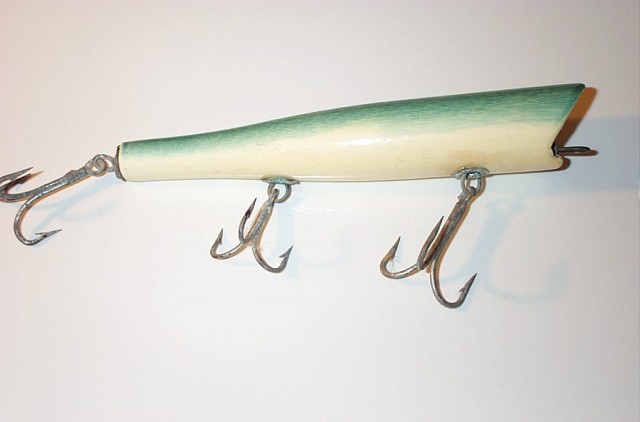
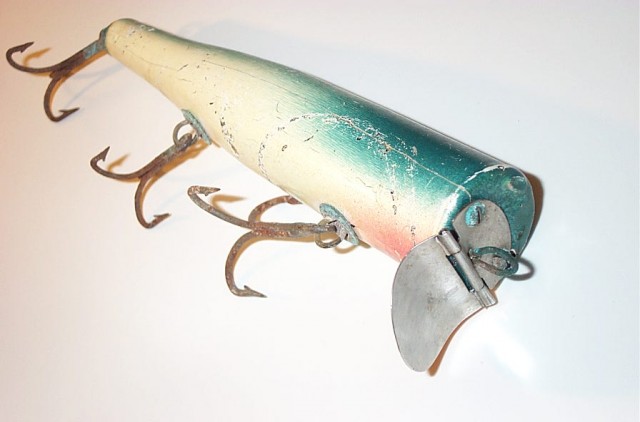
They also produced two wooden lures, the first called the Pogie Popper. This came in several colors and is the more commonly found Woolner plug. The second lure is a special hinged Front-Lip Swimmer. When cast, the front lip would flip up for less wind resistance so fishermen could cast farther out to catch the big ones!
Anyone interested in contacting Peter O’Neill can do so by e-mail:
Historian and Preserver of Vintage Striped Bass Memorabilia
Nice article!
Frank could bring the taste of the salt into an article. and the smell of watermelon permeated the air when he spoke or wrote of surfishing.
I loved reading anything that Frank Woolner wrote. We would go to Nantucket every year for Blues and Strippers and would always talk about Woolner and some of his great articles. His advise and observations were always spot on.
Does anyone know whatever happened to Frank Woolner’s renowned “Woolnerized” Winchester model 59 shotgun ?
Yes, the son of one of Frank’s hunting partners acquired it and it is still shooting quick and straight in central MA woodcock and grouse bird covers.
RE Frank Woolner’s ‘Woolnerized’ Winchester Model 59 shotgun.
I’d love to see that gun, or at least get some clear pictures of it.
I’ve ‘Woolnerized’ two Model 59’s, and would be interested to see how close I replicated Frank’s master piece.
(978) 509-2800
Dean Clark,
Could you please contact me, I’d like to discuss Frank Woolner’s customized Winchester model 59.
Bill Kossowan
(978) 509-2800
I own a pair of remmington 308 carbines that belonged to Jack and his wife. His is the one in the Outdoor Life picture from the 60s where he posed with a nice buck. The photographer had black and white film so the magazine silk screened the Saftey Orange onto the photo. He signed a copy of the photo for me along with some other great memorabilia. Really great guy.
Does anyone know of any archive for the Woolners various outdoors shows?
As a small child my siblings and I were featured in early 70’s on an episode and would like to see if I can access ? Or who I might be able to reach out too.
Thank you
I was his neighbor
I could tell you some stories ,, he was a hero to me
Mike,
We’d love to hear them. Drop me an email at jimmy@onthewater.com when you get a chance.
– Jimmy
I recently came across hundreds of original prints done in the family home basement dark room of different fishing trips and wildlife. I was curious if anyone would be interested in purchasing some of them? Send me a message if so. tdeblois@yahoo.com
Thanks,
Tasha
Frank Woolner was my hero.
I’m still hot on the trail of his Woolnerized Winchester model 59 (actually I thi k there were two).
I would love to see them.