

Imagine a time machine that could take you back to the New England coast of two centuries ago. A time long before private property ate up nearly every piece of coastline, when overfishing was not yet a concern, when fish-finding technology simply did not exist – if for no other reason than because it was not needed.
Schools of large codfish and pollock would join masses of trophy stripers in a collective assault on mackerel or herring along a rocky shoreline. Atlantic salmon and sturgeon could be seen jumping in estuaries. And a bit farther offshore, a giant and powerful fish that New England anglers rarely encounter today was abundant to the point of annoyance.
Indeed, one of the most tragic stories of overfishing is the plight of the Atlantic halibut, Hippoglossus hippoglossus, the world’s largest flatfish. These days, the Atlantic halibut has attained an almost mythical status due to its extreme scarcity in our waters. But during the first half of the nineteenth century, the halibut fishery was of tremendous importance to commercial fishermen from northern Maine to Montauk, New York.
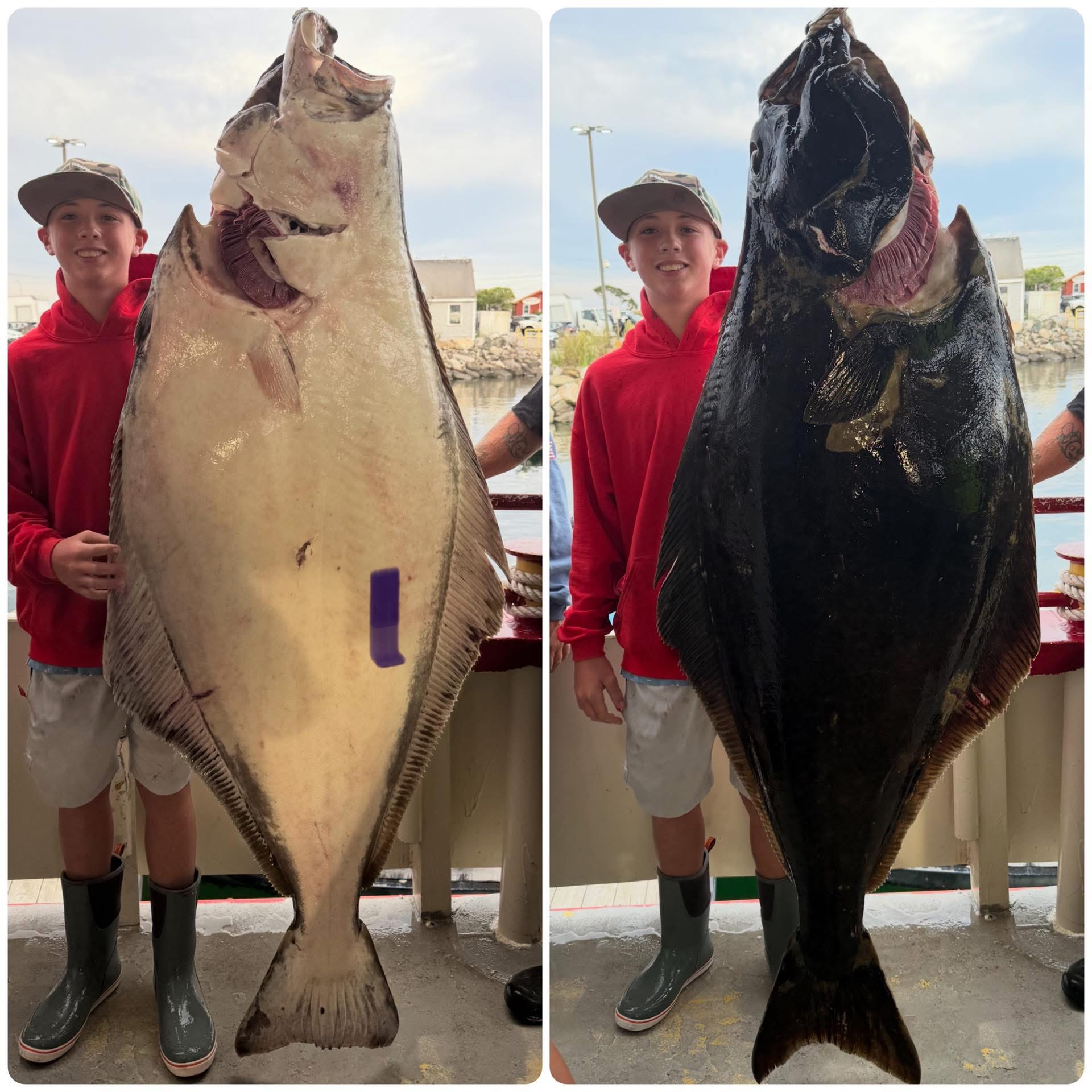
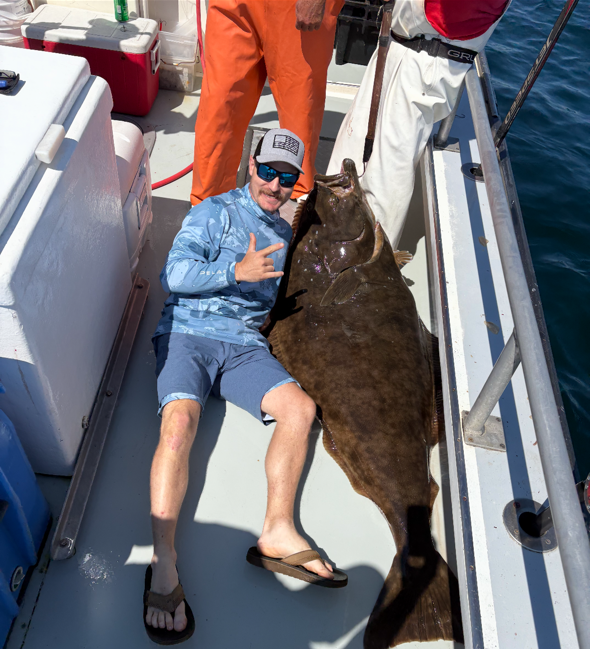
It is strange to think that a fish so plentiful in our waters some 150 years ago is now virtually absent. Only a handful of times each year does one hear of a surprised and lucky offshore cod fisherman bringing a halibut to the surface, and rarer still is one caught that exceeds the federal size limit of 41 inches.

The Atlantic halibut is similar in most ways to its Pacific counterpart, except that it grows slightly larger – there are confirmed reports of individual specimens weighing in excess of 600 pounds. They are long-lived fish, with an estimated maximum lifespan of 50 years. Like Pacific halibut and their smaller cousin, the fluke, Atlantic halibut are voracious feeders that will consume most every living thing that they can fit into their large, toothy mouths. According to Bigelow and Schroeder’s Fishes of the Gulf of Maine, their principal diet consists of flounder, cod and other benthic fishes, as well as schooling baitfish like herring, sand eels, and mackerel. There have also been reports of such oddities as seabirds found in their stomachs! Imagine a more streamlined, athletic version of a fluke that can grow to more than a quarter of a ton and has been known to surface feed in large schools.
Our story begins in the early nineteenth century, when fishermen began to target halibut as a commercially viable resource. Most of these early accounts are detailed in The Fisheries and Fishery Industries of the United States, published in 1884 by the famed ichthyologist George Brown Goode. This six-volume comprehensive treatise expounds just about every aspect of every known commercial fishing activity that took place in the country at the time, and it devotes more than 120 pages to the Atlantic halibut fishery alone.
At the beginning of the 1800’s, halibut were exceedingly abundant in Massachusetts Bay and were commonly caught inshore in less than 60 feet of water. A demand for halibut had yet not developed in the Boston market at this time nor were they considered to be good table fare, so commercial cod fishermen regarded them as a nuisance. Goode remarks that halibut “were considered by the fishermen to be troublesome pests, as are dogfish at the present time [1884].” Any cod fisherman today who ventures into the Gulf of Maine and tries to drop a gob of clam to the bottom can surely appreciate this remark! Around 1820, a demand for halibut sprang up in Boston, and many small-boat fishermen from Gloucester diverted their attention from codfish to halibut.
These fishermen enjoyed remarkable success, and Goode reports that halibut were abundant in the Gulf of Maine as late as 1837. That year, one boat caught 15,000 pounds using handlines on a two-day trip, and another vessel with four fishermen caught 400 halibut, also in just two days.
Catches in the Gulf of Maine started dwindling around 1830, leading more and more boats to venture to Georges Bank, over 100 miles east of Cape Cod. During the halibut season, it is noted, codfish were a rare catch due to the aggressiveness of the halibut. Most of the fishing was done in 20 to 50 fathoms of water, with fish moving into shallower areas as water temperatures rose during the summer.
George’s Bank and the Golden Age of Halibut Fishing
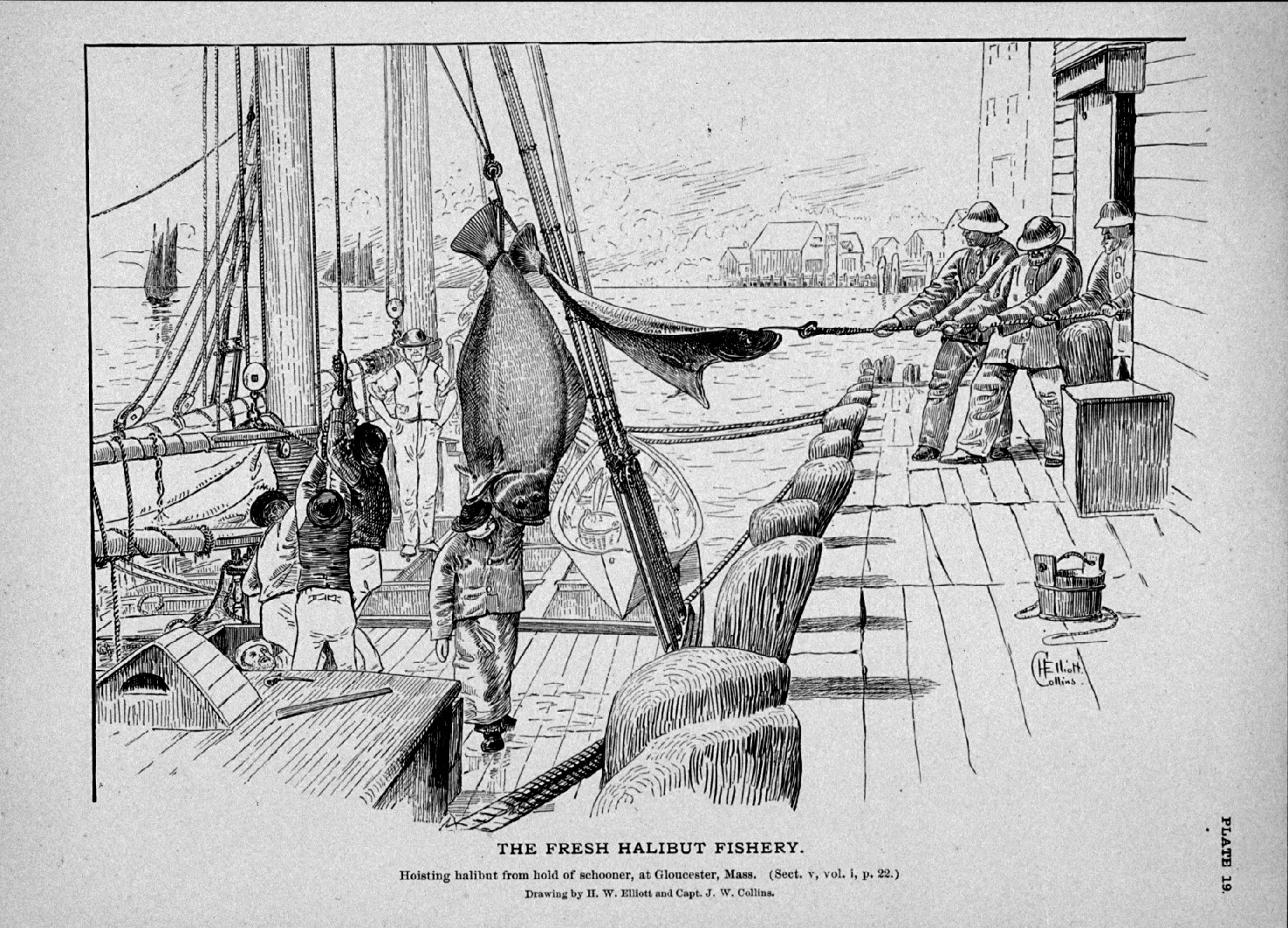
Reports abound of the spectacular halibut fishing that occurred on Georges Bank in the 1830’s and 1840’s. That was the golden age of Atlantic halibut fishing, when the rule during the season (spanning roughly from February to June) was 15,000 pounds per day, each fish averaging 80 pounds. Goode notes that halibut were often so numerous that they would follow their hooked companions to the surface, where they could easily be gaffed! Furthermore, it was not uncommon to see them harassing bait on the surface. Goode relates the account of one halibut captain, Captain Marr: “He has seen ‘a solid school of them as thick as a school of porpoises’ feeding on ‘lant’ [sand eels/sand lance]. At another time ‘the whole surface of the water as far as you could see was alive with halibut; we fished all night and we did not catch a single codfish. The halibut would not let the hooks touch the bottom; we caught 250 in three hours.’”
Fishermen from Gloucester, Massachusetts, as well as from New London, Connecticut, Downeast Maine and eastern Long Island, New York, partook in the action. The New London fleet often brought halibut back to shore alive using “well-smacks,” a boat with a sort of livewell located amidships, while the other fleets normally bled and iced them on the boat prior to bringing them to market.
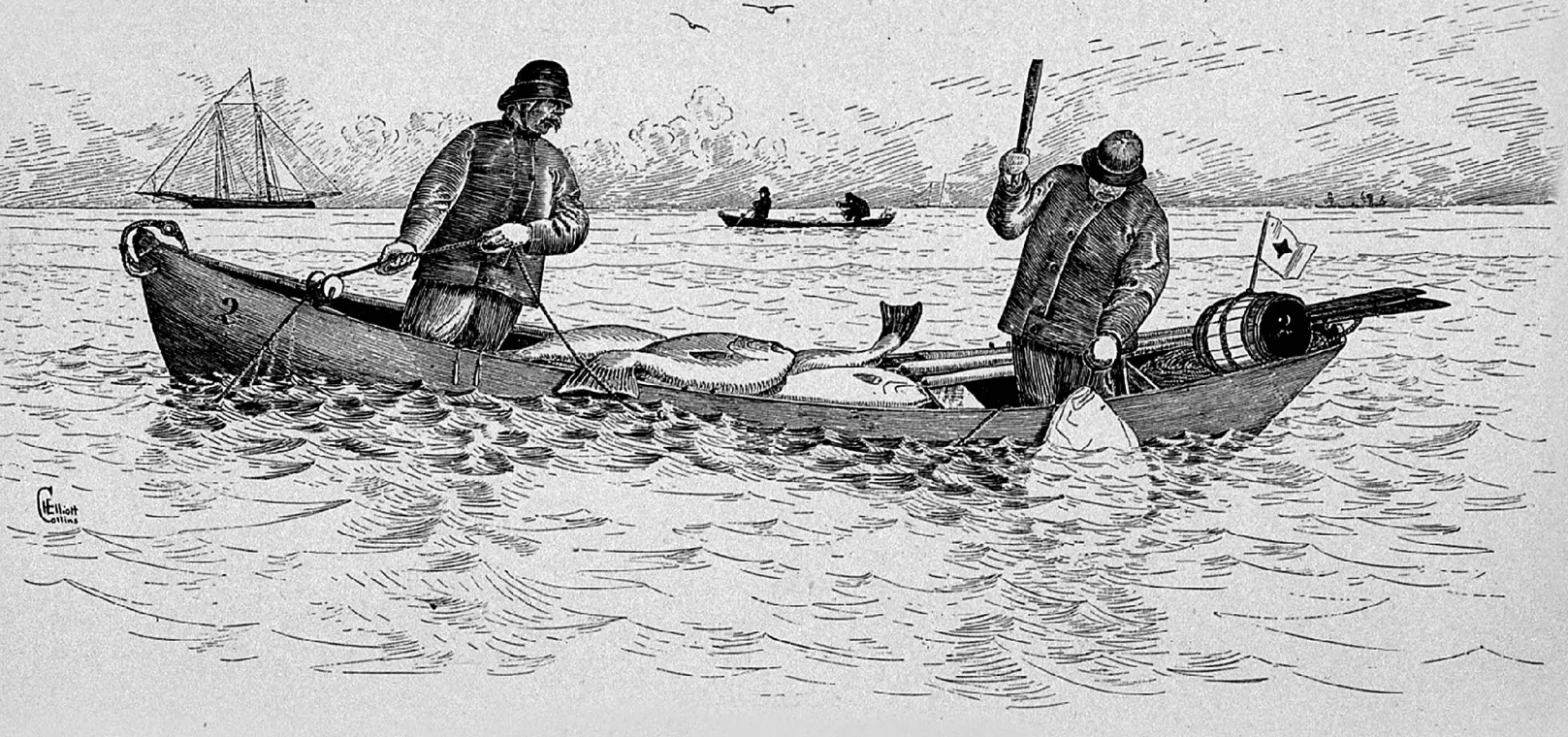
Most of this early fishing, both in Massachusetts Bay and on Georges Bank, was done with handlines. A schooner holding four to six dories would travel to the fishing grounds, where the dories would be launched and used as fishing platforms, with two fishermen in each dory. The favorite bait was a 6- to 8-inch strip of fresh haddock, which was often combined with a whole herring, much like today’s fluke fishermen use a squid and spearing combination. Fisherman also believed that halibut slime could spike the bait’s attractiveness, so they often rubbed their bait across the back of a previously caught fish. Other popular baits included whole menhaden, herring and mackerel.
Successfully landing one of these great fish using nothing more than a handline required great skill on the part of the angler, as Goode describes:
“It may, perhaps, come up easily for 10 or 15 fathoms, when it suddenly takes a plunge downward. Surge! surge! goes the line through the hands of the fisherman, who knows very well that he must ‘play’ his fish or else his line will be snapped like pack thread. This operation may be repeated several times, and it is not uncommon for a large and particularly ‘wild’ halibut to go almost to the bottom after having been hauled nearly to the surface of the water.”
When brought to the surface, halibut were gaffed with a hand gaff, clubbed into submission, and tossed into the dory white-side up to prevent discoloring of the belly. When the dory returned to the schooner, the fish were bled and iced.

Georges Bank halibut fishermen enjoyed plentiful action through the 1840’s, and 65 vessels were operating out of Gloucester by 1848. However, rampant, unregulated overfishing caused the Georges Bank fishery to largely disappear by 1850. This was primarily due to the advent of short longlines, called trawls, which replaced handlines as the method of choice among most halibut fisherman in 1843. Goode notes that although halibut were plentiful both on Georges Bank and in Massachusetts Bay in the early 1800’s, by the time his book was published (1884), halibut were “so scarce on the New England coast, more particularly in Massachusetts Bay, that the capture of one or two has been considered a sufficient novelty for the fact to be chronicled in the newspapers.” Thus, in a span of about 50 years, the halibut in the Gulf of Maine and Georges Bank had been almost completely fished out.
A Change in Tactics and a Search for More Fishing Grounds
As a result of the floundering halibut fishery on Georges Bank, commercial halibut fishermen were compelled to search elsewhere. Some returned to Massachusetts Bay in the early 1840’s, having discovered grounds in the gully between Race Point and Stellwagen Bank that held many large fish of 100 to 200 pounds. Goode describes one catch made in this region by Captain N.E. Atwood in 1840: “Altogether, in an hour [using handlines] they took 13 halibut and … went to Boston, where they found they had 2,403 pounds of the largest ever seen.” That means that each fish averaged roughly 160 pounds!
But that area was soon fished out as well, and by 1850 enterprising anglers had set their sights on northward destinations that included Browns Bank, Seal Island Ground, and the Grand Banks off of Nova Scotia’s coast, approximately 800 miles northeast of Gloucester. Trawls, which had become popular during the 1840’s, were the method of choice in these more northern locations during the 1850’s and 1860’s. The trawl lines were typically composed of six “groundlines” of 50 fathoms each, constituting a total length of 300 fathoms, or 1800 feet. Hooks were attached to 5-foot “gangings,” or leaders, which were attached to the groundline at intervals of 15 to 25 feet.
Much of this fishing was done in deeper water, from 40 to as many as 300 fathoms on the Grand Banks. There is even one account of a schooner catching many halibut in 600 to 700 fathoms on the western slope of the Grand Banks in 1878.
The trawl, when set, fished anywhere from 2 to 18 hours and was then hauled in with a “hurdy-gurdy,” or hand crank. Of course, hauling in a line with several halibut attached to its hooks proved to be a great challenge, and dories were often spun in circles when the fish struggled to escape. Fish in shallower water often gave a much better account of themselves than those from the deep, perhaps because of the pressure change associated with coming up from extreme depths.
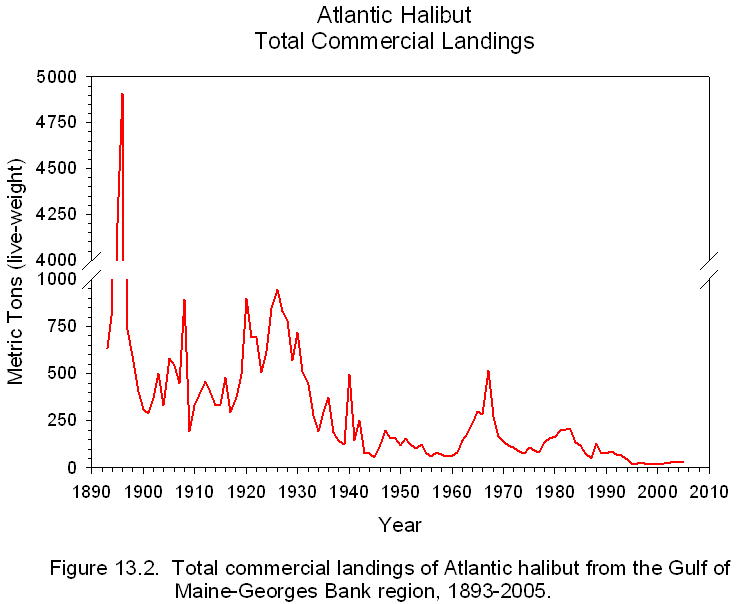
By the 1860’s, virtually all commercial halibut fishing was being conducted on the Grand Banks and Scotian Shelf, as the Gulf of Maine fisheries had been fished to commercial extinction. Fisherman continued to plow north, to the Gulf of St. Lawrence and the Greenland banks, where they continued to catch halibut in good numbers. Goode reports that 40 vessels were still operating out of Gloucester in 1879, and the New England halibut fleet caught a total of about 6650 metric tons that year. But even as the boats moved farther north, catches continued to decline rapidly, and Goode notes that at the time of his book’s printing (1885), total halibut catches were estimated to be less than 2300 metric tons.

One of the captains Goode interviewed, J.W. Collins, made the following prophetic remark, even after a good portion of the halibut stocks had been depleted: “It is my opinion that halibut are being reduced in numbers very fast, and if the present style of fishing is pursued will in a few years become extremely scarce, if not almost extinct.”
Halibut catches continued to decrease over the first half of the twentieth century. Some decent catches were still occasionally made in the deep water on the southeast edge of Georges Bank and in Canadian waters, but overall the fishery had collapsed by 1950. Incredibly, the Atlantic halibut fishery was wiped out almost exclusively by hook-and-line fishing, although some otter trawl (dragged net) was used during the middle of the 20th century.
What’s Stopping a Halibut Comeback?
Why were halibut stocks, relatively speaking, demolished off New England so quickly, while other heavily pressured species, such as cod, have held out? Laurel Col, a NOAA/National Marine Fisheries Service (NMFS) biologist at the Northeast Fisheries Science Center (NEFSC) in Woods Hole, Massachusetts, offers some insight.
Col, a member of the Northern Demersal Working Group, which studies the status of groundfish in our area, believes that the quick demise of the halibut fishery was partly a result of their biology. “Halibut don’t become sexually mature until they are between 5 and 15 years old,” she explained. “As a result, they are probably overfished in their recruitment stages [prior to sexual maturity].” In contrast, other groundfish, like cod and haddock, reach sexual maturity in just 2 to 3 years. Furthermore, catches during the heyday of the halibut fishery were market-driven, and there were no regulations in place. “Markets supported recruitment overfishing, since halibut become large enough to fillet well before they are mature,” she remarked, noting that halibut between five and ten years of age often weigh between 40 and 80 pounds.
And so it happened that one of the largest bony fish on the planet just about completely disappeared from New England waters.
READ MORE

Great article. I believe it’s 41″ minimum size though:
https://www.fisheries.noaa.gov/new-england-mid-atlantic/recreational-fishing/recreational-fishing-regulations-species#halibut