
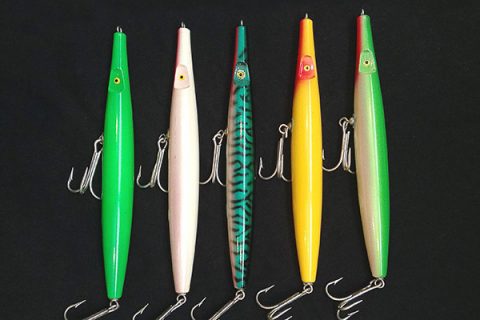
The story of the giant needlefish and the giant stripers that ate it.
In the surf, the giant needlefish could be one of the top striped bass lures of the last 28 years. In that span of time, generations of surfcasters have used it to catch huge striped bass in spots like Block Island, Montauk, Cuttyhunk, and Beavertail. In recent years, surfcasters have rediscovered the effectiveness of these lures, and seeing that brings back memories of 28 years ago when this oversized plug was first conceived.

I was lucky enough to be there to see it. It started on a visit to my friend Steve Campo’s house in Bayside Queens, New York, on a winter night in the mid-1980s. Steve told me he had an idea about having a new extra-large needlefish made for him to use at Block Island. Steve’s new needlefish would be 8 to 9 inches long and weigh 3 to 3½ ounces. It would be made of wood with a heavy swivel and heavy through-wire and rigged with two 5/0 treble hooks. This beefed-up plug would stand up to the huge striped bass of Block Island and, with its heavier weight, would cast better into the Island’s ever-present winds. Steve believed the large silhouette and profile of his new needlefish would pick the super cows from the schools of striped bass, allowing him to catch more fish over 40 pounds.
At that time, Steve had been having tremendous success fishing standard needlefish plugs on Block Island, yet he felt the need to create a new oversized one. Steve was always searching for the next new and hot striped bass lure. He wanted Don Musso to make the original giant needlefish, but Musso said he was too busy. Steve searched everywhere for someone to make his oversized needlefish, but no one would. One of Steve’s good friends, Jim Keller, saw Steve struggling to get his needlefish made, and offered to help. Keller worked at Grumman Aerospace on Long Island and said he could get a small batch of giant needlefish made by a friend. Steve gave Keller the dimensions and weight he wanted, which was basically a much larger version of the standard Don Musso needlefish.

Two months later, the first giant needlefish was made by a Grumman Aerospace craftsman named George Mericke, who had very little experience making plugs. When Steve saw and handled it, he nicknamed it after adult-film actor, Johnny Wadd. When Steve showed his crew of fishing friends the plug, everyone laughed because it looked so weird and stupid. Nobody believed the lure would catch, except for Steve.
The next fall, Steve and his crew were on Block Island, and the fishing was good. The standard needles were the top fish-catchers. We would ask Steve once in a while how his Johnny Wadd was doing and laugh—we had a lot of fun teasing him about it. Everyone then seemed to forget about the Wadd for a while. The fishing was still quite good with the standard lures, but after a few weeks, the fishing slowed. Block Island had shut off, and no one was catching anything.

One night on Southwest Point, Steve brought out the Johnny Wadd to try something different. He walked into a lineup of surfcasters, armed with his funny-looking needlefish, and was instantly into a giant striped bass. Steve passed me in the lineup as he fought the fish, and said, “It’s on the Wadd.” I was in shock at first, and then thought it was merely a lucky fish that Steve had gotten to hit his plug. I was very wrong.
Wherever Steve cast that Johnny Wadd, he was into a big striped bass. The cow striped bass of Block Island had stopped hitting the standard needlefish plugs and would only hit the large-profile Johnny Wadd. Steve caught a 50-pounder and so many 40-pounders that it was incredible. He had his own personal blitz going on while all the other surfcasters on Block Island caught nothing. The big striped bass that surrounded the Island were seeing the oversized Johnny Wadd for the first time. The large profile that Steve had described to me on that visit to his house did pick the giant striped bass from the schools.

The following year Steve was able to get Don Musso to make 120 of the Johnny Wadd needlefish, which then became known as the Donny Wadd. Steve purchased every one of them from Don. The fishing tackle stores and other surf fishermen never got a chance to buy one of the original Donny Wadd plugs, and Musso would never make another order of them again.
Steve evenly divided those Donny Wadds among his fishing crew. He was very generous to his crew with new plugs and fishing information because he loved to see his surf partners do well. That fall, Steve and his crew caught a whole lot of big striped bass on Block Island on the Donny Wadd.
I remember fishing with the crew on Grove Point during the last three hours of the outgoing tide with a 15- to 25-mile-per-hour northeast wind blowing. We were casting mackerel-colored Donny Wadds into that howling wind and crushing 40-pound-plus striped bass. The Donny Wadd worked to perfection and became one of our favorite lures—there were no more jokes or bad things said about it. However, even with its tremendous success, Steve was never content with it. He started to develop an oversized standard Stan Gibbs Needlefish that would have a different profile than the Donny Wadd. The following year, Steve had Stan Gibbs Lures make the first Gibbs Wadd, which became a success too.
As a surfcaster, Steve had a deep understanding of profile, color, depth, weight of his surf-fishing lures. He understood what striped bass saw in the water and what they wanted. With that insight, along with the help of Jimmy Keller and George Mericke, one of the best big bass lures was introduced to surfcasters throughout the Northeast.
Wow that’s a really interesting take on things .do you recon they work in uk for big European bass
NO BECAUSE THEY NEED A VISA TO BITE.
OR AMERICAN EXPRESS HAHAHAHA
😛
Great article!!!! Are the “Donny Wadd’s” wood or plastic?
The originals are wood. The Super Strike Super “N” fish are plastic.