
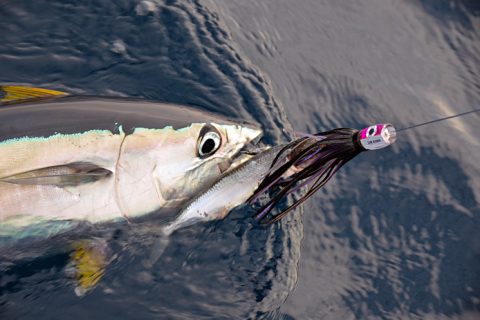
The ballyhoo is a surface-dwelling baitfish that belongs to the Hemiramphidae or halfbeak family. While ballyhoo themselves are not present here in northern waters, there are several closely related species present in the Northeast, including the balao halfbeak and the Atlantic saury.
The ballyhoo we use for bait are caught in Florida, brined, flash-frozen and vacuum-sealed before being shipped out around the world. Ballyhoo come in four different sizes called, from largest to smallest, horse, select, medium and small. They can be bought at most tackle shops that stock big-game tackle, or you can order them from companies such as Next Day Bait (www.nextdaybait.com), which will ship cases of bait right to your doorstep.
Tuna, billfish and other pelagic species love to forage on these slender baitfish, and therefore ballyhoo make an excellent rigged trolling bait. Here are several ways to rig them up.
Pin Rig
The pin rig is a simple way to rig a ‘hoo, particularly if you are just beginning to fish with them, or when fishing with skirts over your baits. To construct this rig, you will need 10 feet of 200-pound-test fluorocarbon, a ½-ounce egg sinker, rigging wire, size G crimps, a chafe tube, a 1½-inch section of size 10 single-strand wire, and a 10/0 7691S Mustad hook.
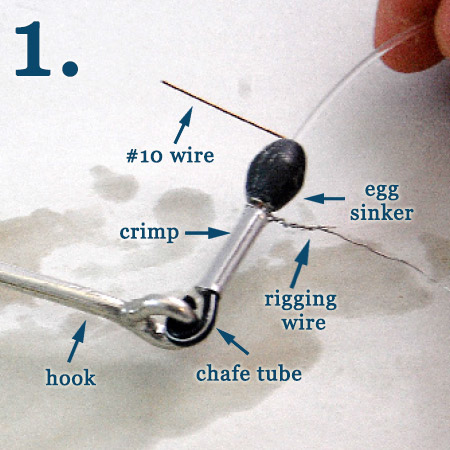
1. Begin construction by sliding the egg sinker onto the leader. Next, place a crimp on the line followed by a section of chafe tube. Run the leader through the eye of the hook and back through the crimp. Cinch the crimp down to the hook eye. Prior to crimping, place the section of size-10 wire in to the crimp. After crimping, bend the wire up at a 90-degree angle. Trim the wire so that there is about a half-inch protruding upward. Lastly, attach the rigging wire to the rig between the crimp and the egg sinker.

2. Now line up the rig next to the bait to eyeball the positioning of the egg sinker and where you want the pin to enter and exit the bait. Using the point of the hook, mark the spot where you want to the hook to exit the bait. Slide the entire hook into the body of the bait beneath the gills, exiting where you made you mark.

3. Next position the weight so that it fits between the gills. Next, push the pin up through both the bottom and top jaw.

4. Now we need to close the gills. First, run the rigging wire through the eye socket twice behind the weight.
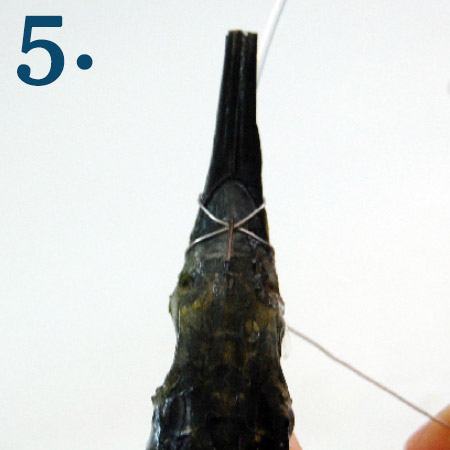
5. Now run the wire in front of the weight and across the nose behind the pin, and then go back across the nose and in front of the weight again. This will create an X on the nose and cinch the front of the weight tight to the bait’s chin.

6. Finish by wrapping the wire down the bill, all the while securing the leader underneath.
Pinless Ballyhoo Rig
The pinless rig is exactly what it sounds like – a ballyhoo rig without the size-10 wire pin. This rig is used for rigging naked ballyhoo split-bill style. The split-billed method is an effective way to make a naked ballyhoo swim like Michael Phelps. This rig is commonly used by those chasing bluefin tuna.
The rig is constructed in the same fashion as the pin rig, except for the size-10 wire. In this case, the rigging wire assumes the role of the “pin.” Once the rigging wire is attached, slide it through the egg sinker and bend it up 90 degrees.

1. Line up the rig next to the bait to eyeball the positioning of the egg sinker and where you want the pin to enter and exit the bait. Using the point of the hook, mark the spot where you want to the hook to exit the bait. Slide the entire hook into the body of the bait beneath the gills, exiting where you made you mark.

2. Now, take the rigging wire and run it through the bottom jaw and out the top jaw.

3. Following this, run the wire back toward the eye socket and go through the eye socket twice. This will shut the gills and secure the weight.

4. Next, run your wire over the top jaw, going around the front of the weight and down the bill.

5. After two wraps down the bill, use a small knife to split the bill and run your leader through the slot you’ve created.
Finish by wrapping the rigging wire in front of the leader toward the front of the bill. Trim off the excess bill when done.
Circle Hook Ballyhoo Rig
I learned about rigging ballyhoo with a circle hook while fishing in Isla Mujeres, Mexico aboard the Magic Lady out of Quincy. It is a simple method that allows for quick changing of baits, extended running time before washing out and a reduced number of deep-hooked fish. If you are fishing in tournaments where billfish are a qualifying species, then under NMFS regulations, all of your natural baits must be rigged with circle hooks.
The materials needed for this rig are 10 feet of 130-pound-test Fluorocarbon leader, a 7/0 non-offset Eagle Claw circle hook, a size-10 barrel swivel, rigging wire and a ¼-ounce egg sinker. Crimp your leader to your hook. Using tight barrel wraps, attach the rigging wire to one eye of the swivel and slide the other eye of the swivel onto the hook. You should hear or feel a slight click when the eye pops over the barb of the hook.

1. Using tight barrel wraps, attach the rigging wire to one eye of the swivel and slide the other eye of the swivel onto the hook. You should hear or feel a slight click when the eye pops over the barb of the hook.

2. Begin by taking the rigging wire and insert it into the mouth and down through the soft tissue of the throat. Slide the egg sinker onto the wire.

3. Then, take the end of the wire and run through the eye socket twice, closing the gills and securing the rear of the weight. Next, run the wire again through the eye socket twice, only this time do so in front of the weight. The gills are now securely closed and the weight is firmly held in position.

4. You will now want to close the mouth and secure the swivel in place. Run your rigging wire through the bottom jaw and out the top of the nose. When doing so, run the wire through the eye of the swivel that is in the mouth.

5. Wrap twice around the nose and base of swivel and finish with wraps in front of the swivel. Trim excess bill.
These three methods of rigging ballyhoo will all work in any offshore scenario, but each also has a place in particular fisheries and for particular target species. The addition of a properly rigged ballyhoo to your spread will increase your catch numbers and give you added advantage over the fish.
Capt. John M. Galvin, Jr. is captain of Mulberry Canyon, a 42-foot Cabo located in Falmouth, MA.
The August 11, 2014 article titled “The Three Ballyhoo Rigs Every Offshore Fisherman Should Know” by Capt. John Galvin featured a picture of a small YFT with a lure/ballyhoo combination in its mouth. What lure was that??
Looks like a Munson Mahi by Beamish Tackle
It is easy and simple. Thank you for sharing
You forgot the donut aka o-ring rig which is easier and less finicky for your average angler than the swivel rig . No need to match the hooks to the swivel allows you to change your hook selection to multiple sizes without rerigging the ballyhoo with multiple sized swivels
Stainless pin shoved up in an aluminum sleeve…now there’s something everyone needs to learn about. Might also want to learn about the IGFA; NMFS has nothing to do with circle hooks and natural bait in tournaments. For anyone reading this who wants to know how to rig a ballyhoo, you’d be best off learning from someone down south. Those guys have been pulling ballyhoo for decades and their rigs don’t look anything like these!
You’re welcome,
Mike
Thanks for sharing on my first trip to the canyons for tuna on my boat
what type and size of hook do I need for the pin rig?