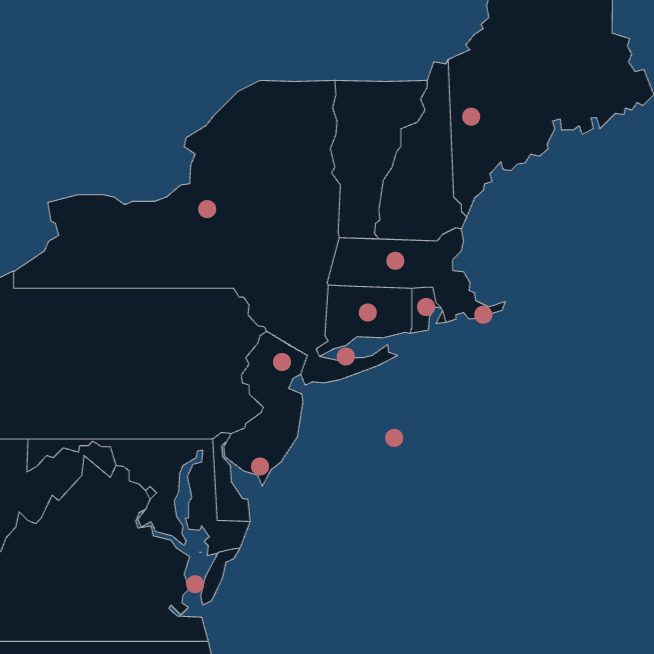

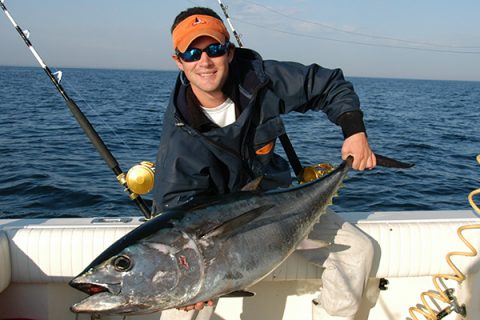
For years, my bluefin tuna fishing off South Jersey involved trolling small lures on light tackle for 12- to 30-pound football tuna. It was a blast, but every now and then a much larger fish would find one of the baits and promptly relieve a reel of its line. Once this started happening with greater frequency, I began to think that there must be a viable fishery for these larger bluefin. Boy was I right.

Last year was the best bluefin tuna fishing I have ever seen, with fish ranging from 60 to 120 pounds. Given the large numbers of good-sized bluefin, my friend, Captain Bob Cope, and I adjusted our tactics. As a result, multiple-fish days and worn-out anglers were the norm aboard the Free Spirit and the Full Ahead during the 2008 fishing season. Catching these fish wasn’t always as easy as dropping spreader bars behind the boat, however. Some days, the tuna wouldn’t respond to trolled baits, and we’d have to adjust our tactics. Being flexible in your approach is the key to making the most out of every trip you make to the tuna grounds.
The When and Where
Before you can decide how to target bluefin, you have to know when and where you’ll be making the trip. The season usually begins off South Jersey toward the end of June, typically around the third week of the month. In 2008, we took our first fish on June 25 and continued to catch fish right through the end of August.
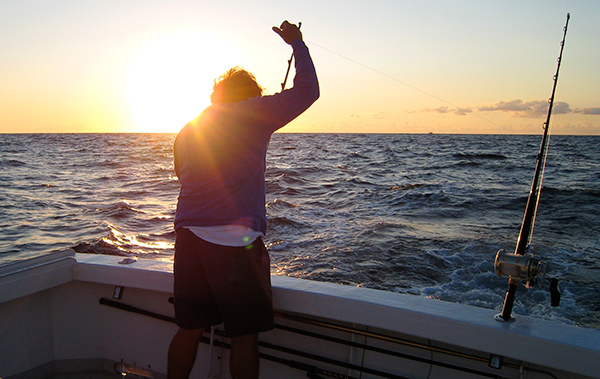
Usually, we leave the dock around 2:30 a.m., in order to have our lines in the water before sunrise. Quite often, the bite will get started before the sun has even cracked the horizon. On other days, however, the best fishing will take place closer to mid-day. By getting there early, you have all of your bases covered.

There are a number of good locations to look for bluefin off of South Jersey. Well-known inshore structures such as the 28 Mile Wreck, the Cigar, Jims Hole, 750 Squared and Lemkes Canyon produce fish year after year. Along the 30-fathom curve, fish will hold at the Lobster Claw, the India Arrow Wreck and the Elephant Trunk. Other honorable mentions include the 19-Fathom Lump, Masseys Canyon and the Hot Dog. Most of these areas can be easily located on NOAA charts, or fishermen’s charts by Captain Segull or Waterproof Charts.
Let Technology Work for You
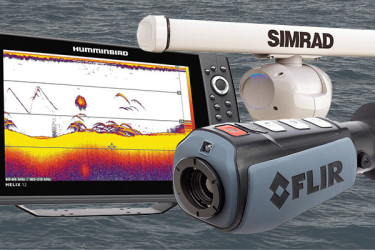
With so many likely areas to choose from, other elements must come into play to help an angler narrow down his options for targeting bluefin. The single most important factor is water temperature. The night before we are leaving, I go online to retreive a surface water temperature (SWT) reading to help me locate any temperature breaks. A difference of only a couple degrees is enough to hold fish. Of course, by the time I’m out there and ready to fish, the SWT information is already 10 to 12 hours old. Therefore, when I’m in the general vicinity of the temperature break, I’ll use my Sirius satellite weather display on my Raymarine unit. By early morning, I can often figure out what the water temperature is doing and be up to date. Last year, we ran into cloudy weather so often that we were unable to get good SWT information, but by fishing nearly every day and having a good network of fishing friends, we usually had a good idea of where to begin our bluefin hunt.
Your fishfinder is an invaluable tool when searching for bluefin. I always have an eye on mine when we’re on the water, looking for bait or tuna. Often, bait can be a sign of nearby tuna. Baitfish will show up as marks that may be blue, yellow or green. Some baits will give different-colored marks depending on their behavior. For example, sand eels will appear as yellow or green on my fishfinder when they are holding in dense schools close to the bottom, and they will show up as light blue when they are scattered throughout the water column. Bluefin, on the other hand, appear as large red hash marks. On some sounders, you can actually count the tuna swimming under the boat. When running my sounder, I take advantage of the split-screen option by zooming one portion of the screen in on the thermocline and zooming the other in on the bottom. The thermocline refers to the portion of the water column where the warmer surface water meets the colder bottom water. The thermocline will often appear as a light blue or green line at a certain depth on your fishfinder. The thermocline may not always be readable however, and its depth can change due to wind, currents and surface water temperature. Bluefin tuna are endothermic, meaning they can generate their own body heat, which allows them to comfortably hang right at the thermocline, staying on the lookout for their next meal.
 Looking For electronics?
You can also find signs of nearby tuna without your electronics. One of the best signs you can see is a slick on the surface, especially if there are “chick birds” (Wilson’s storm-petrels) in it. Many of these slicks are caused by game fish feeding beneath the surface. As baits are attacked and shredded, their oils rise to the surface, giving the appearance of an oil slick. Often times this is accompanied by a distinctive smell, which to me has the aroma of fresh-cut grass. Working scallop boats are another good indication that tuna may be nearby. Bluefin will follow these boats, feeding on the discarded scallop entrails and bycatch. It is not always necessary to stay right on top of the scallop boats, however, as the trail of discarded “chum” can stretch for as long as a mile.
Finding bluefin is only half the battle. Unlike their more careless cousins, the yellowfin, bluefin can be downright finicky at times. Therefore, some days, captains have to employ multiple tactics to get these tuna to bite.
Trolling for big bluefin inshore is much different from trolling in the canyons. For one, I never troll more than five rods a time, as that number best suits the spread that I have found most productive for tuna. The reels we fish are Fin-Nor Santiago 30- and 50-wides filled to the brim with 60- and 80-pound-test monofilament, respectively. I keep the drag set somewhere between 18 and 20 pounds of pressure for the strike. The primary bait I troll for bluefin tuna is a large ballyhoo behind a 3- or 4-ounce Draggin Eyes lure or a Z-Man Needlerz or Bulletz. I have found the two most effective color combinations to be blue-and-white and pink-and-white. When fishing ballyhoo below the Z-Man skirts, I recommend chin-weighting the ‘hoo with an ounce or two to get it down in the water column. For leaders, I use 100- to 150-pound-test fluorocarbon either as a wind-on leader when jigging, or as a 5- to 6-foot leader for trolling lures. On days when the water is especially clear and free of weeds or debris, I opt for the 100-pound-test.

The spread involves sending one bait long off the center rigger. This bait is sent back 200 or 300 yards (yes, yards!). In some cases, I’ll use half the spool just getting the bait out there. On the two long riggers, I’ll fish baits roughly 50 yards in front of the bait fishing off the center rigger. This keeps the spread from tangling when the boat turns. With that much line out, turns must be gradual and at a low speed. The positions of the last two baits will be determined by the weather conditions and where the tuna seem to be holding in the water column. Oftentimes, one of these rods will be used in combination with a downrigger or Z-wing, with the bait set 150 yards behind the downrigger ball or Z-wing. The final bait may end up in the short rigger, or sometimes as a short bait off the center rigger.
Speed is Key
Another major difference between trolling inshore and trolling in the canyons is that under no circumstances should you be dragging lures at 6 to 8 knots like you would in deeper water. Trolling for big bluefin tuna should be done at 4.5 to 5 knots. I use the speed-over-ground meter on my GPS to monitor my speed. The only time I push the throttle beyond 5 knots is when a rod goes down.

Z-Man Needlerz (above left) or the Z-Man Bulletz (top right).
When we hook up a fish on the Free Spirit, we do our best to leave all of the other rods in the water as the angler on the rod fights the fish. I also keep the boat in gear at about .5 knots. This keeps pressure on the fish and keeps the other lines tight. Often, after landing the hooked fish, we hook up right away as the baits that have sunk lower in the water column make their way back toward the surface. Another good idea is to have an angler drop a jig over the side during the fight in case the hooked fish is swimming with others.
While trolling, I’m always keeping an eye out for the signs of tuna that I mentioned earlier, and I keep a very close eye on my fishfinder. If I mark fish, I mark the area as a waypoint so I have an idea of where the fish were holding. I’ll make a pass over them with my lures, and if I don’t get any hits, I’ll make a long sweeping turn, making sure my lures don’t tangle, and will try to run against the wind back to the waypoint. If, after this second pass, I don’t raise any fish, I’ll double back and troll downwind to the waypoint again. As soon as I get on top of the fish again, a different kind of dance begins.
Once I mark the fish after two unsuccessful passes, I shut the boat down on top of the fish and have everyone drop jigs. If we hook up on the jigs, the rest of the anglers pull the trolling rods and clear the deck for action! I like both the conventional and spinning models of the Quantum Boca Jigging Rod, matched with a Fin-Nor OFC low speed conventional or a Fin-Nor OFS 6500 or 7500 spinning. Whatever reels you go with, make sure they have strong drags and plenty of line capacity. All of the jigging reels are spooled with 65-pound-test Hi-Seas Grand Slam braided line. Though there are many excellent choices when it comes to jigs, I like the 8-ounce Vision Flutter jigs in pink-and-silver, glow, dorado and blue mackerel.

I tell my clients to simply drop the jigs to the level where the fish are holding and raise and lower the rod, keeping constant contact with the jig. Keeping the line tight is important in order to feel the strikes. Bluefin will not always slam a jig. If you have ever jigged weakfish, then you will notice that the way bluefin hit a jig is very similar. The hit feels as though the jig has stopped on its way down – this is the fish taking the lure. When this happens you have to reel down as fast as you can and hit the fish hard, and then keep reeling to keep the line tight, setting the hook. If you do set the hook properly, you had better be hanging onto that rod tight because, as soon as that bluefin knows that its hooked, it will do its best to rip that jigging outfit right out of your hands. When it comes to battling these brutes on jigging gear, I will set the drags to 18 or 20 pounds of pressure. This drag setting isn’t too high, but it should at least slow down a bluefin with a full head of steam.
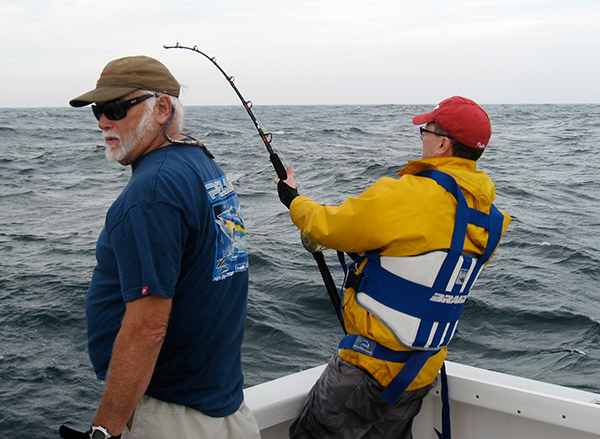
Jigging while drifting works best when the drift speed is less than 1 knot. If the boat is moving any faster than that, the jigs will no longer fish vertically, but at an angle, which is much less appealing to the tuna. If the drift is too fast, anglers are best off going back on the troll.
Whenever we see a large concentration of fish, or if the drift is too fast aboard the Free Spirit, we drop the anchor. Once we’re anchored up, not only can we jig, but we can chunk for these fish as well. Now, between the scent and flavor of the chunks and the action of the jigs, we are effectively tag-teaming these fish.
We set our chunk baits well away from the boat under balloons or floats. A very interesting new float, made by Redi-Rigs, allows you to hold your bait at any depth, and releases the line when the fish strikes, leaving the float to slide down the line so that it won’t interfere with the angler fighting the fish. By setting the baits away from the boat, we keep them clear of our jigs, which we will be fishing straight down. Our hook baits consist of whole sardines with a 12/0 Daiichi circle hook run through the mouth, out the gills, and hidden within the bait. To keep the bait from spinning unnaturally in the current, we use soft copper wire to hold the mouth shut. When it comes to doling out chunks, we do so sparingly, tossing out just enough bait to keep the fish interested. Usually we’ll go through less than a flat of butterfish this way.
I’ve got one last tip for the next time you do some chunking. If there is a good chop on the water, try fishing a jig off the long downrigger with the rod in the rod holder. The motion of the boat will give the jig plenty of action to attract the interest of any nearby tuna. Just make sure you get to that rod fast as soon as that outrigger clip pops.
These three tactics for tempting tuna can all be employed on a single outing. Becoming proficient in each of these methods will make you a better tuna fisherman and give you more options the next time your bluefin plan isn’t working. By assessing the conditions and determining which method is best for a given day, you will certainly bring more tuna to the boat this summer. Also, keep in mind that the conservation of these great fish is very important. We measure each fish in the water by using a tailer to make sure it is legal, or to gauge the size if we already have our limit in the box. If you intend to release a fish, it’s a good idea to leave it in the water to insure that it swims away as healthy as possible to ensure the future of this amazing game fish.
Very good article. It took me 3 years and a lot of gas to learn the inshore Bluefin are fished a lot different then the canyon yellow and long fin. I also picked up a couple of neat tricks, THANX.
I was wondering what trolling rod sizes / mfg. you prefer to match up with your Fin-Nor Santiago 30- and 50-wides?