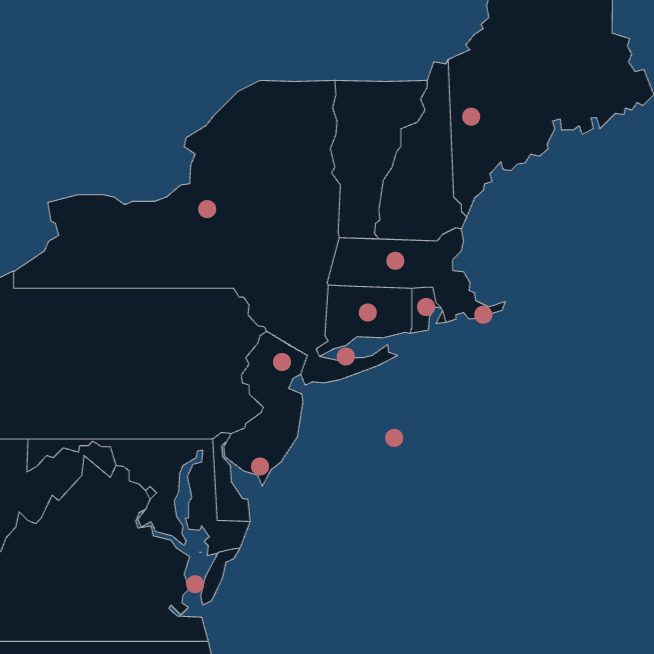

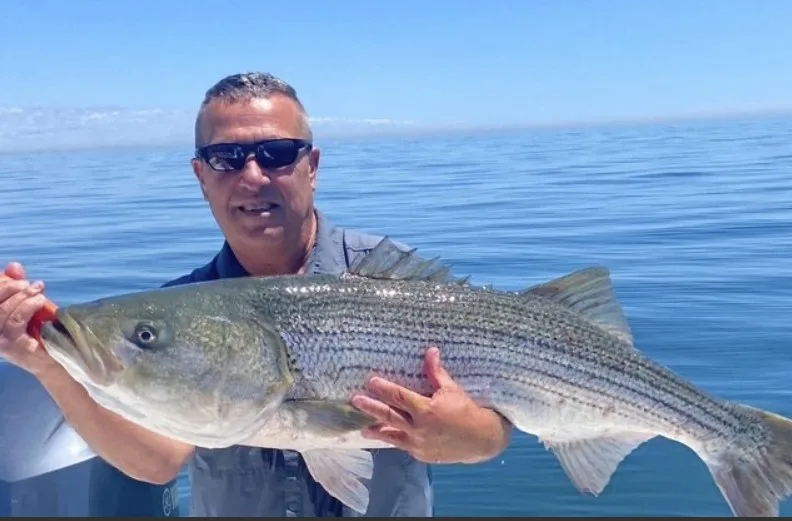
In August things typically slow down in western Long Island Sound’s nearshore areas and fish tend to set up on structure near deep water. There are several areas in the western sound that this setup occurs including the Eaton’s Neck Triangle (11B, 28C, OB, and Can 13), as well as Stratford shoal and Middle Ground. These areas tend to get heavy fishing pressure, so it’s important to understand that most of these fish are not feeding throughout the day.
Nighttime anglers do very well anchoring with bunker chunks or drifting live eels. I prefer not to fish at night and have found ways to get these sulking fish to strike out of territorial aggression and my go-to way is trolling tube and worm.
When trolling tubes on structure, it is important for the captain to pay attention to the contour lines on the chartplotter. If not, the crew will be donating a lot of tubes to the bottom. If you have 50 feet of water on the up-current side of structure that rises to 20 feet, I like to troll my tubes in about 25 feet of water which is where most fish that are sulking will hold.
I prefer using 36-pound-test leadcore line metered at 10 yards per color and at a desired trolling speed of about 2 to 3 miles per hour. I typically reach my desired 25-foot depth with the tube using 6 colors. You will get about 4 feet of depth per color of leadcore. If possible, attempt to troll parallel to the structure instead of up and over. The latter approach will be a major snag hazard costing expensive tubes and leadcore line.
I top my leadcore with 15 feet of 40-pound-test fluorocarbon connected to the leadcore with a very small barrel swivel that will fit through the rod guides smoothly, then the leader gets connected to the tube with a large snap swivel.
For outfits, I have always used 7-foot Lamiglas Tri-Flex Inshore conventional rods as they have a lot of backbone but the tip is light enough to detect if you picked up weeds on your tube. When the tube is tracking correctly, the tip of the rod should have a slow pulsing motion. If the pulse stops, you collected weeds or the tube is tangled.
My go to reels have always been Avet MXL 5.8 as they are small and strong and hold 100 yards of 40-pound-test braided line backing as well as 100 yards of metered leadcore line.