

Upgrade the Starting Lineup
Lure colors, shapes and sizes are important. Second to location, it will determine whether you hook up or not. Luremakers in Hawaii are as well known to the local fisherman as the Red Sox’s infield is in Massachusetts. The level of thought and variations to seemingly similar lures is impressive. At first, I could not believe that a particular shade of blue or a slight shape variation mattered, but tuna are impartial judges. You owe it to yourself to expand your spread beyond a few mass-produced lure manufacturers that make up the typical Northeast offshore options. I started making my own resin heads several years ago, and began to uncover the minute differences that certain species prefer and why those differences make certain lures more successful. A hand-turned lure made by a fisherman who has an eye for what makes lures catch give an angler a feeling of confidence when you splash it. Based on the skirt size, there are three main lure sizes, 9-, 7-, and 5-inch. Generally speaking, the bigger the lure, the bigger the fish. Ahi (yellowfin over 100 pounds) seem to prefer bullets, scoop noses and jet heads—all sub-surface shapes—of 7 and 9 inches, trolled farther away from the boat. Marlin like a lure that splashes and lays down a good smoke trail. Most of my marlin strikes have been on a 9-inch plunger fished on the short rigger. Mahi are equal opportunity feeders and will hit nearly anything, but they quickly wise up and will require bait or a different technique to get more than a few out of the school. Try a variation of sizes and shapes, but again, get beyond the light plastic molded lures. Skirt choices matter and skirting a resin-head lure should be within your skill set. The local shops in Hawaii have walls dedicated to every skirt color imaginable. Typically, two skirts are used for a resin head. I prefer a solid skirt color as the underskirt, with a more translucent skirt on top. The result is a very real looking, iridescent lure. As for the actual color choices, this is a very subjective topic, but I am generally a supporter of natural huesin blues and greens, and contrasting bright colors.

Single Lures Reign
It is a rare sight to see anything but single lures trolled in Hawaii. Spreader bars, daisy chains, and dredges are all notably absent from the Hawaiian starting lineup, though an exception might be the occasional use of a bird. There are two reasons for this. First, the average trolling speed is fast— typically 7.5 to 10 knots, and spreader bars do not respond well to that speed. Second, it is usually rough and windy off the coast of Paradise. Due to the persistent 15- to 25-knot trade winds, steep 4- to 6-footers out of the east are the norm. Spreader bars seem to tangle with themselves and every other lure in the spread with such sea conditions. My go-to game plan is to use small birds on my outriggers and shotguns, and run heavy corner lures with release clips off the transom. On the outriggers, the drag of the bird does a great job of keeping the line tight and preventing lures from sliding across the spread in the wind. On those rare calm days, I like to break out the spreader bars and daisy chains to add more action. Consider keeping your trolling spread simple, with just single lures. You can run more lines, take multiple hook-ups, and if you spot fish in the distance, can pick up the speed without reeling them in.

Speed Thrills
Trolling faster than the typical 5-knot “Stellwagen shuffle” is worth considering. At 9 knots, I can cover nearly twice the water to find birds, debris, and current breaks faster. The lures run well and the additional speed gives the fish less of a chance to inspect my imposter baits. Pelagic fish, being built for speed, have no problem running down a lure trolled a few knots faster than most. On a typical day trip, I cover 50 to 75 miles of track lines, so this allows me to get through the dead water faster and focus on those areas with indications of fish. I have been adding a rigged ballyhoo on my shotgun, and even at high speeds, it tracks perfectly and catches. Putting my money where my mouth is, I have tried this speed technique in the Northeast and caught plenty of tuna and mahi in the canyons by doing so. Try going past an offshore lobster buoy at 12 knots and you can just about watch the mahi skip across the surface as they charge the lures.
Don’t Play With Your Food
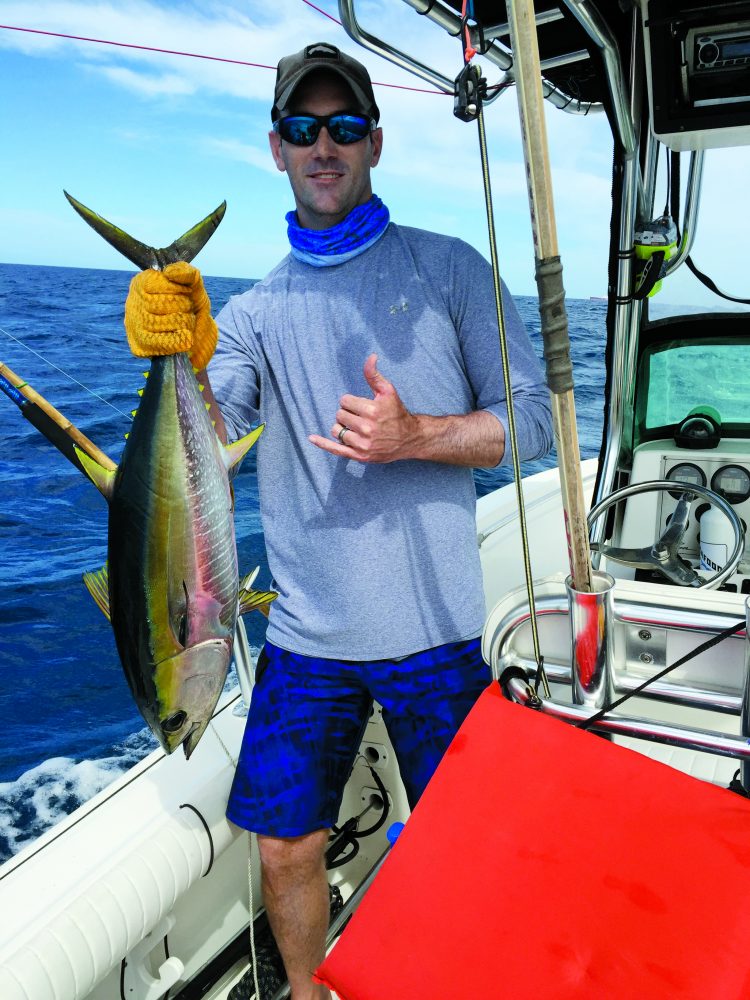
I used to run very sporty outfits, but after a five-hour fight with a bluefin on Stellwagen Bank that nearly cost me my hand, I backed off on using lightand even medium-tackle trolling gear. Chasing big fish on small boats is a fair fight, so it is important to be in control of the fish and not hurt yourself in the process. Reels in the 130- and 80-pound class are the standard for any size Hawaiian boat. We get only a few shots at big fish, and once that strike happens, I want to put the screws to it. On my 20-foot center console, Ohana o’ Kai (family of the sea), I troll two 130s, two 50s, and one 30, and to be honest, the 30-class reel makes me nervous. All my reels have heavy mono topshots and braid backing. My leaders on all but the smallest lures are 300-pound test. It is a lot of firepower for a small boat, but my reason is simple—that next strike could be a 1,000-pound marlin or a 200-pound ahi, or in New England, an 800-pound bluefin. You never know when that fish of a lifetime is going to show up. In typically snotty weather, lighter tackle is a safety issue because a standup fight on a pitching deck is sketchy. To counteract this, I don’t take the rods out of the holders. All my rods are on bent butts and I have installed swivel rod holders in my gunwales. To keep my gear and boat together, I installed mahogany backing plates on the underside of all my rod holders. Initially factory installed with just wood screws, I now have heavy-duty bolts on all the bases to ensure that the 25 to 30 pounds of drag isn’t going to rip off my gunwale in the process.
Break From The Crowd
I have had mornings in Cape Cod Bay or south of Block Island where there seemed to be 100 boats, all trolling exactly the same color spreader bar and no one was catching anything. It can drive you nuts and leave you feeling defeated. Regional techniques develop for of one reason—they work. However, it is always good to have a backup plan for those days when the standard approach isn’t working. In these situations, don’t hesitate to try something new. Fish seem to wise up to seeing the same thing over and over. Although vastly different, there is a lot of middle ground to be shared between the east and west coast in terms of offshore trolling. This season, try a few tricks from Hawaii, which might get you that fish on an otherwise fishless day.
The Island Troller’s Guide to Head Shape
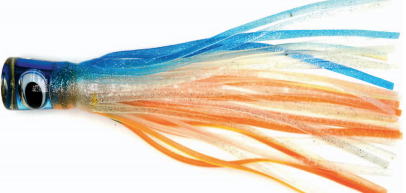
The shape of a lure’s head determines its action in the water. Here’s a breakdown of when to use which style.
Pusher
Jet
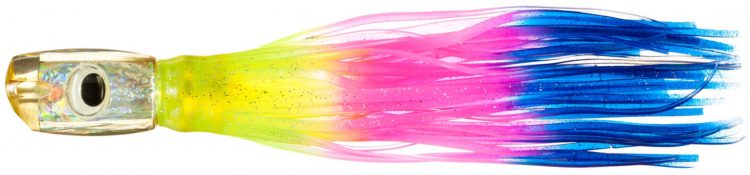
Plungers

Bullet Heads

Scoop Nose

Nice article, good tip is to check out melton.com they have by far the widest selection of Hawaiian and some of the best American (moyes) lures made with the largest selection of skirts available.
Very grateful for all the info. I will be on my first Tuna season this year…?
Nice article, I have recently been adding more Hawaiian lures to my arsenal and agree with the idea of adding them especially on rough days. I also fish a small boat (Parker 2120SC) that is heavily rigged with safety, EPIRB, raft, sea anchor, etc. I fish all 50# to 80# gear not wanting to play around with the opportunity to put big fish in the bag. I installed a swivel base “shotgun” style Hawaiian rod holder that adapts to straight or bent butt rods which allows for fish to be fought from the gunnel if desired. Spreader bars are great but some of my best Tuna came on single, heavy lures. Purple/black, blue/white, blue/pink. Keep up the good articles.
Good article. Thanks from the Bahamas
Great article. Has anyone on this site had luck using single (west coast) style lures in the Northeast for Bluefin? I’ve often thought that it made sense to fish with these lures as the tuna likely have fed on species similar to these lures during various parts of their migration. I think the idea of a faster troll makes a lot of sense in terms of covering more ground and…. as tuna are high speed predators, I can’t see 4 knots vs 8 knots being an issue.
Awesome Article…
Checkout APOLURES.COM
Got what you need.
Nice Article!
Checkout Tsutomulures.com
These lures work and produce fish!
Safe and Happy fishing…Hanapa’a!!!
Thanks for the article, very educational
The amount of Hawaiian plugs on my boat when I bought made me think, prior owner was Don Slater the boat was named invader. Founder of the canyons.
Don caught hundreds of tuna.
You overlooked what has been for me one of the most productive lures for all pelagics,the humble cedar jig,rigged with a relatively long shank needle eye hook on Momoi 80 to 120lb blue mono leader.The needle eye hook slides up inside the jig while the long shank provides some protection against biteoffs.