
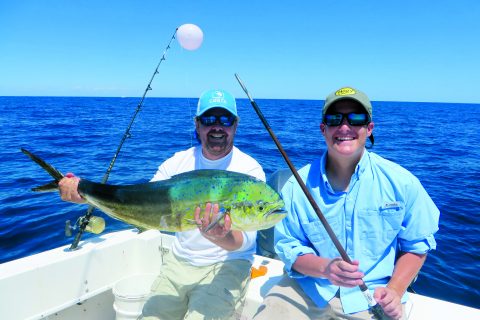
Many offshore fishermen make a run to their local tackle shops to grab some ballyhoo before heading deep, but they never consider filling their livewells with some of the baitfish available right in their marina.
When I take overnight trips to the canyons, I spend the whole night trying to catch live squid, just like the rest of the fleet.
Most often, the tuna are not only feeding on squid, but also butterfish, flying fish, and sardines. Live mullet, snapper blues or peanut bunker are close matches to these pelagic baitfish, and tuna and mahi eagerly eat them when given the chance. You invest a lot of money in your offshore trips, so why not increase your chances of putting some fish on ice by filling up your livewell with these inshore baitfish?
Snapper Bluefish
Hand-size snapper blues are deadly on large mahi mahi. Last year while trolling around an offshore wreck, my wife Gina and I came upon a dead whale. Not only was the whale surrounded by many species of sharks, including a white shark, it was providing cover for dozens of mahi. Most of the mahi were in the 5- to 7-pound range, but there was one big bull that stood out from the rest. It was impossible to get a bait anywhere near him without hooking one of his smaller schoolmates. As I looked inside my baitwell, I saw that I had one large snapper left. I rigged it up on a circle hook and let Gina cast it. Like a lightning bolt, the big mahi streaked toward the bait and ate it. Fifteen minutes later, we boated our biggest mahi to date, an even 20 pounds.

If you plan on catching snappers to take offshore with you, do not use old school snapper rigs. The long-shanked snapper hooks used with these rigs regularly deep-hook the snappers, killing them before you have a chance to get them offshore. Instead, I use a very small circle hook. I use a tip from fishermen down south, and use a small de-hooker to place the baits in my bait pen. The less the fish are handled, the livelier they will be
Peanut Bunker
Last year, I ran offshore with a livewell on the fritz that was filled with peanut bunker. After several hours of trolling with no luck, a call came over the radio that advised all who were listening, “Start chunking – fish are being caught.” As my crew began the process of switching over from trolling to chunking, I maneuvered the boat to get in on the bite. After about an hour of chunking, it was apparent that we couldn’t get the tuna to feed under our boat. A few vessels around us were hooking up, and as time passed, the frustration mounted.


I was ready to throw in the towel, so as the crew began to pack up, I began to dump out the livewell. Most of the peanuts had died because my livewell pump had burnt out, but a few survived. As I scooped out the baits and tossed them into the water, the ocean around us began to boil. There were tuna everywhere!

I quickly saw that they were chasing the few bunker that were still alive. I frantically looked in the well for any that were still moving. I grabbed the first of two that were alive, baited it on a spinning rod I had set up for mahi, and pitched the bait in the water. I’d hooked the bunker through the tail, believing it would better hide the circle hook. As the bait swam out of sight, a tuna inhaled it. Unfortunately, the hook missed the mark, and I was soon back in the livewell scooping out my last remaining live peanut bunker. Twenty minutes later, we had a reason to smile as we iced a 40-pound yellowfin. Without live bait that day, we would have gone home fishless.
By late June, most creeks, canals and rivers will be loaded with bunker in all different sizes. When I’m looking for bait to take offshore, it’s the smaller peanuts I’m after. The optimum size is between 4 and 7 inches, but smaller peanuts are better than nothing. Peanut bunker can be caught by throwing a small-mesh cast net over the schools, and I throw an 8-foot net with ¼-inch mesh. The larger nets used for adult bunker will result in the peanuts being caught in the mesh, mortally wounding them.
One mistake many fishermen make when looking for peanuts is that if they don’t see or hear the baitfish on the surface, they will assume there are none around. However, bunker regularly school close to the bottom. As you cruise through the back bays, make sure someone’s eyes are glued to the fishfinder in order to locate these subsurface schools of prime offshore live bait.
Mullet
Two years ago while jigging behind a dragger, I reached into my livewell and threw a bunch of mullet overboard. As I was looking down into the clear water, a sudden flash caught my eye. I assumed it was a tuna, but as the fish came closer, I saw it was actually a lit-up white marlin. We all stopped jigging and just watched. The marlin had been attracted by the mullet I’d thrown in a few minutes earlier. It was amazing to watch the fish use its bill to stun and separate its prey from the pack. By the time we grabbed a rod for it, the fish had already swam back to the deep.
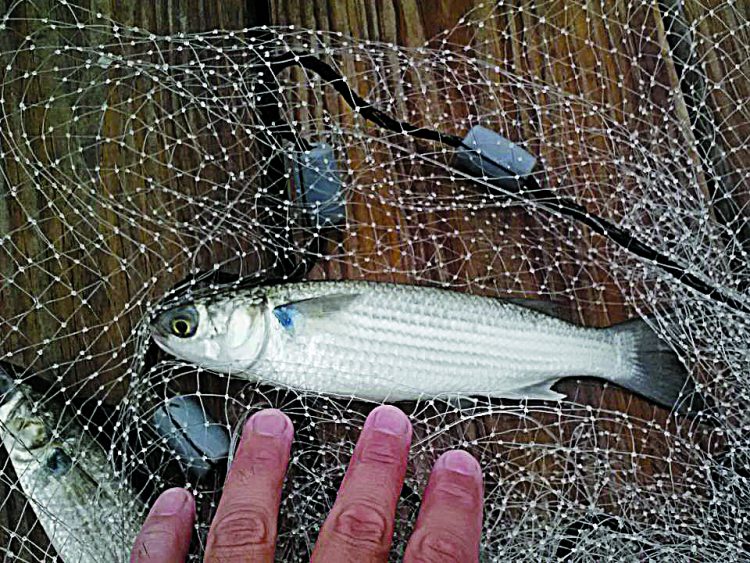
Mullet are much hardier than snapper blues or peanut bunker, but they are also more difficult to find. One telltale sign that sets them apart from a bunker pod is the fact that they will swim on the surface, most likely in a V-shape, unlike the circle pattern of bunker. Once again, I use an 8-foot cast net with ¼-inch holes. Catching a decent supply of mullet may take me a few throws spread out over a couple of hours, but it’s well worth it.