

I was once told, “Don’t allow yourself to become a one-dimensional fisherman.” These words of wisdom were handed down to me from Carl Johansen, an old, salty Cape Codder, with whom I occasionally worked, many years ago, at one of the local bait shops.
Carl had been fishing local waters for more than 60 years and he was (and still is) a wealth of knowledge on all things fishy. Any time Carl would tell me a story or offer advice, I would listen intently, soaking it all in. I learned a lot from him over the years, but what stuck with me the most was that quote about the onedimensional fisherman.
It took me a while to completely comprehend the meaning of Carl’s words. Initially, I thought he was referring to switching up techniques and locations for catching striped bass. Over time, I began to realize he was also telling me there is more to fishing than just catching stripers.
Anglers in the Northeast are blessed with a multitude of opportunities to fish for a wide array of species. Our local waters, both salt and fresh, host more than 60 varieties of game fish. The best anglers are those who know how to catch most of them and are aware of the subtle nuances and techniques that different fish require. A multi-dimensional angler knows a wide variety of techniques and strategies, and is able to apply them appropriately at the proper time and location.
There have been times when I’ve used small-stream fly-fishing techniques to help me fool particularly fussy longfin squid. (I dropped down to 2-pound test leader material.) I have also used shark-fishing techniques to fool finicky midsummer smallmouth bass (with controlled-depth live bait float-fishing). And, I have used smallmouth bass techniques (tube jigs) to outwit wary, shallow water stripers.
Experimentation, when combined with the knowledge of many techniques, will make anyone a better fisherman. Many seasoned charter captains will dedicate 10% of each trip to explore new locations or try new tactics, a good rule of thumb for every fishing trip you take next season. Just because you once caught a big striper on a white popper, it doesn’t mean that is the best technique for every scenario. Mix things up, experiment, and try something new. It may or may not work, but you sometimes learn just as much when you don’t catch fish as when you do.
The same willingness to experiment while fishing can also help you in the kitchen when it comes time to prepare your catch. Most of us have a small bull-pen of tried and true recipes, which have become comfort food to us. (When in doubt, fry it.) But I urge you to try some new recipes this year, mix things up, and explore the vast array of culinary techniques that our wonderful world has to offer.
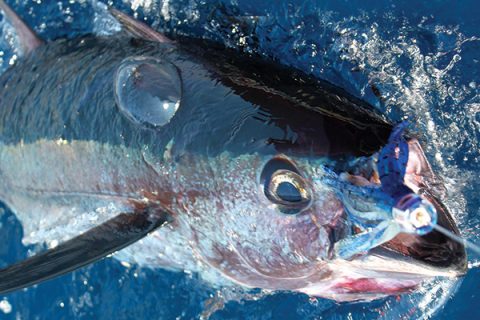
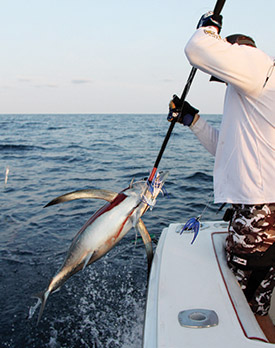
The following recipe for tuna confit was sent to me by my friend Damon Burden. This summer I scored a jackpot of albacore tuna out in the canyons. I ate it for six straight nights, all using different recipes, and this was my favorite.
Confit is a classic French cooking method where meat is slowly simmered in fat at a low temperature for a long period of time. The term is derived from the French word “confire,” which means “to preserve.” It was traditionally used with tough cuts of duck, goose or pork, and the confit was placed in small jars and submerged in the remaining fat. Stored in sealed jars, it can last without spoiling for many months.
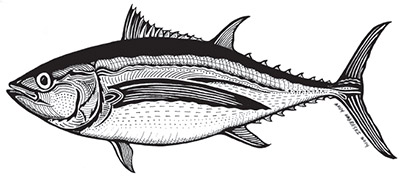
Albacore tuna is perhaps the mildest of the tunoids–its flesh is light pink and has a firm texture. It is the fish most commonly encountered in canned tuna found in supermarkets worldwide. I must admit, though, that I am not a big fan of canned tuna. I’m a bit mortified by the thought of eating fish that has been lurking in a lukewarm aluminum can for who-knows-how-long. The smell of canned tuna still gives me the willies, and so I only eat it as a last resort.
When Damon sent me this recipe, he assured me that, hands down, albacore confit makes the ultimate tuna melt sandwich. I was intrigued. Who doesn’t like a good tuna melt? I had to try it.
Duck confit is one of my all-timefavorite decadent delicacies. So, since I had a lot of tuna steaks on hand, I figured I’d take Damon’s advice and give tuna confit a try. So should you! Here’s how to make it.
“Penguin” Tuna Confit
3 pounds tuna steaks cut in thick chunks
Fresh herbs of your choice: rosemary,
oregano, thyme, basil, dill, etc.
2 green onions, coarsely chopped
Peel from half a lemon
3 cloves garlic, cut in half
2 to 4 cups olive oil
BRINE:
2 cups water
3 tablespoons salt
2 tablespoons sugar
STEP 1: Place your tuna steaks in a gallon freezer bag and top them off with the brine. Place it in the refrigerator for an hour or so.
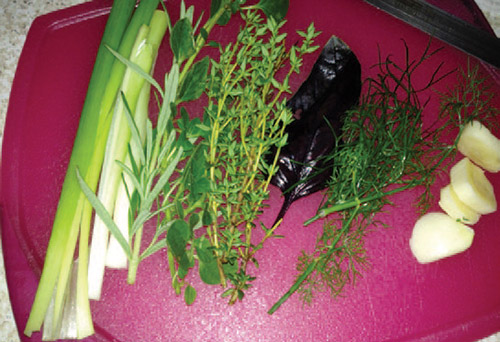
Step 2: Dice up some aromatics. I opted for green onion, rosemary, oregano, thyme, purple basil, dill, garlic and lemon peel.
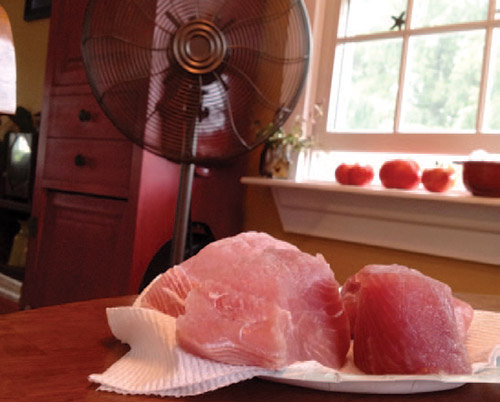
STEP 3: Remove the tuna from the brine and dry it off thoroughly with paper towels. Place it and the aromatics in front of a fan for about 15 minutes to make sure they are all completely dry. (Water and hot oil are not a good combination.)
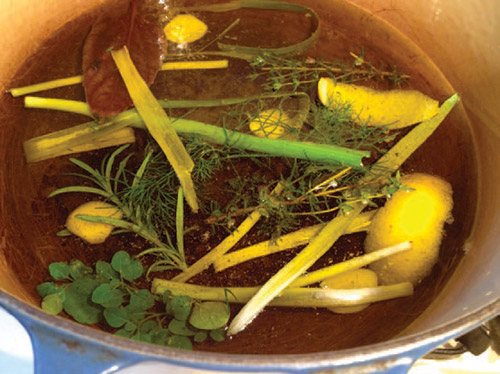
STEP 4: Put about an inch of olive oil into a pot and add in the aromatics.

STEP 5: Gently insert the tuna steaks into the pot and add more oil until they are completely submerged. Set the burner as low as it will go.

STEP 6: A good kitchen thermometer is key here. Cook the fish until it reaches an internal temperature of 135 to 140 degrees. Remove the fish immediately and let it rest until it reaches room temperature.
Once cooked, tuna confit can be stored in the refrigerator for several weeks. Simply strain the oil, place the tuna in mason jars, and top them off with the strained oil. The finished product is fabulous and can be eaten a number of different ways. It’s ideal for a tuna casserole (I made a delightful tuna tetrazzini), you can add it to a salad, or for a real treat, use it to make the finest tuna melt sandwich that you’ll ever eat. I’ve yet to try it myself, but I bet striped bass, or any other firm-fleshed fish, could also be used to make a fine confit. Give it a try!
The next recipe was sent to me by On The Water reader Hugo Medeiros. I’m “friends” with Hugo on Facebook. I like being “friends” with Hugo because he seems to be constantly cooking fresh wild-caught local fish, often in impressive and beautiful presentations. Hugo appears to be quite fearless with his dietary diversions, and, like myself, he will eat just about anything he can catch, gather, shoot or grow. This is a wonderful recipe, especially if you love garlic, and would lend itself well to many other flaky, white-fleshed fish.
Pan Fried Tautog Filets with Portuguese Garlic Sauce
1 pound tautog filets
Juice from 2 lemons
Sea salt
White pepper
6 cloves of garlic, peeled and thickly
sliced (do not crush)
1 tablespoon butter
3 tablespoons olive oil
1 tablespoon paprika
1 fistful of finely chopped cilantro
1 teaspoon red wine vinegar
1 tablespoon Pastene or
Sambal Oelek chili paste
Boiled potatoes (halved or quartered,
depending on size)
Italian bread, warmed in the oven
Season the fillets with sea salt and white pepper. Place in a bowl and add the juice of one lemon as well as about two cloves of sliced garlic. Let stand in the fridge for about 30 minutes.
Heat the butter and one tablespoon olive oil on medium-high heat in a nonstick skillet. Add the filets and sauté for about 4 minutes per side or until they’ve reached a nice golden color. Remove from the pan and set on a plate atop paper towels. Reduce heat to medium and add two tablespoons of olive oil (or more, depending on how much sauce you’d like.) Add remaining garlic and sauté for about three minutes, or to taste. Add paprika and stir, then add cilantro. (Some people don’t enjoy cilantro. I used to hate it, but now I love it. If you dislike it, substitute parsley, scallions or chives.) Turn heat to medium-high and add remaining lemon juice and a dash of vinegar. (Make sure to taste and adjust the vinegar-to-oil ratio to your liking.) Add your favorite hot sauce or peppers to taste. Stir and cook for about one minute to allow the vinegar to meld in. Arrange the filets on a plate along with the potatoes, then top with the pan sauce. Garnish with fresh cilantro or green herb of your choice.
This dish goes well with a simple salad of tomatoes, red onions and lettuce. Hugo notes that “the rules” say we should drink a nice white wine with fish; however, he prefers a red wine with this sauce. He also recommends serving the remaining sauce in a bowl, as one of the best parts of the meal is dunking chunks of bread into this spicy, garlicky concoction.
Remember, there are many ways to hook a fish and many ways to cook the dish. Eating fish the same way every time is boring. Be brave, and try some new recipes this year!
 Cooking The Catch 1 & 2 Combo
Get both of these well written and resourceful cookbooks for one reduced price. Hundreds of great recipes for local seafood.