

The fog bank had just cleared enough for me to see where my casts were landing when I heard the first screaming drag of the morning. In a picket line of casters that stretched for 50 yards down the bank, I located the lucky fisherman three anglers up-tide of me, so I had good reason to hope that a school of fish would be passing my way.
I cast my jig upcurrent, let it settle to the bottom, and started a lift-and-drop retrieve, turning the reel handle just fast enough to keep a tight line. The hit was barely detectable—a slack in the line when I should have felt the weight of the jig. I set the hook and the rod started bouncing under the frantic head shakes of the fish on the other end. Before taking off on its first run, the fish rolled on the surface and there was just enough sunlight breaking through the clouds to reflect the purples, silvers and yellows of a tiderunner weakfish.

While the shoulder-to-shoulder sunrise conditions may seem familiar to Cape Cod Canal regulars, the scene above took place a long way from Bourne, on the sod banks of Townsends Inlet in Avalon, New Jersey. Such was the fervor created by weakfish fishing in May.
In New Jersey, weakfish had a devoted following of fishermen as fanatical, and secretive, as striped bass surfcasters. When I lived and fished in New Jersey, I would pass up a chance to catch 20-pound stripers for a shot at an 8-pound weakfish. At least I think I would have. Perhaps in their near absence over the past half-decade, my heart has grown fonder.
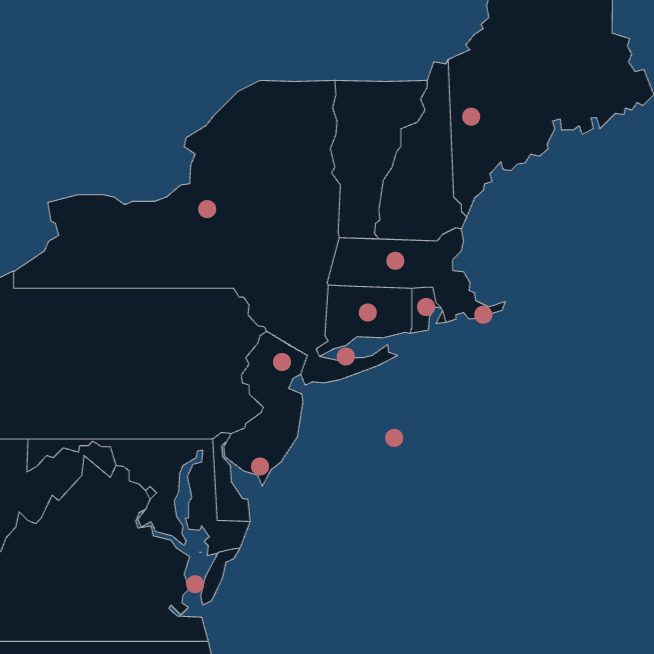
Since moving to Massachusetts, I haven’t heard of a single weakfish— “squeteague” in New England-ese—being caught from shore in New England, much less caught one myself. Cape Cod is the northernmost limit for weakfish fishing; couple that with a major downturn in the weakfish population throughout its range over the past decade, and you have your reasons why the odds of encountering these fish in New England have been slim to none—but that could be changing.
Last year, reports from New Jersey to Buzzards Bay indicated more weakfish caught than in any of the previous five years. Very encouraging was the presence of large numbers of young-of-the-year weakfish in the late summer and fall. Even over the winter, anglers targeting sea bass on offshore wrecks off New York and New Jersey occasionally ran into big wintering weakfish schools. In local waters, spring sea bass fishermen on Buzzards Bay occasionally caught weakfish up to 11 pounds, and a kayak fisherman off Newport reported catching a pair of good-sized weakfish while jigging in deeper water.
There is definitely a history of good weakfish fishing in New England. Heck, I live five minutes from Squeteague Harbor. A friend of mine recalls a night of surfcasting on Nantucket in 1977 when a school of big weakfish invaded the surf. Many fishermen have been passed down stories of schools of weakfish in estuaries from Fall River to the Connecticut River.
Even if the weakfish numbers are bouncing back—though it’s still far too early to tell—are they worth targeting? After all, the height of the weakfish run, even in New England, takes place in May and early June, the same time when spring migrations of striped bass are terrorizing baitfish in every nook and cranny of the New England coast. It might be tough to justify spending precious fishing time pursuing such a low-percentage fishery—unless you’ve caught a weakfish before.
Though I’m not fond of “pound for pound” fighting comparisons among fish, I’ ll admit weakfish fight harder than stripers of the same size. A weakfish has a tell-tale head-shaking response when it feels the hook, and a big one will take dogged runs. And to make it even more interesting, to properly target weakfish, you’ll need light tackle.
Weakfish have delicate mouths that tear easily when anglers try to horse them in, so a soft rod tip and a moderate drag setting are a must when seriously targeting tiderunners. The fishing itself requires more finesse than striper fishing. An angler must use deft hands and a keen intuition to work a weakfish jig to draw a strike. Also, with the exception of brook trout, weakfish are the most colorful and striking fish in the Northeast. When lit up by the soft light of sunrise, a fresh-caught weakfish is one of the most beautiful sights a surfcaster can lay eyes on.

Weakfish prefer smaller forage than stripers, which tend to exhibit an “anything smaller than me” approach to feeding. While spring stripers are hunting down adult bunker, herring and mackerel, weakfish will be sipping grass shrimp, seaworms, mummichogs and spearing. Weakfish lures are similarly small, consisting of 1⁄4- to 1⁄2-ounce jigheads paired with 5-inch soft plastics like the Zoom Super Fluke, Bass Assassin or Fin-S Fish, or small plugs like the Mirr-O-Lure 52M or 4-inch Bomber Long A. For colors, think pink, chartreuse or, at night, black.
Bait works for weakfish fishing too. Seaworms are a popular choice, and so is fresh squid. In fact, for most of the weakfish taken in New England in recent years, squid served as the fish’s final meal.
For the uninitiated—like yours truly— learning where and when to catch New England weakfish will be the biggest challenge. The few anglers in the know keep their weakfish intel tight to their chests. Notwithstanding that hurdle, we can use what we know about weakfish in New Jersey and New York to zero in on them in the Northeast.
Start your weakfish witch hunt in the backwaters. In May and Early June, weakfish invade bays and estuaries to feed and spawn, so this will be your best window. Structure like channel edges and drop-offs will hold weakfish. Look for areas where these are within reach from shore. Shellfish beds should be the first areas you investigate. They are home to all of a weakfish’s favorite forage—worms, shrimp, small crabs and baitfish.
You’ll want to time your weakfishing mission early or late, but never midday. Though boats will have success catching weakfish in deep water in the middle of the day, once the sun gets high, the fish usually split from the shallows. Inlets or river mouths with heavy boat traffic will shut down especially fast. Fishing an hour before to an hour after sunrise is a good bet, with the action extending later into the morning on overcast days. You can’t go wrong fishing at night, either.
Moving water is just as important as time of day for targeting weakfish. The fish earned their nickname “tiderunners” for their propensity to feed in strong currents. Whether the incoming or the outgoing tide is the better tide will depend on the area. Creek mouths, harbor mouths and rivers will likely fish best on an outgoing tide when the small morsels weakfish love to eat are swept down from the upper reaches of the estuary.
I’ll be hunting for my first New England weakfish this month, and I encourage you to do the same. The stripers aren’t going anywhere until November, so you can spare a few nights and early mornings to look for the elusive and beautiful Cynoscion regalis.
Tiverton. Shhhhhh!
We saw a few here and there here in NJ last year, but this year MUCH BETTER!
Now the trick is to keep this year class intact for a couple of spawning seasons. Weakfish have been bottlenecked at Year 1–good young of the year production (Year 0s), but the fish never make it to Year 2. This year class managed to break through the bottleneck, and it would be nice if it stayed around long enough to spawn another good year class or two. Weakfish are very prolific spawners, so given half a chance, we can see them rebuild pretty quickly. But we've got to give them that half-chance.
[…] This is the time of year you would expect to find them in local waters. If this tasty treat interests you Jimmy Fee at On The Water wrote a good recap earlier this week. Check it out. […]
Jimmy, there is a nice shore weakfish population in CT when the run is good. They are commonly caught from shore here. Last I recall , we are still part of New England ;).
We caught over a dozen this year fishing the reefs in central Long Island Sound. I hadn't seen them since I was a kid – absolutely beautiful fish.
[…] This spring, On The Water Publisher Chris Megan and Editor Jimmy Fee headed out early one morning in search of some Cape Cod weakfish. After being mostly absent from Massachusetts waters in recent years, weakfish have returned in surprising numbers, and Jimmy and Chris had a great morning catching these beautiful fish. Look for the full episode to air during Season 12 of On The Water TV in 2014. For more on weakfish fishing in the Northeast, check out this From The Surf column from the April 2013 edition of On The Water magazine. […]
Landed 3 this spring in barnstable, ma. 22″ – 29.5″ dropped a few and many boils. also watched a 6-7 lb blue feed on a (still alive) 20″ weak bit in half by a presumed heavier blue. Like a shark feeding on a whale carcaus. Also was waist deep when that little tsunami hit. That was very weird. One of the crazier springs.
Got Me a 22″ in the surf on a 007 white tailed Diamond jig. First one in 8 years.
Thanks for the great article. I caught a small, 14 incher last night and had no idea what it was!
I was using light tackle with a small piece of squid off a wharf.
We caught Squeteague at the Weweantic river in the early 1970’s under the menhaden schools in buzzards bay