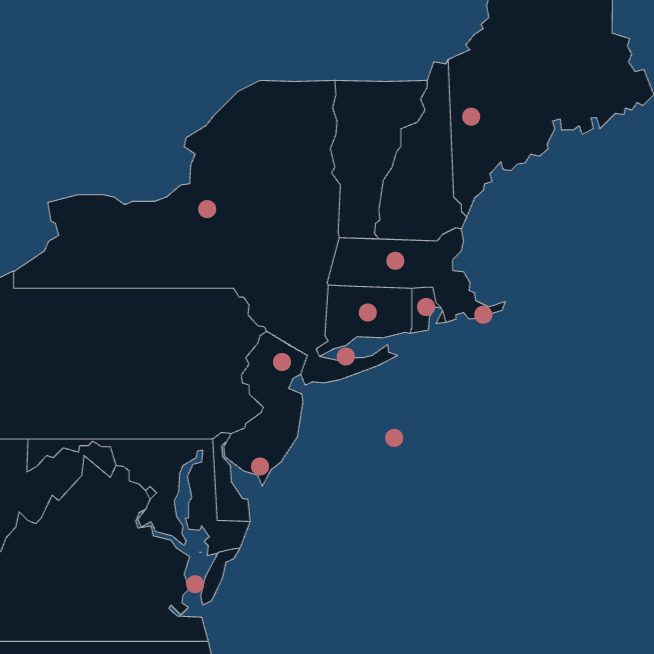

Western Connecticut
By Captain Chris Elser
Family Fun with Multiple Species in the Sound
It’s finally summertime, and for many of us that means family time. What better way to do so than to go fishing on Long Island Sound? Anglers setting out in the summer months have the option to target striped bass, bluefish, fluke, black sea bass, porgy, weakfish, and tautog.
Through fishing, I have created memories that will last forever for me, as well as my wife, children, and grandchildren. We use tried-and-true tactics as well as several new and different methods. For example, I rarely live-line or chunk bunker any more. If it isn’t available near your homeport, the cost of fuel to gather bait isn’t worth the time invested when one could be fishing with topwater lures, soft plastics, flutter spoons, diamond jigs, and tube-and-worm rigs.

As of late May, we were enjoying one of the greatest pushes of big striped bass (and even some bluefish) I have seen in years. The bass and blues that stick around will settle on key structure and rip lines for the rest of the summer.
My preferred method is topwater plugs, but at this time of year I’d need to be on the water by daybreak. Weightless soft plastics are also deadly topwater offerings. I try boulder fields, rocky points, marshes near channel edges, and deep-water pronounced rips. Blind-casting is often necessary, and if you arrive at one of the above-mentioned areas at the optimal tidal phase, you will eventually develop a pattern of success. Many of my top shoreline areas fish better for larger bass within an hour or so of high tide and during slack tide.
If you are not able to take advantage of daybreak fishing, then tube-and-worm trolling will come to your rescue. When I schedule one of these trips, the time of day has no relevance at all since the fish I’m after aren’t feeding; instead, they are sulking and digesting food from the night before. The advantage of this technique is that the tube-and-worm rigs are consistently at the depth where the fish are resting. They will eventually strike out of aggravation or territorial behavior. This is just my theory, but I’m confident in it because I have drifted live eels and bunker over these same groups of fish at midday and they have very little interest in striking.
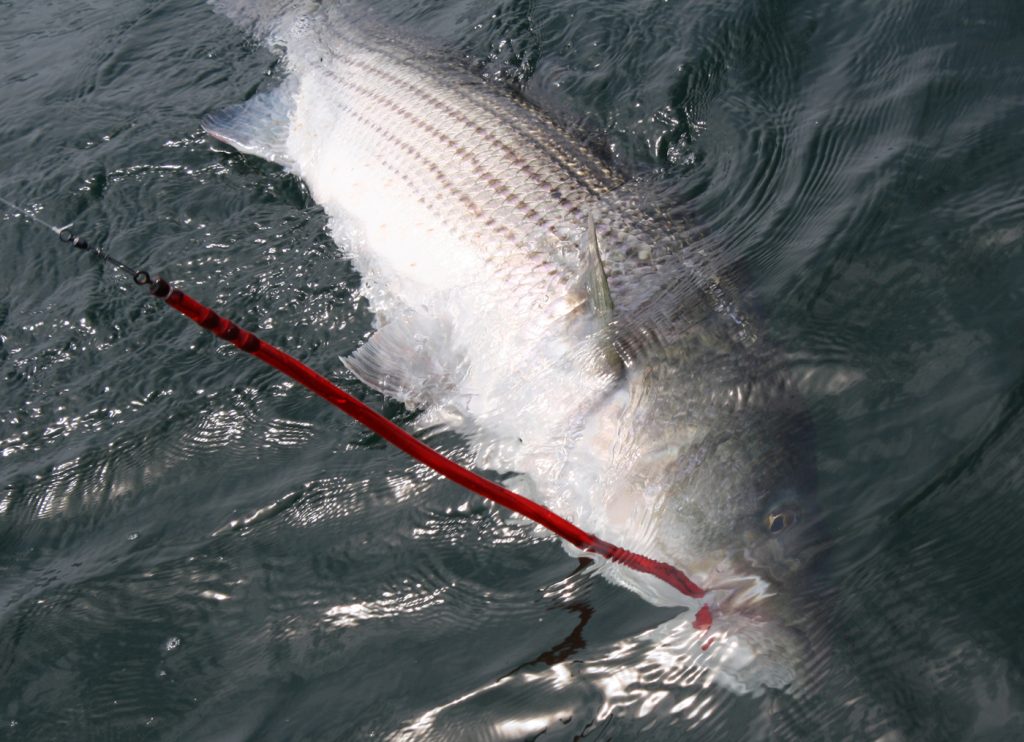
Trolling tubes is not my favorite way to fish for bass and blues, but it puts midday summer fish on my clients’ line better than any other method. It’s worth a try, and the tackle is simple. I use a 7-foot medium-fast-action rod paired with a non-level-wind conventional reel. My choice is a Lamiglas rod matched up with an Avet MXL reel. Level-wind reels are not appropriate since you will be using 36-pound lead-core line and the level-wind can cause kinks and binding when a large bass or bluefish is hooked and taking line.
Lead-core line comes with 10 colored sections of 10 yards each. My calculation is that your tube will sink about 3 to 4 feet per color when trolled at 2 miles per hour. Of course, tide and wind will also have a slight effect—for example, when I am trolling a line in 25 feet of water, I have my clients free-spool five colors of lead-core into the water before locking the lever drag into full drag position. Free-spooling lead-core takes a little practice to keep it from backlashing on the spool, but with some coaching and practice, it’s quite simple.
Tube-and-worm trolling is all about the captain maintaining a parallel pattern on the up-current side of structure because that’s where the fish hang out. Many think the fish are in the wash but, actually, after you hook up with a fish on the up-current side, you land the fish on the wash side, so that’s where people get confused.
Next on my wish list for July and August are black sea bass and fluke. I really don’t eat much striped bass, and you have a better chance at winning the lottery than catching one between 28 and 31 inches in the areas I fish. Black sea bass, in my opinion, is the best-eating (cooked) saltwater fish I have ever had. Be aware of regulations on the New York side because they may differ from Connecticut’s. It is going to be a challenge to consistently find keeper black sea bass.
Fluke are another great table fare option. I have noticed a downward trend for many years in the western Sound, but there are still some good-quality fish in our area.
Don’t forget about the optimal and plentiful bottom fish, the porgy. It’s great for eating and has a lot of pull for a small fish. These are a great way to get the family into some fun with fish that are usually willing to take a piece of clam or small strip of squid.
I highly recommend a porgy trip on a party boat. My favorite is the Middlebank II out of Captain’s Cove in Bridgeport, Connecticut. They will get you on the scup bite and then filet and bag your catch.
Eastern Connecticut
By Josh Rayner
Switch to Dark Mode for Stripers
Summer on the Connecticut shoreline and along the I-95 corridor can be frustrating to a local, but tourism is a double-edged sword. Our beach towns are flooded with people who have summer homes or want to visit charming downtown areas, and I-95 is inundated with more traffic than it can handle, especially on weekends. On any given day, a 20-minute drive home from the grocery store or boat ramp may turn into 40 minutes, simply because of beachgoer traffic. July and August are also some of the busiest months on Long Island Sound and the Connecticut River in terms of boat usage. As clogged up as these area can become, tourism and revenue from recreational boaters and anglers throughout the busy summer months are what keep some small Eastern Connecticut shoreline towns and their businesses alive.
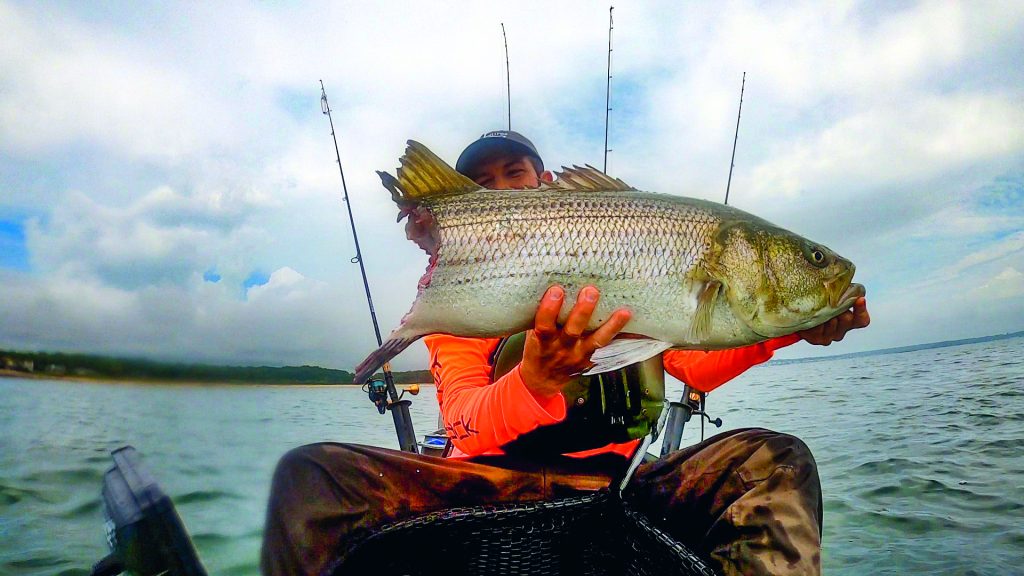
At night, however, it’s usually far easier to get where you’re going, and the boat ramps and water aren’t busy at all. I’m not someone who does too well with summer daytime heat, especially on a kayak, with the only relief from the sun being a hooded AFTCO shirt, hat, and sunglasses. I would also much rather spend my time on the water chasing large, active striped bass that are willing to hit artificials or live eels, fish who also aren’t particularly fond of hot, bright daytime conditions.
Through July and most of August, striped bass fishing means fishing primarily in the dark. Aside from early mornings, which can also be very productive, most daytime trips will fall flat in terms of action unless you have gray, overcast conditions with the right tides. In such cases, the bite may last all day.
Large resident striped bass call eastern Long Island Sound home from June through October. It’s interesting how many anglers stop striper fishing once the Connecticut River exodus occurs. These are the months when the fishing gets especially good. Yes, fast-paced daytime action may fall off for a bit, likely most of July and into early August, but knowing where to be during certain bite windows can be a recipe for the best fishing of the year.

Targeting fish that are 25 pounds and up means being at the right place at the right time, but it also means changing from tactics that worked on smaller fish in the estuaries. You’ll probably find quite a few sub-25-pound fish in the same areas, perhaps schooled with much larger fish, but the big fish are often much more discerning and, at times, can only be caught with a handful of presentations. Live eels are, of course, tried and true, and at least a dozen should be escorted to the bass grounds every time, but since the Gravity Tackle GT Eel hit the market years ago, it has been hard to argue with its results. I believe the GT Eel is successful for many reasons, but ultimately, it comes down to feel. If an angler is confident in his presentation and can feel exactly what is happening at the end of the line, odds go up dramatically.
In certain conditions or on certain tides, it can be difficult to cast and retrieve a live eel on a circle hook and really know where it is in the water, especially at night. One thing to keep in mind with kayak fishing is that the simpler the presentation is, the better. Once it becomes complicated, it becomes less fun—getting tangled, getting stuck, and re-rigging after breaking off.
Sometimes, a 3-way rig is necessary, but if I know fish are in front of me and I’m having difficulty presenting an unweighted live eel, I will switch to a GT Eel rigged on a belly-weighted swimbait hook or jighead. Too much weight and you’ll be dredging up weeds and getting stuck. Too little, and you’ll be skimming through the rip. Just enough weight puts the soft plastic right in their faces and then successfully drifted through a rip, snapped and twitched through the boulders, or dead-sticked close to bottom. Typically, I use 3/8- to ¾-ounce weights, changing up as needed according to tide, wind, and depth. During slower periods of the tide or if fish are extremely shallow, I go weightless on a BKK 12/0 swimbait hook. I fish it on top when fish are active or around first light, which can outshine a surface plug.
Plastics don’t always draw strikes, and it is sometimes necessary to use live eels. In 2023, during a nighttime guided bass trip in early August, my client and I were having trouble fooling fish with artificials. We also had no luck with larger eels, which I had been doing quite well with in the area, both day and night, leading up to this trip. As the night went on and we continued searching, I found a massive school of bass on side-imaging sonar in a windward pocket of a bay. I rigged up a shoestring eel for my client, and within seconds of his first cast, he was on a nice fish. Next cast, same thing, and so on.
We came to realize after switching the headlamps to deal with fish that there was a late-season cinder worm hatch going on in this windblown pocket. This is a phenomenon that doesn’t always occur, but if conditions align, it can. I was ill-prepared for a situation like this, other than a half-dozen or so smaller eels, so my client kept working the school with the smaller eels and wound up having an excellent trip. He was satisfied with what he had caught, and as the southeast wind started to make things uncomfortable and a little too sporty, we decided to head in. The school of bass we were with were so shallow that before we started pedaling back to the launch, we shone our headlamps toward shore to see if we could get a visual on the fish. As we did so, a big brown shark just under the surface spooked from our bright lights and sent a wall of water skyward with its tail.
Brown sharks, also known as sandbar sharks, have been consistently terrorizing striped bass anglers for several years running, making some leery to hit the water after dark. They aren’t anything new, but as a protected species, their population is on an upswing. They seem to show up in inshore eastern Connecticut waters (or make themselves known) in late July and through the month of August. They have certainly made things interesting, to say the least. There are many accounts from surfcasters and kayak anglers of large striped bass being cut in half in one shark bite.
I have had several run-ins with brown sharks, but the one that stands out in my mind was during a solo daytime trip in August 2022, when I had a 40-inch-class fish bitten in half only 15 feet from my kayak. During the fight, the bass came to the surface and, with it, an explosion like I’ve never seen. The shark missed on the initial strike, did a 180 with its dorsal and tail out of the water (their dorsals are distinctly large), and chomped down on the bass. It lingered for several seconds, then disappeared. My fish, or what was left of it, had come unhooked during the ordeal and was bobbing on the surface surrounded by a pool of blood. Curiosity got the best of me, so I went to investigate. I reluctantly but carefully scooped the front half of this poor bass from the water with my net to check out the awesome bite. I felt bad about it, but it wasn’t my intention to kill this fish.
I let about 10 minutes go by before making another cast. My first cast with a 24/7 Lures Mully was blown up on, and it was obvious that it was not a striper. The shark, or perhaps a different one, hit the plug and dragged my kayak up-tide for about 15 seconds until the line broke off. So, it’s not just at night that these sharks are active.
As a kayak guide who primarily targets striped bass in the summer, I find the sharks to be a burden, but I don’t consider them to be dangerous. An attack on a fish is most likely to happen during the fight or landing process, so I brief clients and tell them not to reach into the water for fish. I am happy to land a fish by wrapping the leader on my hand, and with its head out of the water, lip-gripping it to bring it into the kayak. The struggle of a hooked striped bass in the water is what causes the sharks to react, much like a striper going for a live-lined bunker that is freaking out. If prospective clients were already apprehensive about a night trip on the Sound in a kayak, the brown sharks certainly aren’t helping, but as I said, I don’t consider them to be a danger. They probably aren’t going to attack a kayak and provide more of a thrill than a threat, as long as precautions and directions are taken.
Some anglers target brown sharks from shore, boat, and kayak. Remember, however, that these sharks are protected and removing them from the water is illegal. Be ready with the proper tools to remove hooks or cut leaders if you plan to fish for them.
This year, fluke regulations change on August 1, with the minimum size going from 19 inches to 19.5 inches for the remainder of the season. I’ve always had my best luck with fluke in August. At times, I’ve done exceptionally well fishing shallow for them (20 feet or less) with light bucktails/snap jigs and even spinnerbaits (specifically musky/pike spinnerbaits of about ¾- to 1-ounce with hand-tied bucktail skirts) slow-rolled along the bottom.
Keep your eyes peeled for the early arrival of hardtail species like bonito and Spanish mackerel, and it may even be possible to see a breakaway school of albies in the far eastern S ound or Fishers Island Sound in late August. Keep a light rod on hand rigged up with light braid, 12-pound fluoro leader, and your favorite albie lure.
Related Content
Slow-Pitch Jigging in Long Island Sound