
Bay Options for Summer
The days of summer are in full swing, with calm mornings and windy afternoons from the typical midday southern breeze. The month still has excellent bay fishing opportunities with summer flounder, small bluefish, and the occasional weakfish all devouring maturing baitfish. Early mornings are times to work deep channels and bridges for weakfish using small pink or bubblegum-colored jigs. The tranquility of the mornings and low boat traffic mean weakfish are usually feeding on bait lower in the water column. Fan-casting jigs and slowly working them back to the boat or bank with an occasional twitch can elicit bites. Weakfish tend to hit lures more lightly than striped bass do, so be ready for subtle pickups. Some prime locations for early-morning weakfish tend to be in deep pockets throughout Barnegat Bay, along the bridges of Sea Isle City, and at the jetties along Delaware Bay.
(Note: On The Water is reader-supported. When you buy through links on our site, we may earn an affiliate commission.)
Fluke in the Bay
Once the boat traffic starts, it’s time to go after less cautious gamefish like fluke, and work bucktails or jigs tipped with Gulp in the same areas. Be sure to work your baits with the direction of the tide because fluke position themselves headfirst into the current to feed. Baits or lures worked against the current will appear unnatural and evoke far fewer strikes. Barnegat Bay, Great Bay, and Great Egg Harbor Bay all have excellent areas to target summer flounder. As the summer progresses, fluke will transition to areas of deeper water near the inlets before eventually migrating through them into the ocean.

By now, baitfish have grown in size, so savvy anglers begin using larger baits to pull in 18-inch-plus fluke. Peanut bunker, mullet, and large spearing are top prey for August fluke, but don’t throw back those 5-to 8-inch snapper blues—doormat-class specimens love them. A simple, single circle hook or J-hook on a sliding-sinker rig works perfectly when drifted or fished from the rocks around inlets in late July and August.
Ocean Doormats
Anglers searching for larger summer flounder for club or tournament bragging rights will begin fishing inshore wrecks, rock piles, and reef sites through July and August. Over these structures, large baits, such as 10-inch squid strips, 6 to 8-inch Gulp grubs, or legal-size fluke bellies tipped on bucktail jigs or rigs can be phenomenal for boxing a solid limit of fluke. Anglers drifting wrecks can make smaller, shorter drifts, but at reef sites, longer drifts will cover more water and different pieces of structure. If you locate a congregation of fish, work the area with shorter, more tactical drifts.

Head boats, charters, and recreational boaters have plenty of areas to cover since New Jersey has a number of artificial reef sites that can be accessed from nearly every inlet. New Jersey’s Fish and Wildlife Department has outstanding resources with updated GPS numbers of all the state’s reef sites, so use them to your advantage.
Pelagic Opportunities Abound
Offshore action goes from a slow simmer to a raging boil throughout July and August, with more migratory gamefish moving through the area. For about a month, bluefin tuna were piled up on schools of squid just a few miles off Seaside a couple years back. Let’s hope this summer brings more inshore bluefin action.
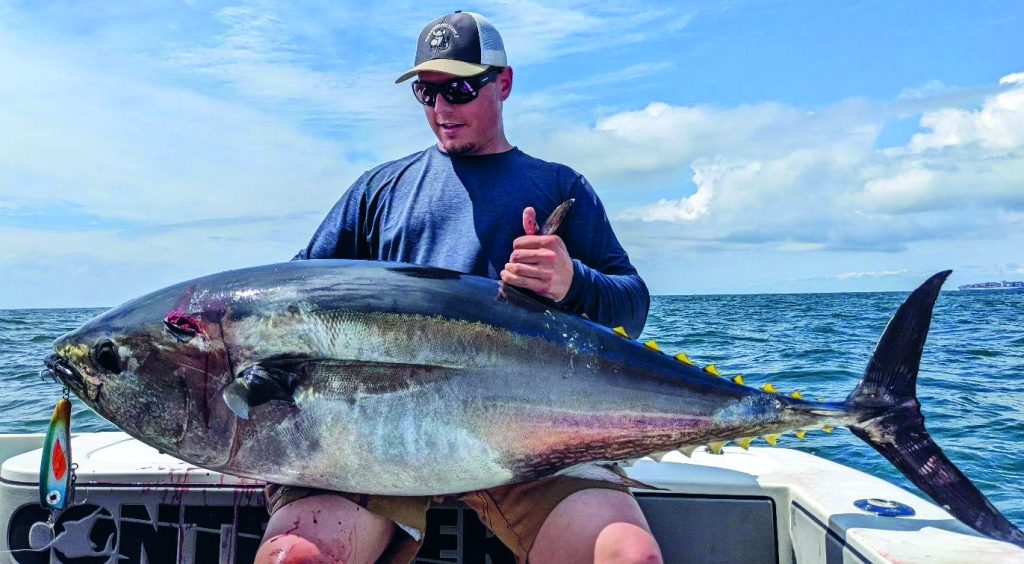
Along with inshore bluefin, cobia are great fighters and a great-eating fish. A heavy-duty rod-and-reel combo rigged with a large RonZ or Hogy eel should always be within arm’s reach when working anywhere from a mile to 10 miles off the beach. Two years ago, a pair of 60-pound cobia cruised by our vessel while we were fluking, so always be ready.
By now, the canyons should have plenty of yellowfin and some bigeye tuna, which are both great targets for the nighttime chunk. Chunked sardines or butterfish will bring tuna into the slick. Anglers getting their fill at night either switch to the troll in the morning or go “pot-hopping” for mahi.
Mahi are incredibly fast growers and prolific spawners, so there are usually a ton of them around. Small jigs, bucktails, chunked sardines, or butterfish will dupe mahi and, once hooked, there are often a few followers. Keep the fish in the water to pick off any other mahi trailing behind. Once they get smart to the bite, switch tactics or baits to reinvigorate the feed and catch a few more.
Summertime Surfcasting
Rather than fishing from a rocking boat or traversing jagged inlet rocks, some anglers prefer to feel the sand between their toes. Beaches offer ample opportunities for a variety of species that make fine table fare or are just fun to catch and release. Northern kingfish and spot inhabit the suds during summer months and can be easily caught with double-hook rigs tipped with small pieces of Fish Bites or cut bloodworm.
Surf fishermen interested in tangling with summertime sharks use kingfish or bunker heads during the extreme night tides. However, be careful and make sure to safely release coastal sharks by keeping them in the water and not dragging them up on the sand.
Fluke and small bluefish can be found in many of the cuts, drop-offs, or holes on the beaches during an ebb or flood tide. Slowly working small 1/2-ounce to 1-ounce bucktails tipped with Gulp in a fan-casted pattern will increase your chances of catching either species. Early mornings or dinnertime outings are the better times since the beaches are much less disturbed by summer crowds.
Fly Fishing in the Marshes
With most anglers concentrating their efforts on our typical summer species, many of the salt-marsh areas go untouched and unworked during the summer. However, if you’re a saltwater fly fisherman, grab a 7- or 8-weight with a sinking line and a few small Half & Halfs, Clousers, or Deceivers to find cooperative striped bass, and even some weakfish. These aren’t the cows of the spring or fall migrations, but rather smaller, aggressive bass in the 12- to 24-inch range. Since these fish are more belligerent, quicker strips are usually necessary, but don’t be surprised if you get bitten off or land a hound fish.
The best time to find feeding fish are early mornings just before sunrise or evenings as the sun ducks below the horizon. Striped bass are much more active during these hours than the rest of the day due to low light and cooler water temperatures. There is nothing like hearing or witnessing popping schoolies along the salt marshes during the summer, so get out there and enjoy it.
Related Content
Jigging for Fluke on the Flats