
Sunlight dissipated as Som Park, with his spear in hand, descended the water column through clouds of seaweed, slip gut, and tumbling silversides. The swift current surging through Manasquan Inlet inhibited visibility, but then he saw it, lying in wait on the sea floor for a meal to drift overhead. It was the longest fluke he had ever seen—a 29-inch “rug” destined to be plated, painted, printed, and framed. First, it’s dinner, then it’s decor.
Park, who developed his own gyotaku style, printed the rack of that 29-inch, 8.80-pound fluke to commemorate one of his proudest captures for years to come. “Photos are nice,” he said, “but too often, they get lost in the camera rolls of our cell phones and lose significance to the fisherman. My goal with each piece is to capture the fish’s unique characteristics and reflect its true size to give the customer a tangible representation of their catch.” Much like a trophy, a realistically detailed print of one’s personal best fluke or tournament-winning tuna deserves a spot on the living room wall. It’s a conversation starter; a piece of the sea that tells a story better than any framed iPhone shot.

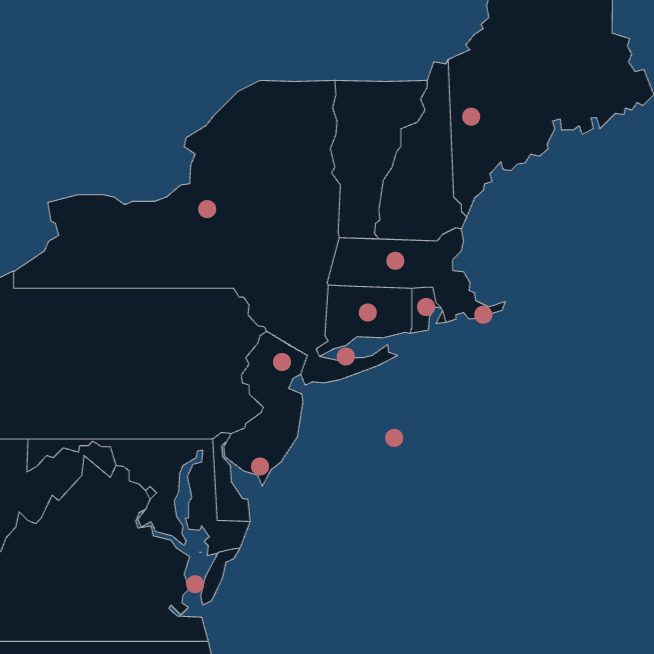
Park was born in 2000 in Pohang, South Korea—a city with 127 miles of coastline along the Sea of Japan—and lived there until age 7, when his family moved to the U.S. “Because of the proximity to saltwater, seafood is a major part of the Korean diet, and I was always fascinated by fish and marine life,” said Park. As a child, he spent his free time in libraries, buried in marine biology books. “I immersed myself in those interests and became very familiar with the anatomy of different fish species, from the positioning of their fins to the size and shape of their scales and mouths.” This preoccupation with fish later influenced his attention to detail in gyotaku, an art form that emphasizes anatomically accurate depictions of the fish being printed.
Upon landing in New Jersey in 2007, Park was excited to discover that his family had chosen to settle near the coast, but fishing would take a back seat as he adjusted to life in the States.
Park’s early artistic ventures consisted of basic studio art classes in school. “I elected to enroll in those courses because in East Asian culture there is a deep-rooted history in the arts. In fact, my uncle owns a studio in Korea, and in his prime, he was well known for his calligraphy artwork.” When it was time for college, Park expressed to his parents that he was interested in attending art school but wound up in the School of Pharmacy at Rutgers University. “An Asian kid going to art school just didn’t fly with them,” he joked, knowing they had his best interests in mind.
Park quickly discovered that pharmacy school wasn’t for him, and when the Covid-19 pandemic hit, a stimulus check and free time afforded him and his brother the opportunity to try spearfishing. “We fell in love with it,” he said. “I’ve been spearfishing for about six years now, and I do a lot of tuna fishing with my friends from the Atlantic Princess wreck to the canyons. But it wasn’t until I started struggling to keep track of my favorite fish photos that I experimented with gyotaku—the traditional Japanese art of preserving fish through prints.”
Photo-tracking issues aside, there was no single factor that led Park to gyotaku. “It was a natural trajectory—a combination of my hobbies and the fact that I like to preserve my catch beyond a picture,” he said. “I found it fascinating. That’s part of the appeal of gyotaku as wall art. It’s just a bit more interesting than a framed photo.”

Although he had found a lane to merge his passions for marine life and fishing through artistic expression, Park admits that his first few print attempts met with poor results. “I partnered with my dad, and it was a very frustrating process for both of us early on,” he said. “My family has a scientific background, so my father and I applied the scientific method to gyotaku to develop a process that would lead to the best finished product. We experimented with various paints of different viscosities and different canvas materials before refining the painting and drying steps. Through trial and error, we discovered that a slightly thicker ink that I brought back from Korea printed on fine linen cloth was the key. That was just over a year ago and since then, I’ve been doing this full time and have never looked back.”
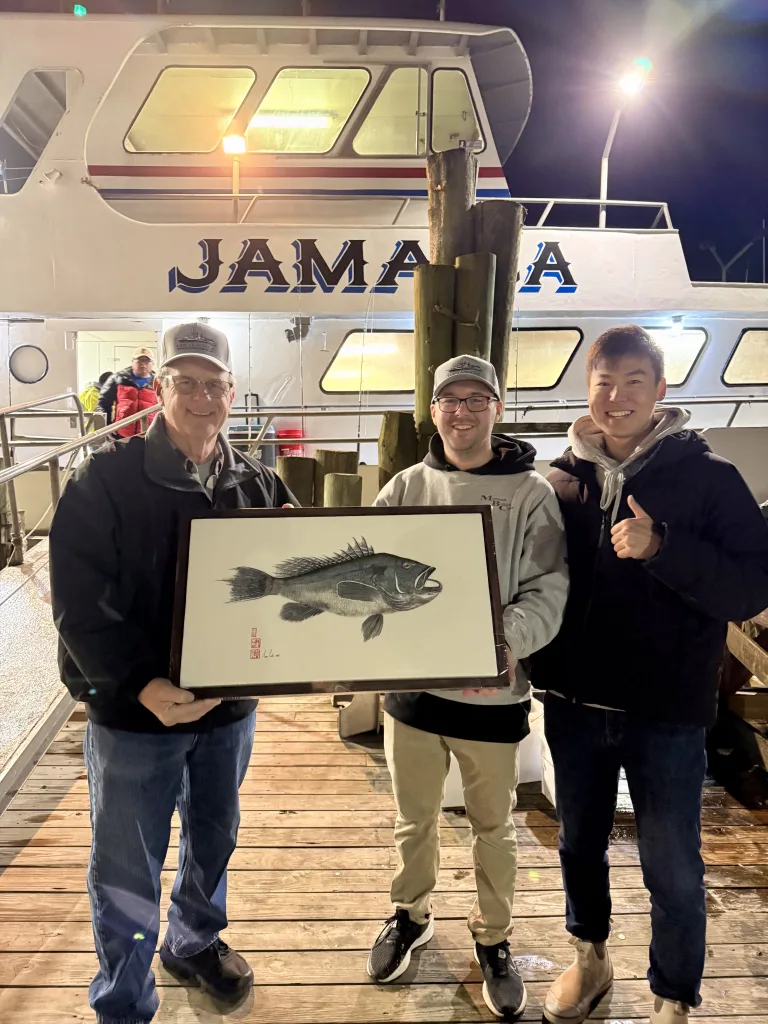
Beyond Park’s meticulous process, there is a lot that needs to happen for a print to be executed properly. It is the angler’s responsibility to keep the fish on ice and deliver it to him in a timely fashion. He then transports the fish to his studio, where it is completely dried of all moisture and slime. From there, he paints every inch of the fish’s flank. “Upon application, I make sure there are no puddles of ink,” said Park. “Minimalism is crucial.” The base layer is very light, but there needs to be just enough ink that it won’t dry before the second layer. “It’s a fine line we’re walking,” said Park. “Time is of the essence, but I also cannot afford to rush. If I’m painting a fluke and I don’t apply enough ink on the base layer, it could dry before I’ve completed the second layer, which details the spots, fins, and scale patterns unique to the fish.” Conversely, if he applies too much ink on the base layer, the details of the second layer will not appear in contrast.
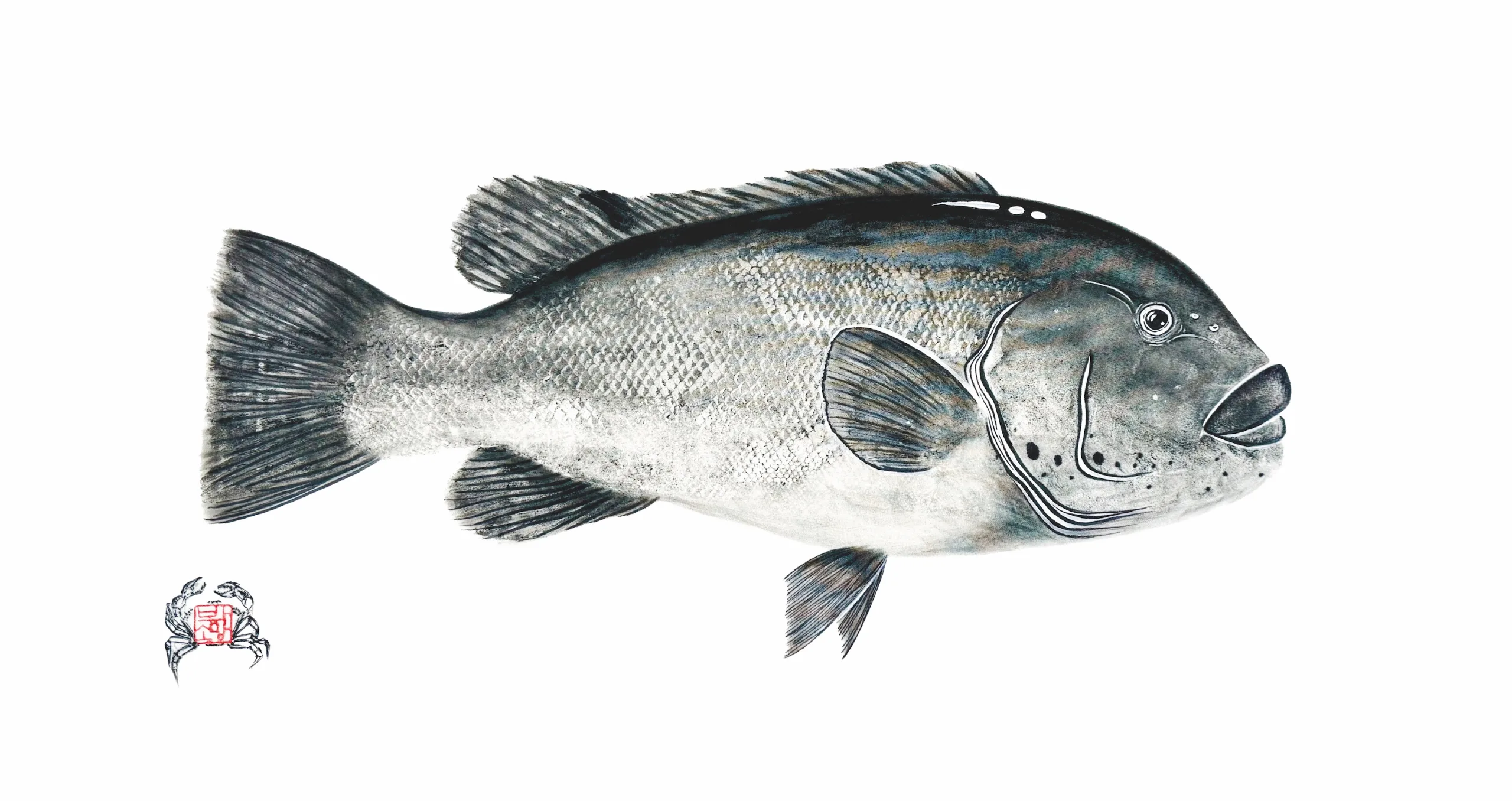
Assuming all goes as planned, Park then takes a pre-cut, appropriately sized cloth and carefully lays it over the fish. It helps to have an extra set of hands during this step to keep the fish centered and avoid creases or folds. Once the cloth is applied, delicate, evenly distributed pressure is needed to get the ink off the fish. After every inch has been gently pressed to its body, the cloth is removed and dried in a controlled environment which, in Park’s case, is an empty closet in his studio. “Generally, it takes about 15 minutes for a piece to fully dry, but it varies depending on the size of the fish and amount of ink used. For example, a tautog has a very dark back, so it takes more ink and more time to dry than the mottled white underbelly, where less ink is used.”
Tautog are Park’s favorite species to print. “Of all the fish in the Northeast, blackfish vary the most in terms of shapes and sizes. I’ve seen a long, slender 18-pound tog with a flat face and another that was shorter and stockier with a rounded jaw and head. Every one looks different, and that gives each fish its own personality.”
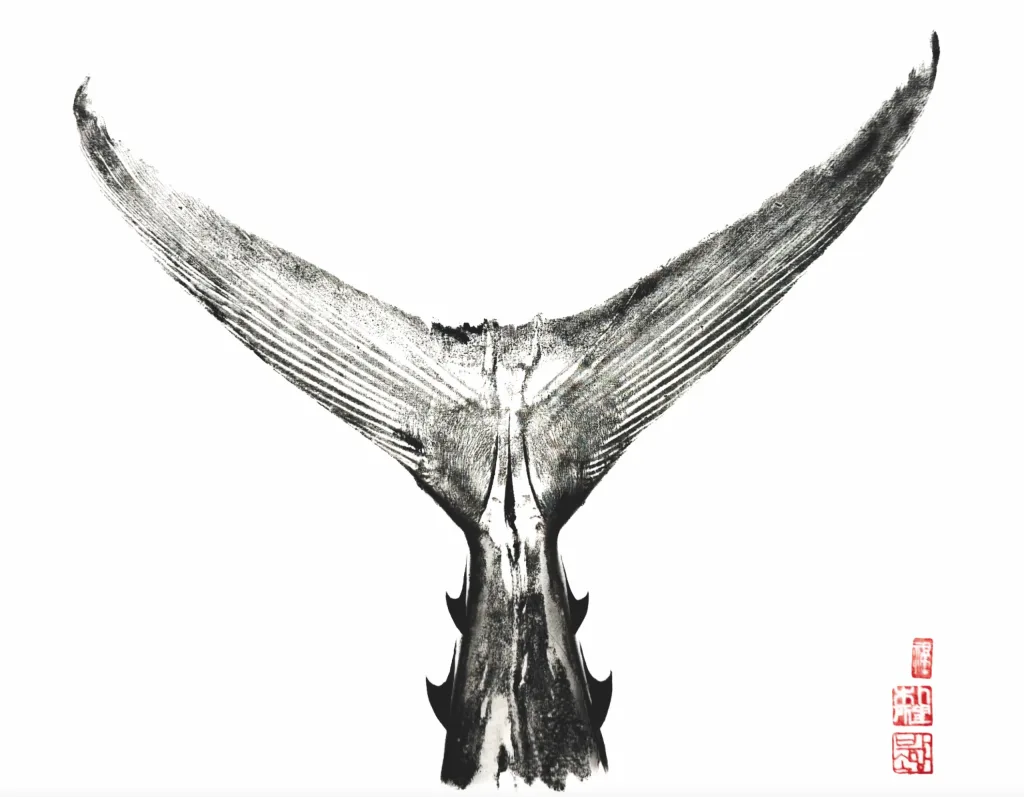
Tuna is his runner up. “Tuna tails are very popular, but I enjoy painting the whole tuna. Not only are they much larger, but their shape is somewhat spherical and 3-dimensional. Trying to capture that depth to make the fish appear as if it’s popping off the canvas is another challenge. I struggled with the geometry of tuna at first, but now they’re one of my more popular requests.”

On top of his fish-printing services, Park offers do-it-yourself gyotaku kits that contain the same cloth, brushes, and specific paint from South Korea that he uses in the studio along with step-by-step instructions. “Many people want to give it a shot with their family and friends. It’s fun to see what fishermen can do with their catch when you give them the tools to get creative,” he said.
Since branding his work and services as Gyotaku by Som over a year ago, Park’s operation has seen impressive growth. He has worked with local fishing clubs, been invited to tournaments like the Montauk Canyon Challenge, and has even partnered with Spring Lake Seafood to offer gyotaku workshops paired with tapas-style dishes.
Above all else, the part of the process he most enjoys is talking to clients about their catch. “When someone goes out of their way to get a fish to me, I know it is special to them. There’s a story behind each catch, and those stories drive me to go above and beyond to deliver their vision. Whether it’s someone’s biggest tournament tuna, their granddaughters first keeper sea bass, or a new personal best fluke, understanding the importance of that fish and creating a print they are proud of is the most rewarding part of the job,” Park noted. “Of course, having the freedom to go fishing when I like is also a plus, but it is secondary to the fishermen’s tales.”
» Follow Som Park on Instagram @gyotaku.by.som
» Visit www.gyotakubysom.com
READ MORE


