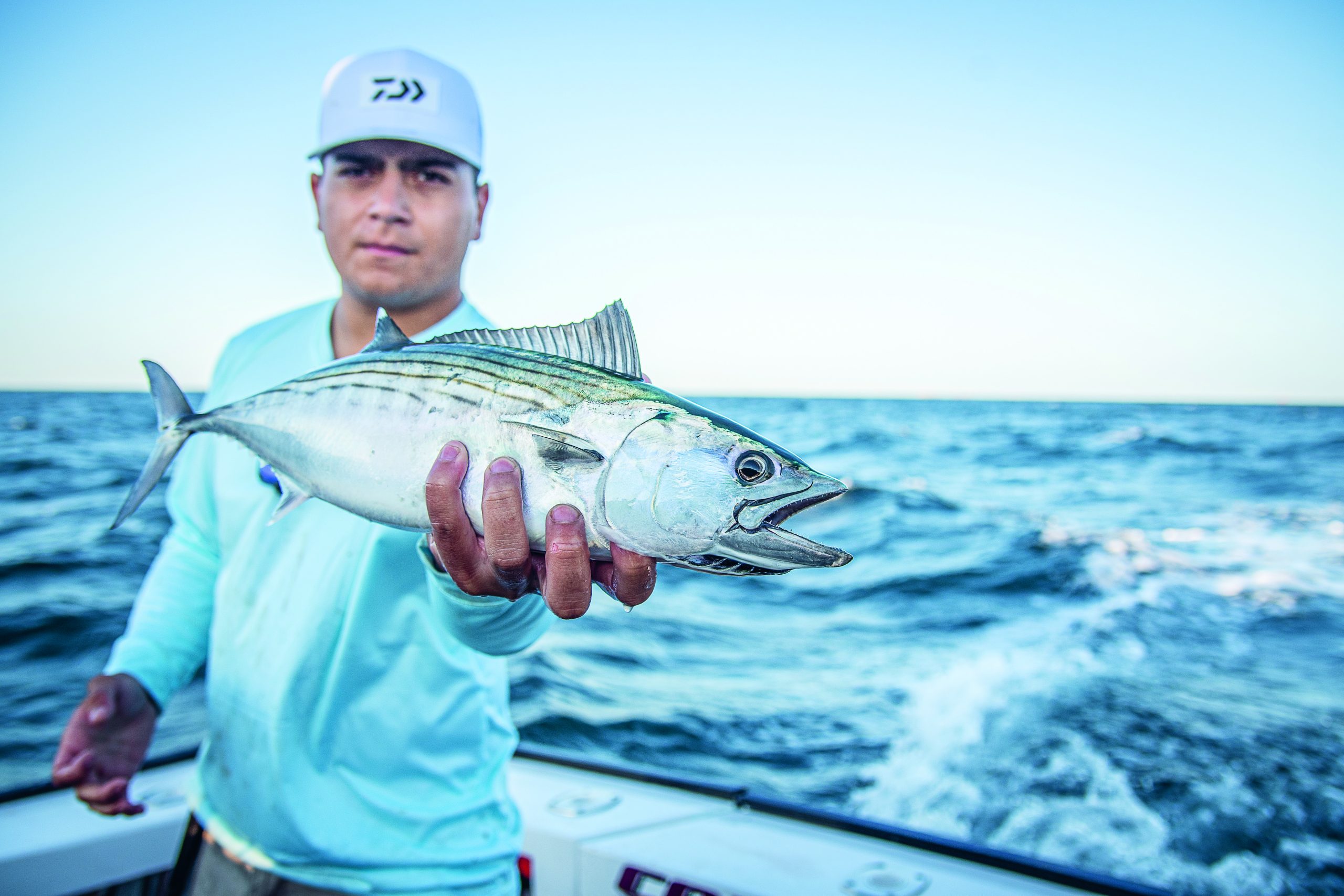

“There!” Nick Hanney shouted, pointing his rod tip at a loose knot of terns working the water 200 yards off our bow. Below the birds, short white streaks tore across the surface — baitfish meeting a violent end in the jaws of one of the fastest inshore gamefish in the Atlantic. Nick throttled toward the birds, I flipped the bail on my spinning reel, and the moment the lure landed and I twitched it twice, the rod bent to the grip. My first Atlantic bonito of the year had just hit the afterburners.

The Atlantic Bonito
Atlantic bonito are a widespread species, with populations along the east coast of the United States and across the ocean in Europe and Africa, where they are far more popular as both a food and sport fish. While there’s been relatively little research or tagging efforts done on bonito on our side of the Atlantic, in Spain, they are heavily studied, and there have even been efforts to breed bonito in captivity. All we know about them is that they are scarce during some years and wildly abundant in others.
Besides the Northeast in the summer and fall, bonito appear off the Carolinas in early spring, where a few anglers take advantage of the fun light-tackle fishing they provide.

Bonito belong the Scombrid family, making them relatives of mackerel and tuna. They have an average lifespan of 4 to 5 years, during which they grow to sizes in excess of 10 pounds. The largest specimens live across the ocean, including the largest ever captured on rod and reel, an 18-pound, 4-ouncer from the Azores in 1953.
Anglers often lump bonito in with albies, since the two species have a similar look and are fished similarly. Many anglers believe bonito swim faster than false albacore, but lack the strength and endurance of little tunny. Bonito also have a higher tolerance for cold water than albies, and they arrive earlier and stay later in the Northeast.
One of the most noticeable differences between an albie and a bonito is that a bonito’s mouth is full of needlelike teeth. While albies are content ram-feeding on nearly invisible anchovies, bonito tend to favor larger baits like full-size silversides and peanut bunker.

Bonito Techniques
While most of the albie fishing in the Northeast and mid-Atlantic centers around running and gunning after blitzing fish with light tackle or fly rods, bonito techniques are more varied. Anglers happily troll, chum, or run and gun for bones, depending on the time of year and location.
Trolling
Most years, trolling is the most effective way to catch bonito. As their schools settle over rips, shoals, and lumps, anglers set a spread of two to four rods, depending on the size of their boats. The lures that end up in a bonito spread varies depending on the region.
Off southern New Jersey, where I first fished for bonito, captains favor the Clark Spoon—a wafer thin, metal lure with an integrated hook—trolled behind a drail weight or planer board. Some, like my good friend John Grymzko, add some small trolling feathers to the spread, which has the added benefit of fooling the occasional school bluefin tuna.

When I moved to New England, I learned that Cape Cod captains overwhelmingly use small, deep-diving plugs. A repurposed salmon lure, the Rebel Fas-Trac, did the heavy lifting for the Cape Cod and Rhode Island bonito trollers in the 1990s and 2000s, until it was discontinued. Anglers haven’t missed a beat, though, as the Rapala X-Rap Magnum 10 proved to be an improvement over the old Rebel.

I learned from Captain Doug Toback that scaled-down spreader bars make a deadly bonito presentation. The heavier tackle required to troll small spreaders deadens the fight of the bonito a bit, but the improved chances of raising a wayward bluefin makes it worthwhile. Bonito trolling speeds begin at 5 knots and move up from there, depending on whether there are bluefish plaguing your spread.

Chumming
While it’s standard operating procedure for the headboat fleet, chumming for bonito is rarely employed by private boaters. It is, after all, a messy endeavor that, done right, requires considerable prep work.
Deploying a gallon of frozen bunker chum can pull in bonito, though it also pulls in sharks that will happily eat any hooked bonito. Chumming with whole, dead silversides better targets bonito and other inshore pelagics like Spanish mackerel, false albacore, mahi, and small bluefin without attracting the taxman.
A half- to three-quarter-full bucket of fresh silversides seined the day before the trip should cover a few hours of fishing. Set aside the largest silversides as your bait. Drift them back into the slick with a small, but strong hook snelled to a 12-pound-test leader fished on light spinning tackle. When the bonito find your chum line, you can also cast epoxy-style jigs, Albie Snax, other plastics, or even small topwater lures like Rebel Jumping’ Minnows.

Run and Gun
No different from albie fishing, running and gunning for bonito involves locating a school of feeding fish (most often under small seabirds like terns or juvenile gulls), positioning the boat in range, and casting into the melee. While you may be tempted to retrieve at the breakneck speeds that are effective for albies, bonito respond best to moderately paced retrieves.
As for lures, bonito fall for all the same offerings as false albacore, including epoxy-style jigs, Albie Snax, 4-inch RonZs, as well as a wide range of baitfish-imitating flies like the Bonito Bunny developed by Captain Jamie Boyle of Martha’s Vineyard.

Atlantic Bonito From Shore
Bonito infrequently feed in surfcasting range in New York, New Jersey, and Connecticut, but in Rhode Island and Massachusetts, fishermen catch bonito from shore every season. Two of the most reliable areas include Great Point on Nantucket and South County, Rhode Island. During years like 2024, when big schools of bonito moved inshore, the fish popped up in the Cape Cod Canal and along the beaches on the south side of Cape Cod.

Casting distance is a consideration when choosing bonito lures for shore-bound pursuits, especially from open beaches, so fishermen tend to use larger, heavier epoxy jigs to cover more water. As with boat fishing, moderate retrieve speeds tend to generate more strikes. Last year, while pursuing November bonito, I discovered that many of the anglers having success had traded in their epoxy jigs and Albie Snax for small minnow plugs. In the rapidly cooling waters, slower retrieves were the key, and the minnow plugs provided enticing action while remaining in the strike zone.

Bonito Recipe – Steak them up!
Bonito have a mild flesh that can be grilled, seared, or served as sashimi. It’s a bit soft, but when steaked, instead of filleted, the meat holds together beautifully on the grill.

Grilled Spicy Bonito Steaks
- 4 bonito steaks
- 1/3 cup butter
- 1/4 cup lime juice
- 1/4 cup hot sauce (I use Frank’s)
- 1/2 teaspoon garlic powder
Over low heat, melt the butter in a metal baking dish. Stir in the lime juice, hot sauce, and garlic powder. Add the steaks to the pan to marinate for a few minutes. (Keep the pan warm or the butter will congeal.) Grill the fish on high heat for about 4 minutes per side, basting with the excess marinade as you go. The melted butter will cause flare-ups on the grill that will help get a nice char on the fish. Once the fish is cooked to 145 degrees in the thickest part, heat the reserved marinade, whisk it, and drizzle on top before serving.
READ MORE