
When I approach the water’s edge, I often feel a sense of calm, but not for the typical leisurely reasons associated with ocean play. Instead, my serenity is born from a unique helplessness that comes in the face of things that cannot be changed or conquered with wit or brute force. Like a fall from a high perch, there is no muscle that can reverse the trajectory; there is only surrender. There’s comfort in the inescapable fact that I am ill-equipped and meek in comparison to the vastness, the depth, and the wild nature of the rolling swell, and the creatures that evolved to thrive in that salty soup.
I am armed only with a small surf belt and bags, crafted and sewn together out of sailcloth. In them are a few plastic tubes filled with the evening’s selection of plugs, which I cast out, hoping to fool a striped bass into thinking that my offering belongs there and is good to eat. So goes my nightly routine as a surfcaster pursuing striped bass.
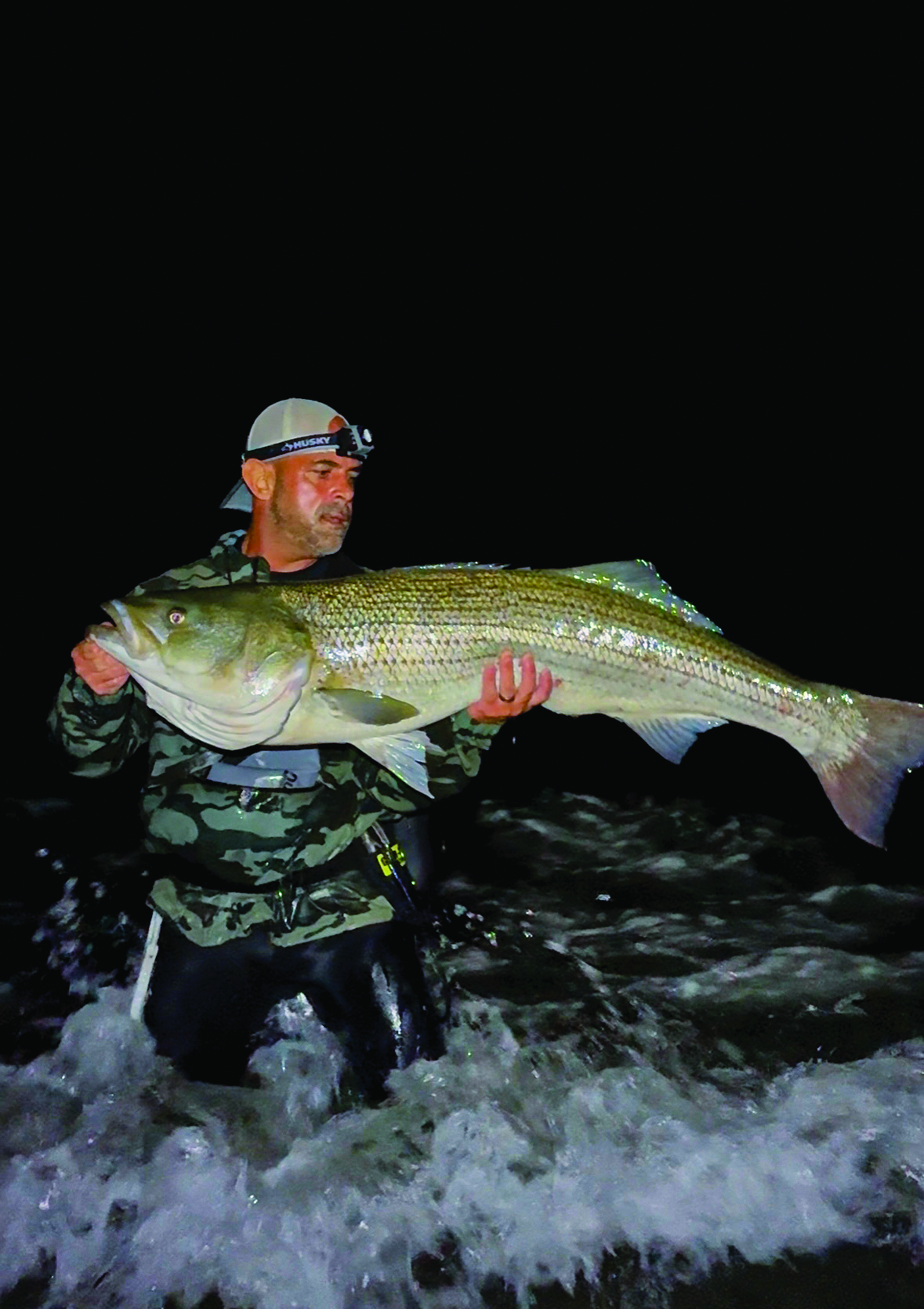
There’s comedy here somewhere, woven into my elaborate attempts to trick a wild fish. I squeeze into my wetsuit and clumsily bobble around in the water at night, swimming and climbing up on rocks to get a reprieve from the waves and improve my perceived vantage point in the “hunt.” When I succeed, my friends and I pose right out there in the water and have a little photoshoot to capture the memory of bringing a bass to hand. And, as photos will attest, I am usually wielding some pricy surf gear—top-of-the-line rods and reels, the best money can buy, all while simultaneously pouring urine into my wetsuit like a 200-pound aquatic toddler until I decide to call it quits and head home. This is when I start calculating my surfcaster’s “sleep math” as I pull into my neighborhood. If I fall asleep in X minutes and sleep until Y, that will be about two hours and 44 minutes of sleep. Not bad.
In the context of this seemingly ridiculous pursuit, it’s clear there are so many factors out of my control when I get into the ocean. Because of this, I think there is a hyper-focus baked into the surfcasting culture to control what we can. The plugs that occupy the tubes in my surf bag are an attempt to insert my own order into the chaos. Lures are like my special ingredients in a recipe that was written and revised over many years. Each night, I take great care selecting what styles, colors, and profiles I decide to bring along. Despite my intention to always have a well-rounded variety, there is one plug that preoccupies and bewilders me above all others.
With its rudimentary design, the needlefish doesn’t “swim” like other plugs. It doesn’t rely on tantalizing wobbles or vibration to coax striped bass into a strike, nor does it comfort the surfcaster with tactile feedback as it’s reeled through the water. It has no lip or proprietary hydrodynamic body design to aid in its action. It is, essentially, a wooden or plastic-molded stick with hooks, and if you were to see one on a tackle store shelf you might surmise, as I once did, that it’s the dumbest-looking fishing lure that exists.
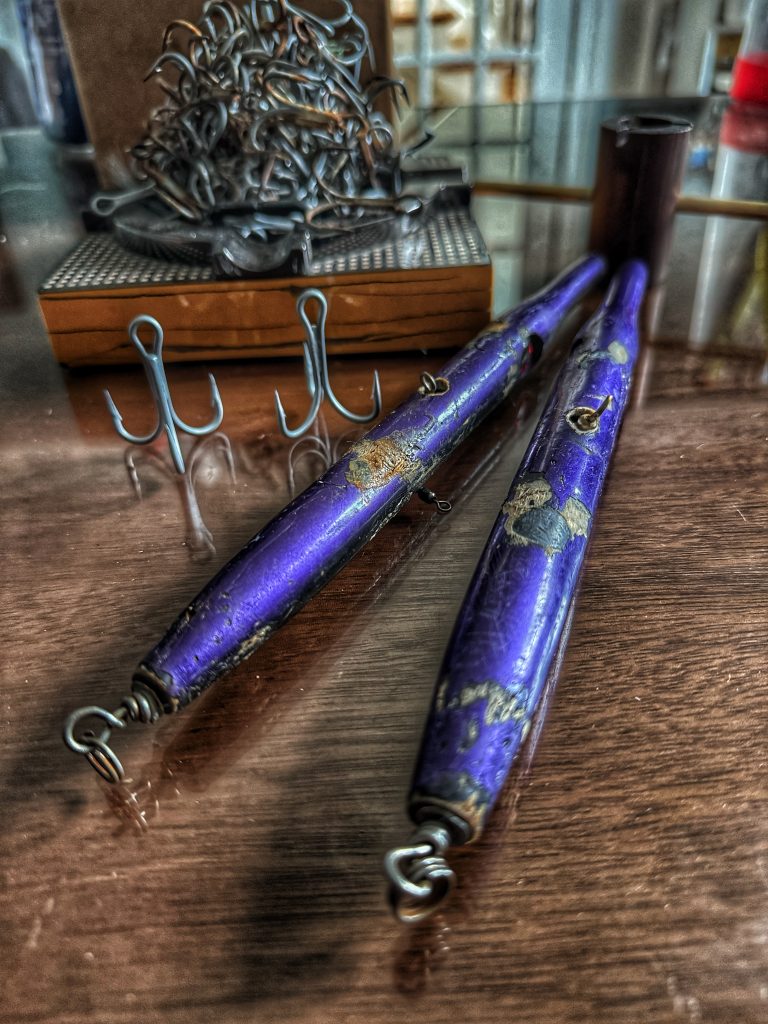
To make matters worse, as a target food source for striped bass, actual needlefish are not extremely common in the waters surrounding Cape Cod, at least not in my experience. I have seen them on a few occasions, but they fall far down on the list behind the more common baitfish like mackerel, bunker, herring, lobsters, crabs, scup, and eels. It is logical that the plugs I use should mimic and resemble the actual baitfish bass like to target, but like so many revelations that come with a descent into the surfcasting rabbit hole, suppositions don’t always align with reality.
So, now that I have established that needlefish plugs look absurd and are a crude imitation of a seemingly elusive baitfish, I must get to the irony at hand. Needlefish are my preferred “big fish plugs” and, on most nights, they occupy the most real estate in my surf bag. If I were faced with the unfortunate fate of having to use only one lure for the rest of my days, I’d choose the needle.
If you are looking for some swanky wisdom as to why they work so well, you will be disappointed. However, I will attest that they are the most effective lure you can use in the surf, particularly if you fish at night or in very low-light conditions, which I do almost exclusively. Despite my own bewilderment as to why striped bass are attracted to needles, I have strong convictions, from a pragmatic standpoint, as to why the plug rises to the top of my list of weapons as I target large striped bass in the surf. While there is a time and place for all types of surf plugs, the needlefish offers the widest array of advantages in the areas I frequent most. In this context I will discuss profile, distance, and targeted depth in the water column.
Profile

The flap at the top of my surf bag is reinforced with both Velcro and a plastic buckle. On this night, I didn’t bother with the buckle because I was changing lures frequently, trying to cull out smaller fish. When I am in the water, I face a myriad of problems. The increasing presence of sharks, big surf, sketchy terrain, deteriorating eyesight, and hooking myself are just a few that come to mind. On a recent trip, I had the best kind of problem a surfcaster can dream of having. There were too many big fish. In every direction, I was surrounded by what can only be described as a biomass of large striped bass. (I should mention that this phenomenon is exceedingly rare, and this instance was not the result of some inherent Jedi intuition, but rather the result of some dumb luck and intel from a close friend.)
After two hours of hooking and releasing endless 22- to 30-pound bass, I couldn’t help but selfishly ponder how many giant bass were in this pod of fish. Even when moving through the thigh-deep water, hundreds of large fish were spooking and swirling at my feet. At this point, it was clear that this was a numbers game. There were hundreds, if not thousands, of fish around me. They were all big, but I knew there had to be even bigger ones mixed in. How do I get through the big fish and target 35 pounders and larger?
All night, I had alternated between a 12-inch rigged Slug-Go and a 9-inch slow-sinking needlefish. Both were producing well but were hooking the same 25- to 30-pound fish, over and over. It is also worth noting that given the absurdity of the bite my buddies and I had stumbled on, midway through the tide, we decided to wager a friendly tournament. Biggest fish wins. Game on.
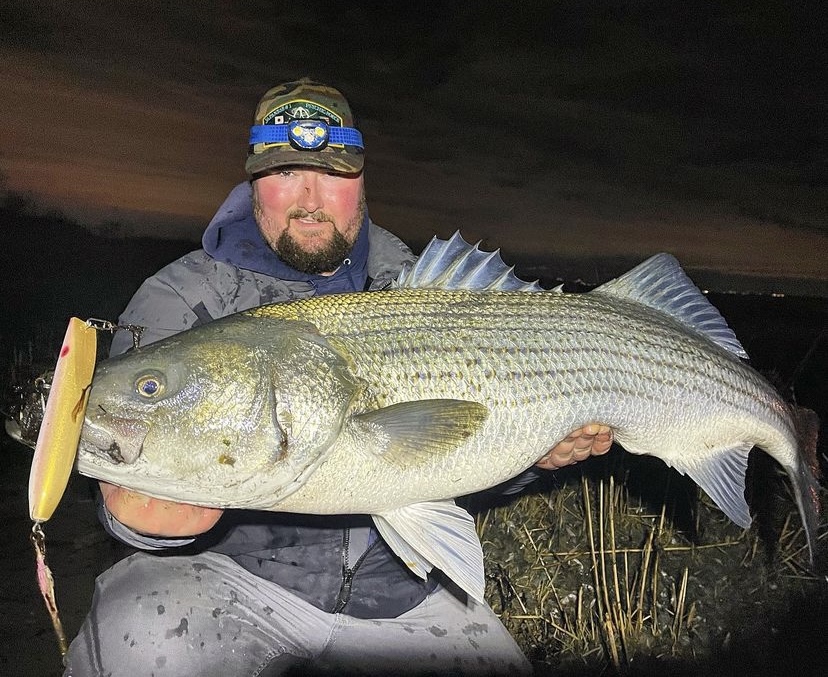
It was time to switch it up, so I pulled out a huge needlefish that I had purchased at a plug show earlier that spring. It was 11 inches long, with a single oversized belly treble. I hadn’t cast it until this moment and rarely brought it with me because the sheer size makes it hard to fit in my bag. On my first cast, I felt that familiar thump, but I immediately recognized that the weight of this fish was more substantial. After a few initial head shakes on the surface, the fish started to peel drag from my reel. After a good fight, I was able to get it to my feet. She taped out at just over 46 inches and weighed just shy of 35 pounds, not a giant of a lifetime or even my biggest of the season, but it was a noticeable bump up in size-class. It was clear that upsizing may have made smaller fish think twice about attacking such a large profile, allowing a chance for a bigger fish to strike.
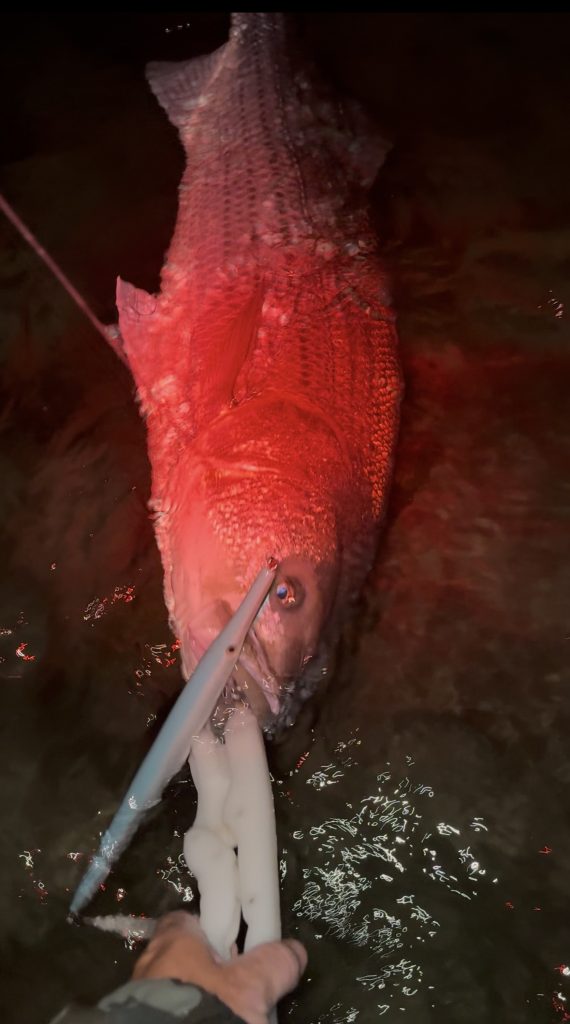
In surfcasting, many perceived patterns can be the result of luck and circumstance. I am not suggesting that throwing a giant needlefish will always, or even often, result in hooking up with larger fish. However, given the circumstances, surrounded by a school of large fish of varying sizes, I think that intentionally upsizing the profile was a key factor in culling smaller fish from getting in the way of my target. The following cast resulted in a fish of the same size, both the biggest of the night. And, yes, I was victorious in our friendly tournament, thanks to the oversized profile of the High Hook Dinner Catcher needlefish.
Although one could claim that this method could be employed with other common plugs like darters or metal lips, those options simply don’t offer such a wide range of profile sizes. Most fall within a smaller range. I would argue that over 90% of darters are of similar size. I have never seen an 11- or 14-inch darter, and the same goes for metal lips. The extremely wide size range of needles offers a unique advantage when the need to cull smaller fish arises. It is not foolproof, but I have experienced enough success with drastically upsizing my offering to believe that it is a useful method when conditions are right.
Distance
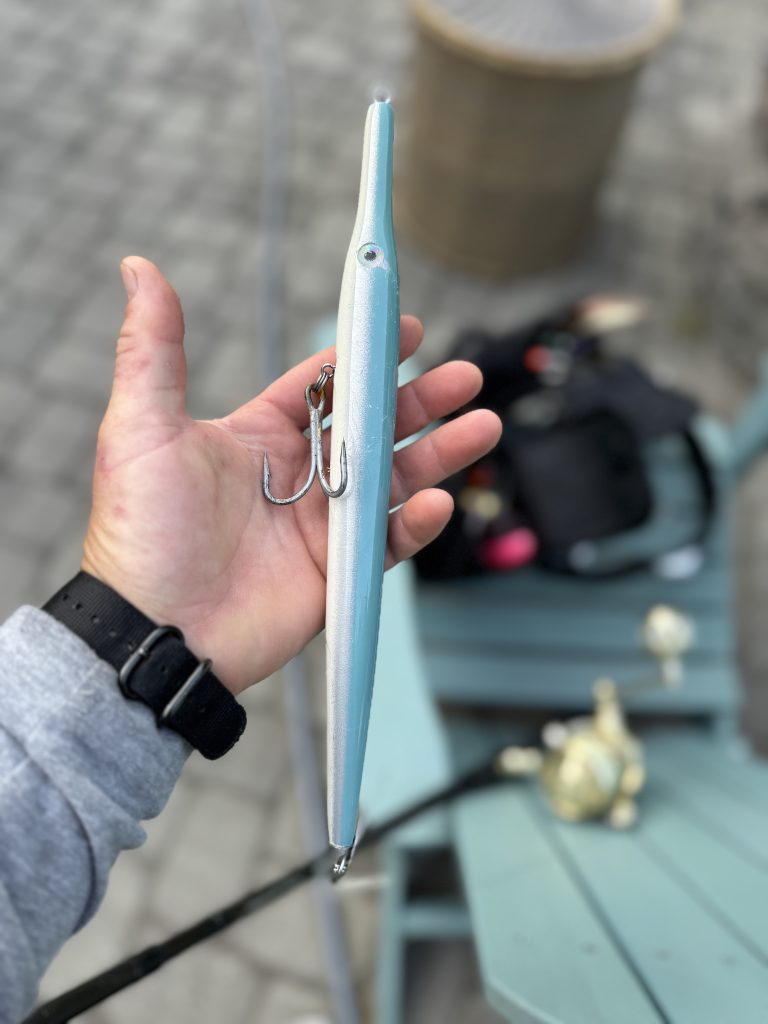
The most advantageous but least glorious needlefish attribute is its ability to cast great distances. Simply put, one cannot catch fish that are out of reach. It is a fear of mine, standing at the water’s edge, that fish are always just out of reach. When the fishing is slow, my mind wanders and I suspect that just beyond my cast, there are fish that I can’t reach with soft plastics, darters, and metal lips. Needles come in a variety of weights, and my favorite styles typically cast like rockets. The 24/7 Lures 9-inch slow-sinking needle is one of my favorites to cast when I arrive at a spot. The slim profile has minimal drag in the air and casts extremely well, even in windy conditions.
Maximizing casting distance severely broadens my immediate search perimeter. As a shore-bound angler, the amount of water I can access is infinitesimal compared to the expanse of the ocean, so it is vital to maximize my distance when searching for fish. There is also a mental aspect to it. Believing I can reach a larger area of water gives me confidence to keep going when the fishing is slow. I can’t stress the number of nights I almost called it quits and ended up connecting with a good fish simply because I stayed an extra 15 minutes. Bombing a properly weighted needlefish into the dark night, feeling it land off in the distance, starting that long, painfully slow retrieve, and anticipating the moment it gets slammed by a fish has kept me awake and focused through many tides where I had little reason for hope. Several spots that I fish would be essentially “unfishable” without using needlefish simply due to the distance where the fish like to set up. No other effective options exist to reach the strike zone.
Depth
When I pack my gear to head out at night, I typically bring a variety of needles. Although I have colors that I gravitate toward (usually the darker the better), I am more concerned with how they will perform in the water as far as getting them in a favorable zone in the water column. Luckily, most needles are designed and weighted to accomplish just that. It is typical for these lures to have ratings related to their sink speed. Floating, slow sink, and fast sink are the common classifications that plug builders use to describe this. Matching the appropriate sink-speed with the right conditions can be the difference between catching fish or not.
I use slow-sinking needles most of the time. Many of my favorite spots are shallow, usually less than 6 to 8 feet of water. A slow-sink needle simply refers to the speed at which it sinks when not actively being retrieved through the water. Once the appropriate depth is reached, I start retrieving, just fast enough to keep contact with the plug. Subtle rod twitches and occasional pauses often result in a strike. Other times, a painfully slow retrieve with no twitching is all it takes. Most times, I don’t even wait for the needle to sink at all. Since a slow-sink needle typically rises up just at or below the surface after the first few cranks of the reel, I waste no time waiting for it to sink to some perceived “strike zone.” For this same reason, I never use floating needles as I find slow sinkers keep better contact with the water due to the added weight—they essentially stay right on top once retrieved. In shallow water, there is typically no need to get to the bottom since bass will happily attack a well-placed needle that is a few feet overhead.
On occasion, I use a fast-sinking needle to access deeper water. This is when you can use similar retrieve methods or you can also cover the full depth of the water column by making a jigging motion with your surf rod. On any given night, I cycle through varying retrieve speeds and tactics, almost without thinking about it, to see what is working. Just by switching the style of needle, I have the ability to target the depth that I want. Metal lips are also designed to dive to certain depths, but the target depth can be harder to achieve with accuracy versus the simplicity of a weighted stick that simply sinks to depth.
More than anything else, striped bass love to strike needlefish lures. I may never fully understand why a wooden stick being dragged through the water is attractive to them; however, over time, I stopped asking questions and I found peace in the data. Needles have brought more large fish to my feet than any other plug. They require little skill to work properly, cover the most water, and have a habit of catching large fish. The only downside I can see is the lack of “feedback” a needle offers to the novice. Lipped lures, like minnow plugs or metal lips, allow you to feel when they are “swimming” properly, sending a pulse through the tip of the rod. A needle offers only the most subtle resistance in the water, leaving you wondering if it’s “working.” Keep casting and find your confidence. You will know it’s working based on the number of fish you catch. Once you have the confidence in that absurd stick, you will never enter the water without one.
READ MORE