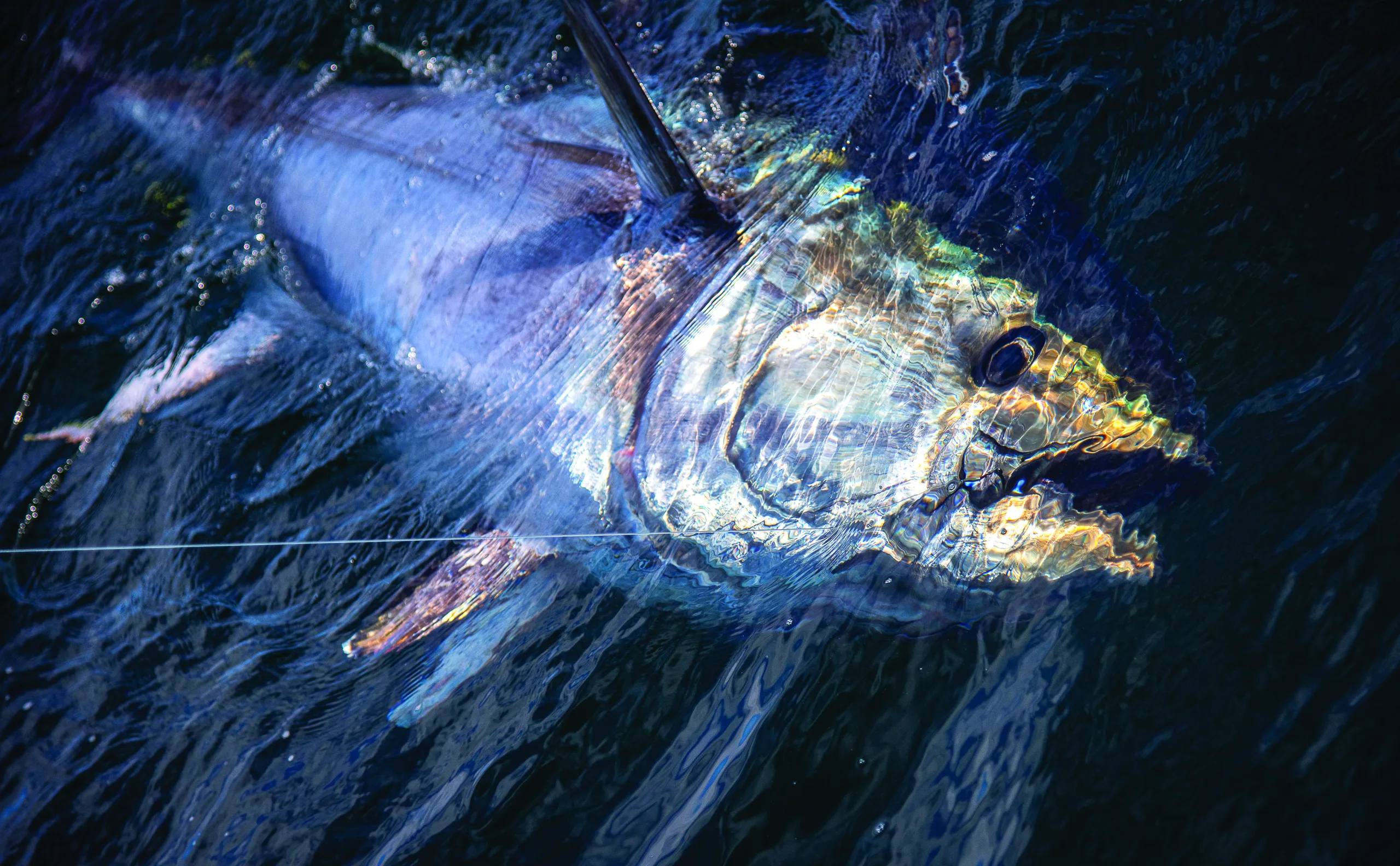
“Are you freakin’ kidding me?!” I screamed as fish the size of Volkswagen Beetle began to blow up around the boat while dozens of menhaden sprayed around us. We were in the middle of one of the craziest feeds I’d ever seen. What made it even crazier was that we were two miles off Rockaway with an iconic New York City skyline as the backdrop.
Yet, we couldn’t buy a bite … and I’m not sure we wanted one. These were 100-inch-class fish. If we managed to stick one? Fun for the first 30 minutes. Not so fun after that. And, I knew there was a pretty low percentage of actually landing one. Still, I’m in the entertainment business, so I wasn’t about to leave. Catch or no-catch, just being around this spectacle was pretty darn cool.
A dozen feeds and a hundred casts later, the fleet had found us, and the crowds began to build. I was about ready to pivot to striped bass when one of my guys, mid-retrieve, predictably said, “I’ve had enou-” Before he could get that last syllable out, 20 feet from the boat, a giant bluefin turned on its side, flared its gill plates and inhaled a 9-inch Hogy Paddle Tail, damn near ripping the rod out his hand.
“Set the hook!” I screamed, as a look of shocked disbelief covered his face.
Ten miles, three hours, and maybe a dozen rod pass-offs later, we were still playing a physically demanding game of tug-of-war. We saw the fish a couple times, but it seemed all we were really doing was following it.
But then it came up 50 feet from the boat, turned on its side, and looked as if it might be ready to capitulate. I grabbed the harpoon, but if fish had fingers, I’m pretty sure which one would have been sticking up at us. After a couple of tail splashes, it dove, and then a sudden pop sent the angler tumbling backwards.
It ain’t easy!
Truthfully, that’s how most of them end.
Landing a fish like that on spinning gear isn’t easy. In fact, it’s damn hard.
“They’re definitely not charter fish,” says Captain Darren Dagastino from One More Cast Charters. “You can’t expect guys to pay for frustration, punishment, and, ultimately, disappointment.”
Maybe I’m a sadist, but I love this stuff. Because if you do hook up, it’s the craziest blistering run you’ll ever witness. True unadulterated saltwater power. These fish will dump a 400-yard spool at full drag if you don’t get the boat in gear quickly enough to follow them.
And the adrenaline dumps? “I don’t know about you, but my heart rate skyrockets just seeing them,” says Captain Gene Quigley of Shore Catch Charters. “You stick one, though, there’s no better sound in the world than 100-pound braid melting off a Stella. If that doesn’t give you an adrenaline high, you need to quit fishing.”
He’s 100% right, of course. It’s pretty freakin’ awesome—the “Oh my gods,” the not-believing-what you’re-seeing, the moment of disbelief when (if?) a giant comes up and smashes your offering. It’s all very surreal, like you’re existing in an alternate marine world even though, in most cases, you can see land. And, ultimately, if you do manage to land one, it’s sublime.
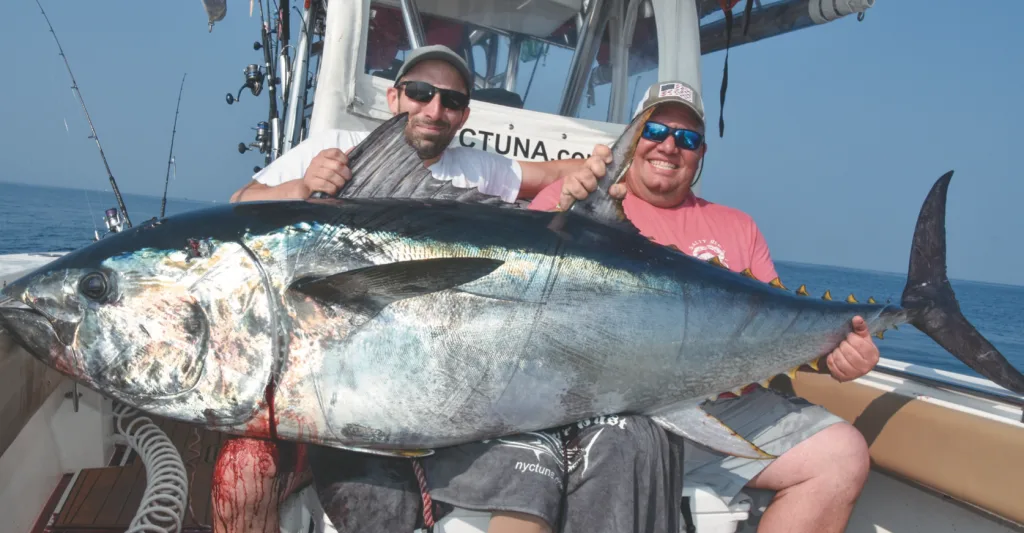
But, like anything truly awesome …
It Comes with a Price
For one, chasing giant tuna on spinning gear is frustrating.
It’s not unusual to make a hundred casts into feeds and not get a bite. This can be surprising because there are often dozens of giants feeding, and you fully expect to get a bite with every cast. I don’t care what you’re using, though, it will be ignored most of the time.
“I think they get in this shallow water, they get super spooky and may be less willing to eat something that doesn’t look quite right, especially when they’ve got boats running over them,” says Quigley. “Everything has to come together. You have to have a day when there are a lot of fish around—rather than ones and twos popping up here and there, minimal boat traffic, and, most importantly, the fish seem to be unusually aggressive.” Unfortunately, that doesn’t happen often.
When you do see them come up? Of course, you run and gun!
Anglers experience a powerful adrenaline jolt when they see a fish weighing hundreds of pounds blast bait. There’s a primal sense of the hunt and, ultimately, the chase. So of course you pin that throttle and run them down like a maniac!
But that ain’t the “right” way.

You might get one doing that, but most of those big fish we’ve stuck over the last several years were the result of being in the right place at the right time, on days when we’ve had the fish come up around the boat rather than having to chase them.
We also got quite a few bites well after any surface activity died down, blind-casting in the general area we saw them last.
But, come on, who’s got the willpower to do that? Certainly not me. If I see a blowup or two, I’m burning it over there as quickly as I can. I can’t help myself, and neither can most red-blooded anglers. The guys who are really good at this seem to have the willpower and patience most of us don’t.
You must be able to cast heavy tackle long and quickly. When I say heavy, I mean 20k-class reels and 7- to 8-foot heavy-duty popping rods. There are many manufacturers who make popping rods these days, but there are only two reels capable of handling big bluefin: the Daiwa Saltiga 20k and 25k and the Shimano Stella 20k, 25K, and 30k. These are big reels with lots of line capacity and 60 pounds of drag—you will need all of it.
When you do get one of these tuna to eat…
Then Comes the Pain
Hooking one is the easy part, relatively speaking. Once (or if) you stick one, they all do pretty much the same thing. It goes for two or three (or sometimes more) blistering horizontal runs while the boat follows to keep the angler from getting spooled. That’s the fun part, when everyone is hooting and marveling at the tuna’s unbelievable speed and strength.
Then they dog down and a long, painful tug-of-war begins. Gain a few feet, lose a few feet, for hours. This is not like a striped bass, where the reel’s drag does the work. If you want any chance of landing a giant, you tighten the drag to the limit, and you basically just break your back on these fish until one of you gives up.

I sometimes get pleasure from ridiculing and calling anglers wimps for passing off the rod, which is good fun until the entire crew is gassed and I have to get on the rod. Then? Not so fun.
Honestly, it sucks. At times, it really seems like you just can’t budge the fish. Depending on the layout of the boat, your midsection is pinned against the boat’s bolster, the rod is digging into your pelvis (if you’re too dumb to wear a gimble), and there is a ton of pressure on your lower back, shoulders, and biceps. You must be in good shape to do it. If you’re not, that rod is getting passed off quickly.
I was explaining this to a group of more than 100 anglers at a presentation a few years ago, when I got a question, “Why don’t you just have anglers wear a harness?” My response, expecting some good old-fashioned laughter was “Because we’re not …” Record scratch. Silence. No laughter.
I said this when we were primarily tussling with 60- to 70-inch fish, not 80- to 100-inch fish. However, if you’re serious about landing a fish of that caliber, it does make sense to use one. Black Hole makes a good one for spinning rods, but fair warning, the strap that goes across the reel seat will sometimes break the rod there, especially if it isn’t a well-made rod. In my experience, E-Fish and Zacks Custom make some of the more “unbreakable” rods available.
There are also a few tricks to the trade here, like getting a good angle on the fish instead of straight up and down. And, while it’s nerve-wracking to see all that line leave the reel because you might get spooled, if that fish gets parallel with the line, it can sometimes tail-wrap itself. This will sometimes break the line, but may also tangle the fish and end up drowning it by pulling it backwards. Is that cheating? Maybe, but all’s fair in love and giant tuna fishing.
Also, most of these giants will come up within the first 20 minutes or so, maybe to check out the boat. They’re not exhausted at that point, but there are some guys who can throw the harpoon and close the deal. I am not one of them.
Lastly, yes, there are a few anglers who make it look easy, such as Jim Kuhl, Billy Hayes, and Jesse Wynn, but let me tell you, it is not. So, like my dating prospects way back before I tied the knot: lower those expectations.
The Good New Days
It’s become difficult, even for the staunchest doom-and-gloomers, not to acknowledge that there’s been a steady increase in bluefin abundance. Not just big ones or small ones—there’s currently a wide range of age and size classes both inshore and offshore. Such abundance is indicative of a healthy stock.
That’s not an anecdotal or geographically isolated observation. It’s the case from North Carolina to Maine. The science is clear on the increase in bluefin abundance. Bluefin tuna stocks in the Atlantic have been on the increase since the early 2000s, which is interesting because bluefin tuna stocks were the poster child for “overfishing” in the 80s and 90s.
So why the increase? It’s nuanced. Environmental conditions have allowed for what fishery managers call good “recruitment,” but the species has been managed very conservatively both nationally and internationally. Anglers may not like the bluefin tuna regulations, but harvests have been kept at reasonable levels.
More and larger fish have been invading waters within 5 miles of the beach in recent years. Why? Well, I’m not sure there’s science to indicate this to be the case, but as someone who spends most of his life on the water, I’d say with certainty that it’s because of the bait.
Bluefin, particularly the big ones, key in on menhaden, and we have seen tons of them in recent years. Huge schools, often covering miles of the South Shore of Long Island and the Jersey Coast. This is most certainly a new occurrence as no one can remember seeing so many.
Why are they so abundant? While large reduction fisheries lined the coast a couple of decades ago, this fishery is much smaller than it used to be, with one remaining in Reedville, Virginia. Those boats do occasionally come up here to harvest menhaden (which are ground down for fish meal and Omega 3 fish oils) but they must stay outside three nautical miles by New York state law.
Like bluefin, the menhaden boom is also a recruitment success story. Environmental conditions for menhaden recruitment have been favorable for a couple of decades. There will be winners and losers with climate change, and menhaden appear to be winners.
The reason we have these big tuna inshore in such number is presumably because they are coming in to feed on menhaden. Yes, we occasionally see them feeding on other baits like sand eels and herring, but once you see a few 500-pounders ripping through a school of bunker, it becomes clear what they’re here for.
Lures for Slinging at Giants
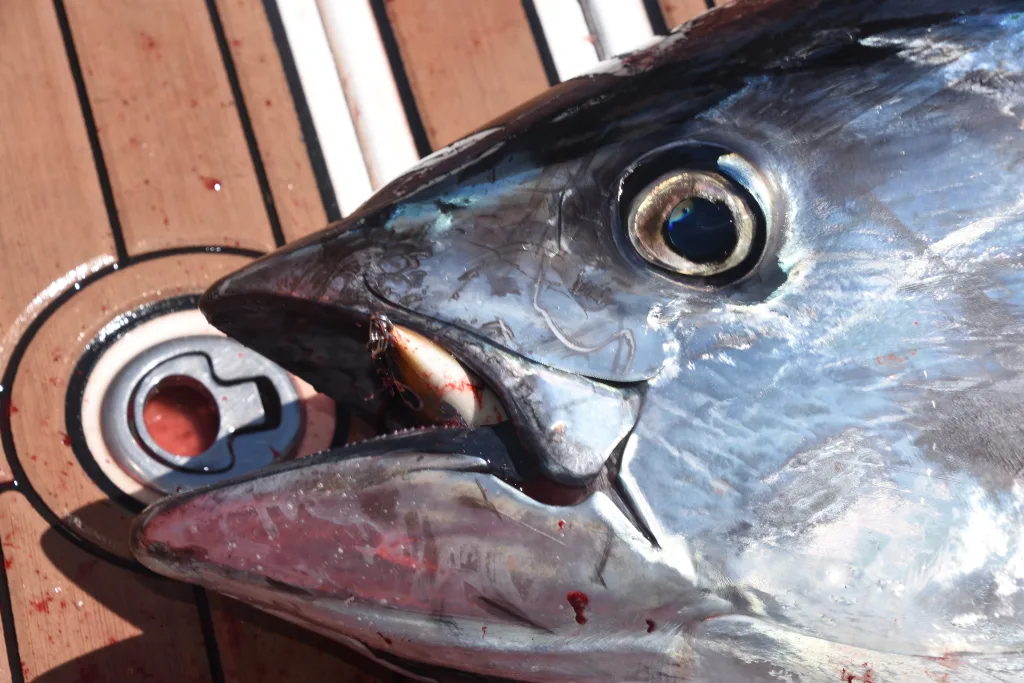
Choosing the best lures is a slippery slope because there’s no one bait that always works, and there seems to be a new must-have bait every year that so-and-so is getting them on. That then becomes THE bait to have. However, there are plenty of lures that will work on any given day. Here are the “top 5”—in other words, what all the cool kids are using:
NLBN 8″ Straight Tail on a 4X Super Duty Jig Head in “Hell Yeah Butter”
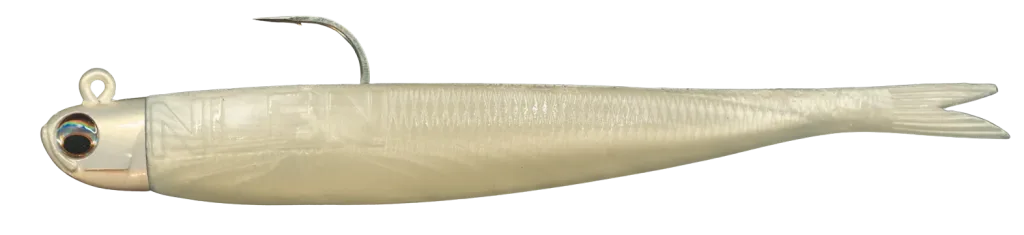
Hogy Protail (Bone color – 9 inches if they are on adult bunker, and 6 inches if on smaller bait)
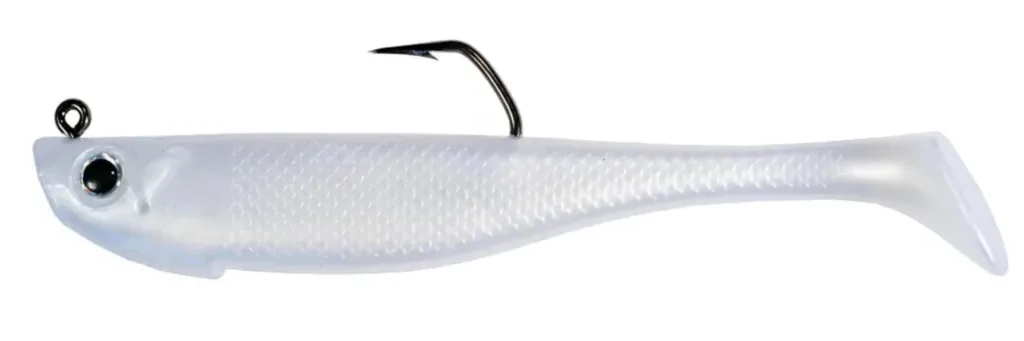
Siren Lures Deep Seductress in “Black Tie Affair”
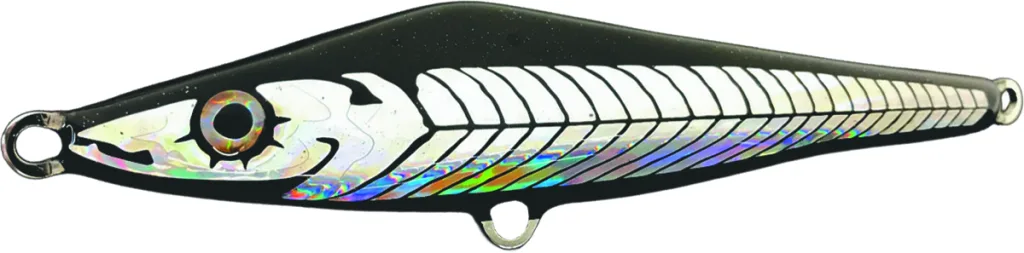
RonZ Big Game 4-ounce in Silver Metallic

Madd Mantis Cherry Popper (6.7-inch) in “Frostbite”

Timing
When you are most likely to see giant bluefin inshore is anyone’s guess. In western Long Island, they could show up unannounced anytime between May and December, but the fall/early winter months tend to be the most reliable.
Know Your Limitations
Let’s be clear about one more thing—not everyone should be targeting these giant bluefin tuna.
First off, every boat targeting bluefin tuna needs a NOAA Fisheries Highly Migratory Species (HMS) permit. It’s as easy as going to their website and paying $20.
For recreational anglers, there is a quota set for the “trophy” category of fish over 73 inches allowed to be kept. When an estimated number of fish 73 inches and greater are caught, it closes. Given their abundance in recent years, that happens quickly, usually in late May or June. At that point, recreational anglers are prohibited from targeting and/or keeping any fish 73 inches or greater.
If you have a Charter/Headboat HMS Permit, you may apply for a “Commercial Endorsement,” which allows you to target and kill a fish 73 inches or greater, although for most states, you’ll also need a Landings Permit, as well as a Commercial Fishing Vessel Safety Inspection. There are also “Restricted Fishing Days” with bluefin (every Sunday, Tuesday, Friday, and Saturday as of last year), meaning you can’t target or keep fish 73 inches or greater on those days. And lastly, NOAA Fisheries opens and closes the commercial category based on estimated landings, so you’ll need to monitor the HMS website.
And, if you haven’t made a significant investment in the right spinning gear, don’t even bother. It’s not cool to hook one of these fish and get your entire reel dumped before breaking it off, only to leave that fish swimming around with 300 yards of braid tangling up its tail. That tuna is not likely to survive.
Please, Release Me…
If you do manage to hook and land a fish over 73 inches when the season is closed, you must release it. If you decide not to and get busted, you’re looking at big fine. NOAA Fisheries and the Coast Guard are eager to make examples out of people who disregard the regulations. And, frankly, those people deserve it. It’s not fair to the people who do follow the law.
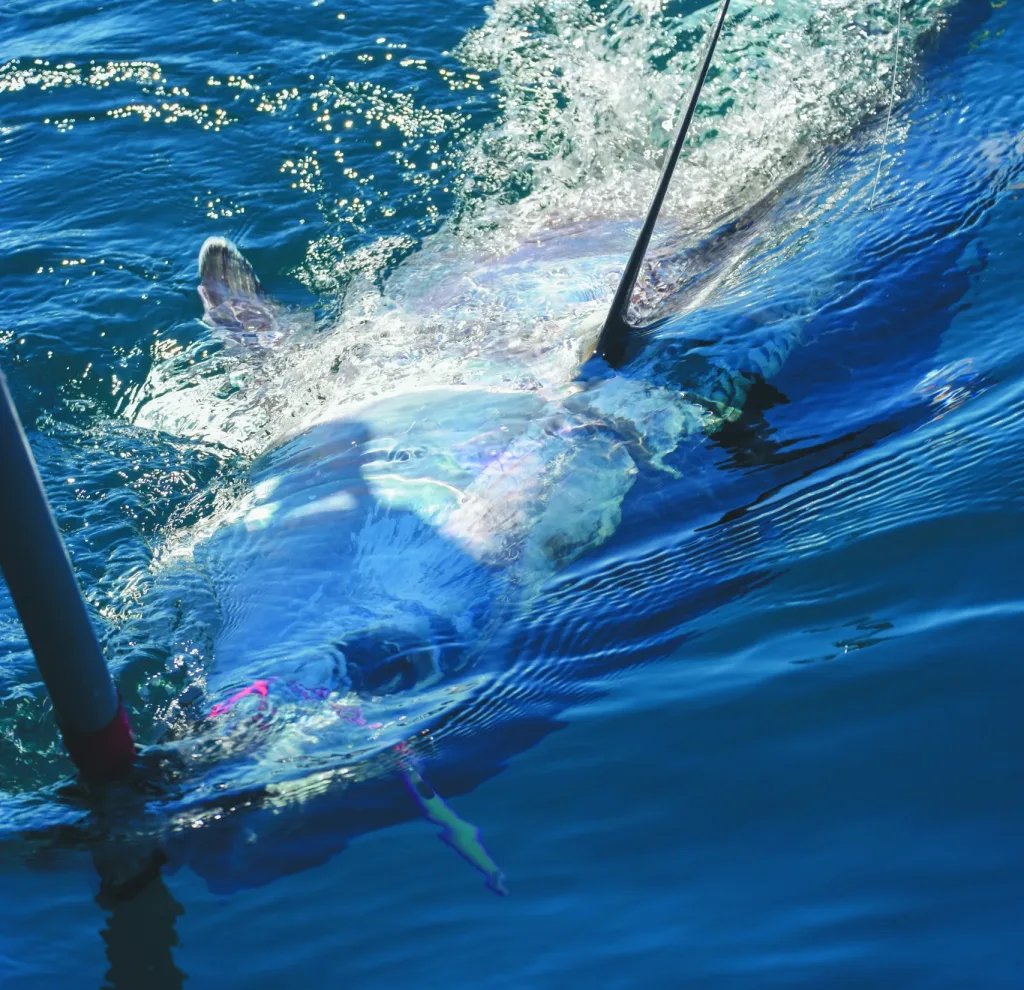
Releasing large tuna is not easy, though. It’s generally done with Pratiko Tuna Grips (recently rebranded as “Tuna-Tongs”), which are essentially giant Boga Grips. They are very expensive and there is a steep learning curve in getting the hang of them. Most people, including me, use a hand gaff to lip-hook the fish, pop the plug out, and send it on its way.
Do those fish survive? It may be hard to believe they do, given you’ve often fought them for hours, but they do tend to swim away relatively strongly and, according to the science, release mortality on bluefin tuna is low.
Seeing a giant tuna blitz may be one of the coolest things you can witness on the ocean. Since it’s been happening very close to the beach, it’s accessible to just about anyone with a small boat. If you can manage to stick one on the right spinning gear, it’s absolutely insane. To land one may be the pinnacle of sport fishing.
READ MORE