Bigeye tuna are powerful, deep-diving fish that can grow to more than 400 pounds. They live in the Atlantic, Pacific, and Indian oceans. To catch them consistently, focus on eight key elements: biology and ecology, structure, depth, water, bait, mammal life (especially pilot whales), lure selection, and how to apply it all. This article focuses purely on bigeye tactics, as if you’re heading out for a tournament where the only goal is catching bigeyes. Real-world experience matters most—nothing beats time on the water. These ideas come mostly from charter fishing, where the boat mixes fun action for customers with serious bigeye hunting.
1. Biology and Ecology
Bigeye tuna migrate long distances. They are opportunistic predators that eat mackerel, lancetfish, squid, small baitfish, and even crustaceans like shrimp and crabs. Scientists still have a lot to learn about bigeyes in the Atlantic, but studies from other oceans help. Bigeyes can dive very deep—up to 500 fathoms (about 3,000 feet). They feed on the Deep Scattering Layer (DSL), a thick zone in the ocean full of tiny fish, squid, and other creatures that reflect sonar like a false bottom. The DSL moves up and down each day.
2. Structure
Bigeyes love underwater structure more than most tuna. In the Mid-Atlantic and Northeast canyons, look for them from 100 fathoms to more than 1,000 fathoms deep. Focus on steep spots: canyon corners and east notches (where the canyon walls meet the continental shelf). These areas hold fish year after year because they trap bait. Use detailed bathymetric charts on your plotter. Tight contour lines mean steep drops, which are great for holding bait. Look for ridges and plateaus where bigeyes can push bait against the walls and feed near the bottom.
3. Depth

About 95% of rod-and-reel bigeyes are caught in 100 to 400 fathoms of water. The sweet spot is usually 150 to 350 fathoms. Yellowfin tuna usually stay shallower, rarely deeper than 200 fathoms. My favorite depth is 250 fathoms. Very few bigeyes are caught in less than 100 fathoms unless special conditions push them there, like a sharp temperature break or bait trapped on a plateau. Bigeyes dive deep during the day to feed in the DSL, 200 to 1,800 feet down. They feed closer to the surface and down to 300 feet in the evening and at night. That’s why the best times to troll are often the hours right before and after sunrise and sunset. Many bigeye spots overlap with swordfish spots.

4. Water
The “right” water helps a lot, especially early in the season. Bigeyes often move in with the first clean blue water from Gulf Stream eddies. Early season, sharp color changes (green to blue), and temperature breaks can bunch up the fish and create fast action.
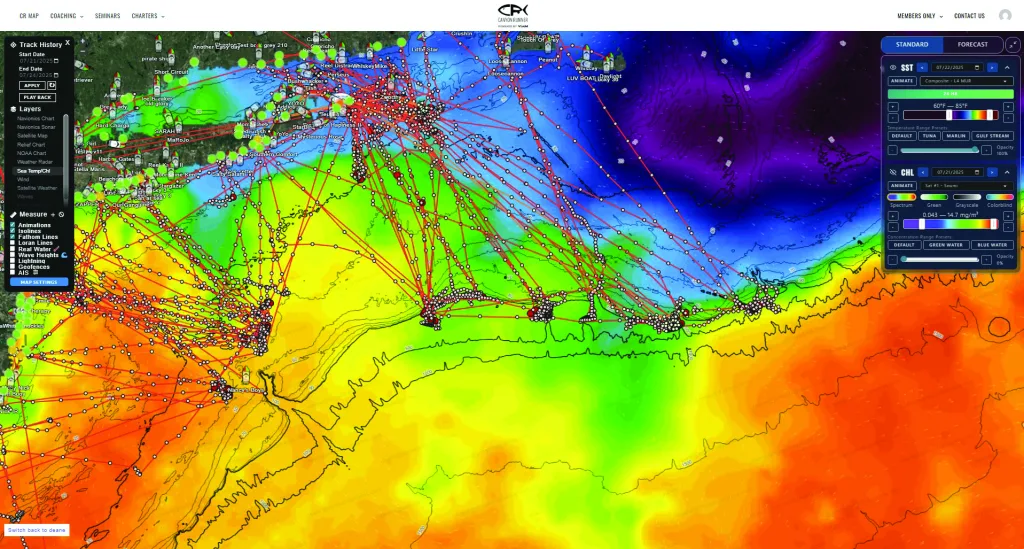
As the whole area warms up later in the season, water color and temperature matter less. The fish spread out and hold over structure instead. Bigeye tuna tolerate a wide temperature range of 60°F to 82°F, but they seem happiest in the mid-60s to mid-70s. When temperatures are similar everywhere, structure becomes more important than water.
5. Bait
Wherever the bait is, the bigeyes usually follow. Look at breaks and structure, especially where those two overlap. Bigeyes dive deep and handle cold water well, so don’t look only in the top 200 feet. Once you mark bait, stay on it.

As the bait rises (often near sunset), the tuna rise with it. Continue trolling into the dark as bait often doesn’t drop back down until late at night. Some of the best bites happen after 10 p.m. or before 4 a.m., though prime time is usually one hour before sunset to one hour after sunrise. Night fishing is especially productive around the full moon (the three days before, the full moon, and the three days after). Once the moon is high overhead, the bite often slows.
6. Mammal Life

Pilot whales (sometimes called black fish) are your best clue for bigeyes—and are sometimes your competition. Pods of these whales often hover over structure, especially northeast corners or east notches of canyons like the Hudson, Wilmington, and Baltimore. Whales are great at finding and balling up bait (primarily squid). When you see hundreds of whales, set up and stay put into the dark. As whales tighten up and push bait, the sounder gets “fuzzy” with thick marks. Bigeyes move in from offshore and from the bottom to feed. Troll right among the whales when this happens. Evening is often best, but bites can happen anytime. About 60 to 70% of bigeye catches around whales happen near sunset as bait rises. Keep watching your sounder and stay on the troll.
7. Lure Selection and Tackle
Choosing the right lures is essential for catching bigeyes. Use heavier lures of 9 to 12 inches long that run straight and stay in the water even when a big fish hits hard. They should imitate squid, the main food bigeyes eat. Good options include Melton Cherry Jets (including the “Canyon Runner” color), Canyon Runner Green Machines, Sea Witches, Ilanders, Joe Shutes, Wolfpack Ahi Heads, artificial tails like the RonZ, and Wolfpack heads with ballyhoo. Mix colors so you cover light and dark options. Confidence in your spread matters more than any “secret” color.
Many crews now use artificial tails instead of ballyhoo since artificials can be fished with J-hooks in tournaments, which improves hookup rates. Still, a few rigged ballyhoo (running true and black-backed, never spinning) can help.
Dredges add a big edge. These are hookless spreader bars with lots of squid imitations (rainbow, pink, white, purple, or green). They increase your “footprint” in the water and pull more fish up from depth, which is especially useful in crowds or tournaments. Plugs like Marauders, Bomber CD30s, or the Rapala X-Rap Magnum 30 also work well, especially around whales in the evening.
Use heavy fluorocarbon leaders of 130- to 200-pound test, and upgrade hooks/rings for tuna strength. Check them after every fish. Sonar is a game-changer. Modern all-around sonar shows exactly where to turn the boat over bait or fish marks.
The best trolling speed for bigeyes is usually between 5.5 and 7.2 knots. Change speeds until you find what triggers bites that day.
8. Application
Success comes from bringing all the above elements together. Find good structure and the right depth. Look for clean blue water early, then shift to structure. Mark deep bait on the sounder and wait for it to rise. Watch for pilot whales balling bait. Run a confident spread with heavy squid-like lures, tails, some ballyhoo, and dredges. Troll the best hours, especially around dawn, dusk, and full-moon nights. Stay with the conditions instead of running around.
Bigeye fishing can be frustrating, but also very rewarding. The key is being on the water, reading the signs, and staying patient. Put in the time, trust your tackle, and the big bites will come. Don’t forget: Fish hard and fish fast.
READ MORE