

Chasing tuna has become a problem for me. It’s an addiction. I’m aware that this is a widely used cliché, especially when talking of tuna, but I say it with zero hint of irony. I cannot get enough. The availability of sub-commercial fish around the Cape in the past five years has taken a drastic toll on my mental well-being and my bank account. But honestly, I wouldn’t trade it for anything.
I am completely enthralled with my inability to track, pattern, and target these fish, and I spend many waking and sleeping hours envisioning white disturbances and lolling shearwaters just off the horizon. The agony of a missed opportunity just a few miles away drives an incomprehensible fire in me. I scrounge archived forum posts, weather app data, and chlorophyll charts to put together some semblance of a plan, only to abandon it after a two-sentence conversation and a head nod from some fishy-looking dude at the boat ramp lit only by the glow of his brake lights reflecting off the water.
The sudden stop of a jig at 90 feet in 130 feet of water during the afternoon hours of a fish-less tuna trip; the fishy-looking pile of shearwaters we’ve been hounding all day that suddenly grow frantic as a dorsal cuts just barely through the surface; the smell of fish oil in the fog before you see the tight group of tuna chicks and the solid red marks creeping onto your sounder. These things turn me into an insane person, and I have videos to prove it. Regardless of the numbers—the fish seen, hooked, and caught—these things make chasing tuna on spin gear worth the effort.
2026 Tuna Predictions
South of Cape Cod
2025 remained largely identical to the previous two seasons in near-Cape locales on the tuna front. Brief flurries of fish moved in around the backside and out into deeper water, chasing schools of pelagic sand eels for short windows before they ran east, out of the range of any sane recreational angler. South of the Vineyard remained recreational tuna nirvana, with miles of fish targetable on the spin, jig, and troll throughout the entire offshore season. Chatham and nearshore spots were consistently inconsistent and held excellent fishing for short spans of time throughout the season. The tuna areas reachable by South Shore anglers remained a distant third option, never reaching the fever pitch of the 2021 season, but fishable with some good intel, a full tank of gas, and some magic tuna dust in your pocket. Will we see a return to form in 2026? Yes, I hope so.
With early reports indicating that we recreational tuna chasers may have a healthier “quota” at our disposal for the coming season, our wishes turn to prayers to the tuna gods that the south-of-the-Vineyard contingent share the wealth with those of us north of the Cape. Tuna don’t seem to follow the traditional migration pattern of stripers, so southern locales do not always see the first wave of fish. The 2021 grand entrance began on July 1, well before consistent reports were heard from Chatham or south of the Islands.
It all depends on the bait. If we have a favorable push of pelagic sand eels in late June and the wind blows just right, creating highways of nutrient-rich water from the basins into the shallower water inside the lanes, we’ll see a repeat of the past season. However, the buffet of bait south of the Islands may continue to hold the fish in that area.
Bluefin of Boston and Cape Cod Bay
Tuna fishing north of the Cape in 2025, in general, painted a primarily grim picture, with both jig-and-pop and commercial-balloon watchers complaining of long, tuna-less days. Last season’s giant tuna pogie massacres were less consistent but awe inspiring, nonetheless.
Regardless of my wishy-washy prediction for the 2026 tuna season, you’d better believe I’ll be cruising south toward Nauset during the last week of June, zig-zagging from shallow to deep water, eyes on the horizon, hoping to manifest my winter visions of tuna. It’s the only way to do it. Burn the gas, will it to unfold, and make my own report.
South Shore Striper Options
I can wax poetic all I want about my fire for tuna fishing, but deep down, I always return to thinking about stripers in the shallows pushing bait. The excitement has never waned. Yes, I like to target big fish pushing pogies out deep or drift mackerel along a singular rip line that I know will produce a slot fish, but if I could snap my fingers and catch only 24-inch stripers on artificial baits for the rest of my life, I would be mostly content.
This is why 2026 and the foreseeable future feels so bleak. I’m speaking not as a biologist or conservation advocate or someone who’s well-versed on the intricacies of the striped bass population, but as a guy who likes to cast a lure to a striper and watch it eat. The lack of small fish in the biomass continues to limit our opportunities to do this type of fishing.
Techniques, Approach, and Where to Search
I’m not going to turn this into a striped bass doom scroll. We did find some incredible blitz fishing during the 2025 season. Most of it occurred in deeper water in the middle of Cape Cod Bay or around Race Point in the first half of the season. In May, we found the typical bass on small bait around the Three Bays and in the bays and estuaries to the north, but it was short-lived and a shadow of what previous years brought us for a spring run.
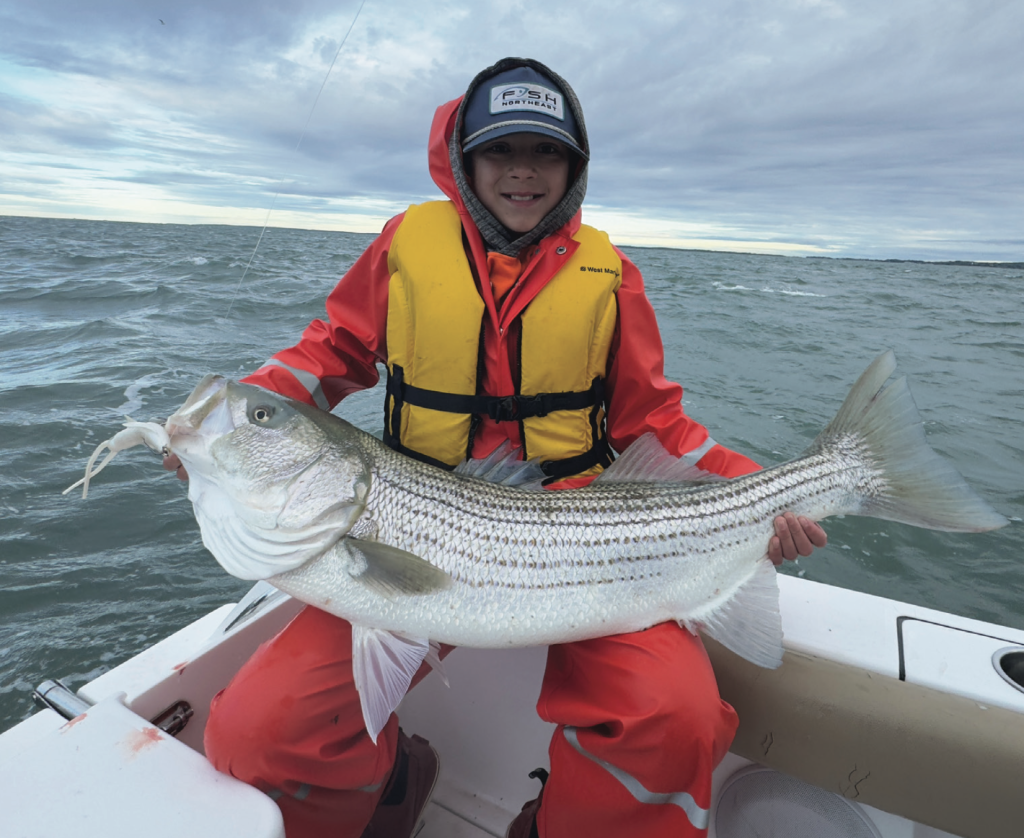
In June, we located rafting stripers on sand eels around the backside—all-day blitzes that reminded me of my early-day treks across the Bay to striped bass heaven. From late June into July, we found hordes of big stripers hounding large schools of herring and mackerel, which created incredible aerial shows and easy sight-fishing for some of the largest fish of the season.
The most consistent strategy this year, aside from drifting mackerel along the rip lines in Plymouth and the rocky structure to the North, was vertical jigging. Oddly enough, it is a close second on my list of favorite ways to target stripers. I fished with a charter captain when I was younger who took us out to Chatham, where we dropped A27 diamond jigs and white plastic tails on nondescript jigheads to fish grubbing on sand eels in deep water. It was an old-school method that simply produced fish. Not only that, it’s an incredibly fun way to fish for bass.

I make sure to start my search for schools of deep-dwelling fish. Stripers holding shallower than 40 feet typically won’t hit a sand eel jig bounced off the bottom. I don’t know why this is the case, but it is. My favorite vertical jigging lure is a Bill Hurley sand eel that is heavy enough to drop quickly to the bottom and hold nearly vertical for the full drift considering depth and tide. Dead-sticking can work just as well as frantically jerking the rod tip. This year, I expect the vertical jig bite to stay strong, from Race Point all the way down the backside, for the entirety of the season.
In 2026, I’m planning to worry about the things I can control. No, the striped bass population isn’t what it was. The tuna seem to be making their home south of the Cape, leaving us northern folks in the lurch, praying for a return to the jig-and-pop fishing of yore. However, there are still world-class fishing opportunities for us. You just have to get out there and find them.