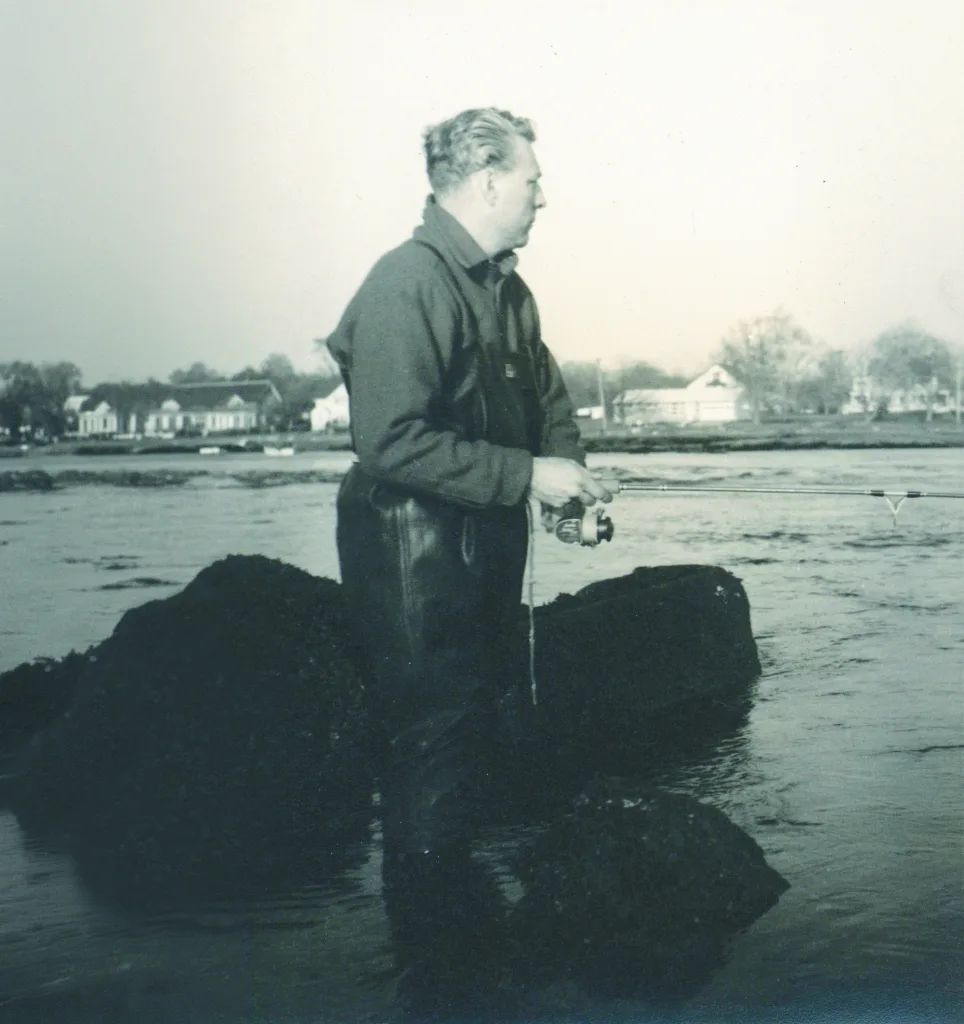
“Not to worry, boy. They’ll be here soon,” said Del. “Don’t look so glum. I know you’re disappointed, but they arrived here last year the day before yesterday.” My timid response was, “What if something happened and they don’t come back?” Del smiled and ruffled my hair. “I’ve been coming to this cove for over 35 years, and the stripers have never let me down yet.”
We were on the Lee River, at a place where my mentor and a very few select friends had hiked through his yard and down the narrow, winding path to the water’s edge to celebrate the first saltwater rites of spring. On that unsuccessful night, we trudged up that slippery trail in the dark on the way back to his home, with the emergent bull briars and thorns pulling at our legs and stockings. Although I was very concerned, I was with a man who had always kept his promises. He assured my late father he would keep an eye on me and take me fishing. He helped me through the challenging transition from a broken-hearted boy to a respectable teen, and he did so with sincere concern for his accepted duty.
My first-ever trout was a tiny native brookie from Rattlesnake Brook, a sliver of winding water that ran from Assonet Ledge to the salt chuck of the Taunton River. That beautiful little fish came on a pricy bamboo fly rod, a special Christmas gift to him from a man he had hand-carved a decoy for. He told me that if the creator of that featherweight bamboo rod had seen me catch that trout with a free-floated garden worm, he would have wept. At that time, I had no idea why.

After that unproductive hike and the disappointment at the river, I had difficulty falling asleep, worrying that this might be the spring the stripers did not, could not, or would not return to the rivers of Mt. Hope Bay. Did they bypass us, or did something even more dreadful happen to those beautiful little seven-striped fish before or during their long, arduous migration from what Del explained was the big bay in Maryland, the Chesapeake?
It was a chilly April afternoon when I returned home from school the following day. While dressing to dig clams and worms on the low spring tide that exposed a relatively untouched stretch of stony beach along the opposite shoreline, I felt my spirits lift. Mom came upstairs from the cellar, where she was washing clothes, to tell me that Del had called. He said his friend Roland (soon to be recognized as Captain Roland Coulombe of the Cuttyhunk charter boat, Jig-M-Up) had caught two schoolies in our spot that morning on a small chrome Les Davis spoon with a pinch of seaworm on the hook. He told Mom that if I could get a ride to his house, we could fish, and he would drive me home after sundown.
One of the softball players from the team my dad founded returned a favor and drove me to Del’s house in the “country.” We only had his light trout spinning rod between us, and on his second cast, he hooked a fish on a gold Colorado spoon. At that time, most of the lures for stripers were larger versions of the proven freshwater variety.
“I thought I could smell these fish last night, but the tide was too low, and they couldn’t get to the eel grass where the silversides and minnows would likely be hiding if the tide had been higher,” said Del. “We’re an hour later this evening and might be able to move within casting distance.”
Smelling fish? I dared not ask for an explanation at that critical time. That all-important first striper of the season made a determined run, and when its pectoral fins appeared at the mussel bed, a swift turn bent out the light treble hook on the spoon, and it escaped.
At Del’s behest, we began slipping and sliding through the soft mud, heading toward the northwest corner of the cove, where he could reach the long, narrow trench that led to the 15-foot depths that ran to that huge cavity under the highway bridge. He hooked another striper on a replacement spoon and handed me the rod. It was one of the first hollow glass spinning rods Bridge Bait began building when they switched from the solid white blanks of the 1950s. That striper came to the surface in the shallows, its dorsal fin lit by the glow of the retreating sun. Del said it was at least a five-pounder and expressed concern about the thin hooks just as the bass turned and I reared back. The fish tore off with a loud slap of its tail, and the lure came back with the corrupted treble showing one broken and two bent barbs. Talk about mixed emotions. Del apologized profusely for not switching to saltwater-grade lures while I looked on, somewhere between awe and anguish. Despite my friend’s regret, it was my fault. In my haste, I had applied too much pressure on that fish.
That was when Del spotted a pair of huge, black-tipped herring gulls on the opposite shore, fighting over the carcass of a dead herring. Despite losing our first two fish of the season, Del remained upbeat. “The herring are in, boy. There will be some bigger fish showing up on the coming moon tides.”
He was spot on. For the next three nights, we were joined by Captain Roland, who loaned me a new spinning outfit and some small white-and-silver topwater lures, the kind he used to bring stripers to the surface to slash at the plugs. Del and Roland accounted for seven bass from four to six pounds, while I managed to land a single fish that was a few inches over the 16-inch minimum size. That’s when my introduction to the sale of stripers began. Roland slipped our bass into burlap bags and invited me to meet him the following morning on the Somerset Shore at the location where he and his father’s crew were building new houses on their waterfront land.
We drove to Drapes Market in the city and around to the rear loading dock, where we met Frank, who handled all the wholesale purchases. “Great timing,” he said. “With Lent just ending, these beauties won’t last long in the display case. These are the first fresh-run stripers I’ve seen this season.” After the transaction, Roland drove to the Bridge Diner, situated along the east bank of the Taunton River. We picked a window seat that looked down on the drawbridge, which opened for marine traffic. He pointed to the riprap along the main bridge channel and told me that in a few weeks we would be catching much bigger stripers under the night lights that illuminated the main channel. He paid for my coffee, milk, and donut, then handed me a dollar. He told me the going price for stripers was 20 cents a pound, but Frank always upped that by a nickel for the first-run fish of the season.
Later that season, on an early June weekend, Del introduced me to Russ Cookingham, a biologist from Massachusetts Marine Fisheries who was assigned to tag some early-run stripers to determine where they went once they left the rivers of Mt. Hope Bay. Del and the biologist caught quite a few breaking fish at the gut at the Coles River, while my excitement at being included in such a significant operation made me anxious as I bungled numerous attempts to keep the live fish in the water as I brought them to Russ to be measured, tagged, and then recorded on index cards. That was the introduction to a boy brought up in the prevailing catch-and-kill mindset to an awareness of the early stages of striper conservation efforts. I never learned where those fish ended up or if any were caught, but my mind began to imagine that any day now we might learn something about the whereabouts of those mysterious migrating fish.
I have no idea how many stripers I have boxed, iced, sold, and shipped ever since I was old enough to participate in the striped bass commercial fishery. It was a challenging way to supplement my income, yet it was a legal and honorable occupation that many fishermen of my day were engaged in. It paid for bread, milk, fuel, and on abundant weeks, replacement tackle and perhaps Friday night dinner out with the family. We never gave any thought to the possibility of an excessive catch problem with such a consistent source that always brought the fish back to us year after year. But then, our ancestors never believed there would ever be a problem with the number of passenger pigeons or plains buffalo.
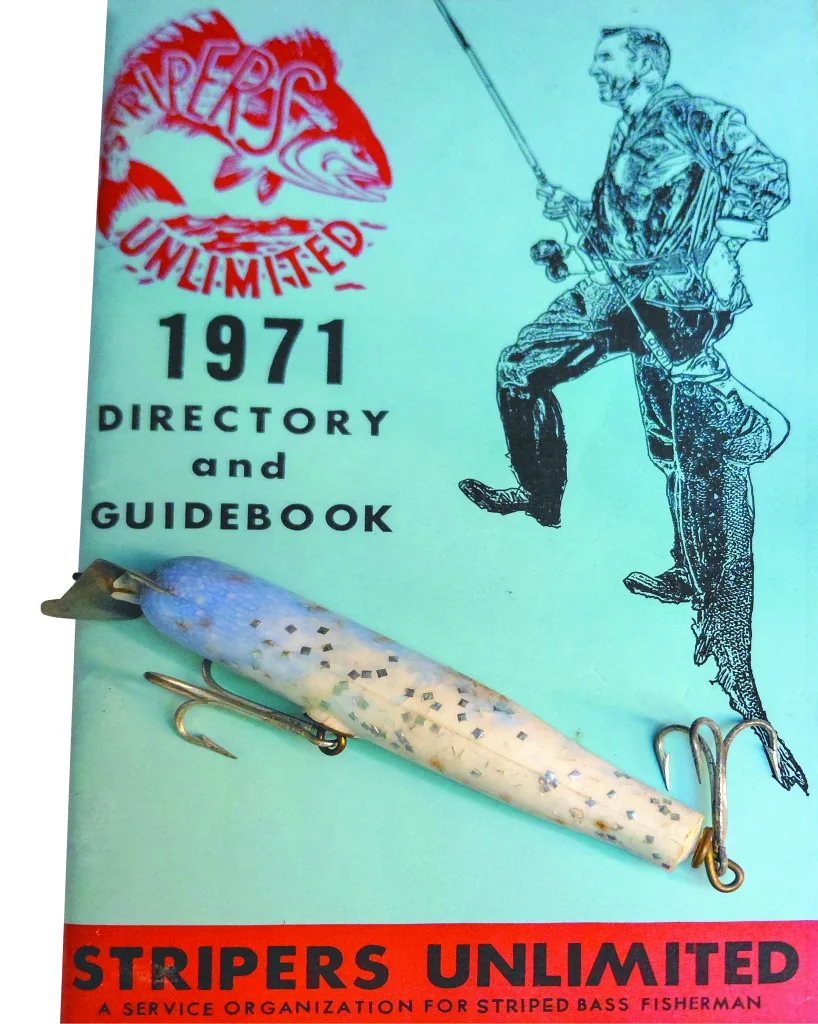
One of striped bass’s greatest ambassadors and a close personal friend, Bob Pond, devoted so much of his time and treasure to studying stripers. He and his wife, Avis, spent almost every striper spawning season hand-stripping and mixing the eggs with the milt they and state biologists collected, in an effort to help save one of our greatest natural resources. Pond founded Stripers Unlimited, an organization that lived up to its name. Years later, I humbly accepted an invitation to join their board of directors.
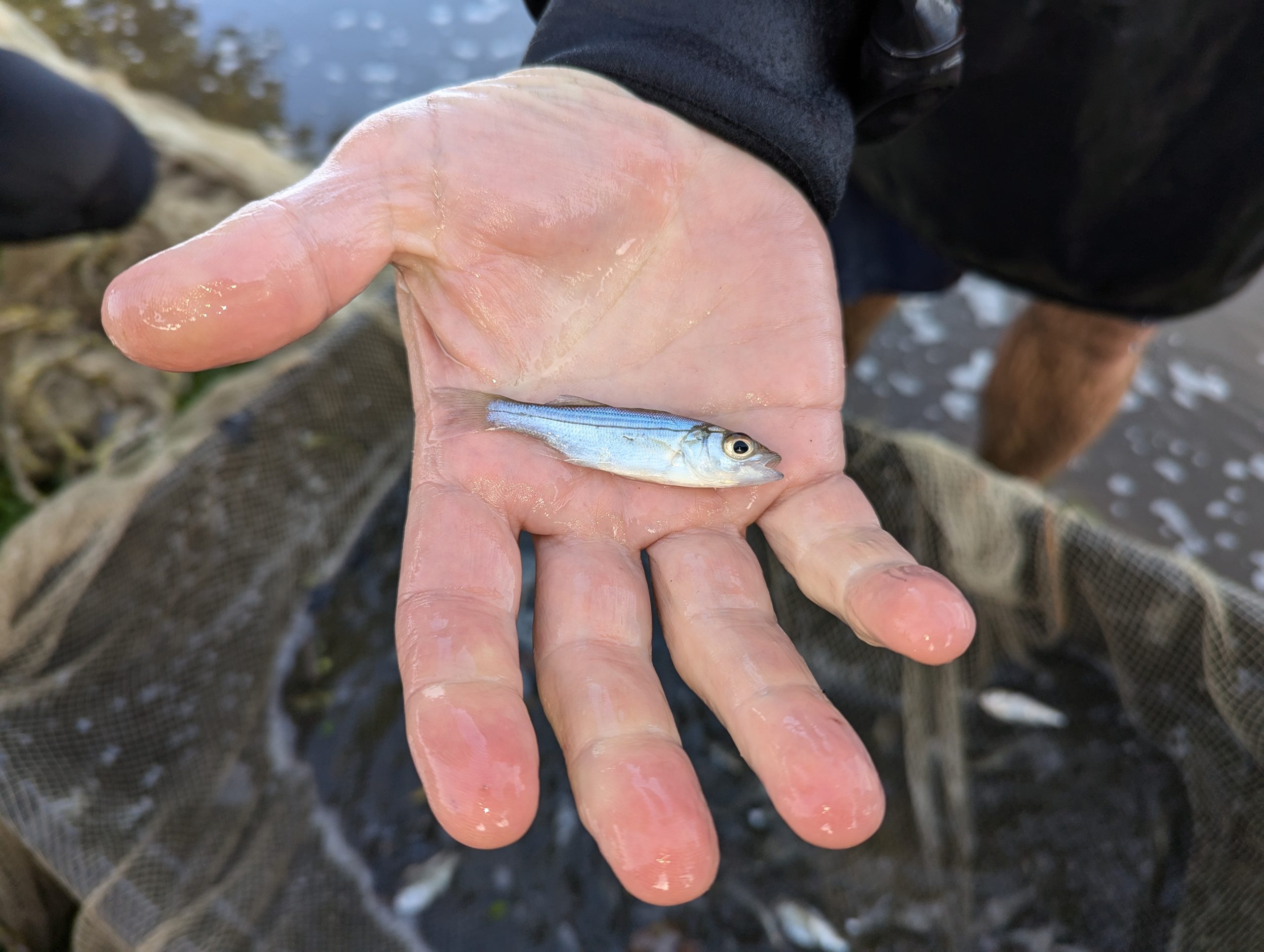
Pond and the team of Maryland state biologists found that it was not that the fish weren’t spawning; the problem was the formation of the eggs. Rather than floating and providing food for the embryos, the eggs sank to the bottom and either died or were eaten. The eggs they hand-raised and nurtured in large tanks were kept afloat and survived the critical initial period when they became sustainable. I can attest that Pond never won the acceptance of the marine biology community because he was not one of them. While most of them were making critical decisions in an office or conference room, Pond was hands-on in the field, raising stripers from eggs to viable fry that he and others transported back to New England, where he found high school biology classes willing to raise them to a sustainable release age. Although he wasn’t satisfied with the forage he found in the Assonet Bay and the lower reaches of the Taunton River, he had to get those crowded fry out of their tanks and into the water, so they were released in those locations.
Those were longtime, very familiar fishing haunts for white perch, winter flounder, and eel potting areas for me. They never held stripers until the typical migration periods from late April to early May. But a few years after those initial stockings, I found myself catching perch up there in early March and decided to cast a Bill Upperman bucktail into a deeper hole in a bend off Grinnell Street. With the head of a seaworm on the hook, I caught two stripers just under the 16-inch minimum and lost a bigger one when unhooking it with freezing hands. I have a photo taken a few years later of me and my friend Joe in a heavy early March snowstorm, with three fish under 10 pounds on the beach and another putting a substantial bend in a rod. I believe those fish were the result of Pond’s stocking, which developed into a winter and very early spring fishery for me and numerous others who would not allow cold weather to interfere with their passion for striper fishing.
Stripers today, as measured by the current status of the Chesapeake Bay stocks, are in dire straits, yet every year we hope and pray that something positive will happen. My cursory research has found at least 38 lakes, impoundments, and bodies of water that have viable striper fisheries, with bass up to and exceeding 50 pounds. In fact, I believe we ran a photo of a 70-pound bass from the Colorado River, which I have since used in my presentations. I only wish we now had Senator John Chaffee’s 10-million-dollar striper grant from the moratorium period to use for hatcheries, stocking, and transfers today. I believe there are better alternative solutions than crossing our fingers or praying and waiting each season for stronger spawning success that could solve our striped bass reproductive problems.
READ MORE