
For the first time in twenty years, I found myself far from my migrating stripers in the first week of June. I’ve been peripherally aware that other fish migrations happen in the early summer, but until I beheld a writhing mass of a northbound predator even more ancient than the striped bass, I’d never considered traveling outside the Northeast to fish them.
I bucked the northbound trend last June to attend a “Writer’s Camp” hosted by Quantum Reels in Jensen Beach, Florida. Writers from fishing publications throughout the country gathered at the River Palm Fish Camp to get an early look at the resurrected fan-favorite spinning reel, the Cabo, along with other new products from Quantum. When I asked about the target species, Quantum Brand Marketing Manager Sam Zyak rattled off more than a dozen different species we might encounter during the week.

After a delayed flight from Boston, I reached the camp around 11 p.m., where I found my cabin right next to the Seminole Chickee Hut overlooking the Indian River Lagoon. With my circadian rhythm stuck on striper time, I grabbed a beer and walked the lighted dock to look for snook. Like the other anglers in the camp, it seemed like the snook had retired for the night. My fishing would have to wait for morning and the first of two days with Captain Cody Rubner of High Roller Guide Service.
Rubner has been guiding in Florida for more than five years, following a one-way migration south from New England. In addition to guiding, he fights to bring awareness to issues including Florida’s water management through Captains for Clean Water and fishery regulations through the American Saltwater Guides Association. He compares being a guide in South Florida to being a chef who, at the beginning of each day, doesn’t know what ingredients he’ll be cooking with. Depending on the available baitfish, the conditions, and how far he’s able to run, a “meal” could include anything from speckled sea trout to Atlantic sailfish.
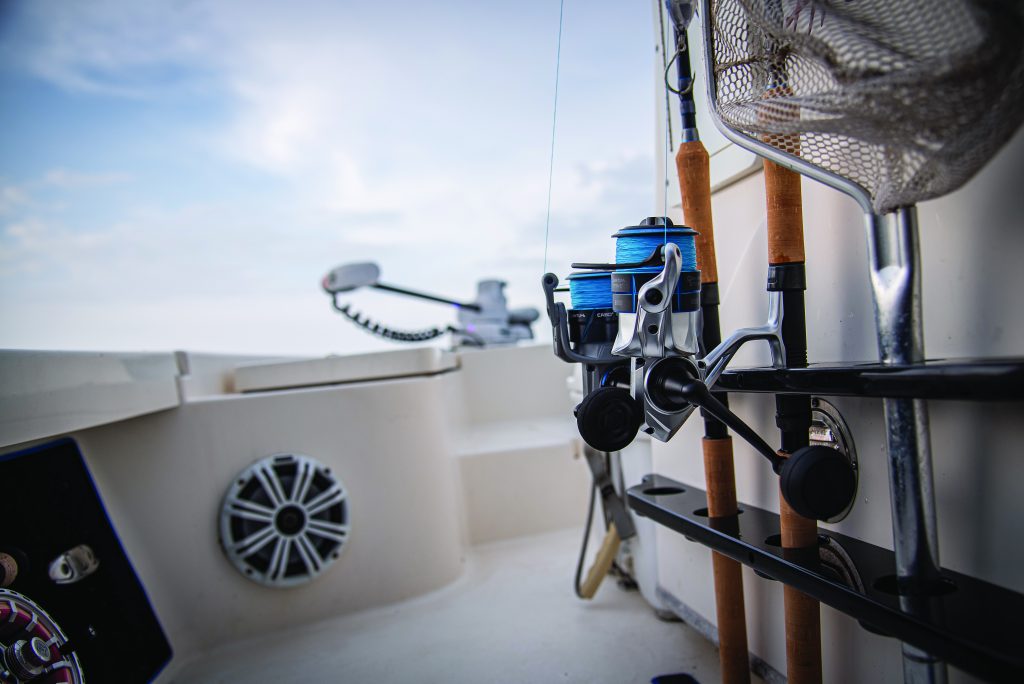

Around St. Lucie Inlet, snook are the bread and butter, so to speak. These fish are available all season, schooling up around structures from docks and jetties to islands and sandbars. Snook will attack flies and lures, but live bait is far more reliable, especially for resident fish that regularly see hooks and lines.
Rubner’s rotation of snook spots seem too peaceful to require 5000- and 6000-size spinning reels, but snook are smash-and-grab specialists, barely giving an angler enough time to announce, “Fish on!” before wrapping the line around a mangrove root or dock piling. While I never like to admit that other inshore gamefish are stronger than stripers, snook feed and fight in the panicked way of a fish that’s accustomed to being a lower link on the food chain.
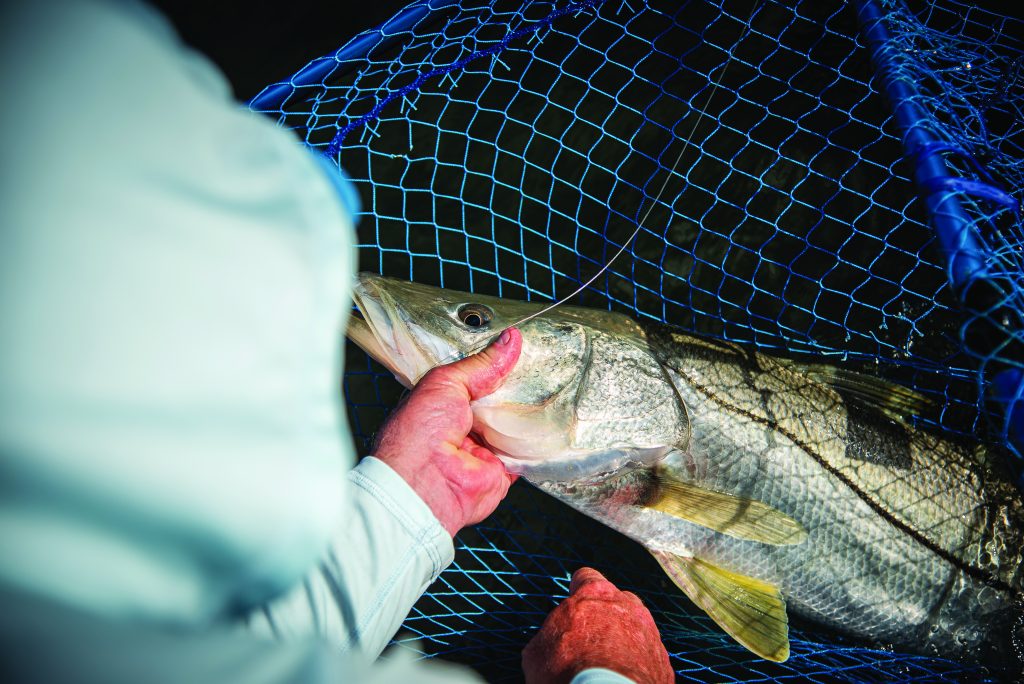
But snook aren’t major migrators. Their longitudinal migrations are driven by comfortable water temperatures and the urge to spawn. Some live out their lives within a single estuary system, while others may migrate between inlets, but rarely much farther than that. The fish that most excite Rubner in the early summer are the ones that undertake long northward migrations along the beachfront.

Even years after his expatriation from New England, Rubner hasn’t developed the jaded attitude that afflicts some lifelong Floridian fishermen. He knows a good gamefish when he sees one, regardless of what the locals say, so when other guides stick to the backwaters for snook or run offshore for sails, Rubner runs the beaches in search of jack crevalle. His passion for the species drove him to create The Jack Project, an initiative of the Atlantic Saltwater Guides Association aimed at learning more about these fish in order to better protect them.
Jack crevalle are big, angry fish with Cro-Magnon brows and beady eyes. They have a reputation for killing anything that moves past them at high speed. Yet, the first group we found hadn’t heard of that reputation.
We’d broken St. Lucie Inlet and headed north in search of schools of migrating jacks with Katie Turner of Quantum Reels. The jacks, Rubner explained, would look like a patch of dark, nervous water that he called a “rumble.” After I pointed at every cloud shadow, grass patch, and baitfish school for three miles, Rubner slowed the boat near the first actual school of jacks.
It was a smaller school and appeared nervous, Rubner said, which we confirmed when they spooked at the splashdown of our topwater lures. While it’s possible to encounter big jacks through the summer, the migration winds down in June after peaking in April and May. On our second day of fishing, we saw just one more school of smaller jacks that happily ate our topwaters, but by then, the jacks had been overshadowed by a more mainstream migratory fish.
At first, we thought it was another school of jacks until a gulping roll revealed a tarpon in all its glory. The fish were “floating,” Rubner said, using more new-to-me fishing jargon, this one meaning the tarpon were hanging, somewhat lazily, just under the surface. Using his trolling motor, Rubner got the skiff into position. By this time, I could see the full school, a line of tarpon three fish across and dozens of fish long. Rubner theorized they’d just returned from offshore, where they had spawned, and would be migrating north to wherever they’d spend the summer.
Like striped bass, this interstate migration takes them to the food-rich waters of the (relative) north. Some of those tarpon may travel to the Chesapeake, where a budding fishery for the silver king has developed in recent years. More will drop off in Georgia, South Carolina, or the Outer Banks. I know that at least a couple kept going, driven by competition or curiosity, because they were captured on film by a drone photographer off Long Island in July.
I drew a fresh pilchard from the livewell (one of the myriad silver, wide-bodied baitfish available to Florida fishermen) and lobbed it toward the lead fish. My cast fell short, and the line of tarpon swam on without giving it the slightest look. My next cast fell more toward the middle of the pack. I felt a sharp thud and watched as a fish peeled out of the school.

In tarpon fishing circles, many anglers consider an outing successful if they fight a fish long enough to see it jump. For instance, someone might report on a fishless day by saying, “We jumped three tarpon,” which is an honest (and glass-half-full) way of saying, “We lost three tarpon.”
Knowing that most hooked tarpon either pull the hook or break the line, I had already decided that as long as I saw the fish jump, my day would be made, as the image of a jumping tarpon may be the most iconic image in all of sportfishing. It’s been captured on film, in photographs, in paintings, and on tattoos. Even if you’ve never set foot in Florida, you can probably still picture a leaping tarpon, its hinged jaw open wide, its back arched, its saucer-sized scales brilliantly reflecting the subtropical sunshine. I did not blink, for fear that I would miss this moment, but it never came. The tarpon, and it was a tarpon, did not leap.
“This could be a long one,” Rubner said ominously.
You see, those magnificent leaps not only inspire awe in anglers everywhere, but they also tucker out the tarpon. Propelling a 100-pound-plus body six feet into the air, often multiple times, takes a heck of a lot of energy. It’s an all-in strategy of shaking the hook or breaking the line, and more than half the time, it works. My fish, however, seemed to be conserving energy, swimming steadily, and unstoppably, out toward deeper water while the drag on the 6000-size Quantum Strive slowly bled out line.
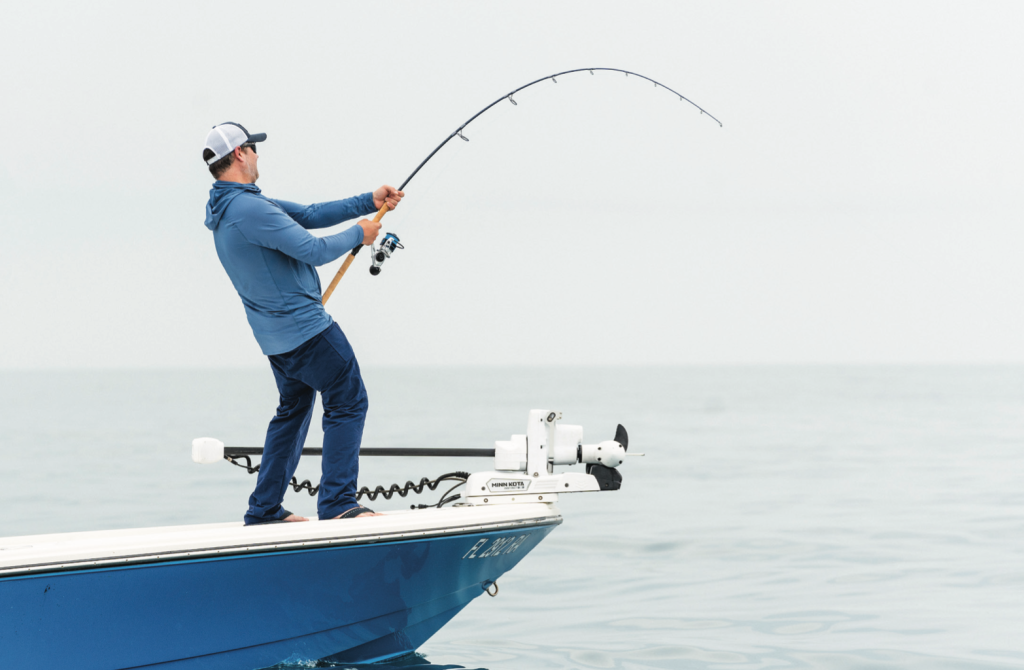
Five minutes passed. Then ten. Then twenty. Rubner offered instruction and encouragement, advising me to “pull across its spine” to keep the fish unbalanced and “prevent it from gulping air.”
Gulping…air? Part of the tarpon’s success as a species is owed to the ability to supplement its oxygen intake with mouthfuls of air. The adaptation primarily benefits juvenile tarpon, which seek refuge in low-oxygen (and low-predator) waters far from the ocean. When a hooked tarpon gulps air, however, it receives a fresh jolt of energy. Rubner warned that each unimpeded gulp could extend the fight by five or ten minutes.
I failed to thwart the tarpon’s first gulping roll and, as Rubner had warned, a strong run followed. While that roll gave me the first good look at the fish, it also gave the tarpon a good look at me. I’d never before felt sized-up by a fish, but I felt it then, in the ancient, appraising gaze of the silver king.

When the fish tried a second gulp, I did as Rubner instructed, pulling hard in the opposite direction at just the right moment. The tarpon became enraged, thrashing its head and slapping its tail as it sounded once more. Despite the display of power, at that moment the odds shifted in my favor.
The rest of the fight played out as a slow grudge match, the tarpon delivering slow, heavy body blows that I tried to absorb long enough for the fish to tire out. Every couple minutes, Rubner twisted the Strive’s drag knob two clockwise clicks to increase the pressure. And then the fish appeared on the surface, making a single sloppy figure-8 before Rubner secured the catch. I remember the look of the massive, forked tail, the roughness of its lower jaw against my palm, and the unstoppable upward movement of my breakfast.

While holding the tarpon next to the boat, I heaved from over-exertion—the first time I’d done so since a scorching August football practice in eighth grade. The tarpon rolled its giant eye, casting one final judgment before shaking from my grasp and swimming north, just as all the Atlantic’s great gamefish do in June.
Gear from the Trip
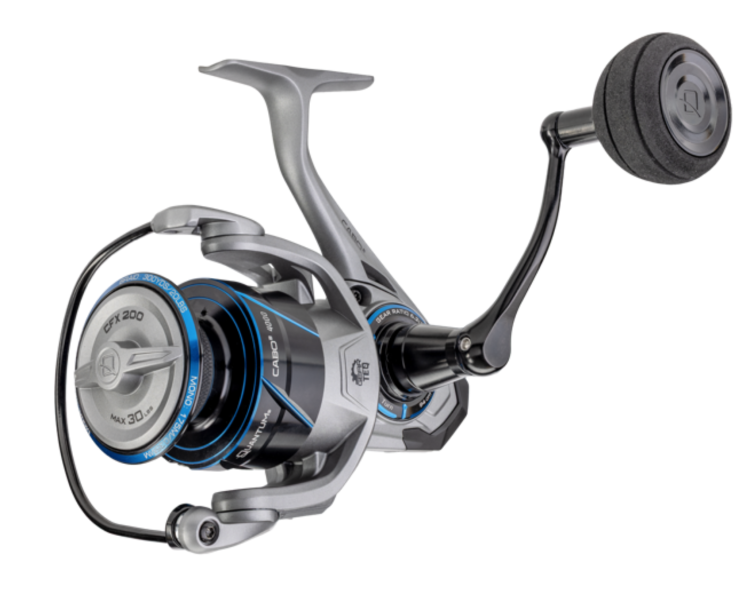
Quantum Cabo 5000
To pitch live baits to snook snugged up to structure, we used the 5000-size Cabo, the 3rd generation of this beloved spinning reel that’s been upgraded with a stronger drag, IPX8 waterproof rating, and “Gearteq” machined gears to provide smoothness and cranking power to steer snook away from the danger zone.

Quantum Myth Rods
With a soft enough tip to deliver live baits accurately and the backbone to lift a heavy tarpon, the Myth rods are durable, versatile, and lightweight, making them a pleasure to fish for a variety of species.
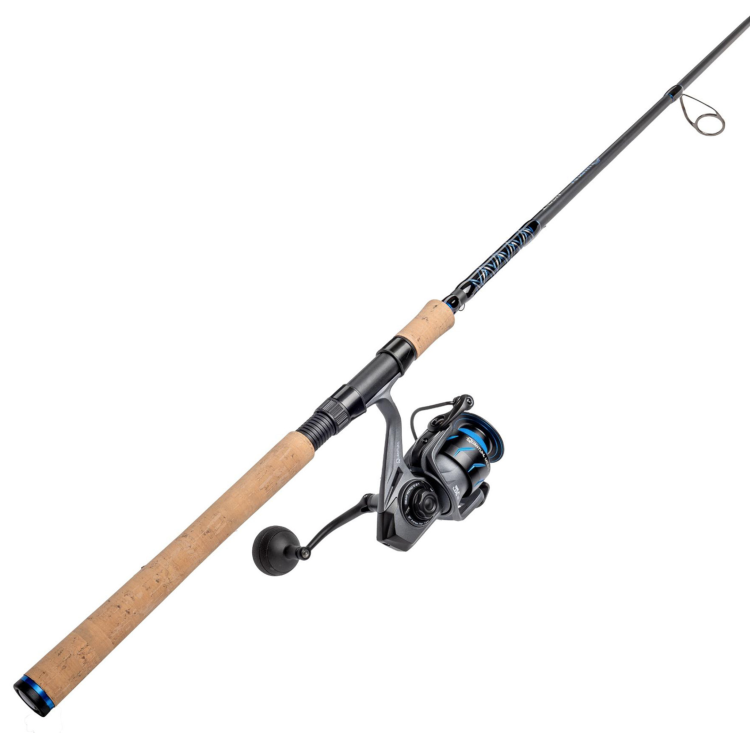
Quantum Merit Combo
With a feature-packed reel at an affordable price, and a sturdy, graphite composite rod, we used this combo to toss topwaters to jacks, jigs to tripletail, and live baits to snook.
Captain Cody Rubner, High Roller Guide Service

Captain Cody Rubner specializes in light-tackle and fly fishing for tarpon, jack crevalle, snook, permit, and more. His skiff is capable of fishing the backwaters for snook and trout, and when conditions are right, running offshore for sailfish, offering anglers a great variety of fishing experiences in a single trip.

River Palm Cottages and Fish Camp
With quick access to some of South Florida’s most fertile fishing grounds around St. Lucie Inlet, River Palm has a rustic fish camp feel. A central Chickee Hut provides a gathering place for post-fishing cocktails and storytelling through afternoon rainstorms, and the dock allows guides to pick up anglers just a short walk from the cabins.