My father was fond of saying, “Every house on Cape Cod should have a bird book.” Cape Cod, and the rest of the coastal Northeast, is rich in beautiful and unique bird species, from rare migratory visitors to familiar year-round residents. For many years, I saw this quote as a complete and solid creed. I’ll go further to say that if every house ought to have a bird book, anglers should be familiar with each page.
Every summer, seabirds from across the globe gather here to fish alongside us, creating some of the most impressive feeding spectacles an angler could hope to witness. To be able to learn from them is to deepen not only your skills, but your connection to the ocean itself.
Keegan Burke is a local birder, photographer, fisherman, and a Natural Resources Officer for Orleans, Massachusetts. His main professional focus is birds, particularly seabirds. A New England native and an angler-turned-professional birder, Keegan grew up fishing on Cape Cod with his grandfather. His passion for the outdoors and the ocean eventually led him to his current role studying the seabirds of Cape Cod. Bringing his fishing background to birding has given him an understanding of the food chain that can only be achieved by studying each component of the system. By recognizing these birds’ patterns, as Keegan does, a fisherman gains an advantage that even the best electronics can’t replicate.
The Northeast is home to numerous species of fantastic marine birds, but some of the most well-known, while spectacular to behold, don’t directly help anglers. “Famous birds like ospreys or kingfishers are great hunters,” Keegan said, “but they don’t need gamefish to ring the dinner bell in order to feed.”
The birds that rely on fish to drive prey to the surface are the ones of greatest interest to anglers. “This facilitative predation, whether coordinated or not, is a direct signal to fishermen that there is some form of predation going on,” Keegan explained. “Taking a step back and changing the way you look at the seabirds involved in these feeding events can directly benefit your angling skill set. The key is to not just ‘spot’ the birds, but dissect and read them, which puts you in the shoes of a predator chasing the same food as the fish you are targeting.”
Terns
The Bird
The precision snipers of the winged predator world, terns rely on their quick, agile flight and their keen vision to capture prey.
There are several types of terns in New England. The most abundant is the common tern, but the Roseate and Forster’s terns are also found in our coastal habitat. They behave and look the same, and from a fisherman’s standpoint, serve the same purpose.
Common terns are the most abundant of the terns found in the coastal Northeast. To fishermen, they indicate the presence of smaller baitfish, like sand eels (pictured above), silversides, and bay anchovies. (Photo by Keegan Burke)
A tern is no larger than a loaf of bread with wings. Those long, pointed wings and deeply forked tail make them easy to identify among other seabirds. “One of the more abundant seabirds in New England, terns return to nest on our barrier beaches every year between May and June. In a way, terns are our seabird,” Keegan said.
Roseate terns also inhabit the coastal Northeast, but not to the same degree as common terns. (Photo by Keegan Burke)
“The largest nesting colony of common terns in the world gathers on Monomoy Island, where between 30,000 and 40,000 pairs descend on its shores each year. They build their nests directly in the sand, with both partners sharing in its construction and the raising of chicks. Parents tend to the chicks for several weeks until they are competent flyers. To see a tern colony that large, it’s an incredible thing.” Keegan explained. Once airborne, terns spend 8 to 10 hours a day over the water, returning to land only to rest or feed their chicks.
In breeding season, which can last from early spring to around midsummer, look for the black cap, bright orange legs, and a thin reddish-orange bill with a black tip. You’ll usually hear them before you spot with their distinctive Kreek! call as they dart overhead.
“Their flight is a giveaway—quick wingbeats, abrupt turns while searching, and frequent hovering with heads cocked down when over bait,” Keegan noted.
Common terns are easily identified by their thin, reddish-orange beaks and somewhat frantic flight patterns. They spend most of their time airborne in search of food, but occasionally return to shore to feed their chicks, rest, or nest, like this one. (Photo by Keegan Burke)
Fully grown, the tern becomes a precise predator. It patrols the skies until its keen vision locks onto bait, then hovers with head and beak pointed downward before tucking its wings and plunging toward the water. Their deep forked tails and pointed wings act like rudders, allowing them to stop abruptly, make sharp turns, and drop quickly into a dive. Their distinctive, quick, and shallow flight style allows terns to cover water efficiently in search of food. Their exceptional eyesight allows them to spot baitfish below the surface, even singling out smaller prey within a school to feed younger chicks.
Any small fish within inches of the surface is fair game for the tern’s long, narrow bill. Though it may hunt alone, terns often gather in loose flocks over bait schools. Their diet consists of sand eels, silversides, and peanut bunker. As a result, this preference for small bait leads many anglers to associate their presence with false albacore. In truth, it is not just their shared menu, but their sharp eyesight, agile flight, and quick maneuvers that make the tern such a fitting aerial counterpart to albies.
The Playbook
If terns are diving in the area, consider the following to bring fish over the gunwale: small bait, small presentation. Terns cannot tackle a full-grown bunker or mackerel. Consider downsizing your offering to match the baitfish. Trade the Doc for a Rebel Jumpin’ Minnow, or a glidebait for an epoxy jig. If you’re not finding fish, watch the terns work.
One or two terns picking away may not mean much, but follow the direction in which they are cruising. Check their flight paths against your charts. Are they flying above ledges, rips, or contours? Are they working with or against the tide? Terns can see better, move faster, and cover more ground in a shorter period than you. They spend a small percentage of their time diving into feeds, so pay attention to their behavior even when there is no obvious feeding event taking place.
Northern Gannets
The Bird
“With a wingspan that can grow up to 6 feet wide, the gannet is a force.”
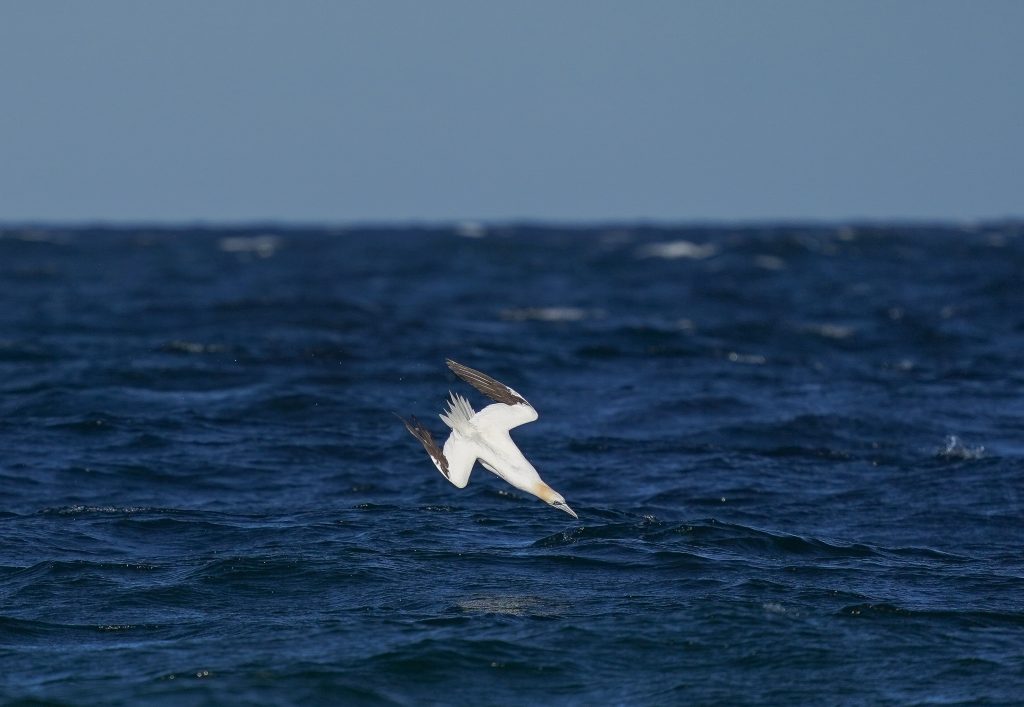
White in color, with long, black-tipped wings, from afar they could be confused with a gull, Keegan noted, but their flight pattern gives them away. “They take long, low glides while searching for food. Their giant wings and giant beaks are dead giveaways. The juveniles have scraggy, speckled colorations before they reach maturity, which for the northern gannet takes up to five years.”
The wingspan of a mature Northern gannet is impressive, reaching up to 6 feet wide. To put it in perspective, an average 6-foot-tall adult man has nearly the same wingspan. (Photo by Keegan Burke)
Gannets are true pelagic birds, spending nearly their entire lives at sea, only returning to land to breed and raise chicks. They nest in colonies on cliff faces and remote islands in the North Atlantic. Clumsy and slow on land, gannets usually return only outside of breeding season if they are sick or injured. Their extensive time above the open ocean has driven adaptations that make them highly effective hunters.
“Similar to terns, gannets hunt by first using keen eyesight to locate bait. They have binocular vision, meaning both eyes are positioned forward, allowing them to pinpoint prey below the surface,” explained Keegan.
Binocular vision in the animal kingdom is a defining trait of elite predators. Just like terns, gannets can see much better than we can, so allow them to be your eyes: scan for that low-swooping flight pattern and note the direction of their path. Once a gannet has bait in its crosshairs, it will elevate, sometimes as high as a hundred feet, before tucking its wings like a falcon and plunging into the water. From there, the gannet uses its webbed feet and powerful wings to chase bait as deep as 35 feet. Capable of diving at speeds up to 60 miles per hour, a gannet hits the surface at breakneck speed … literally. The only reason it can withstand the force of hitting the water is because of specially evolved air sacs found in its head and chest.
“These cavities function as an airbag and absorb the blow, protecting the gannet’s frame and organs. Reinforced skull and a thick, strong neck helps the bird keep its body tucked and absorb force as it dives. It’s an incredible spectacle—a flock of large birds dropping out of the sky, pounding themselves headfirst into the water at highway speeds.”
I’ve always thought that baitfish have the toughest lives of any living creature. Picturing myself as a lowly mackerel or bunker subject to a raining hellfire of gannets from above, and a school of hungry tuna from below, solidifies that sentiment.
Gannets rely heavily on the presence of predators to push bait to the surface. According to Keegan, “They can swim underwater, but their chances of a successful hunt dramatically decrease the deeper they are in the water. This makes them good indicators that there may be game fish in the area.”
The Playbook
Gannets are known to dive-bomb large prey such as bunker and herring from extreme heights, which allows them to reach speeds up to 60 miles per hour as they plummet head-first into the sea. (Photo by Keegan Burke)
Given their size, it is unlikely that gannets spend time hunting small forage that other birds may be keyed in on. Gannets need large, caloric-dense prey like herring, mackerel, and full-grown menhaden to fuel themselves. It just so happens that mackerel, herring, and bunker are also the favorite forage of many game fish, especially tuna.
Gannets often return to the surface with their catch still in their beaks, giving an onlooking fisherman a great hint as to how to match the hatch. There is nothing subtle about gannets hunting; it is plainly obvious if there is a feeding event taking place. Diving gannets is a near-sure signal that there is bait being preyed upon by game fish, and anglers should waste no time pointing the bow toward the chaos.
Wilson’s Storm Petrel
The Bird
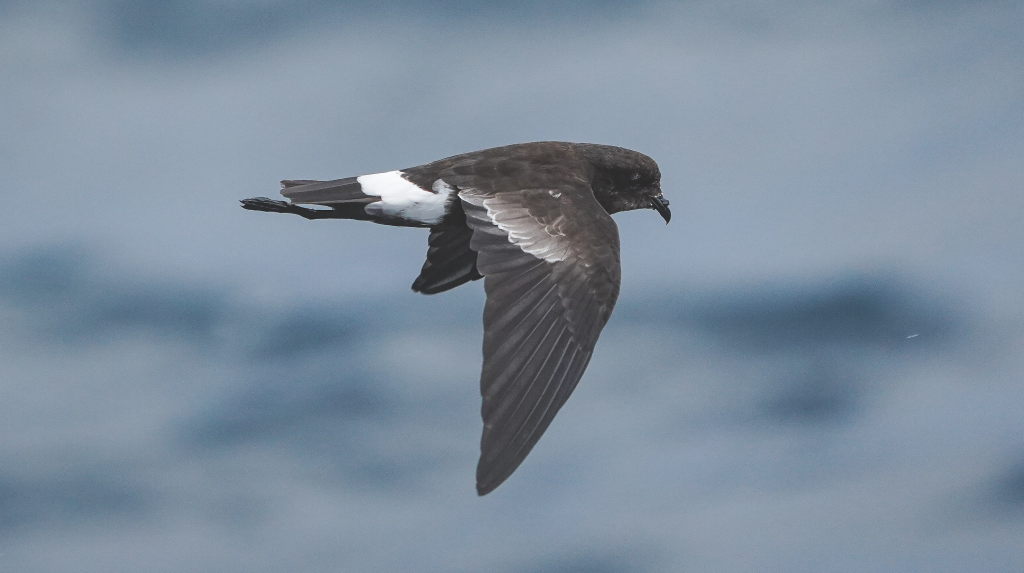
The petrel is a small, black, sparrow-sized bird that has an erratic, low, moth-like flight pattern. The quick wing beats and hopping or skipping across the water helps anglers identify storm petrels from afar. Offshore captains call them “tuna chicks,” named thusly as they are often found above schools of tuna. They are also referred to as St. Peter’s birds for their ability to skitter across the surface of the water (“petrel” is derived from Latin for Peter).
Wilson’s storm petrel, the most abundant species in New England waters, is among the smallest seabirds in the world, slightly larger than a sparrow. Yet, these diminutive birds are masters of the open ocean, numbering in the hundreds of millions and traversing hemispheres to take advantage of the North Atlantic’s summer productivity. They have an incredible sense of smell and can find slicks of oil and blood created by feeding tuna from miles away.
Wilson’s storm petrels may be some of the smallest seabirds in the world, but their presence is often an indicator of big pelagic predators nearby. (Photo by Keegan Burke)
“Storm petrels belong to the order Procellariiformes, the ‘tubenoses,’ alongside shearwaters and albatrosses.Despite their small stature, they are more than equipped with tools that will lead an observant fisherman to the right area,” Keegan continued. “Its flagship feature is tubular nostrils set on top of its bill. The nostrils house specialized salt glands that allow the bird to drink seawater without consequence. More than just a desalination system, these tubes also grant it an unusually powerful sense of smell.”
A petrel’s sense of smell is so strong that it finds its nesting site using smell, the only bird on the planet that does so. Petrels nest in burrows on remote land in the southern hemisphere, so a strong homing adaptation is much needed. Its incredible nose also enables it to detect the chemical compound dimethyl sulfide, a byproduct of zooplankton eating phytoplankton.
Zooplankton is the forage for a long list of marine life, from whales to baitfish. In practical terms, this allows storm petrels to “smell out” the ocean’s buffet from miles away. They feed primarily on copepods, euphausiids, larval squid, and minuscule fish fry, prey too small for most other seabirds to target efficiently.
“Their feeding style is also unique; by hovering and ‘walking on water,’ they exploit the upper few centimeters of the ocean’s surface, a microhabitat largely untapped by other birds. This niche hunting technique minimizes competition with larger seabirds, allowing them to thrive in extremely large numbers,” Keegan said.
The Playbook
Offshore fishermen keep their eyes peeled for low-flying groups of Wilson’s storm petrels when searching for yellowfin or bluefin tuna, which earned them the nickname “tuna chicks”. (Photo by Keegan Burke)
For fishermen, storm petrels are less about immediate action and more about context. You will never see them raining down on peanut bunker or squid, but their presence is proof of plankton, microbait, and the foundational layers of the food chain. A seam or rip line marked by storm petrels often signals a fertile piece of ocean where forage will accumulate and predators eventually appear.
Storm petrels can also effectively feed on oil and blood droplets that accumulate when game fish feed both above and below the surface. A flock of dipping petrels can reveal a tuna slick, which direction the slick is drifting, and how large the feed may have been. Often spotted with other birds, mixed flocks of storm petrels, shearwaters, and gannets are a near-guarantee of game-fish activity, if not immediately, then soon.
Shearwaters
The Birds
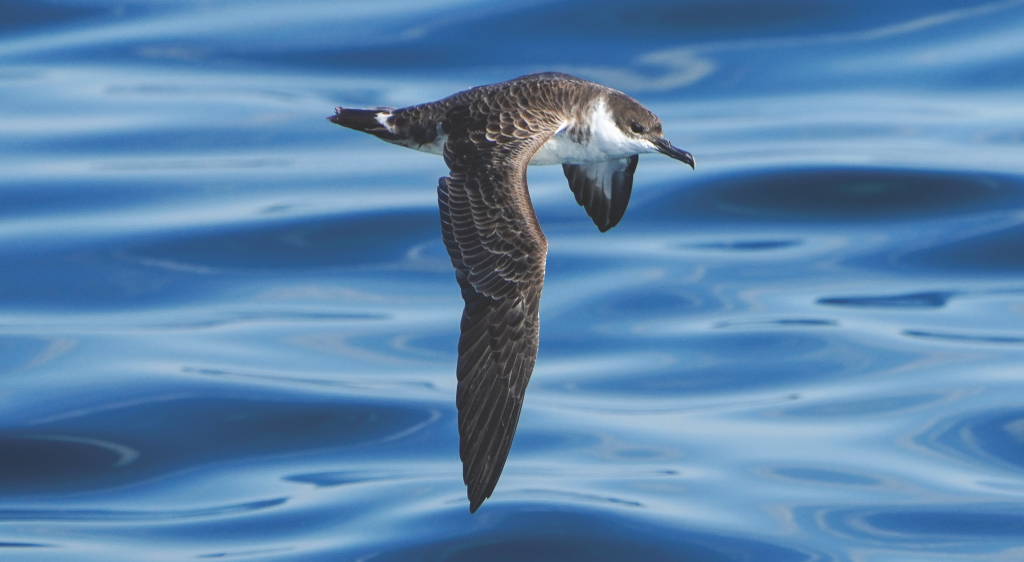
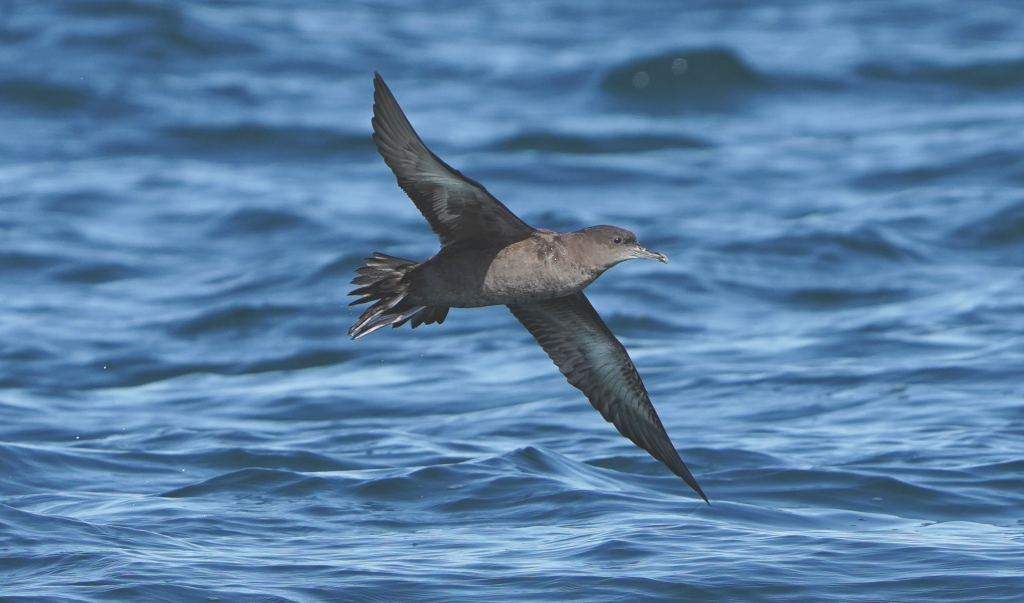
Burlier than most birds, shearwaters aren’t built for skimming and fluttering across the surface, but for soaring thousands of miles over the open ocean. Greater, Cory’s, Manx, and Sooty shearwaters populate the Northeast summer skies.
Greater shearwater (Photo by Keegan Burke)
Manx shearwater (Photo by Keegan Burke)
The aptly named Sooty shearwater. (Photo by Keegan Burke)
Shearwaters travel vast distances to spend the summer in our waters. Greater shearwaters nest in burrows on remote islands of the South Atlantic, while Cory’s breed near Portugal and the Azores. The Manx breed across the North Atlantic and migrate east and west over the ocean.
Shearwaters epitomize the physics of efficiency. Their long, narrow wings are adapted to dynamic soaring, a flight pattern that captures energy from the differential in rapid wind above waves to low, still currents at sea level.
“By tipping their wings into swells and rising into wind shear, they can travel miles without needing to flap their wings, save for preservation of momentum and gliding control with their bodies,” commented Keegan. This allows them to travel insanely vast distances. In the Pacific, sooty shearwaters using a figure-8 migration pattern result in up to a 40,000-mile round trip. In the Atlantic, sooty shearwaters make a more modest—but still remarkable—12,000-mile round trip.
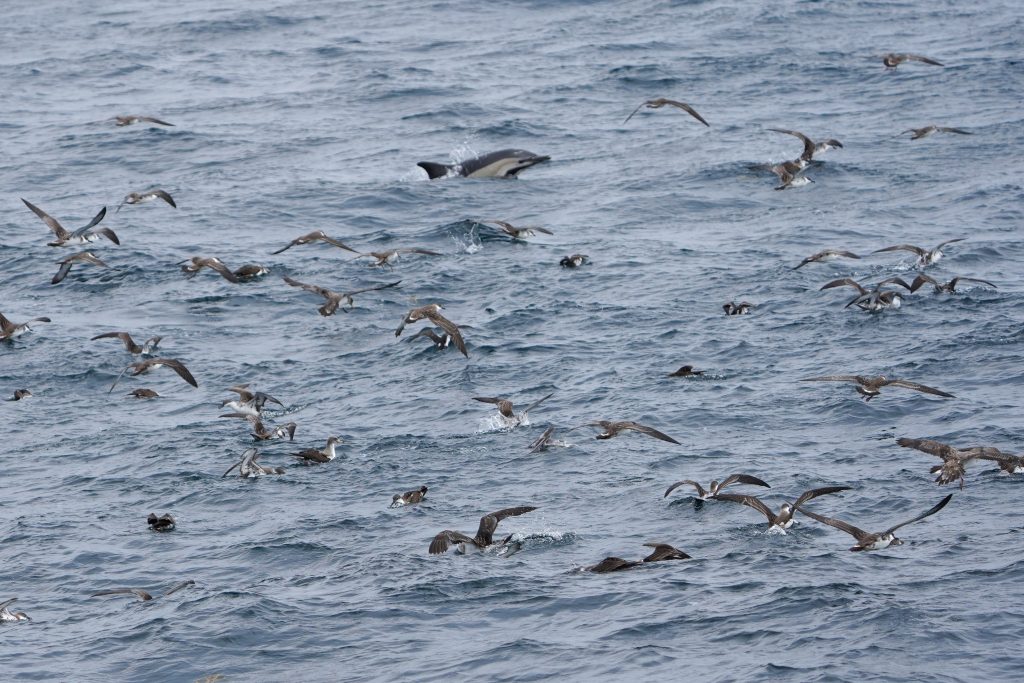
Shearwaters travel all that distance for food. They feed on sand eels, herring, mackerel, squid, and other mid-sized pelagic forage fish. Capable of picking bait off the surface, diving underwater, and swimming after bait, shearwaters are versatile predators. When making a journey of tens of thousands of miles, being able to feed in a multitude of ways is invaluable. Their unique ecological niche allows them to capitalize on both cruising pods of bait and prey pushed upward by hungry fish. Shearwaters also forage in flocks, sometimes thousands at a time. Such a large throng often riles up bait on the surface and can also trigger predatory responses from tuna, whales, and other large marine life.
The Playbook
Be careful where you cast when shearwaters are feeding. They are known to pursue and attack artificial baits, and untangling or unhooking them is not an easy or enjoyable task—especially when the tuna are chewing. (Photo by Keegan Burke)
Shearwater feeds can be so large and intense that anglers can find it hard to make a presentation without entangling or hooking a bird. Never a pleasant experience, shearwaters will attack surface plugs, dive-bomb plastics, and fly across your line. When faced with a shearwater birdnado, opt for casting on the outskirts of a feed or, better yet, try to determine the direction the fish are feeding and cast ahead of the birds and lead the fish. The excitement of a large surface feed can overtake any of us, but taking a breath, laying out a nice cast, and not launching a lure directly into the middle of a frenzy will result in a higher number of well-presented baits. If all else fails, avoid casting at all and drop down a jig, which would be out of range for even the most ambitious diving shearwater.
A Rare Bird to Watch For: The South Polar Skua
(Photo by Keegan Burke)
Just as fishermen delight in catching a rare fish, birders like Keegan get equally excited when spotting rare or unusual birds in the Northeast. Knowing which birds to look for can add additional excitement to a day on the water.
The South Polar Skua is an epic rarity for pelagic birding. Like the name implies, they live and breed in the southern hemisphere along the coast of Antarctica. These bulky, gull-like birds are opportunistic feeders that will prey on everything from fish to carrion to baby penguin chicks. They are considered the bullies of the sea and str even nicknamed “pirates of the sky” by some. This piracy stems from a feeding behavior called “kleptoparasitism,” which entails chasing and harassing other birds, such as terns or gulls, until they drop or regurgitate their meals.
After breeding season, South Polar Skuas head out over open oceans in search of food, extending north into the Atlantic, Pacific and Indian oceans. It’s incredibly rare but still possible to spot a Skua from shore if one ventures close enough during large fish and gull aggregations. They are high up on the “target list” for pelagic species among birders.
The Benefit of Birdwatching
As dedicated anglers, we spend plenty of time buried in logs, maps, charts, and electronics. But often, the best signs of fish don’t come from a screen; they fly right past us. Here in New England, seabirds are just as important as the fish below the surface. Each feathered hunter that flies by is an arrow in your quiver of clues, helping you align with the game fish of your choice. Birds have been at this far longer than we have, and they’ve never needed side-scan or livescope to get a meal. Modern technology has its place, but when you combine it with a true understanding of the food chain, you can elevate yourself as an angler and a sportsman.
READ MORE
The "Supporting Cast" of the Fall Run
Besides the stripers and blues, there are several other species to watch for off New York and New Jersey this fall.
Dialing in Birds with Radar is a Game-Changer for Anglers
When it comes to saltwater fishing, birds are your best friends. Learn to master "bird mode" and you can find fish from miles away.
Big Bluefin Tuna Behavior
Understanding bluefin tuna behavior and patterns will ultimately help catch more fish.
Excellent! Good quality information. Regardless of the new technology, an angler will never reach the next level without a thorough understanding of nature’s clues. There are a few birds that I would definitely add to your list.







Great article! Love the playbook per species addition, something often overlooked.
Great article! Love the playbook per species addition, something often overlooked.
Excellent! Good quality information. Regardless of the new technology, an angler will never reach the next level without a thorough understanding of nature’s clues. There are a few birds that I would definitely add to your list.