
A nasty nor’easter blew through about a week ago, stripping away any remaining leaves on the trees. Now, they grabbed at the dusk like clusters of starving hands. Veins of deep, red light ran across the sky as the sun faded behind the steeple on the hill. Across the bay, the moon rose with a sickly yellow aura diffused by thin, gray clouds.
My wife asked if it was a good idea for me to go out. It was darker now than it had been for weeks before, and it was getting cold. A north wind gusted and rattled the bushes beneath my front window just as she sighed and said, “Just be safe, please.” “Of course, of course.” I reassured her.
Stepping onto my back porch, I felt a web strain against my face and break. I looked toward the porch light to see a spider bigger than my thumb creating a perfect web. It was so quiet that when my phone rang, I startled a bit.
“Hey, yes, I am leaving now,” I answered. Tony and I were meeting at my local sandbar to ambush a group of large migrating stripers coming into the bay on their way south.
“North. Like ten, maybe twelve, so it should be good.”
“Whatever color you want … as long as it’s black,” I replied curtly. I wanted to get geared up and moving.
Standing still out in the open, for some strange reason, made me feel…Exposed? Visible? Watched? Yeah, watched. I couldn’t shake it.
Tony was pressing.
“Night like tonight? Only one thing.” He was skeptical, and I was anxious to get going.
“Yes. I am sure. Can I get going now?”
“I want to get moving. It feels, I don’t know.” He pressed again.
“I don’t…don’t know…It feels…”
…Spooky
The torpedo-shaped topwater lure, known as the spook, has been a favorite among anglers for decades. Using a pull-slack-pull reel cadence, the lure creates a fleeing fish’s S-curve through still water, which brings out the worst in predators like striped bass. Sometime ago, the spook migrated from bass ponds and lakes to salt water. Favored by redfish and speckled trout anglers in southern waters, it wasn’t long before it found its way into Northeast surfcasters’ plug bags. The diminutive spooks used for largemouths, reds, and specks weren’t what a hungry cow bass was looking for, so inventive surfcasters turned their attention to muskie lures for spooks that were both big enough to imitate an adult bunker and stout enough to stand up to stripers in the 30-pound class or better. Now, there is a wide variety of striper-specific spooks in all sizes, from peanut bunker to eight-inch sticks that throw a wake like a small skiff. No matter the size, spook fishing has a unique appeal.
Seeing a fish smack a walk-the-dog-style lure is one of the most visceral and entertaining things in fishing, and that is the operative word: seeing. There is much to be said about the visual nature of walking-the-dog-style or spook fishing. Generally done in glass-calm waters, a slowly walked lure will draw a bulge of water behind as a striper follows it in and waits for the swing or a pause to strike. Then, it is a monstrous blowup as the bass uses its vacuum-cleaner mouth to pull in the lure. The thrill of seeing it may be why many anglers opt to holster their spooks after the lights go down. It isn’t as much fun if you can’t see it happening.
Or is it?
Put another way, it’s the difference between The Shining and The Conjuring.
(Note: On The Water is reader-supported. When you buy through links on our site, we may earn an affiliate commission.)
—
I stepped into the water ahead of Tony. The sable-black bay had just the right amount of wind chop. It is always unnerving wading out in the dark, even though I know the water and the sandbar like the back of my hand. It is primordial to fear the water when you cannot see what is beneath it. I have a deep and abiding respect for the ocean and a clear understanding of the fact that I don’t belong in the water at night, and I take it very seriously. If I was cautious, Tony was terrified. He was a daybreak angler due to his work schedule, but the dawn bite had been lacking and all accounts pointed to a great night bite. I did my best to calm his nerves, and he seemed better once we settled into our spots.
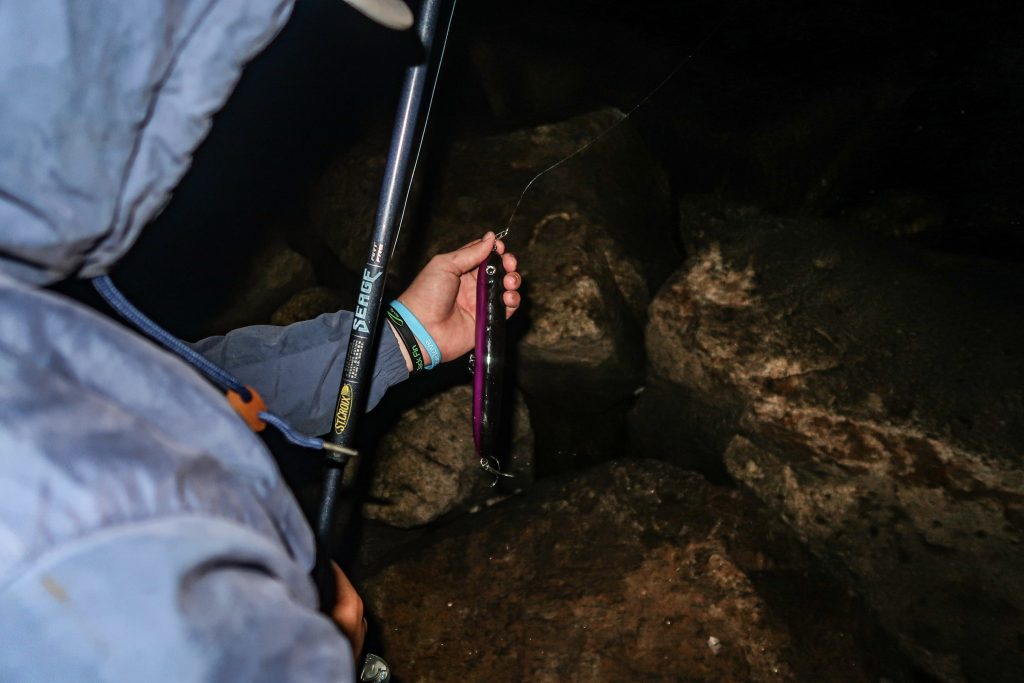
I flipped on my red-filtered headlamp (preserving my night vision), pulled out my Lil’ Doc spook in black, and loaded it into the clip by feel. The spook instantly disappeared into the night sky, and I only knew to flip the bail when I heard it splash. Tony mimicked my actions, and we settled into working the spooks back across the dark waters.
“You like this?” Tony said, obviously wondering if this was a wise venture.
“Love it.”
“I don’t know. It seems a little sketchy.”
“It is, but that’s what makes it fun,” I replied.
“I am not too sure, man,” the doubt full in Tony’s response.
Four casts later, something went bump in the night, and Tony changed his mind.
—
The Color Out of Space
People are accustomed to using ambient light to detect movement and identify objects. Fish, especially striped bass, rely on other senses, and anglers can use that reliance to fool them. This is doubly true when using spooks at night. The S-curve walk of a spook along the surface is key to drawing in fish when using the lure, but the wrong choice of color can undo that.
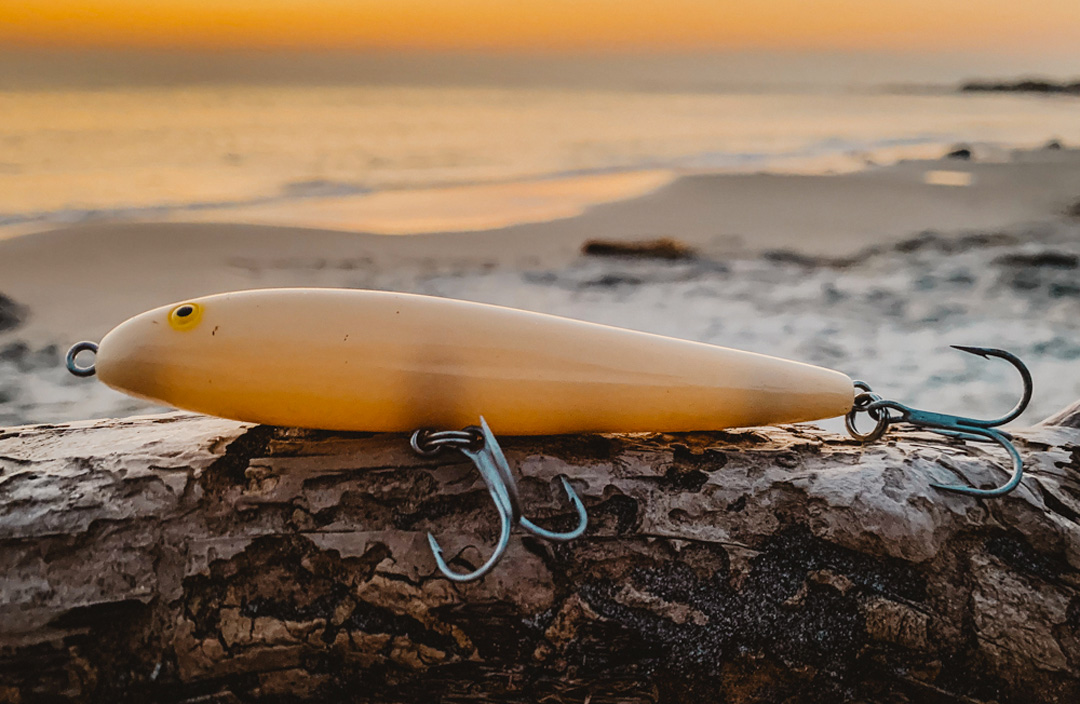
Bone is the color of choice for spooks on cloudy days, the hour before sunset, and the half-hour after, when the light is diffused and the off-white mimics the belly flash of a baitfish near the surface. Stripers see bone-colored lures better during these times. Switching to yellow works in the near-dark of twilight because it produces a minor “glow” that stripers can detect better than any other color in low light. The choices lure makers offer in colors today can be overwhelming. Spooks that used to come in one or two colors now range from unpainted transparent to photorealistic mackerel.
Full dark, no stars? A photorealistic bunker lure isn’t going to do much good. That’s when you reach for the black.
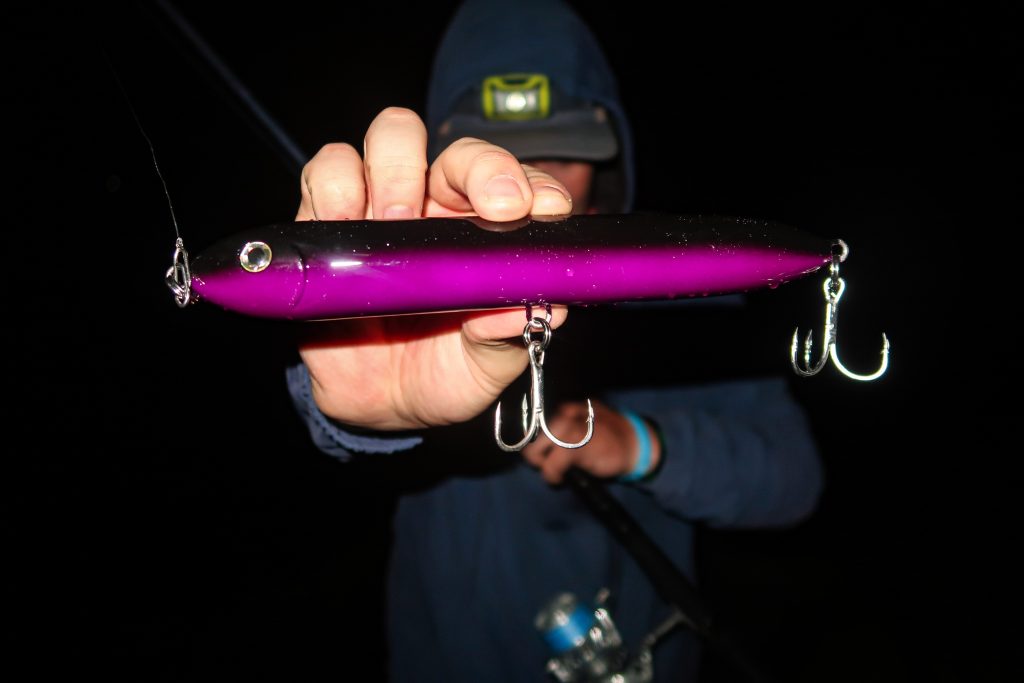
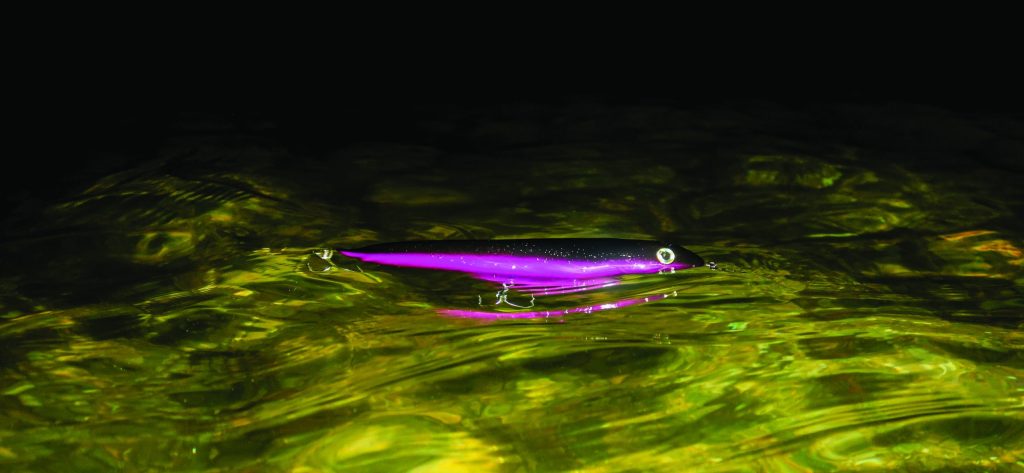
Black or blurple lures are prime for lightless nights, more so because of what they don’t do than what other colors add. Bone, yellow, and silver are all meant to imitate baitfish flash of some kind, but in the deep night, there is no light to cause the flash, so any lure that shows color will look out of place. With a black lure, it is motion and profile only. The lack of specificity is precisely what makes it so effective.
You are giving the fish a vague target by eliminating color from the equation. They know something bait-like is moving in a fleeing motion, but they are not exactly sure what it is. Often, a fish is likely to strike if it thinks it’s food rather than letting a potential meal escape.
—
Cold, clear, and with the north wind dropping below 10 miles an hour, conditions for nighttime spook fishing were the best they had been all fall. Without the luxury of seeing the lure clearly, we had to rely on hearing it. With the slight wind chop, the Lil’ Doc’s single big rattle served two purposes. First, it allowed us to set the rhythm of our retrieve without watching the lure. We worked it correctly if the rattle sounded in the right cadence. If not, it either fouled on some floating jetsam or a hook had hung up on the leader during the cast. Second, it sent a clear message to any stripers in the area: time for a late-night snack.
Tony teed up his fourth cast and let it fly. He started his retrieve, and I could hear the click-pause-click of a good retrieve. He was working the lure back at a good pace.
“Pause it and then start it back up more slowly.”
Tony took a minor pause in his retrieve and made one swipe to move the lure. The explosion behind it was unmistakable. It shocked Tony so badly that he yelped and launched into a frantic stream of expletives as his drag screamed.
“Like it?”
“Holy…”
“Yeah, you like it.”
—
The Telltale Heart
Beat, pause, beat, pause, beat—the sound of a skipping heart. That is what a good spook rattle should sound like. Sound, in this case, is just as important as color. A rattle in a lure like a spook can be like ringing a dinner bell. Combined with the vagueness of shape and movement, this is a great way to bring in hungry fish in the dark. The bigger spooks from Drifter and Jigging World tend to have a single large rattle that produces a deep, thumping click when the slack is picked up and the rod tip is swept back. The smaller spooks from Heddon and others may have a smaller multi-rattle setup, except the Heddon Zara Spook One Knocker. This small, four-inch model has just one sizeable, loud rattle and, over the years, has been one of the single best-producing lures in my surf bag.
A Ghastly Grimoire – Nighttime Spook Selections

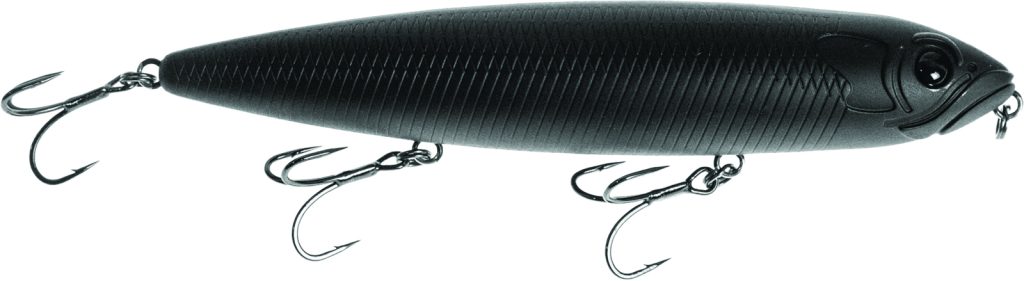

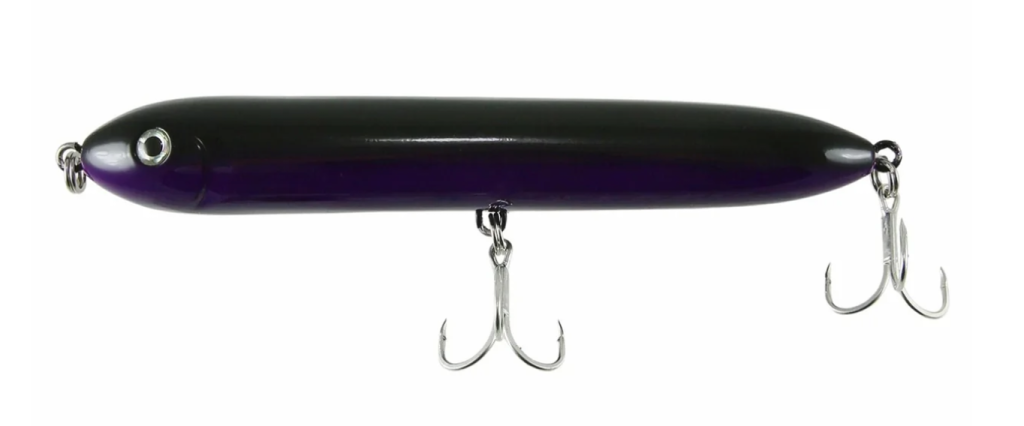

There are a few tricks to using sound to your advantage at night. The first is the pause. Yes, we are imitating a fleeing baitfish and sometimes stripers want something moving fast but, remember, at night, you are working with different factors. You must allow fish to find the lure. The rattle will bring them into the general area, but if you’re moving the lure too fast, it might be out of their range when they get there. By pausing the lure occasionally, you allow the fish to find the source of the sound and stage for the attack. Once they have staged, the lure starts moving again and they explode on it. Or, they will follow it for a few more moves and then pounce. The rattle speaks directly to their lateral line and drives the stripers’ predator instinct.
Sometimes, though, you need to go to a quiet place. A slight wind chop is ideal for spook fishing in big bays, but glassy water can also be effective—if you go silent.
You can get many spooks without a rattle, which initially confused me. Why would I want a lure that didn’t make noise? Then, after ordering a silent spook from Heddon by mistake, I found out how it could be employed with great results. The large one rattles nicely in a slight chop because the water is noisy below the surface. Just like having to shout in a noisy room, a loud rattle can be heard over the sound of waves. But do you need to shout in a library? No. So, why do we often use the same loud lures on mirror-calm water? Choosing a rattle-less spook is usually more productive if the water is flat. The lure’s inherent movement creates sound that, in still water, is more than enough for a striper to find it.
—
A Ghost’s Story

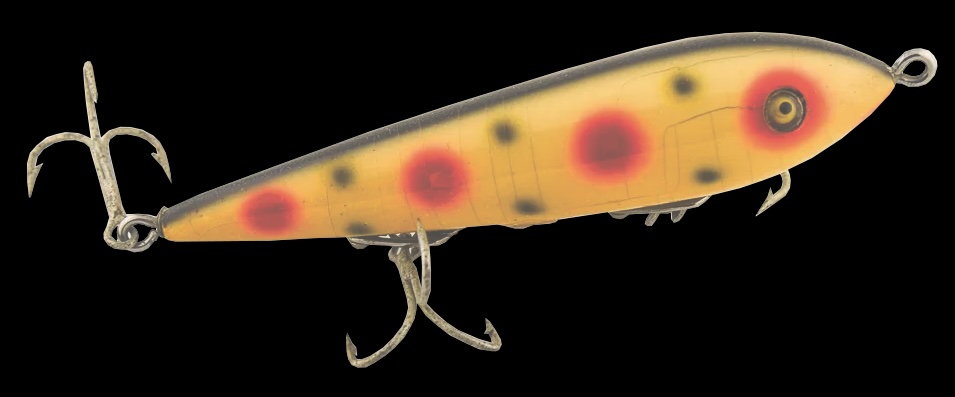
Initially developed in the 1920s as a wooden stickbait, the Heddon Zaragossa 6500 (named for a street in Pensacola with a colorful history) evolved into the Zara Spook in 1939 when Heddon switched from wood to a clear, white plastic, giving the lure a ghostly, translucent appearance.
—
Tony’s fish, a very healthy 20-pound migrator, splashed around him as he worked the dehooker to free it and send it on its way. I waited a bit for the water to settle before casting again. After a few minutes, I heard a slapping splash behind where I thought my lure was. I paused, started, and paused again, but nothing materialized. I put the lure back in at about the same spot, and as soon as I twitched it, the rod bent down to the test curve. While I couldn’t see it, I felt a few big surface headshakes and heard some heavy smashes before the striper unpinned itself.
Tony and I traded hook-ups, landed fish, and lost fish for a long while. The night was getting deeper and colder. We were getting tired. Very reluctantly, we both agreed to leave them biting. Tony headed to his car, and I headed home.
The streets of my neighborhood were empty and still. The houses were buttoned up against the dark. The wind faded to nothing, and it was well past midnight. Dead silent.
I turned the corner and thought I caught a glimpse of something ducking behind a trash can, though it was too big to be a cat or even a dog. It could have been just a trick of the light, but I stopped to see if it moved again. Then, from somewhere in the woods near my house, I could have sworn I heard someone whisper, “Fish on.” I wheeled around.
Nothing was there. It was just plain…spooky.
READ MORE