
South Shore
By Billy Mitchell
The Everchanging Fall Run
Another season on the striper coast has come and gone—where did all the time go? However, don’t put the rods away or winterize the boat just yet. Keep those waders crumpled up in your trunk. Make sure that topshot is in good shape. There are still fish to catch.
September and October are funny months to group together. Yes, they are the typical “fall run” months, but within them, there are at least three distinct phases where my strategy shifts dramatically. With the crazy weather we’ve experienced this summer, I have to expect we’ll find some odd bites in unexpected places (possibly albies on the South Shore?). The one constant is that these months will bring the best and most consistent tuna bites of the season, if the last 30 years are any indication.
(Note: On The Water is reader-supported. When you buy through links on our site, we may earn an affiliate commission.)
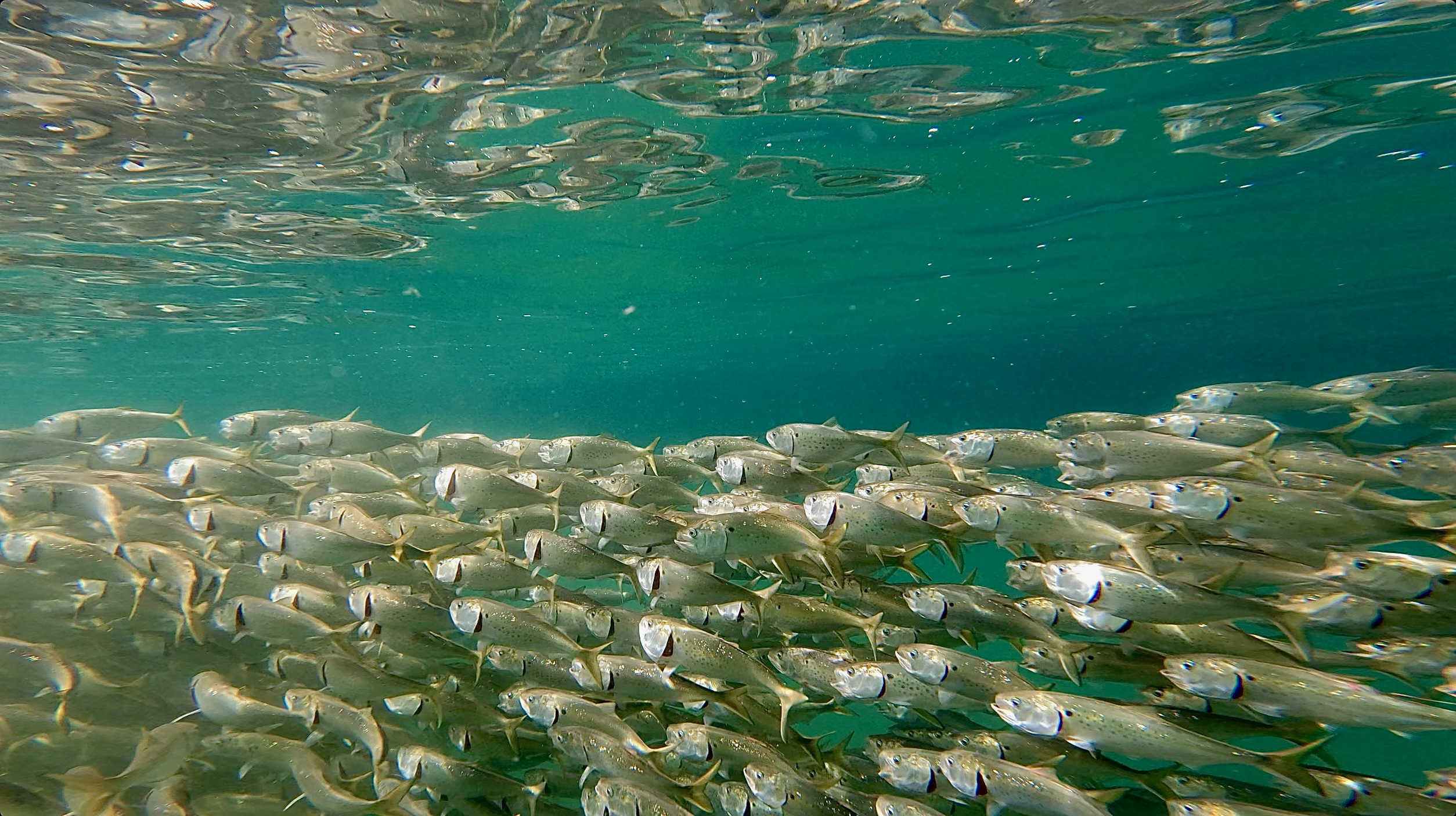
Early September gives us the best of both worlds—beautiful weather, calm winds (fingers crossed), and ferocious feeds. The “pre-fall run” is a product of peanut bunker pouring out of rivers, harbors, and estuaries, bringing us the return of topwater fishing. Bait will initially be small, leading to sometimes frustrating striper fishing. The Hogy Protail in the 1-ounce size and a white Albie Snax fished weightless are sure ways to get finicky fish to bite. One of the hallmarks of this phase of the season are all-day blitzes. These occur most often around big tides and the new moon. Stay close to inlets and harbors to cash in on this bite.
Midway through September, larger baitfish join the party. Butterfish, mackerel, sea herring, and larger peanut bunker are all common fall forage species. This is often when I leave the inshore haunts and cruise the beachfronts and open ocean, keeping a close eye on the horizon for terns and gulls. Typically, I avoid north or east winds like the plague. But in mid-September and October, a fall north wind can trigger incredible feeds. Keep moving and find the birds. Stripers, bluefish, bonito, and, if this year is anything like last year, albies will be right under them.
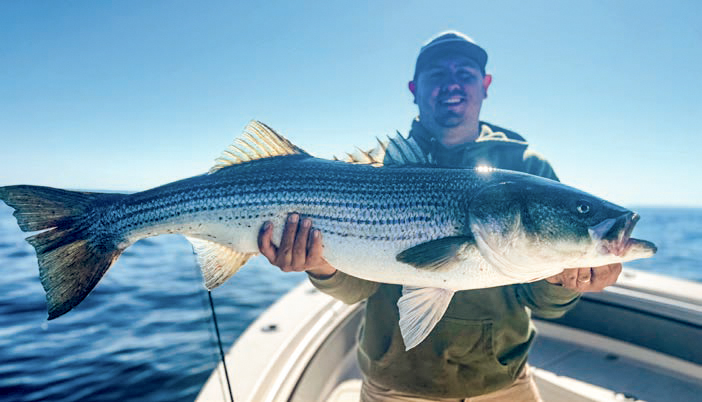
October represents the last gasps of the fall striper run, especially for those of us on the South Shore. Sure, there are stripers to catch all the way through November and into December during some seasons. For the most part, however, the stripers, our annual summer visitors, will make their final goodbyes in October before heading to their ancestral rivers to the south.
What does this mean for the fishing, for those of us still plugging away for a couple late-season stripers before the long winter? Two words: feast or famine. Late October features the most extreme fishing swings of any month during the season. It can be frustrating to try and pattern out when these great bites will happen. Being out at dawn is less important during the late-fall run. Instead, try to target periods of peak current movement during days when winds shift to the north before building into a low-pressure system. The most important tactic for finding success in the late fall, though, is to put your time in. Spend as much time as you can on the water and you’ll find the stripers; you’ll regret it in the winter if you don’t.
A constant for those with access to a boat and the ability to go offshore is the tuna bite. Unfortunately, you’ll often find that the fish won’t be the limiting factor—it’ll be the weather. Days of light and variable winds will be few and far between in September and October when the cold winter northerlies begin to take up residence. So, if you do get a weather window, get out there. I shouldn’t need to remind you to make sure you dress in warmly and have all of the necessary safety equipment on the boat. October storms are no joke, and that perfect weather window you were eyeing for a week can shut just as quickly as it opens.
In the fall, the variety of baitfish that tuna will be feeding on can vary widely. In the areas around Stellwagen, out to the lanes, and down the backside, you may find fish feeding on sand eels, herring, mackerel, halfbeaks, or butterfish. For this reason, it’s important to cover all of your bases when it comes to lures. I keep a variety of Hogy Protail sizes and colors (from 2 ounces to 5 ounces) on my rods due to their utility and ability to mimic a variety of the aforementioned baitfish. Sliders and stickbaits also find their way into my arsenal. Some popular plugs of this type include the Siren Deep Seductress, the Hogy Slider, and the Jackfin Pelagus. The Siren Antidote has become a popular lure to throw when the tuna are fussy and keyed in on butterfish. In these situations, you may need to size down your leader and throw smaller presentations to get a bite.
» Note: Be sure to adhere to the most recent bluefin tuna regulations for 2025.
Late fall is typically a topwater game, so it is critical to keep moving until you find life. Dense concentrations of shearwaters, petrels, and feeding mammals will almost always point you to tuna on the hunt. It also tends to be a report-making, versus report-chasing, type of bite. The tuna are on the move and may be here one tide, then gone the next. While it’s important to be out and on the grounds at dawn, it’s equally important to be fishing the times around slack water. A good day of tides should give you two slacks to fish, which will be prime times to find big offshore feeds.
My typical search pattern consists of hitting the southeast corner of the Bank and running up the eastern side until I get to the lanes. I may push deeper toward Wildcat if there have been good reports in the last few days. Then, I move down the backside in a zigzag searching pattern to the Golf Ball. Some days, I’ve gone as far as Nauset and Crab Ledge. It can mean long days, but getting that last tuna on spin gear will make it all worth it. Just watch those wind reports and don’t get stuck down there when the wind shifts north or east.
The stripers will be around for as long as you want to fish for them this fall. Find an estuary or harbor, or a beachfront in close proximity to either, and you’ll usually find the fish. No, you probably won’t get your season best, although anything is possible. Stripers in October, regardless of size, are special, and you never truly know which fish will be your last for the season.
Billy Mitchell is a dedicated striped bass and tuna fisherman who hosts episodes of the Rigging Bench with Fish Northeast and is a monthly columnist at On The Water Magazine. You can follow him on Instagram @sevenstripesfishing.
Greater Boston
By Ron Powers
Bass And Brown Bombers
Regardless of how your season has trended, even if the trips have been more skunk than slam dunk—the next few weeks can redefine it. Stripers of all sizes, including mega-sized bass that gave short shrift to Boston early on, will be cruising by our shoreline, supplying our final and best shot at them.
Is nature the perfect machine or what? Just as peanut bunker arrive in force, along with the seaward migration of the first wave of river herring fry, striped bass flip the switch into feed mode. If you’ve been paying attention as to where the main mass of big bass has been for much of this season, then you’re probably jealous of our counterparts up north. For the second year in a row, schools of exceptionally large striped bass slipped right past Boston, much to the delight of our North Shore neighbors.
Locally, we’ve had plenty of pogies, but sea herring and mackerel have not been as abundant as they were from Cape Ann through the Isles of Shoals. The bass biomass is smaller than it was just a few years ago, and with less competition from other stripers, the fish continue on until they find the ideal combination of water temperature and bait. Two years ago, it was as if Boston had a bullseye on it for big bass. This year, if you weren’t willing to haul up to Gloucester or Essex, you were left out of the big bass sweepstakes.
Boston Harbor has not been devoid of striped bass. We’ve had plenty and good fish, but the true jumbos moved on by. Thankfully, that is about to end.
By the time you read this, you should be noticing a change in the air and certainly the sea. The foremost change that is symbolic of stripers in September is the blitz. Pogies—in both adult proportions as well as peanut size—will be the kindling for the best surface feeds of the season. At first, the fishing will be equal parts fun and frustration as the stripers are often fussy as they focus on a certain size forage. Raining casts of 4-inch shad baits while the bass are belting adult bunker is not going to pay dividends; conversely, the same can be said for working 7-inch pencil poppers over an acre of bass busting peanuts.
Striper success, at least in the infancy of the fall run, usually depends on how accurate an angler matches the prey’s approximate size and profile. This is especially so when peanut bunker are on the menu. The exception is when smaller predators are also feeding on the juvenile menhaden. In areas close to open water, anglers will occasionally see mackerel, baby bonito, harbor pollock, or even whiting join in the mayhem. It takes a keen eye to spot such a phenomena, but noticing the multi-level food chain taking place and deploying larger lures will often pay off with bigger bass.
I’ve had luck during those diverse feeds with larger RonZs, Bill Hurley Canal Killers, and Al Gag’s Whip-it-Fish. Nearby anglers will occasionally catch more fish than I will, but I’ll take a cow or two over quantity anytime. It’s not easy when fish are busting all around, but try to resist beginning your retrieve as soon as your lure touches down. Instead, let your offering sink toward the bottom before picking up the line because the biggest bass always swim below their smaller counterparts.
Cows crave the cover of darkness, but unlike the summer months when the bite is best along the open ocean, estuaries and marshes will come alive, especially in the latter stages of September and into October. Darkish Slug-Gos, RonZs, Bill Hurley Jerk Baits, and Gravity Tackle Eels will account for big bass at night this month. And, of course, so will the staple of generations of nighttime striper sleuths—the eel.

While much of an eel’s appeal ls that its allure is built in, I did learn a little casting trick years ago that pays off. In fact, I was reminded of this when discussing live pogy fishing with Captain Brian Coombs in July. He talked about the need to have a sturdy rod when attempting to pitch a pogy some distance into the middle of a school. The Get Tight Sportfishing skipper is convinced that tossing a live, flopping pogy into the midst of a menhaden melee attracts nearby striped bass that sense the opportunity to take advantage of injured prey.
One of my main methods for fishing eels at night mirrors this. Flipping an eel up a bit and giving the cast a high arc before touchdown, as opposed to taking just a perfunctory straight cast, leads to more strikes. I’ve heard this referred to as the “splat effect.” I would love to have a striper’s eye view of the reaction to the sound of that flopping tail impacting the surface; I bet it beelines right to what it deems an easy meal.
Inshore areas in the fall to consider, especially at night, are Lynn Harbor, Crystal Cove in Winthrop, Shea’s Beach (officially Constitution Beach) in East Boston, the area by the Schrafft’s Building in Charlestown, Quincy Bay between the Town and Fore rivers, and Hingham Harbor.
Unless Neptune tosses us an unforeseen bonus, I just don’t see much of a bluefish presence for the last two months of the season. While a few did appear from Massachusetts Bay into New Hampshire this summer, they largely were flash-in-the-pan nomads that did little more than tatter soft plastics and chomp up mackerel and pogies intended for stripers. One possible explanation for the dearth of those world-class fighters is the wild fluctuation in water temperatures we were still experiencing as late as mid-July. Nothing sends blues packing more than when they can’t consistently find water temperatures in their comfort zone of 64 to 72 degrees; too often, there were pockets of water in the upper 50s.
While we may be bemoaning the lack of blues, our other “sportfish” should make up for it—the Atlantic cod. If you scoff at that statement, then maybe you should appreciate cod more. Our Norwegian brethren certainly do. It doesn’t take much searching to find video after video of sportsmen from Norway and Iceland reverently catching and releasing cod with gear and tactics not all that different from what we deploy for stripers.
A few anecdotes I heard recently reminded me of how cool a fish the cod is. One was from a charter captain I know on the South Shore who, while searching for haddock, couldn’t keep big brown bombers off his jig—and he wasn’t complaining. Around the same time, a surf sharpie I’m friends with on the North Shore sent me a photo of a beautiful, bright-red rock cod that inhaled a snack intended for a striper. The last was from a boater buddy who was working his Sabiki rig for mackerel by Graves Light and came tight to a stringer of cod, including a 30” on the bottom diamond jig.
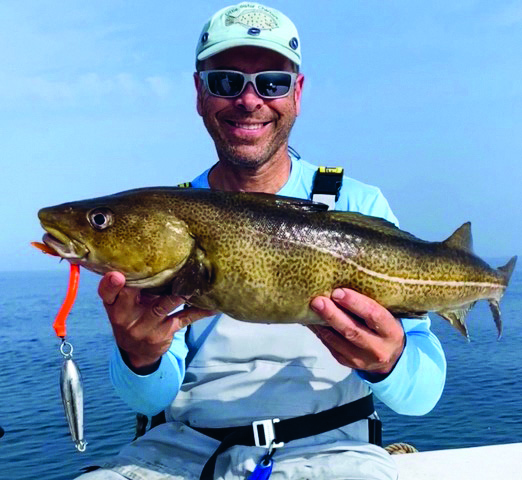
There is no shortage of cod in Mass Bay, and in the fall, they come in close enough to be caught by small boaters, kayakers, and maybe even shore-casters. While not known for their fighting ability, when in shallow water, cod provide some action and can be taken by all manner of jigs, bait, and weighted soft plastics. Federal and state regulations state that one cod of at least 23 inches can be kept per person per day from September 1 through October 31. A couple of the more consistent in-close cod locations are Harding’s Ledge, Ultonia Ledge, Toddy Rocks, the PR Can, Dread Ledge, and Egg Rock. President Roads has been a perennial harbor hot spot, so as October waxes, I wouldn’t be surprised to find them there as well.
Unquestionably, the Massachusetts state fish is one cool critter. Being a denizen of the deep and reveling in cold water, they are the perfect fish to fill the void when striped bass depart. Best of all, anglers won’t have to do a heck of a lot of adjusting since many of the same methods and areas will produce both. I’d say that’s pretty close to perfect as perfect gets, but what else would you expect from Mother Nature?
Ron Powers is the longtime author of the weekly Massachusetts Fishing Report and a monthly columnist at On The Water Magazine.
North Shore
By Steve Gallant
Pack for a Small-Bait Blitz
The fall run is here. It’s the time of year when you have to cover a lot of ground and keep a good pair of binoculars at the ready if you want to make the most of your time on the water. Everything is in motion in fall. The bait, bass, and blues are marching south, and the old fishing adage, “You should have been here yesterday,” is never truer than during these months.
The most crucial factor in finding success is finding the bait. Fish have started to move from their summer residences where they have been settled into a routine. Now, large schools of bait are on the move and things will change quickly in some areas.
There are a couple of strategies when it comes to fishing the fall run. One approach is to pick a likely place that migrating fish will pass by and devote a lot of time to it. This will allow you to try fishing different tides and conditions. The drawback is that if the migration doesn’t come through that area or if you time it wrong, you could miss out.
The other approach is to stay mobile and establish places to check or find a route to drive with a good view of the coast. I keep a pair of binoculars on my passenger seat and my rod, Korkers, and plug bag ready to roll when I’m out cruising for action. What I’m hoping to see is birds circling over the water, cormorants working the surface, pockets of “nervous” water, or maybe even blitzing fish.

However, finding fish is only half the battle this time of year. I’ve tangled with some of the most finicky, frustrating, and hard-to-fool fish in the fall. This is because the bait can be so small that it’s hard to imitate. Peanut bunker has been the predominant bait in recent years, although we do occasionally get schools of adult bunker, too. We also see schools of juvenile sea herring, which is very small and hard to mimic.
I keep small options in my bag during the fall. In terms of topwater, I like a small spook or a pencil popper. A Jumpin’ Minnow, or even a smaller freshwater lure with beefed-up single hooks, is a good option. If the fish are not hitting on top, I will switch to a bucktail jig without a trailer or a small paddletail on a jighead. If those are not getting any attention, I will try a small tin like a Kastmaster or a Deadly Dick. If none of these are getting any response, I always try something way bigger than the forage that stands out from the melee. This approach has worked for me when nothing else would. Honestly, it pays to have a decent-size plug bag and a lot of options.

Blitzes on small bait will bring in fish of all sizes. It’s not like an adult bunker blitz, where you have predominantly large fish due to the big forage. Peanut blitzes can have fish from schoolies to 40-pounders, and bluefish often mix in this time of year. Don’t give up on a blitz because you’re catching only schoolies. Larger fish can sometimes be hanging further down below during a blitz, letting the small fish do the work while they pick up scraps. Once, I put on a paddletail after catching nothing but small fish on top during a blitz. After making a cast, I let the jig sink for a few seconds before making my retrieve back through the school. I actually hit bottom and almost got snagged, then when I popped my plastic free of the rocks and seaweed, a 20-pound striper inhaled it.
One wildcard this time of year is the weather. Although New England’s hurricane season technically starts in June, the majority of storms hit in the fall. September and October have given us plenty of nor’easters, tropical storms, and bomb cyclones (whatever those are). These affect the fishing and sometimes the whole fall run. For me, the best time to fish these events is when the winds just start to pick up and conditions begin to deteriorate. Once the water gets too dirty, I call it quits until the storm passes and things clear up.

The start of the storms is also when the air pressure is dropping dramatically, which seems to get fish fired up. There are several theories as to why this is, and I won’t get into them here but, trust me, if you see that the pressure is going to fall through the floor, you should get out and fish if you can do so safely. Most storms this time of year bring an east wind and waves of varying sizes. Take caution if you are fishing from shore, especially along rocks but even on sandy beaches.
Steve Gallant is an avid surfcaster on Massachusetts’ North Shore and a monthly columnist at On The Water Magazine. You can follow him on Instagram @stevegallant141.
READ MORE