
One of my life’s great good fortunes was to have grown up close to the Sea Bright Bridge.
You could fish under it, jump off it, and walk across it to get to the beach. Winter flounder and striped bass arrived in the spring. Bluefish weren’t far behind, then blowfish and blackfish would join the party. Then there were all kinds of assorted creatures hanging around, like eels, sally growlers, killies, crabs, and worms. What more could a kid want?
Jumping off the bridge took place on the Sea Bright end, where it was deeper. A foolish dive on the Rumson side nearly planted me like a piling in the bottom of the Shrewsbury River one afternoon. Any leap from the structure was frowned upon by the local authorities.
The Shrewsbury River boasts a fierce tidal current that could swiftly sweep you out to Sandy Hook or back into Monmouth Beach. But that was a long time ago. I’m old enough to have watched Howdy Doody. And like me, time took its toll on the bridge.
Decades of nor’easters, blizzards, heavy traffic, salt, frigid cold, and blazing heat, led to cracks, rust, crumbling concrete, and other age-related problems. Built in 1950, the span finally reached retirement age and had to be replaced.
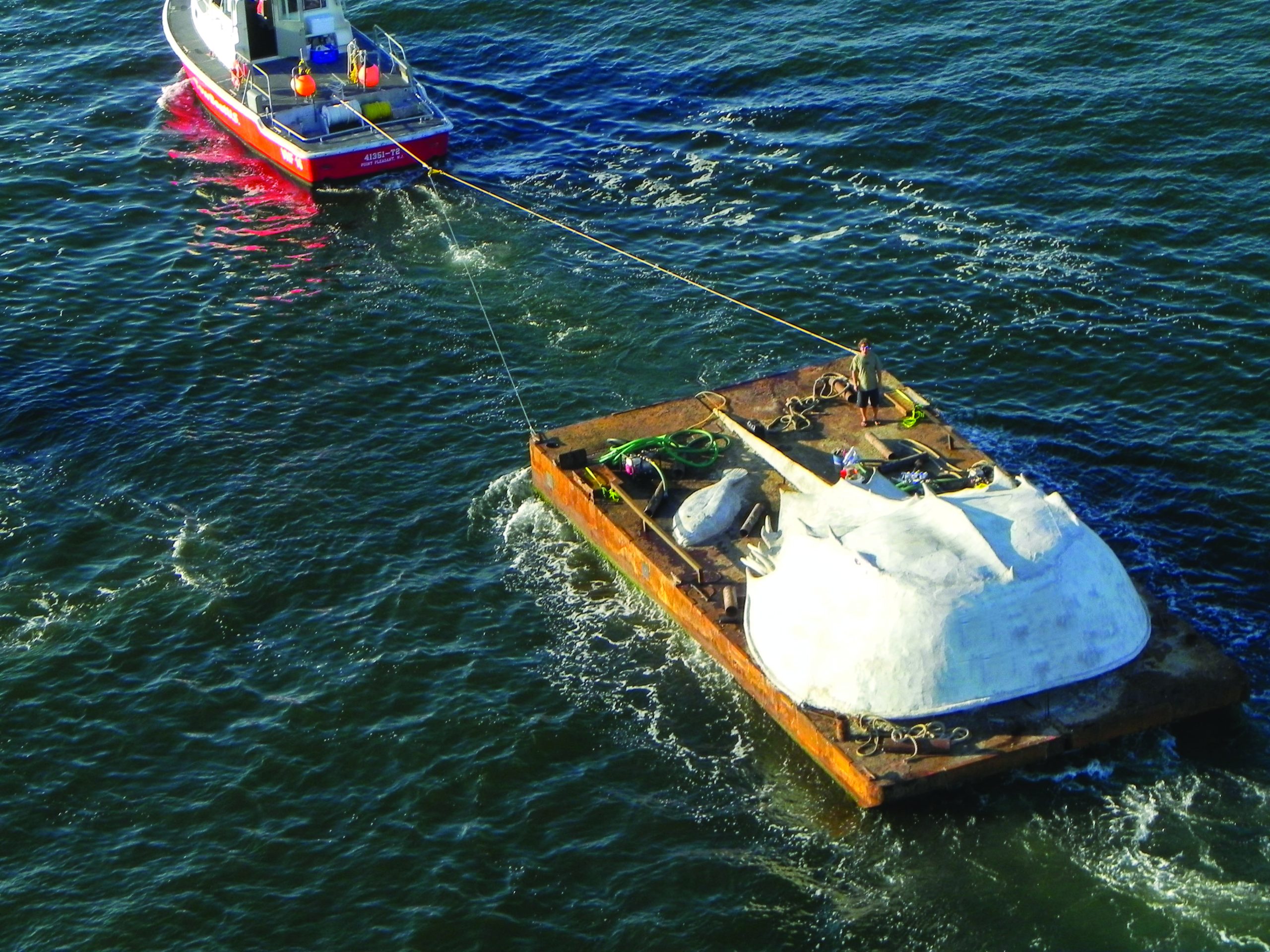
Fortunately, the old bridge found a new home under the water instead of over it as part of New Jersey’s Artificial Reef Program. How that came to be was the result of a cooperative effort from public and private parties for the benefit of everyone, including the fish.


It all started when Chuck Casagrande, chairman of the Monmouth County Planning Board, was attending a regular board meeting in 2022. A passionate fisherman, Casagrande’s ears perked up when County Engineer Joe Ettore was giving an update on Bridge Project S32; the dismantling of the old structure and construction of the new bridge between Rumson and Sea Bright. Casagrande’s first thought was what are they going to do with the rubble?
A Spring Lake native who has fished New Jersey’s coastal waters his entire life, Casagrande knew an opportunity when he heard one. He remembers telling Ettore, “Joe, that’s perfect reef material.”
Now all Casagrande needed was some help to get the concrete that was once over the water, underneath it. He enlisted his old friend Greg Hueth, a member of the Mid-Atlantic Fisheries Management Council, New Jersey Marine Fisheries Council, and a prominent figure on the New Jersey fishing scene.
Hueth has been fishing the reefs since he was a kid, along with his twin brother Chris, and was interested in honoring his late brother’s legacy as the captain of the Big Mohawk. A reef dedicated in his name would be a fitting tribute.
Hueth was immediately on board. “I’d like to do this and get it under my brother’s name,” he said.
Both Casagrande and Hueth were interested in injecting some life into the artificial reef program. The program, which is funded solely through the Sport Fish Restoration Fund, has faced monetary issues and a drop in donations from the private sector. One source of funding that disappeared was the Reef Rescue Project, supported by the Mako Mania Tournament. The tournament, organized by The Greater Point Pleasant Charter Boat Association, came to an end when the mako fishery was closed. No tournament meant no more money for artificial reefs.
The pair then approached Peter Clarke, the head of the New Jersey Artificial Reef Program. Clarke, a Wall native, has been with the state’s artificial reef program for 11 years and is always on the lookout for material to enhance it using concrete, rock, and metal.
Ettore set up the initial meeting in 2023 between Casagrande, Clarke, Hueth, and R.E. Pierson Construction, the company that had won the contract to build the new bridge while dismantling the old one. Thus began several years of meetings with all the parties involved, including the Department of Environmental Protection, Monmouth County Board of Commissioners, New Jersey Division of Fish and Wildlife, R.E. Pierson Construction, and the towns of Sea Bright and Rumson.
Clarke said that a project of this scope involved a lot of moving parts on land and sea and required dozens of meetings, discussions, plenty of give-and-take, and compromises to make it work.
But as Casagrande said, it’s hard to argue with something that’s ecologically sound and delivers so many benefits to the environment. Casagrande said that Joe Ettore worked closely with R.E. Pierson to help smooth the process and overcome any obstacles the company might encounter in making the donation. It’s no small feat to disassemble an entire bridge, then move what remains out to the ocean.
Pierson’s initial plan had been to repurpose all the salvageable material from the site. That plan would cost time, money, and additional resources. Now that the rubble was headed to the reef, the need to move it by an army of trucks through local towns was eliminated.
Pierson also received a tax credit for the donation to the artificial reef program. Clarke said that all future contracts awarded by the county for demolition of other structures can include a similar tax credit to encourage similar donations.
“Once people understand the concept behind this, they can get behind it, Clarke said.
The Monmouth County Board of Commissioners also got involved and offered to pay for cranes and other costs associated with the reef project. In a statement, Commissioner Director Thomas A. Arnone said, “My fellow commissioners and I are proud to see the Rumson-Sea Bright Bridge project contribute to both our infrastructure and our environment by transforming the old bridge into a resource that supports our coastal ecosystem.” Creating a fishing reef from the former bridge demonstrates the county’s commitment to sustainability and to using every resource responsibly, he said.

Commissioner Arnone added that Monmouth County intends to pursue similar opportunities on future county bridge projects, including the Oceanic Bridge replacement.
The Oceanic Bridge connects Rumson to Middletown over the Navesink River. It’s estimated that the Oceanic Bridge will contribute four times more material than the Sea Bright Bridge.
“Monmouth County’s 27 miles of coastline support tourism, as well as both the commercial and recreational fishing sectors, which play an important role in our local economy. Initiatives like this help strengthen those sectors while supporting our marine environment,” Arnone said.
So far, one barge of rubble has been placed on the Sandy Hook Reef this past January, and two or three more are expected to be deployed by the summer of 2026. But it can’t be just any rubble. Clarke is very particular about what he can accept.
“As long as it meets certain criteria, as long as it’s clean rubble, meaning it doesn’t have asphalt, oil, plastic, rubber, or foam,” he said. “It’s got to be clean demo concrete. My job is to either accept or refuse a load, and I’m not looking for everything. I’m looking for big pieces, nothing smaller than a basketball.” Clarke had to reject one barge of material because it contained too much loose dirt.
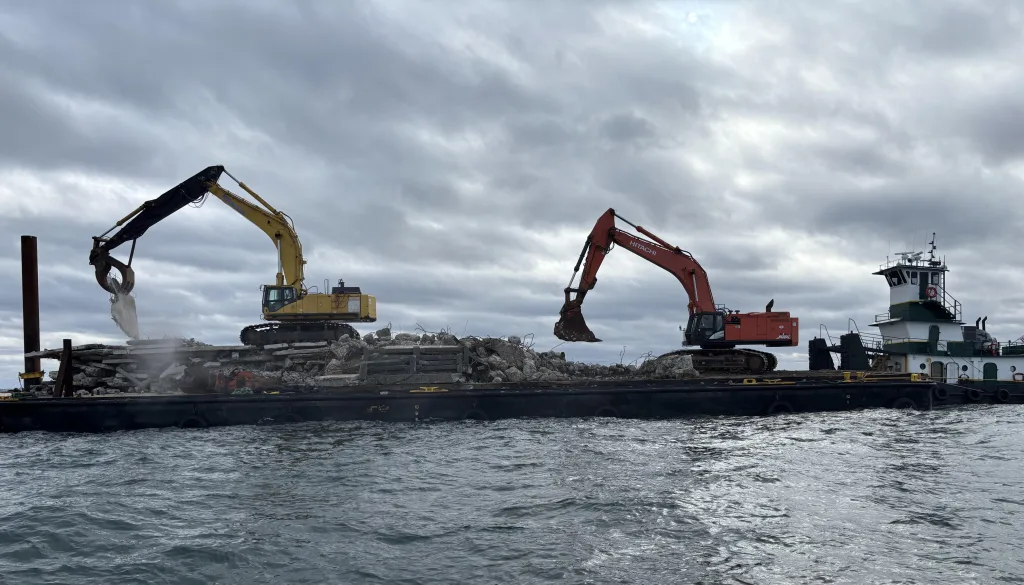
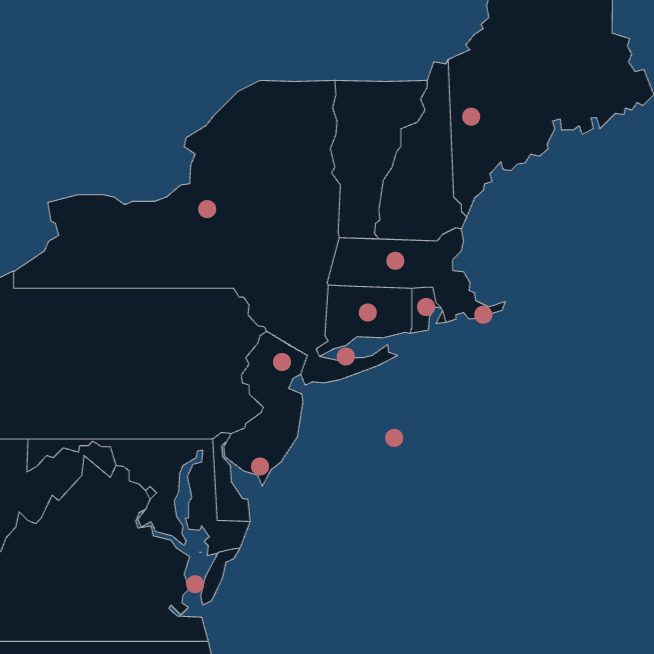
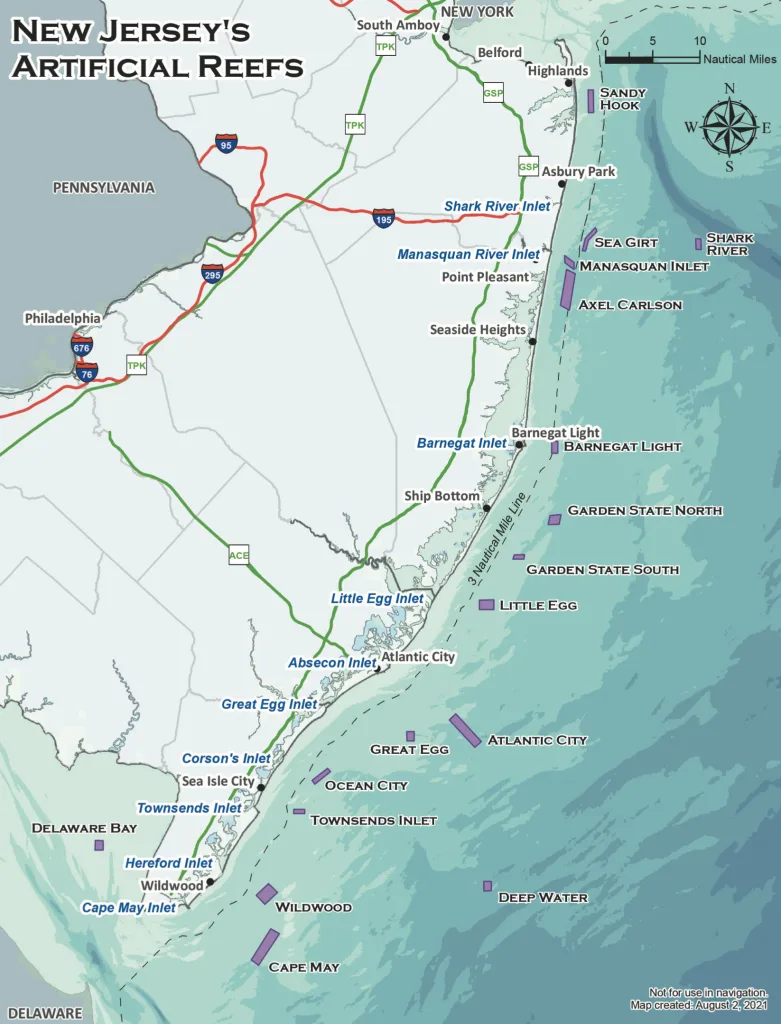
The Sandy Hook Reef is one of 17 reef sites managed by the state, and approximately 5,000 deployments of material have been made since the program started in 1984. The reefs cover 34 square miles of ocean bottom.
The reef program, Clarke added, counts on private donations from fishing and diving clubs throughout the state to maintain and enhance the sites. No part of its budget is allocated to purchase reef material.
The rubble from the Sea Bright Bridge that will end up on the Sandy Hook Reef is known as an additional patch reef, and it will be named the Captain Chris Hueth Memorial Reef in honor of Capt. Hueth of the Big Mohawk out of Belmar. Hueth was a widely respected fisherman who spent decades on the local wrecks and reefs targeting blackfish, striped bass, sea bass, and fluke.
“I think it’s wonderful, the family is thrilled about the whole thing,” Kathy Hueth, Chris’ widow, said. We’re sure he’s up in heaven smiling down.”
Kathy, who handles reservations and social media for the Big Mohawk, said that they used to joke that she booked them and he hooked them. “Chris helped a lot of people become good anglers, and he fostered a love of fishing for so many,” she added.
The Big Mohawk, one of the most recognizable vessels on the New Jersey party boat scene, has been plying the waters off Monmouth and Ocean counties for decades. Capt. Payton Gepp, a former mate mentored by Hueth, now runs the Big Mohawk.
Capt. Hueth built a devoted following and a reputation for finding and catching trophy fluke, striped bass, and blackfish. “It was his passion and his life’s dream to have his own boat,” Kathy said. “He was the fish whisperer.”
Greg Hueth said there will be a dedication ceremony to his brother at some point in the future. “He loved bottom fishing on these reefs,” Hueth said. “He’d be proud to be part of this.”
Clarke is equally proud of the state’s artificial reef program and the benefits it has brought to anglers. The State of New Jersey has the best fishing along the coast. “I’ve fished from Maine down to Florida, and it’s absolutely amazing how good our fishing is.” Clarke said. “We have every type of fish, and artificial reefs provide habitat that just wouldn’t be there otherwise. Once we start up in May, it’s incredible fishing through mid-December.”
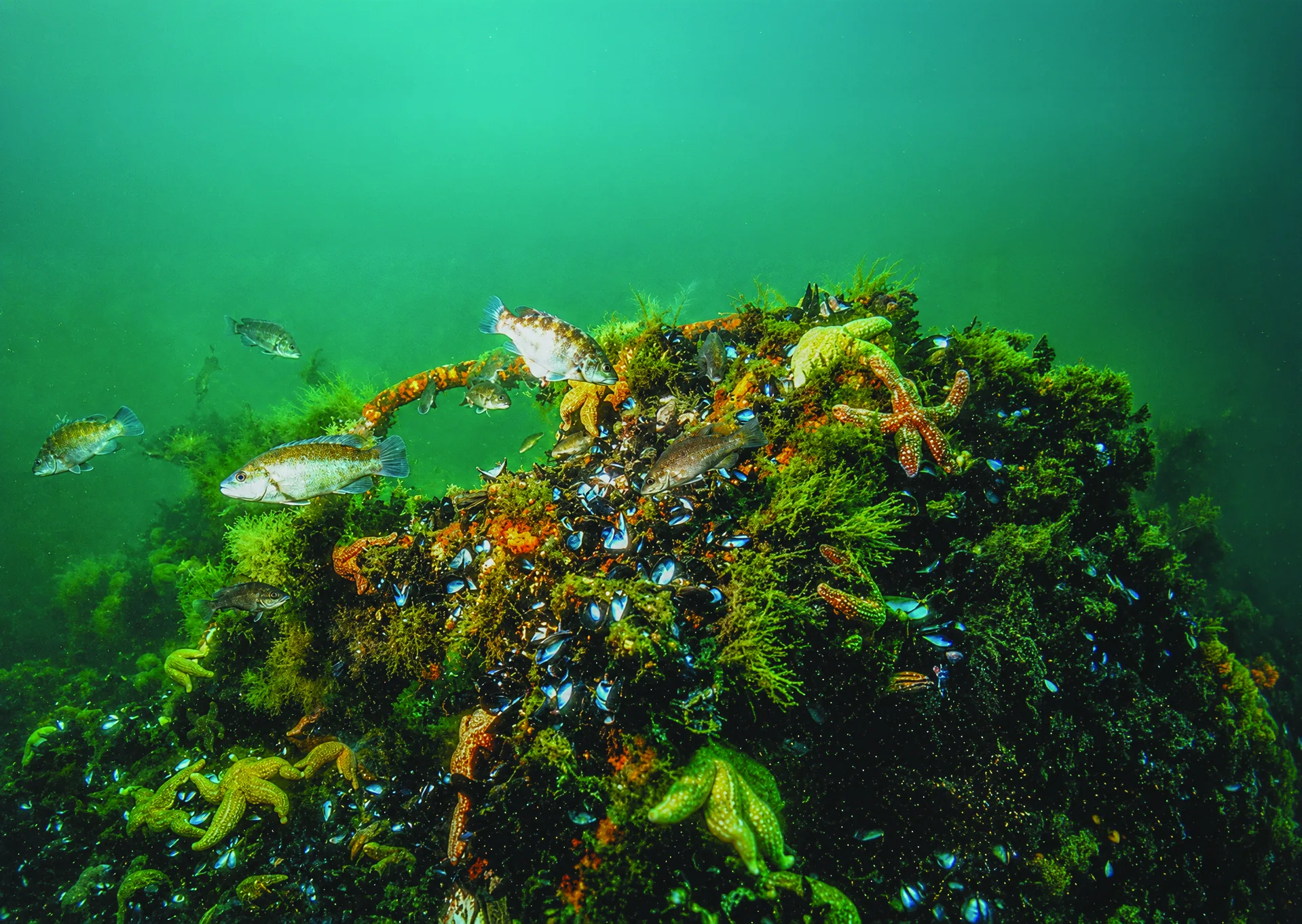
When the material is put in place, Clarke said it is encrusted with organic material right away. “Fish will be on it within a day, he said, “they need a home, and the program provides that dynamic habitat.”
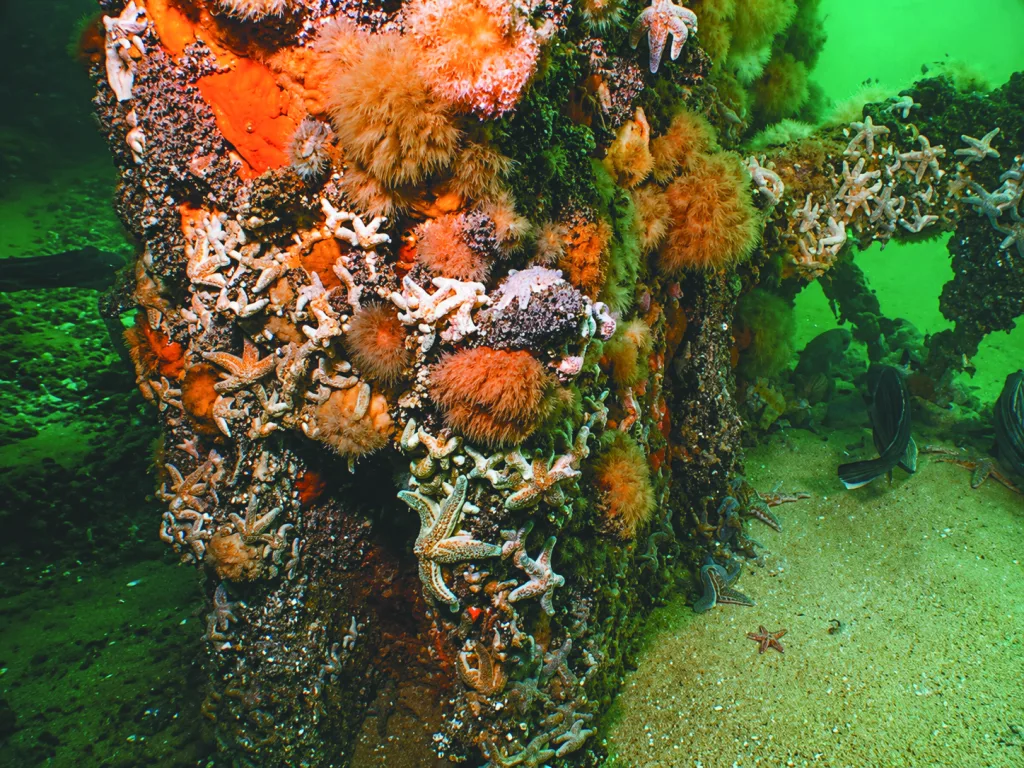
Clarke explained that artificial reefs are vital for the health of offshore waters. “For better or worse, humans have adjusted the coastline of New Jersey,” Clarke said.
He believes that by changing the symmetry of coastal waters, we are obligated to do something about it. “We’re addressing the impact we’ve had on the coastline by the creation of these reef habitats,” Clarke said.
The reefs provide a focal point for anglers targeting bottom fish such as fluke, blackfish, and sea bass, but Clarke stressed they are much more than that.
Clarke has a master’s degree in Wildlife and Fisheries Conservation from the University of Massachusetts at Amherst. “These reefs are staging areas offering food and shelter, and New Jersey has a matrix of reef sites,” he said.
They benefit all stocks of fish that use those reefs, including pelagics, like tuna, Spanish mackerel, and bonito. And since most states have reef sites, Clarke added, the entire East Coast benefits from sites in neighboring states, making these programs synergetic with one another. “Fish migrate north and south, they don’t know boundaries,” he said.
Clarke said it’s important for people to understand that artificial reefs are much more than fish-attracting devices, or FADS in industry parlance. “Reefs attract fish and fishermen, but it’s unequivocal that there’s productivity occurring on these reef sites, and it’s from the bottom up, he said. He estimates there are 150 marine organisms on the reef, everything from barnacles to striped bass. The reefs, as he sees it, are not improvements or restorations, but enhancements to the environment.
New Jersey’s artificial reef program does not rely solely on repurposed concrete for material. In the past, decommissioned barges, tug boats, and old subway cars have been sunk on the sites.
“We’re not just dumping waste,” Clarke said, “There’s a lot of thought going into material acquisition.”
The state has also deployed reef balls, pre-cast hollow concrete structures with multiple openings that invite marine life to set up house.
A project to bring similar pre-cast structures to the state’s artificial reefs is currently in the planning stages. Clarke is very excited about the new venture as it will provide new material to maintain existing reefs. The whole enterprise, which has been a win-win for everyone involved, proved that projects like this are possible.
One other thing is certain. Like me, New Jersey is no spring chicken. Much of the state’s infrastructure, such as bridges and overpasses, needs to be replaced. Why not put the old ones at the bottom of the ocean?