
The 20-minute drive from Niagara Crossing Hotel & Spa to Erie Basin Marina felt long. I was finally about to fish Lake Erie proper with a legendary captain, the waters where the largest smallmouth ever caught in the Great Lakes come from. I’d seen the proof for years—camera rolls full of footballs, stories of not just crazy big smallmouth, but crazy numbers of them.
I’d never fished Erie by boat. The closest I’d come was a kayak mission inside Buffalo Harbor, targeting protected breakwalls, docks, and shorelines, though even that equated to the best smallmouth fishing I’ve ever experienced. If it was that good in the harbor, how good was the main lake?
Captain Joe Fonzi has been piecing Erie together for 35-plus years, and I couldn’t wait to get ushered to the very grounds where he’s built his legend and cashed plenty of tournament checks along the way.
It was a bluebird morning on Erie. Not a breath of wind. I hopped out, pulled on my bibs and jacket, and beelined for the gangway where an overbuilt 23-foot Ranger waited. As I got close, the first thing I noticed was Fonzi himself—sun-seasoned skin, gray hair, that salty look you expect to see in Gloucester, not at a freshwater marina. His boat matched him: rugged, purposeful, set up to take abuse. I thought, I’m going to like this dude. My excitement boiled over into an animated intro that Fonzi snuffed out immediately.
“What the hell are you so excited for?”
“I’ve never fished Erie, and I hear you’re the man…”
He cut me off. “This lake sucks without wind. You see any wind? No? So don’t get your hopes up.”
On the ride out, I told him about the side bet I had going with my friend, Robbie Tartaglia. He was fishing the lower Niagara and we were both keeping track of our best five-fish bag on Bubba Smart Fish Scales: winner-take-all.
Fonzi didn’t hesitate. “If you lose fishing Erie smallmouth to someone fishing the river, you should quit fishing. Different class of fish here.”
Two and a half hours later, dragging tubes across sandy bottom in 50 feet, it didn’t feel like a different class of anything. We were all frustrated, especially Fonzi, which became obvious when his wife called to ask if she should go turkey hunting after oversleeping.
“Honey, I love you very much,” he said, “but I’m two-plus hours into this trip and haven’t gotten a single bite yet. I’ve got a serious case of guide’s gut. Let me pay attention and get the program on track.”
We moved. Then moved again. Bob George, the other angler on board, finally got the first two taps but didn’t come tight. Fonzi saw it all, even with his back turned. When Bob said he wasn’t sure it was a bite, Fonzi deadpanned, “Nothing but smooth sandy bottom. If it wasn’t a smallie, it could have only been a mermaid.”
That bite was Fonzi’s cue to grab a rod. Soon after his tube started dragging, he sent a four-pounder airborne from 50 feet down. Twenty minutes later, another. I finally boated a 3.10 on Fonzi’s custom tube, but the fishing was still painfully slow.

We agreed to stop chasing giants deep and slide shallower to boulder fields where blade baits, jigs, and small swimbaits would provide some welcome proactiveness over dragging a tube. Fonzi explained the truth: The giants were where we were leaving from. We could see them on the electronics, but without wind, the bite windows were miniscule.
While running in a little shallower, we marked a pile of fish on plane and swung back to set up a drift. Bob pulled out a sandwich and mentioned how the weather almost made up for it.
Fonzi shot it down: “No wind SUCKS!”
I dug through my tackle and grabbed a 2.5-inch Crush City Mayor in a natural shade they call electric shad on a 3/8-ounce VMC jighead. Fonzi watched out of the corner of his eye. “That’ll get bit, but move that net back to the center of the forward deck. Fish won’t bite if the net isn’t in its correct place.”
“Superstition?” I asked.
“Yup.”
Halfway through a long cast, I felt the thump and swung for the fences. My rod tip arched toward the calm surface. I backed off the drag a couple clicks and up came the biggest smallmouth I’d ever seen attached to the end of my line.
Once it hit the net, Fonzi laughed. “You didn’t give that thing a chance to escape and take a breath? Couple more like that and you’ll be fine in your little competition.”
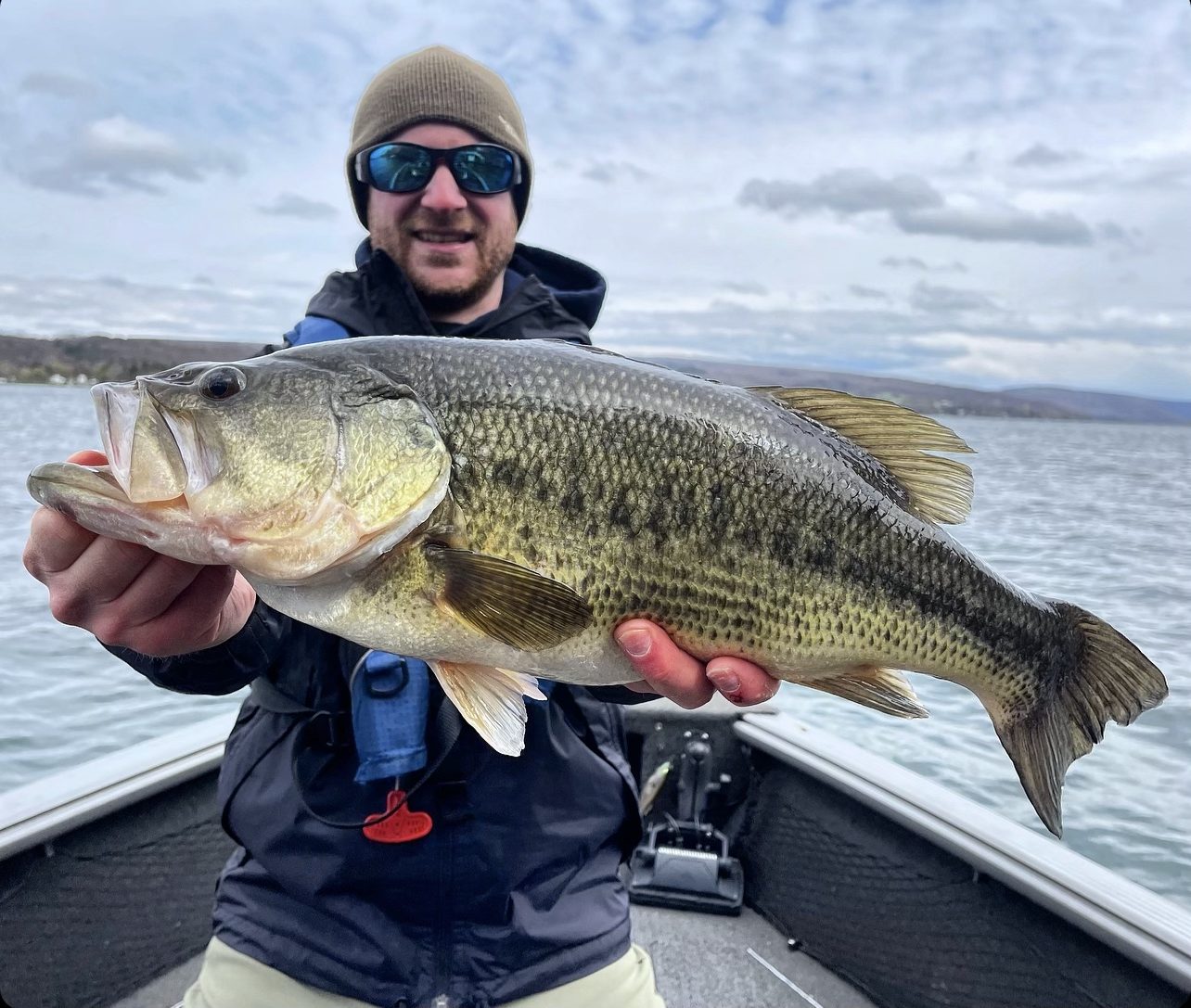
The Bubba read 6.0. A few casts later, 4.2. Then another bronze blimp at 6.2.
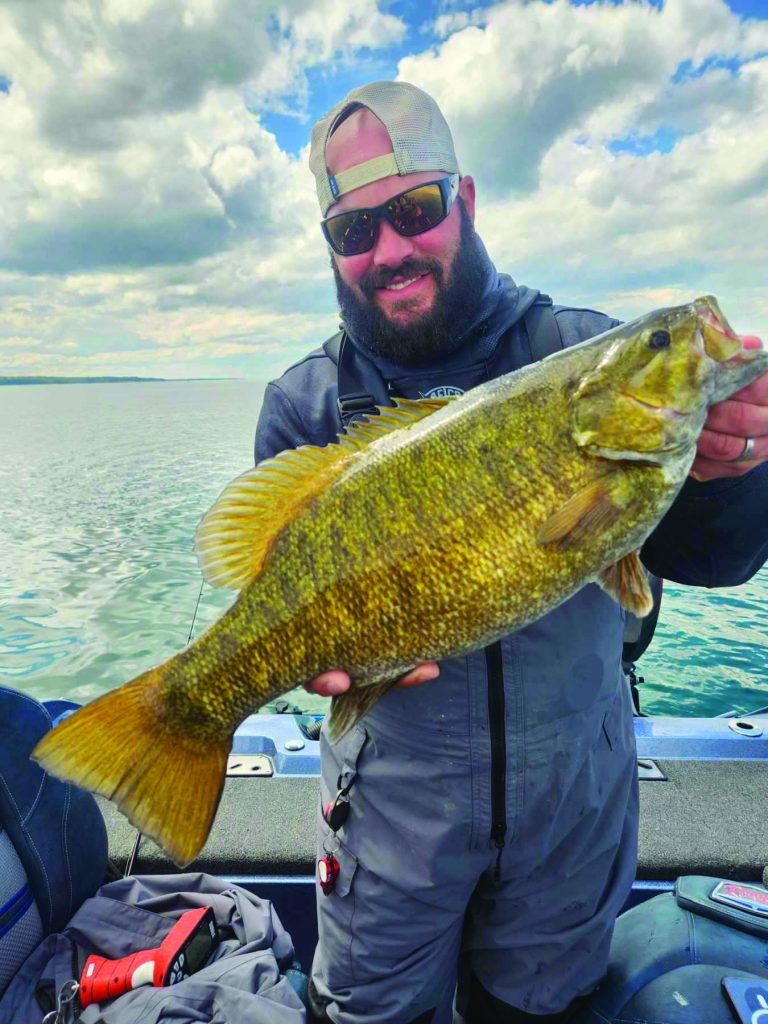
The switch flipped. We were finally in the right place at the right time and I didn’t want to leave. Fonzi and Bob each boated 6-pound-class fish. I filled my five-fish bag and culled right up until we had to call it to make the group dinner.
Niagara River, Where Everything Is Supersized
Every May, Captain Frank Campbell of Niagara Region Charter Service invites outdoor media and fishing-tackle companies to showcase how special this region’s fishery truly is. He calls the Lower Niagara—where outsized smallmouth, walleye, muskie, kings, cohos, browns, lakers, and steelhead all roam—his office.
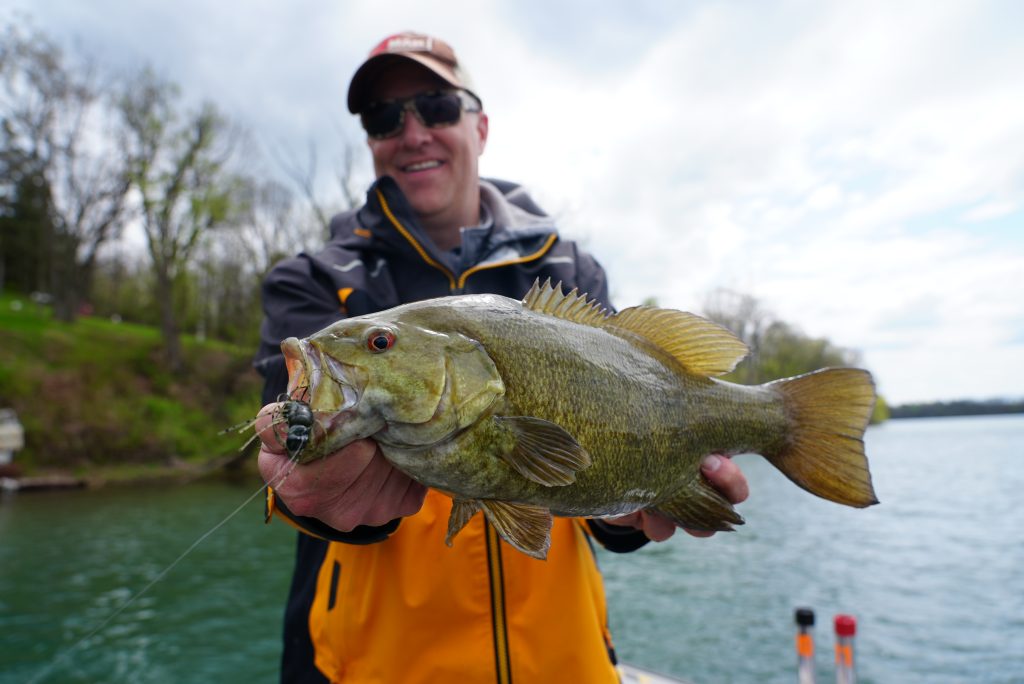
The accommodations at Niagara Crossing put us two minutes from casting range of the biggest, meanest versions of North America’s freshwater game fish. That proximity does something to me. Even though the trip was fully outfitted with the latest gear from attending brands, I brought my own gear so I could fish before and after the scheduled fishing.
On this trip’s first morning, my alarm went off a half-hour before sunrise. I grabbed a medium-light spinning rod, which had a 4000-size reel spooled with 10-pound TactX braid and 12-pound Seaguar Gold Label. I had about 90 minutes to fish the boat-ramp area before we met up to order breakfast and lunch and get our captain assignments for the day.
I was all-in on smallmouth, but on a river like this, I had to stay versatile. I started slow-rolling a small swimbait and jighead that almost anything will eat when I spotted a chunky smallie cruising riprap. I dug into my sling pack for a jig and found a fresh 1/4-ounce Beast Coast Lil’ Magnum—then realized I’d left my go-to Crush City Cleanup Craws back in the hotel room. Classic.
I grabbed what I had—a Yamamoto Fat Ika. First cast to the fish: Nothing. Second cast: Nothing. Third cast, halfway back, the jig just felt heavy. I swung, thinking snag, and then the snag did what you always hope a snag does—it shook its head.
Big lake trout, I figured, but then it took off, sending braid screaming off my reel. I palmed the spool, turned the fish, and got it close enough to see a telephone-pole-thick muskie roll on the surface.
I’d never seen one bigger than 42 inches in person. This was bigger—and thicker—and in my hands was a combo better suited for crappie. I was five feet above the water on a bulkhead, with slick riprap below. I didn’t like my odds of landing the fish, but I still wanted proof I’d hooked it.
I fumbled my iPhone out and hit “record,” holding it between my knuckles while I turned the reel handle with the same hand. The fish ran again and surfaced about 20 feet out, where I captured it on video, and that’s when it detonated. It whipped its body, throwing water everywhere, and took a mean, line-snapping run.
Zzzzzz—zzzzz—pop.
Gone.
I checked the time and hustled back toward the truck, still shaking when I saw Frank.
“Cheech! You look like you saw a ghost.”
Frank glanced toward the ramp and then back at me. “You hooked a massive muskie down at the ramp, didn’t you?”
After getting a bite of breakfast, a packed lunch, and our day’s assignments at the local Topps Grocery store, we were loading boats at the same ramp where my muskie battle had just played out. Walking down the dock, I fired a jighead and swimbait, immediately launching a three-pound smallie airborne. Everyone started laughing. On the second cast, I hooked a bigger one; suddenly, people were scrambling for rods. Robbie grabbed his and tied on the same swimbait. On his first cast, he caught his personal-best smallmouth. On his second, he caught a 20-inch lake trout.
We spent the day drifting seams, casting toward shore, and stacking smallmouth, with a few lakers and pike mixed in. Robbie improved his PB twice more, topping out around 5½ pounds. Some boats ran to the Lake Ontario bar and tangled with giant lakers and salmon while others headed toward Devil’s Hole for smallies, steelhead, and lake trout.
It’s just that kind of place.
Erie, With a Heavy Dose of Wind
For my final fishing day, Robbie, Seaguar’s Gerry Benedicto, and I headed up to Lake Erie with The Fonz (Fonzi) on a day calling for 20- to 25-mile-per-hour winds.
At idle, we were already holding our hats. We passed a 28-foot walkaround headed in, and two guys looked back at us while shaking their heads.
I turned toward the breakers and stared at the wall of water beyond them. Before I could ask if we were actually doing this, Fonzi eased the throttles forward.
His demeanor was different today. Calm. Focused. Maybe even excited a little, enjoying the ride out. He climbed swells and backed off at each crest, working hard to find the best angle to mitigate the conditions as he’s done thousands of times.
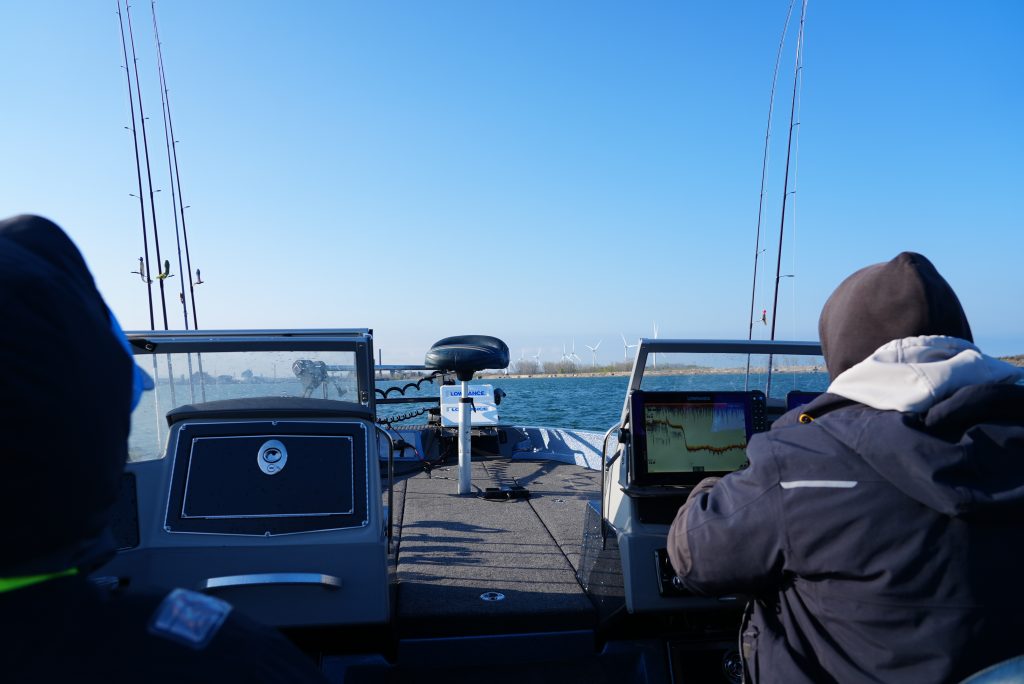
About an hour in, Erie reminded us who’s boss. I ended up on my back on the deck when the pedestal broke clean from its base. Fonzi shrugged. “Only thing you can’t make Erie-proof,” he said. “Third or fourth time this year. I’m just glad you didn’t get hurt and are still in the boat.” The previous night’s heaping portions of Buffalo’s famous wings probably didn’t help.
Once we set up, Fonzi handed out custom 5-inch swimbaits in olive and brown, and told us to fish them on ¾-ounce football jigheads.
“Keep ’em glued to the bottom,” he said. “Fast drift today, boys. Stay in the strike zone and show them something worth moving for.”
Gear Up for Erie Bronze
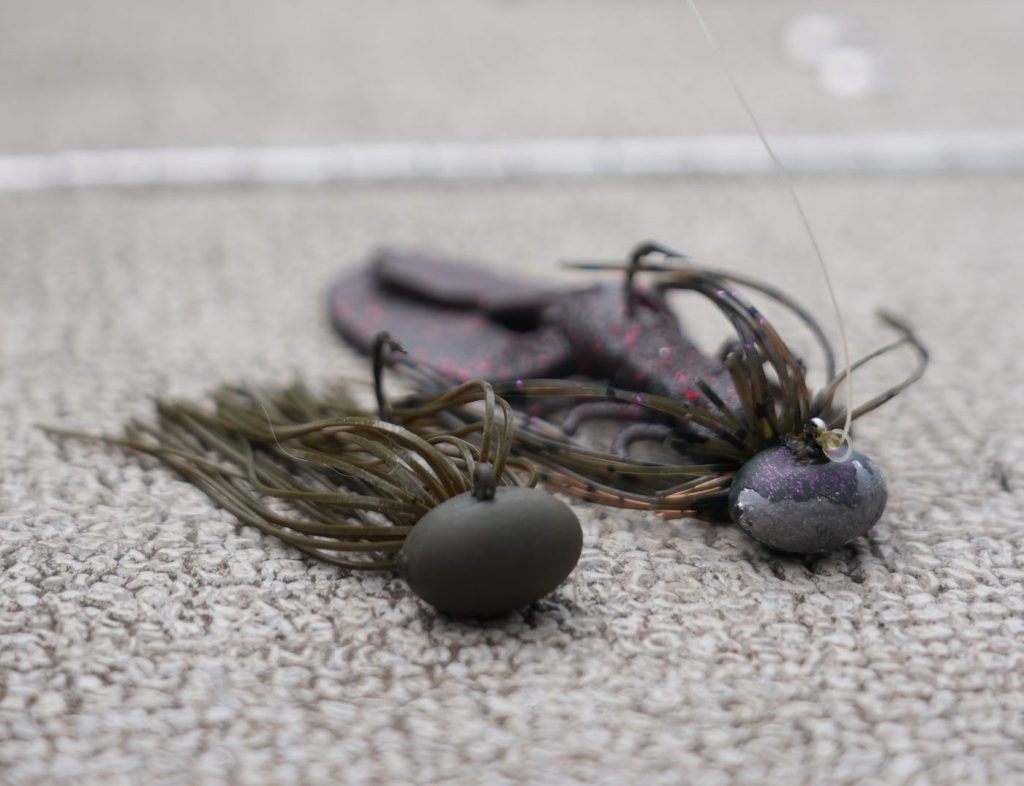
You want a 7-foot or longer spinning rod to make long casts, supported by a reel that will cast light braid a mile. A rod with a fast action will detect everything from bottom composition to subtle cold-water bites, yet have the length and backbone to drive the hook home. In situations like heavy wind, or heavier jig heads, I’ll select the rod according to the lure weight rating. The thing braid to fluorocarbon leader provides additional sensitivity benefits, cuts through water better for maintaining bottom contact, while increasing abrasion resistance fishing around zebra mussels and rocks.
Line and Leader:
- 10-pound-test Seaguar Smackdown
- 10-pound-test Seaguar Gold Label fluorocarbon
Rods:
- St. Croix Legend X2 (LXTC71MHF)
- 7’ Trika 6X Medium Light, Fast Action rod
Reel: Shimano Vanford 3000
Baits:
- 3-inch Z-Man MinnowZ
- 2.5- and 3-inch Crush City Mayor
- 3/8-ounce, Gamakatsu Football 24 Jighead
We half-walked, half-crawled to our spots and started punching casts through the wind. Waves smacked the hull, spraying us. The second the bait touched down, slack blew off the reel so fast that one lapse of focus might cost half a spool. The technique was to close the bail and feel the jig tick boulders and then slow-roll it back.
One “tick” was more solid, and a swing of the rod confirmed my suspicion that a smallmouth inhaled my offering. I watched my line rise up in the water column as swells reached up and grabbed at it. Out of the top of a wave launched a slab of bronze, just to smash into the face of the next wave until it gained a little traction, ripping drag in the process, until it was airborne again. Gerry, who had just dropped straight down, was already fighting a fish of his own.
With such a fast drift, I decided to use the wind and make super-long casts to reel back to the boat extra slow instead of casting back over water we’d drifted past. It made sense to me, but it didn’t seem to matter, as every jig that hit the bottom got thumped by one big bronze bomber after another.
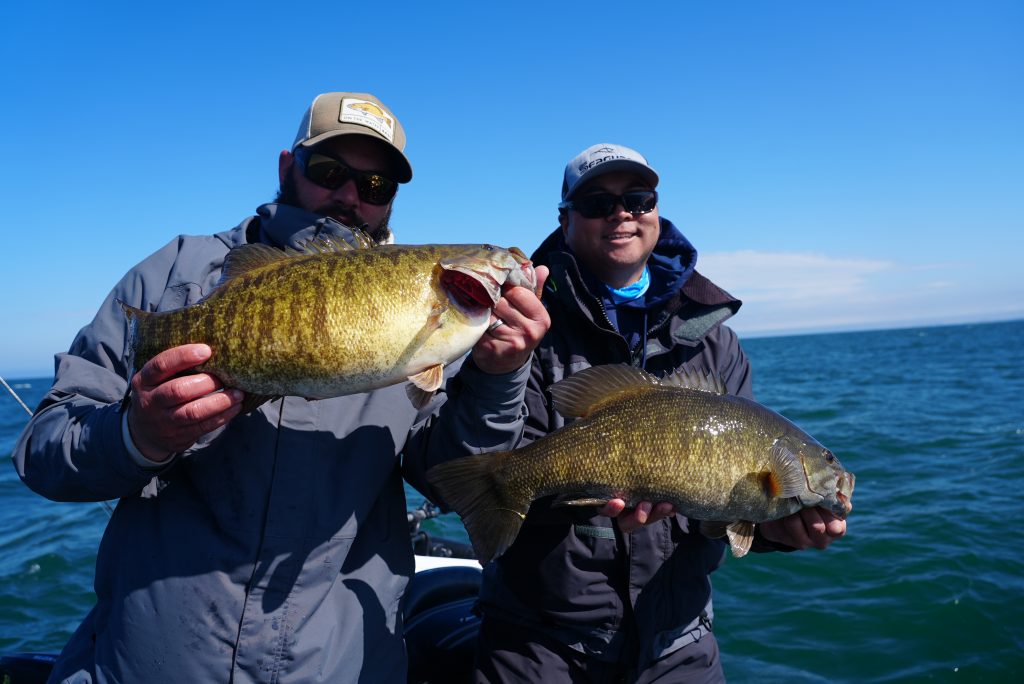
Just when we drifted past the juice and Fonzi thought about moving back up, another pile of fish appeared on the graph, causing us to stick with it well beyond his normal drift length.
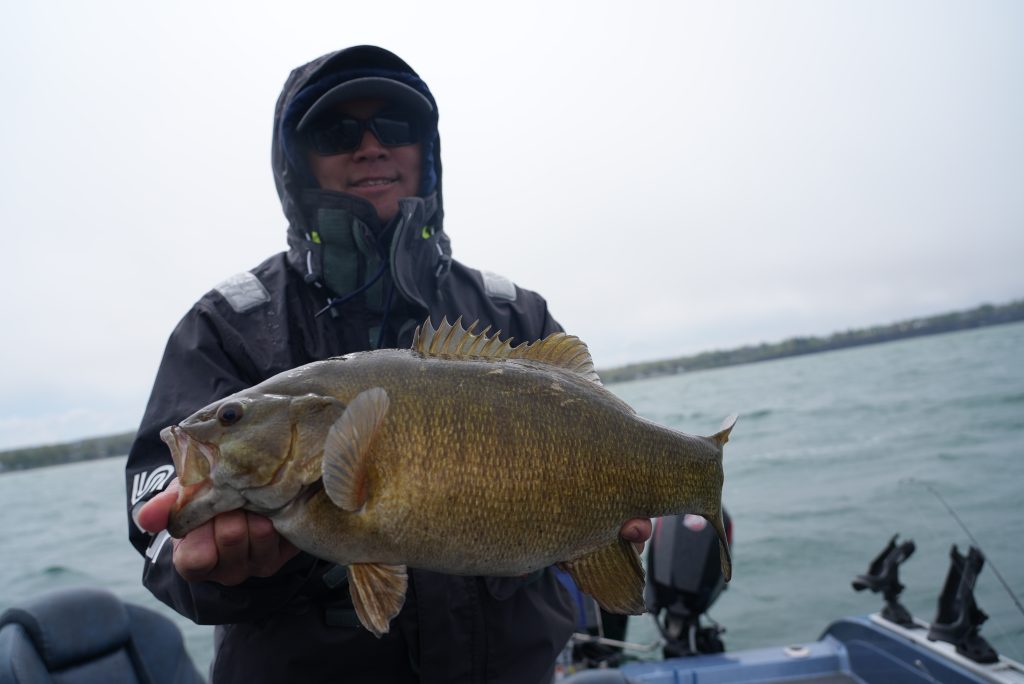
There were doubles and triples and quads. There were respectable 2½- to 4½-pounders being called “rats.” We caught countless fish in the 5-pound class, and six beautiful leopard-patterned smallmouth in the six-pound class. Many had begun thinking about spawning, evidenced by what looked like Wolverine claw marks down their sides. Captain Fonzi explained that this was from the fish fanning over the bottom strewn with razor-sharp zebra mussels that have invaded Erie. Everyone had a pair of scale-verified 6-pounders, except Robbie.
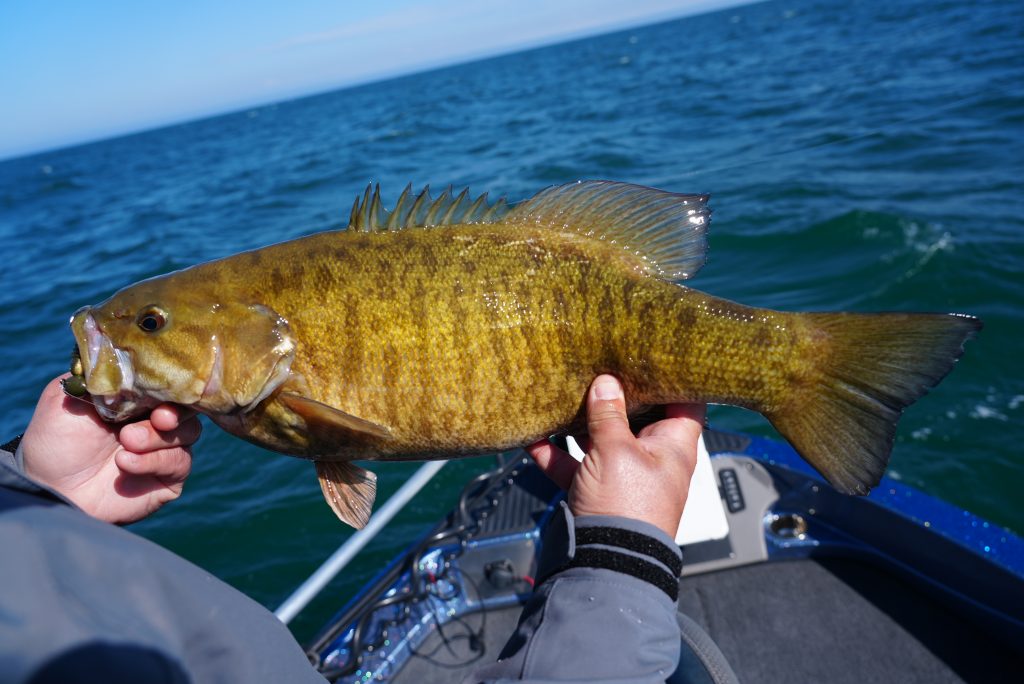
As the wind intensified, the waves grew teeth. Robbie’s intensity to get the right bite leveled up as he sensed that time was running out. He hooked into a fish, thinking it was the one, but a big white belly with golden-hued sides revealed a 10-pound-class freshwater drum. A minute later, I heard the unmistakable sound of a hookset, followed by the slipping of Robbie’s drag.
“This is her, this is her,” he shouted, hoping it wasn’t another Erie oddity but rather the bass he’s dreamed of his entire life.
“Definitely a smallie—a big one. Stay buttoned, stay buttoned,” he pleaded, as his line rocketed up the water column.
Out came a USDA Prime slab of smallmouth, too fat to totally vacate the water. Robbie reacted with a crouch and a rod-angle adjustment, bowing in acknowledgement of it being a fish he definitely didn’t want to lose. A four-foot roller crashed into the side of the fish, then swallowed it. On the backside of the roller, there she was again, tail-walking and shaking her face.
The giant smallmouth turned and tail-walked again, this time into oncoming traffic. The next wave smashed into her face and just like that—Robbie’s jighead and paddletail hurdled back toward him. He collapsed into a full crouch, hands on his head. Silent, but shaking.
That fish looked bigger than the 6.5 we’d weighed earlier. He might have skipped 6 entirely and caught a 7-pounder. But that’s Erie. It gives and it takes.
Cloud cover rolled in and the bite changed. The same wind Fonzi told us to pray for finally sent us packing with sore bodies, soaked gear, full memory cards, and a fresh respect for how special Lake Erie smallmouth fishing really is. Especially when it blows.
Book a Trip
Capt. Joe Fonzi
Thumbs Up Guide Service
716-998-8373
Capt. Frank Campbell
Niagara Region Charter Service
niagaracharter.com
READ MORE