For a brief and terrible moment, it looked like I might end up swimming in the dark, soup-warm waters of Vineyard Sound. We’d left Falmouth Harbor at 3:00 a.m. with the goal of dropping jigs among the humpbacks and storm petrels before the sun cracked the horizon. With the radar spinning and a lookout on the bow, we’d made our way down Vineyard Sound at a reasonable and prudent speed until the horrible sound of something fouling the props forced Chris Megan to throttle back and assess the situation.
A length of warp hidden inside a mat of sargassum had snarled the port-side Yamaha. Burdened with the knowledge of the many hungry brown sharks swimming around Martha’s Vineyard, I desperately wanted to stay in the boat. Thankfully, after some engine straddling and smart handiwork with a serrated knife by Chris, the Vineyard Sound baptism was avoided, and our southwesterly voyage resumed.
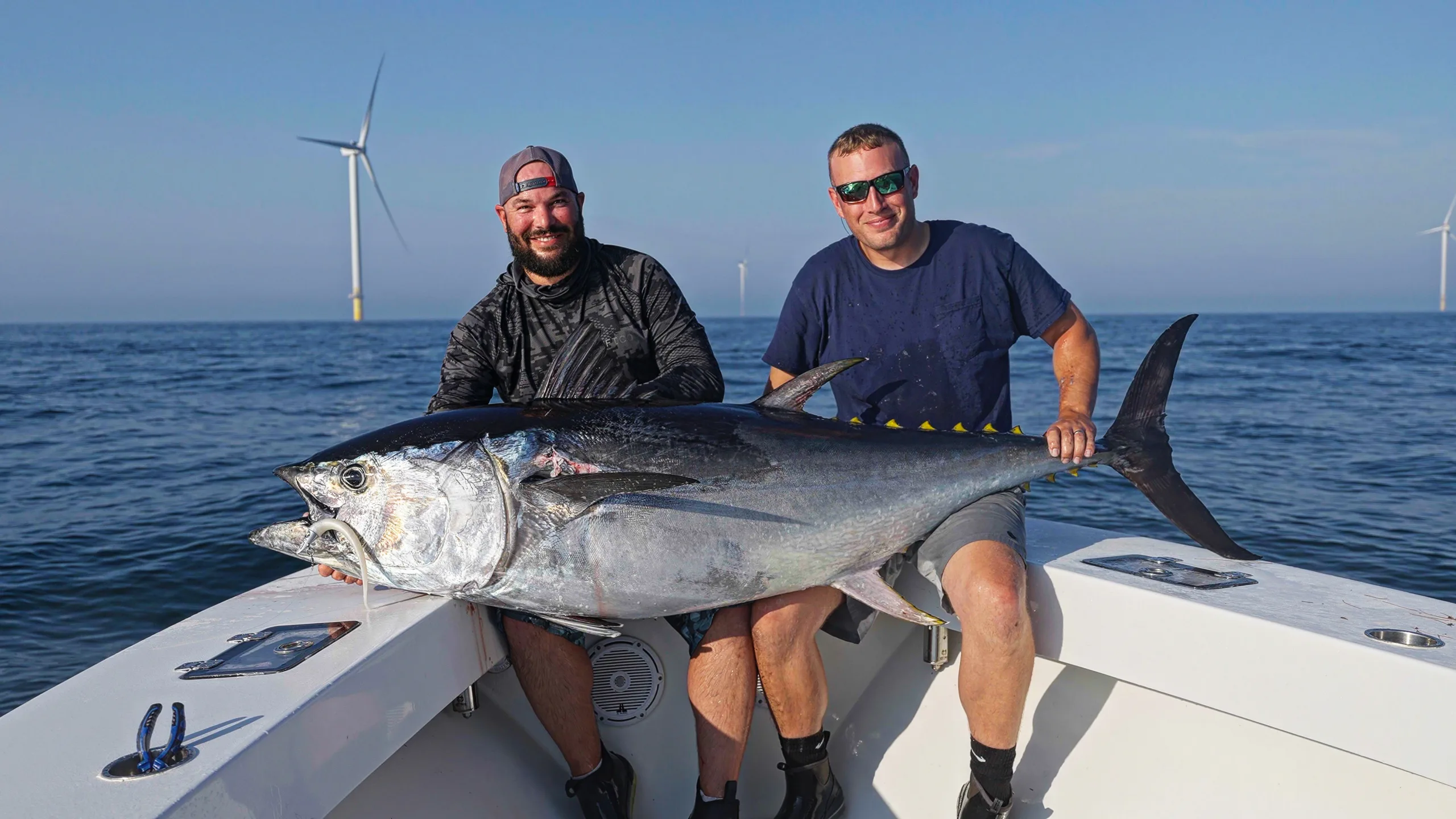
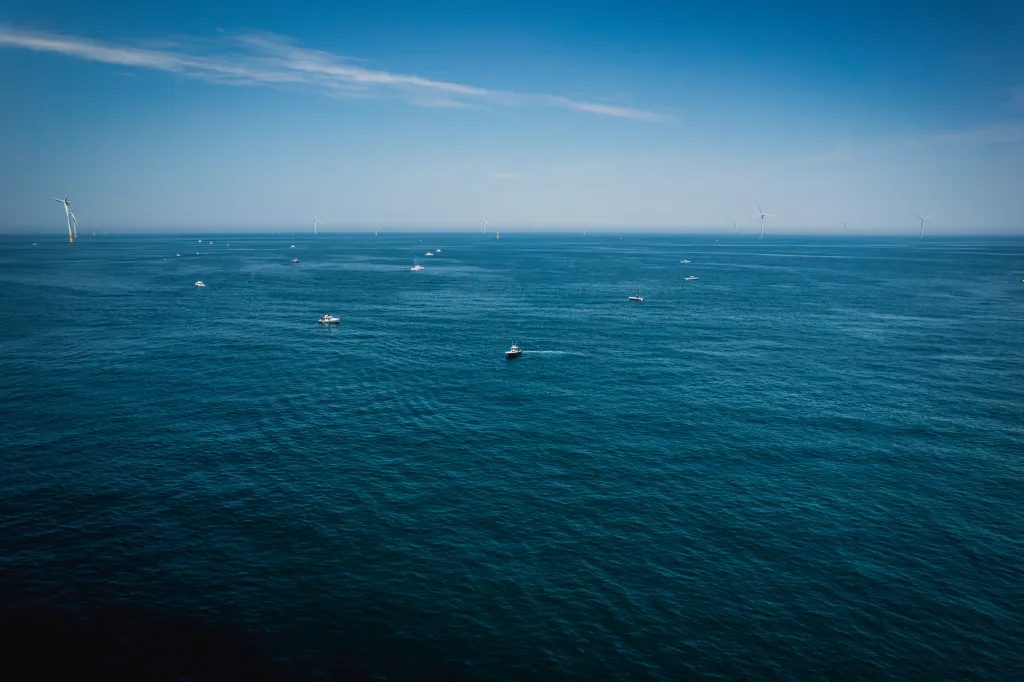
Mid-summer has seen us tracing that same route over the last several years as the school bluefin have favored a western path north, bringing them to the 30-mile swath between Coxes and Habbs ledges for most of July and August. The scenery has changed since this bite developed, with the turbines, and their flashing red lights, imposing themselves on our offshore horizon. Thankfully, the bluefin still return, indifferent to the massive monopiles and the deafening thump of the pile driver.
By the time we cleared the wind farm, the fouled prop already a distant memory, it was light enough to scan for life. For tuna fishermen, there’s a hierarchy of the marine life as it pertains to finding tuna. This hierarchy changes depending on the location and time of year, but for the tuna grounds off Block Island, the most common forms of life are shearwaters, dolphins, whales, and storm petrels.
Tuna fishermen have mixed feelings about dolphins. At a distance, they can look like blitzing tuna, giving false hope, but sometimes a popper cast around them can pull out a bluefin. (Photo by Liam O’Neill)
In other places and at other times of year, shearwaters are the harbingers of topwater tuna glory; but south of Block Island in late July, they offer little more than false hope. The tuna, or rather the sand eels that hold the tuna here, have gone deep as the surface waters warmed, bringing the tuna with them.
Dolphins are usually summarily dismissed by tuna captains, except when they’ve been confused for breaking tuna. In times of desperation, however, I’ve seen a Hail Mary cast launched ahead of a pod of two-tones yield a bonus bluefin.
Whales are the superior cetacean, especially the “big-winged New Englanders,” the humpbacks. Famously messy eaters, the humpbacks feed on the same sand eels as the bluefin, leaving hundreds to thousands of wounded and disoriented baitfish in their wakes.
In the summer, abundant sand eels bring bluefin, whales, dolphins, and more to the tuna grounds off Block Island. (Photo by Liam O’Neill)
While whales are a better sign that tuna are present, they are not the best sign. The best sign would be a tightly clustered pack of storm petrels hovering over piece of slicked over water. These small pelagic birds gather to feed on the sand eel puree that float to the surface as the tuna gorge below.
A slick can be a promising sign, even without the petrels, depending on its size. A large slick does not, as one might reasonably think, indicate a larger school of feeding tuna. A large slick is most often an old slick, one that wind and waves have spread out after the tuna have moved on. A small slick indicates recent and possibly ongoing activity below that requires immediate attention.
We saw none of these as we pulled back the throttles near the coordinates we’d entered into the chartplotter that morning. These numbers, not quite at the Gully, were the site of a good tuna catch just days before. While we couldn’t expect the bluefin—a fish capable of trans-Atlantic migrations—to be in exactly the same area, the most recent available intel provides the best starting point for a new day’s search.
A tuna search can be even more effective if you coordinate your efforts with other boats. We’d done just that with Ty Reine, who’d also departed from Falmouth Harbor that morning.
Ty, who was accompanied by my co-worker Anthony DeiCicchi, agreed to stay in touch on channel 68. The VHF, a time-honored means of marine communication, has become obsolete for the sharing on fishing intel in recent years. The radio has obvious limitations, the first being range and the second being how broadcasting a good fishing report for anyone to hear can bring the fleet right to you in a heartbeat.
There’s still plenty of chatter on VHF, mostly from fishermen sharing where they aren’t finding fish, but as alternatives became available, many captains have taken their reports off the airwaves.
First there was inReach, a satellite messaging service that allowed text messages to be sent and received offshore. It worked well, but delayed transmission of time-sensitive fishing information drove many anglers to adopt Starlink, which provides faster, full internet access so that fishermen could even check their email while monitoring a trolling spread in the canyons. The horror.
We had neither Starlink nor inReach, but we’d developed a “code” for exchanging coordinates with Ty and Anthony over the radio. We would add a predetermined number to our latitudes and longitudes to throw the fleet off our trail. It was very basic as ciphers go, but the subterfuge made us feel like Navajo code talkers.
Unbeknownst to us, while navigating through the wind farm, Ty and Anthony stopped to answer nature’s call, and while doing so, marked a tuna on the fishfinder. They dropped jigs and promptly doubled up on 70-inch bluefin. The tuna gods, in their fickleness, sometimes bestow such gifts.
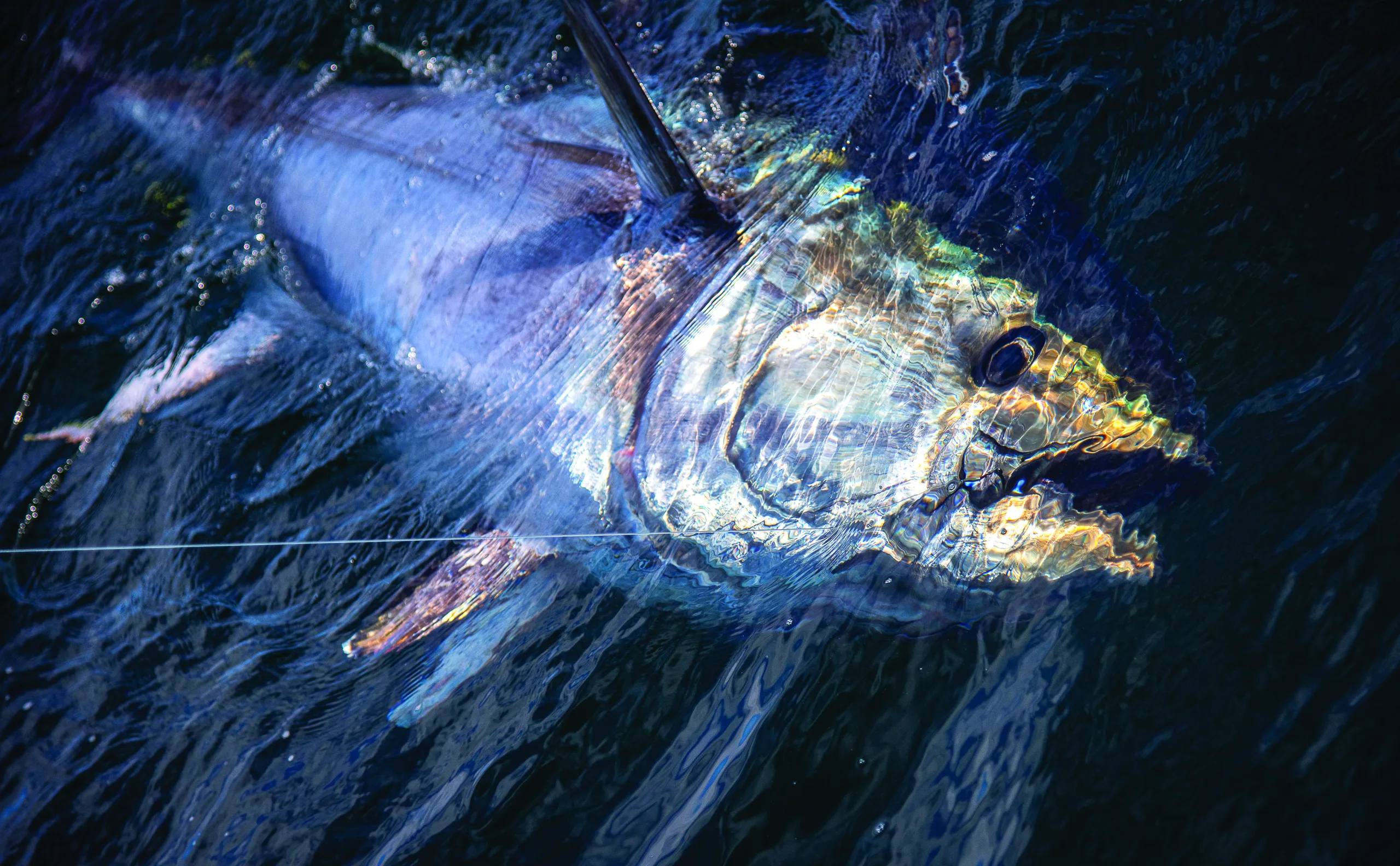
Captain Ty Reine seals the deal on a bluefin.
Afterwards, Anthony insisted he tried to radio us, though I refused to believe him. I didn’t think he’d intentionally want to withhold the information, but I know how he gets when fish are involved—like nothing else exists except him and his quarry. GoPro footage later exonerated him, clearly showing his attempts to call us in, preserving his honor as a fishing buddy.
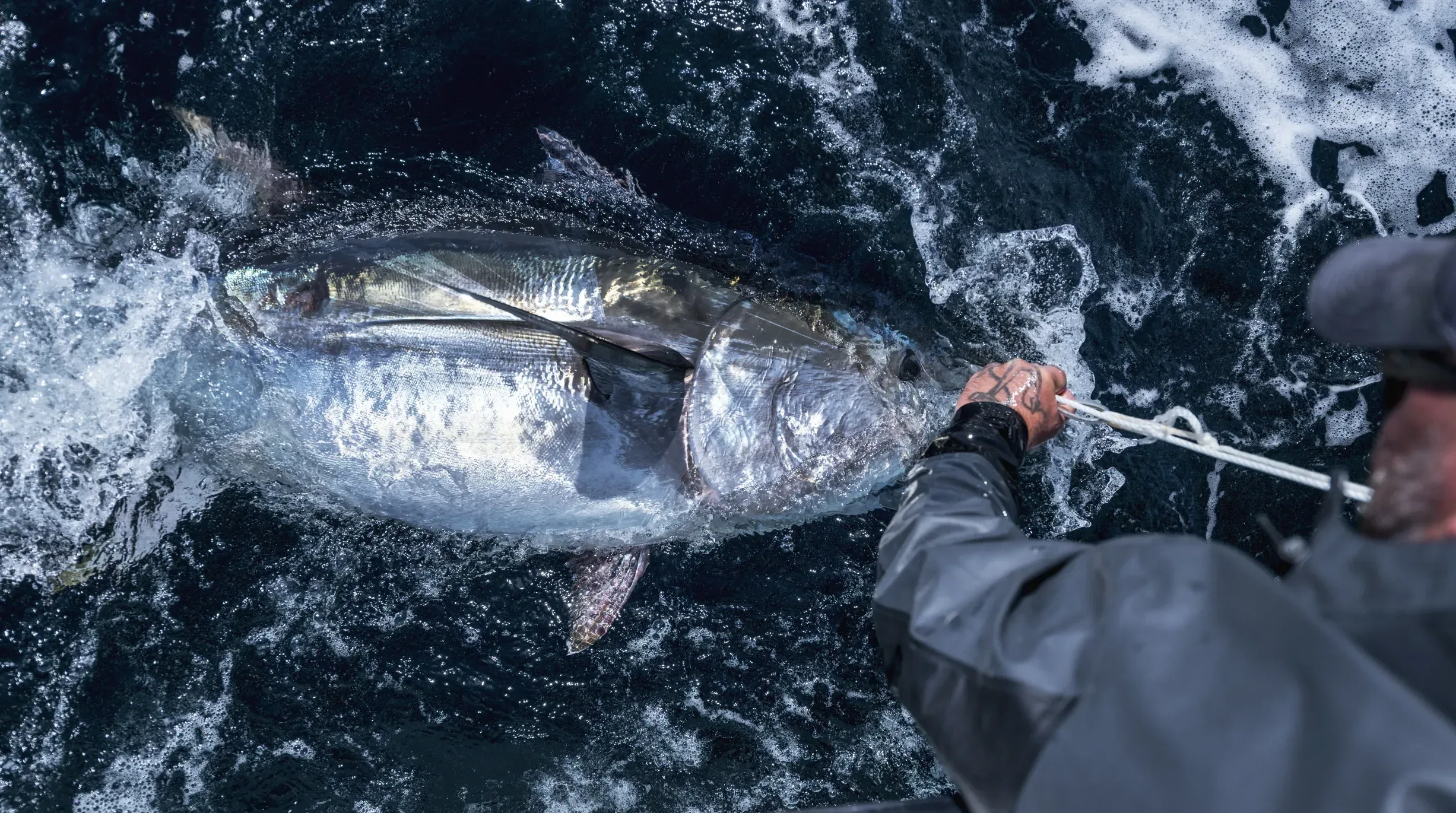
Tail-wrapped and bled to preserve the quality of its meat, this bluefin is destined for the fish box.
While they were busy high fiving over the successful capture of one of the two tuna, we’d spotted a pair of humpbacks. Chris Megan pushed the Regulator a hundred yards past the whales and took the boat out of gear. A few minutes into the drift, we marked a fish. We marked another a few minutes after that. With each mark, we jigged with greater enthusiasm, working to bring our chrome-plated slivers of lead to life.
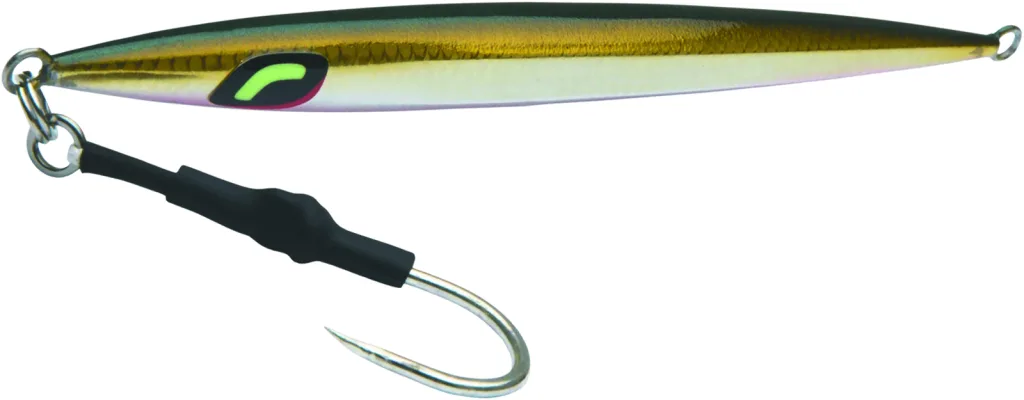
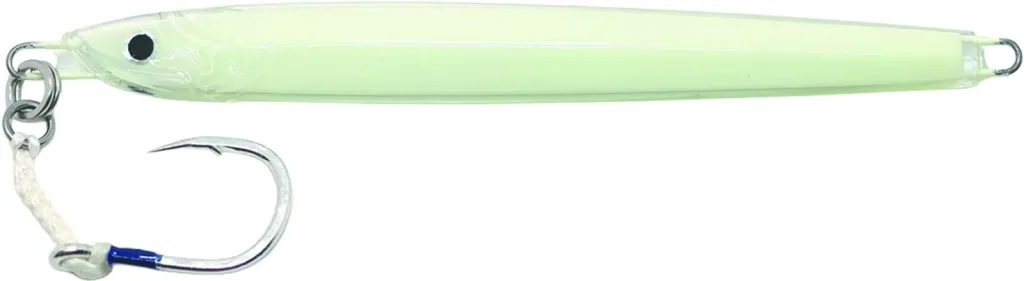
A good tuna jig for fishing the 120- to 180-foot depths south of Block Island weighs 150 to 210 grams and has a slim, tapered shape meant to match a sand eel. When coordinating short pumps of the rod with single turns of the reel handle, these jigs dart erratically toward the surface in a motion that tuna find irresistible. It can be tiring, though, leaving anglers wondering if they’ll have enough strength left to fight the fish. After hours of fishless jigging, I’d begun to wonder that when something stopped my jig’s upward progress. The rod bent briefly and snapped straight again.
“Missed him!” I shouted.
Chris, jigging on the other side of the boat, didn’t miss when his fish hit a few minutes later.
Tuna Jigs for South of Block Island
Sleek, fast-sinking jigs mimic sand eels and get down to the deep-holding summer bluefin off Block Island. (Photo courtesy of Capt. Ty Reine)
Tuna fishing is often a team effort, with everyone contributing to a successful outcome. While that’s most often pointed out by the guys who aren’t holding the rod with the fish attached, it’s true nonetheless. One of the best ways to contribute to the capture of a friend’s tuna is to gaff it. It provides the opportunity to get into a physical altercation with the fish, and can be spectacularly botched, proving that it requires at least a little skill.
I’ve been on both ends of botched gaff shots, as the angler and as the gaffer. Believe me, it’s better to be on the rod. While the angler will feel rightfully annoyed and disappointed, that’s better than embarrassed and shameful at losing someone else’s fish. Plus, if someone loses your tuna, you then have license to remind them of their shortcoming as often as you’d like in the years to come.
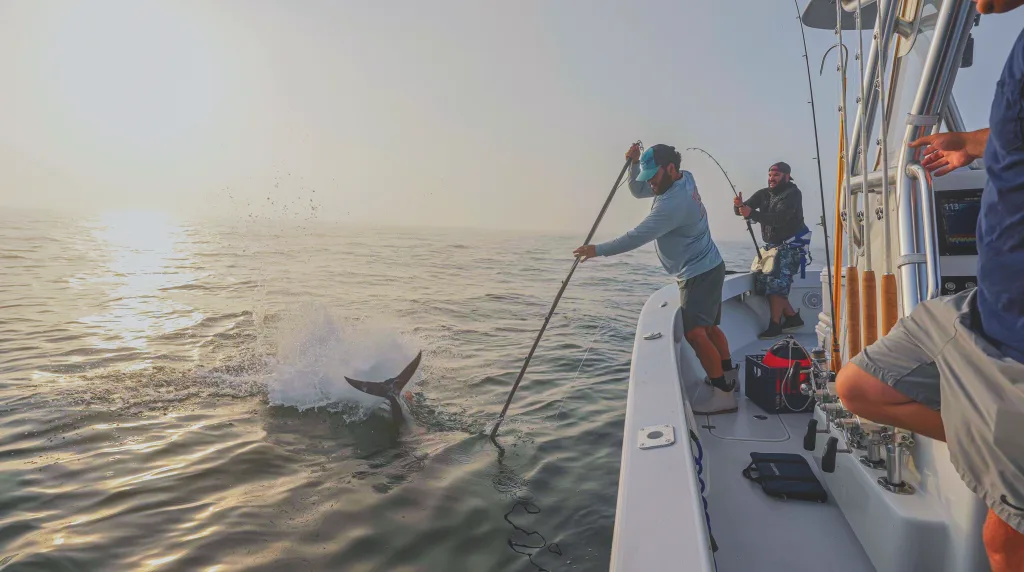
When Chris’ fish circled close, I sunk the gaff behind the tuna’s shoulder, right through a prime cut of sashimi. As the crew started to give me grief about ruining the meat, I pointed out that the fish was in the boat, unlike a certain yellowfin of mine that had been knocked off the hook by a wild gaff swing two years before. That settled it, and as I bled the fish, Kevin, Liam, and Chris resumed their jigging.
If a fishing buddy ever gives you grief about where you gaffed a tuna, point out that the fish is in the boat, and go back to jigging. (Photo by Liam O’Neill)
Just beyond radio range, Anthony and Ty continued to pick away at a larger class of tuna. The summer bluefin south of Rhode Island have arrived in a wide range of sizes the last few years with fish too short to be kept recreationally (less than 27 inches) caught in the same area as fish large enough to sell commercially (73 inches). There has been one dominant size class of tuna, fish that in 2024 measured between 32 and 35 inches, and in 2025 measured 42 to 48 inches. If these fish return in force again in 2026, expect them to range from 50 to 60 inches.
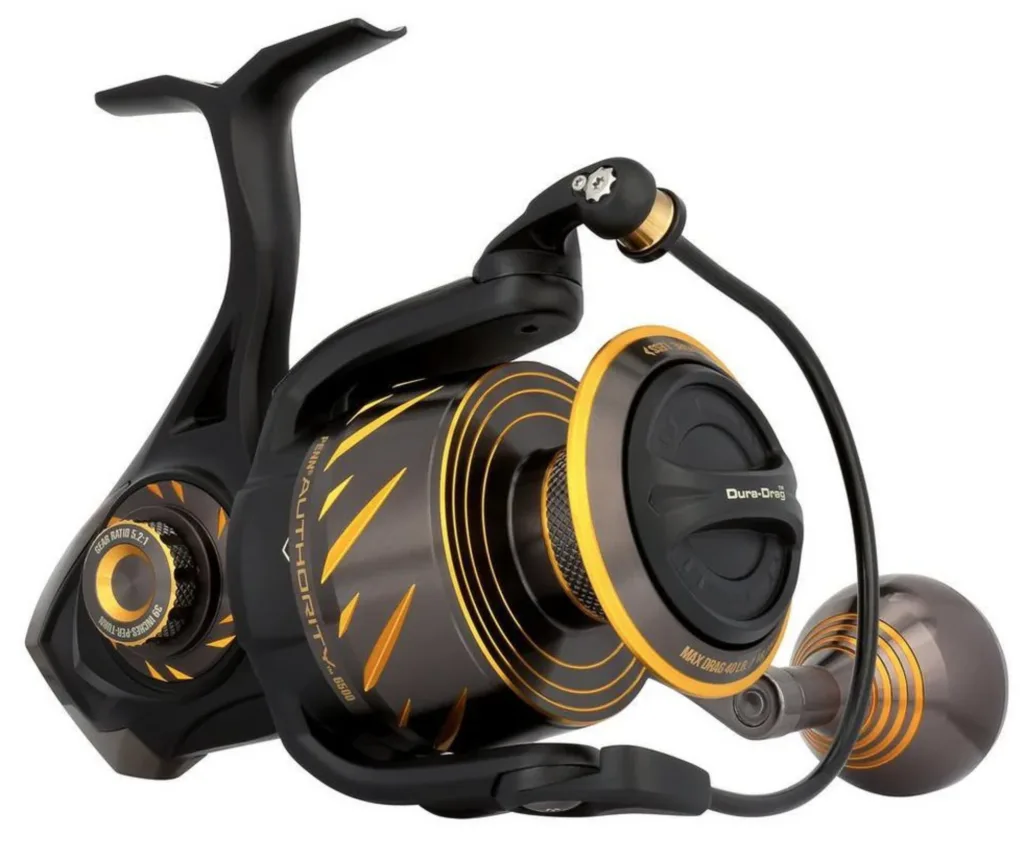
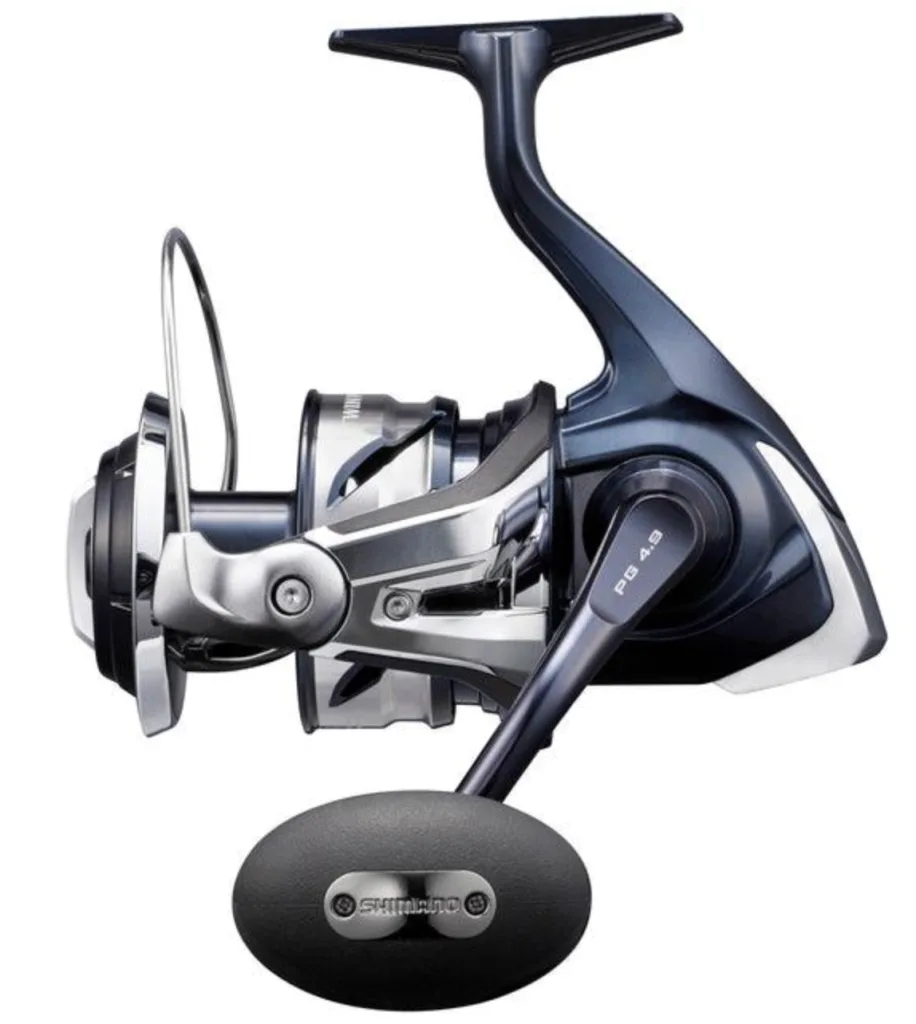
These fish have been perfect for targeting with 14000-size spinning reels (or 6500 in the case of Penn) spooled with 65-pound-test braided line and paired with 40- to 80-pound class jigging rods. Fluorocarbon leader of 60- to 80-pound test is enough most days. As the average size increases, 18000- and 20000-size reels may become more appropriate, but for now, 14000 is the sweet spot.
Soon after tucking Chris’ tuna into the ice, the marks thinned out, the whales moved on, and we went on the hunt for more life. We spun up the radar, hoping to see a flock of birds, but instead saw a fleet of boats to our east. Nothing attracts a crowd like a crowd, so we headed in that direction.
The tuna regularly fed among the windmills last season, along with mahi and sharks. (Photo by Liam O’Neill)
The fleet numbered at least fifty, with possibly one hundred boats packed into a square mile of ocean. It looked as if half of the exhibitors at the New England Saltwater Show relocated to Tuna Ridge. We spotted Joe Diorio, Joe D’Agostino of JoeBaggs Outdoors, and out toward the edge of the fleet, the Reel E-Z patrolled. By the time we arrived, Diorio and D’Agostino had released more than a dozen fish each. As Diorio gave the report, two of his anglers got tight. We deployed our jigs, certain that a strike was imminent. Within minutes, Kevin Blinkoff, channeling the Kool-Aid man, crowed “Oh yeah!” loud enough for half the fleet to hear. His joy turned to confusion when the fish failed to take drag.
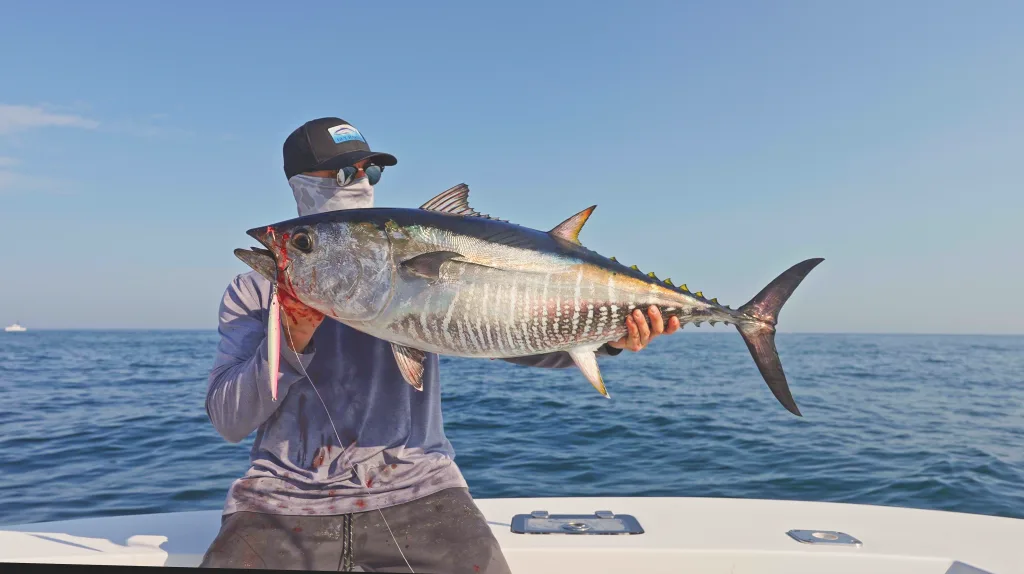
“Maybe it’s swimming at you,” Chris encouraged as Kevin reeled quickly to keep the rod bent. When the fish corkscrewed into view, instead of the deep blues and golds reflected by a bluefin, we saw the green and silver of an Atlantic bonito. Into the box it went, the last fish caught before the fleet dispersed with the captains chattering openly over the radio about the morning’s fast action as they headed to port.
Our move east had put us back into radio range of Anthony and Ty, who had, by then, added a couple stickbait-smashing 50-inchers to their epic outing. Communication finally established, they informed us they were heading home and suggested we swing through their numbers to see if the fish might turn back on. We did, and the fish didn’t. We fed a RonZ to a brown shark and decided to cut our losses.
A fisherman must have coined the old saw, “comparison is the thief of joy.” If we hadn’t spoken to the other boats, we’d have returned to the dock feeling victorious having found and caught tuna, rather than sulking in the bean bag chairs wishing we’d found the fleet sooner. As I got to work evening out the Modelo-to-bluefin ratio in our cooler, I remembered how the day began, and decided that anything beyond a trip-ending motor issue still put us ahead of the game.
READ MORE
Tuna Fishing at "The Dump"
One of the Northeast’s richest big-game fishing grounds is an easy run from Montauk, Rhode Island, and Massachusetts.
Chasing Giant Bluefin Tuna off New York City
Casting for giant bluefin, within sight of land, may be the pinnacle of sport fishing.
How New Research Could Reshape Atlantic Bluefin Tuna Management
Scientific breakthroughs aided by anglers are helping tuna management catch up with on-the-water reality.
Jimmy Fee is the Editor of On The Water and a lifelong surfcaster. He grew up fishing the bridges and beaches of Southern New Jersey before moving to Cape Cod in his early 20s. He's pursued striped bass from North Carolina to Massachusetts. He began with On The Water in 2008, and since then has covered a variety of Northeast fisheries from small pond panfish to bluewater billfish through writing, video, and podcasting.