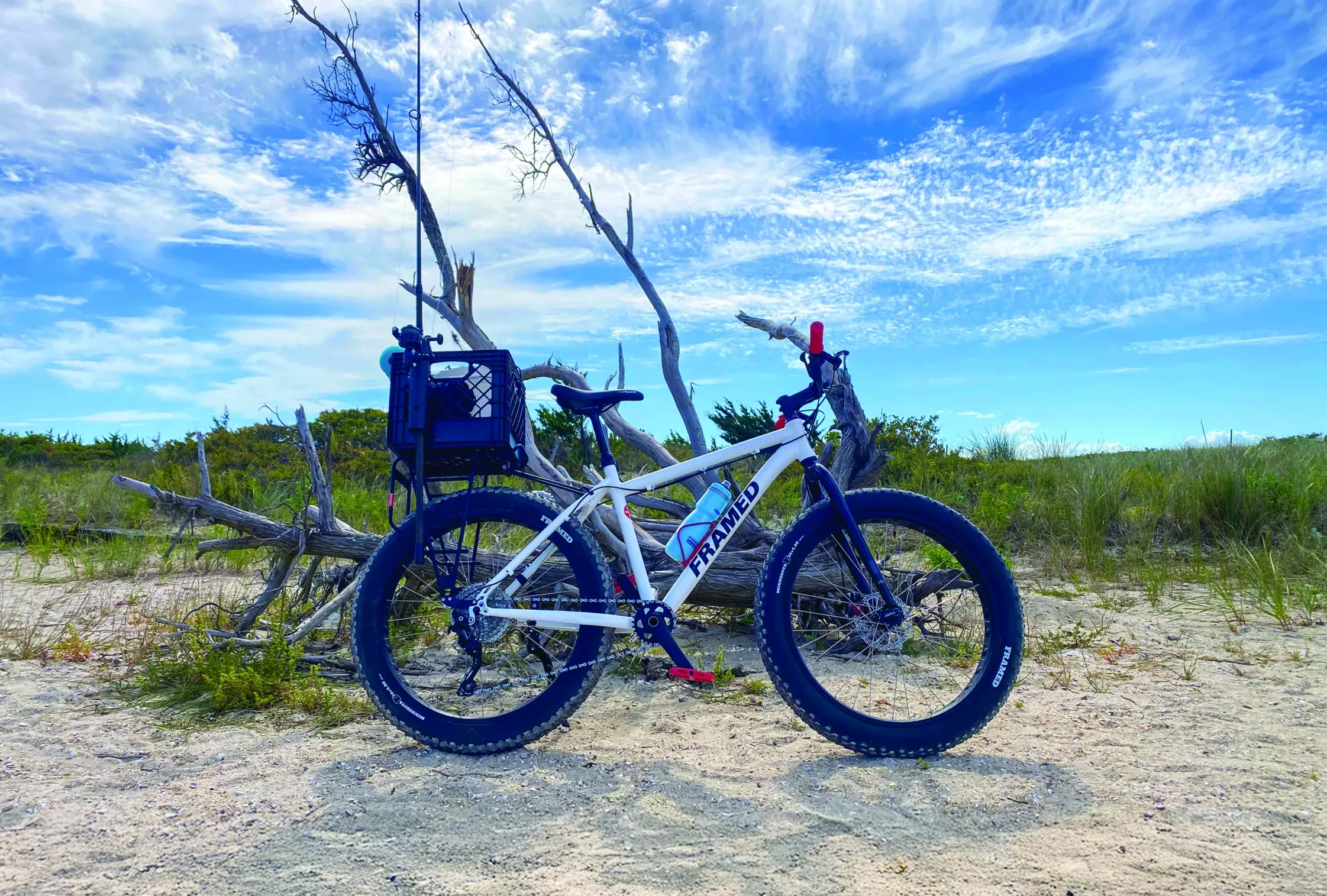

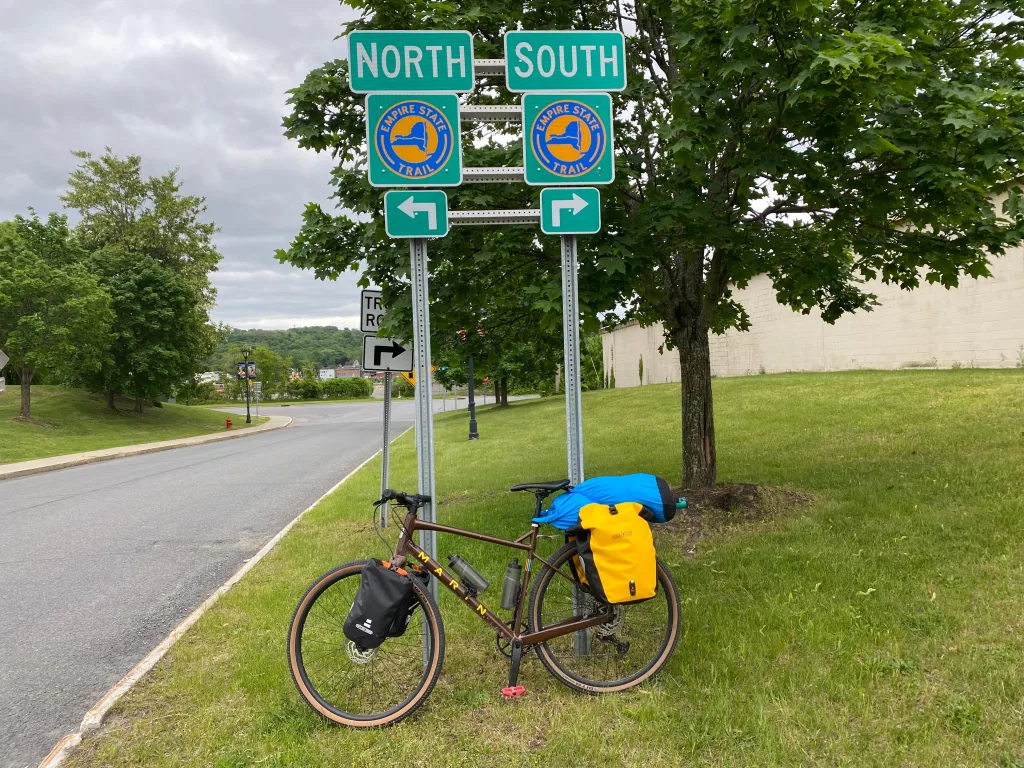
It was 8:00 a.m. on an overcast May morning on the shore of Lake Erie in Buffalo Harbor State Park. I engaged my left cleat, followed by my right, into the retention springs of my gravel bike’s clipless pedals and propelled myself forward from the westernmost terminus of the Erie Canalway Trail (ECT), a 363-mile shared-use network of paved, gravel, stone dust, grass, and dirt paths running between Buffalo and Albany. Hanging from each side of my bike’s rear rack were 20-liter waterproof panniers; 5.6-liter panniers were attached to both sides of the front fork. A bungee cord secured a 35-liter dry bag, along with a joined pair of fishing-rod tubes, to the top of the rear rack. A second cord linked both to the seat post, reducing the likelihood of losing them in my wake. Distributed across the 85 liters of storage space was approximately 35 pounds of gear for bikepacking the trail. One rod tube contained a 4-piece medium-power 6’6″ graphite spinning rod, while the other held a 4-piece, 4-weight, 7’6″ fiberglass fly rod. I was starting a journey of discovery and exploration, one I hoped would reveal the vibrant fishery readily accessible along the ECT.
The ECT, along with the 187-mile Champlain Valley Trail (CVT) and the 200-mile Hudson Valley Greenway Trail (HGT), collectively form New York’s 750-mile Empire State Trail System. All three trails share a terminus in Albany. The CVT extends north to the Canadian border, and the HGT runs south to Manhattan Island. All three trails are patchworks of individual paths interconnected by city streets and country roads. Eighty-six percent of the ECT is off-road trail, half of which is paved. The remaining 14 percent is surface streets. It follows the route of the original Erie Canal, an entirely manmade waterway carved out of the New York State landscape with hand shovels and explosives. Construction began on Independence Day in 1817, and it formally opened eight years later on October 26, 1825, featuring 83 locks and a net elevation change of 565 feet. It was enlarged in the mid-1800s, but ultimately replaced in 1918 by a broader and deeper waterway known today as the New York State Barge Canal. Improved lock technology was designed to “tame” and “canalize” the Mohawk, Oswego, Seneca, Oneida, and Niagara rivers, Tonawanda Creek, and Oneida Lake.
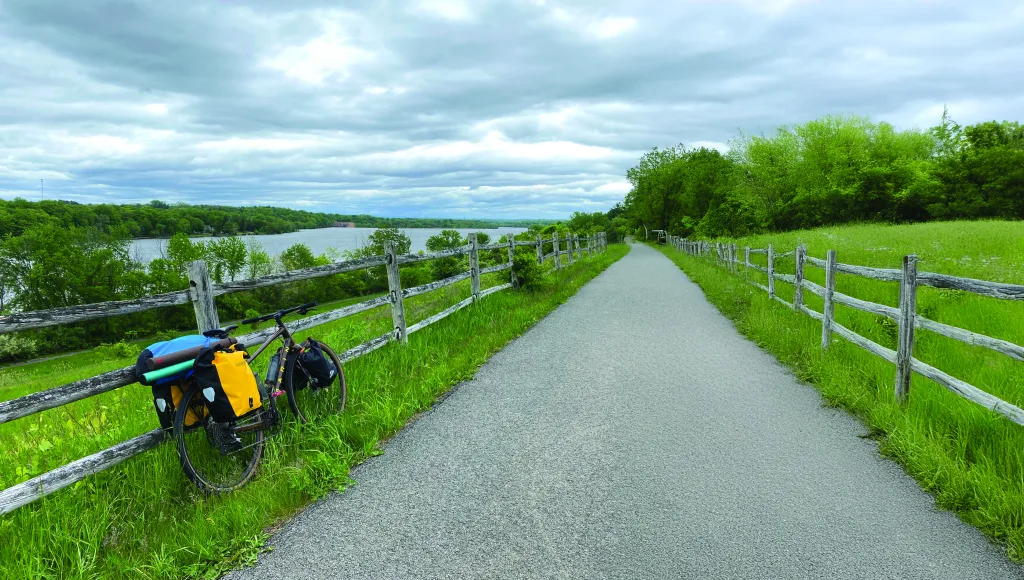
The Barge Canal’s peak commercial cargo year was 1951. Over the ensuing decades, pipelines, modern highways, railroads, and alternative seaways offered more economical means for transporting raw materials and processed goods; thus, the Barge Canal fell out of favor as an artery for commercial cargo. Today, it is strictly a recreational waterway, consisting of 34 locks under the auspices of the New York State Canal Corporation, and is part of the National Heritage Area System. The paths of the modern-day canal and the original generally parallel each other except for an 80-mile stretch between Clyde and Rome. Those following the ECT give up proximity to the Oswego, Seneca, and Oneida rivers as well as Oneida Lake, but in return get access to restored portions of the old canal.
It was not my first time cycling the ECT. Ten months earlier, my wife Debbie, our friend Bonnie, and I pedaled the same route. Our itinerary included seven days of cycling, with breaks for visits to cultural and historical sites, dining at local restaurants, and overnights in charming and welcoming B&Bs and small hotels. We needed to keep to a tight schedule in order to arrive each evening at our predetermined destination; otherwise, we might find ourselves scrambling for alternative lodgings and incurring excessive cancellation fees. We pedaled past small hamlets, through large cities, and along bucolic countryside, all of which were adjacent to and had strong ties to the storied Erie Canal. I spotted anglers fly-casting, baitcasting, and spin-casting from banks and boats along most of the route. Our schedule left little room for pause, so we breezed by most anglers, offering only a fleeting wave or nod.
Online research, along with input from contacts familiar with the area, revealed what species those anglers were targeting. The restored portions of the original canal tend to be lazy water, fostering lush aquatic vegetation that offers vital cover and a rich, biodiverse food source for fish. It holds bass, pickerel, perch, carp, sunfish, and even northern pike. The Barge Canal runs wide and deep—its locks, guard gates, lift bridges, fixed bridges, and retaining walls create strong directional currents and swirling eddies that stir up bait for opportunistic feeders such as walleye, bass, catfish, and muskellunge. Adjacent rivers, streams, creeks, and ponds add trout to the mix. Finally, the Great Lakes of Ontario and Erie, along with the Finger Lakes of Seneca and Cayuga, each support vibrant landlocked salmon populations and are within striking distance of the bicycle route.
On that maiden bicycle trek, we chanced upon Jim, a 56-year-old math teacher and experienced solo bikepacker from Syracuse, who was taking advantage of his extended summer break to cycle and camp his way to Boston. Unlike us, Jim had no advanced booking at lodges nor a firm timetable to keep; all he had was a rough idea of when he would see the silhouettes of the John Hancock and Prudential towers on the horizon. From his touring bike, in a makeshift fashion secured primarily with bungee cords, hung a minimalist collection of camping equipment, clothing for a few days of life braving outdoor elements, bike and human first-aid kits, three water bottles, and, oddly enough, a box containing the remains of the dozen donuts he had started with earlier in the morning. Before parting ways, Jim filled me in on the abundant and budget-friendly camping options along the trail, including sites operated by the NYS Canal Corporation, town welcome centers, state parks, and private campgrounds.
The next day, we were flagged down by a New Zealand couple bikepacking their way in the opposite direction. Jim had met up with them 15 miles down the trail and, while sharing with them what remained of his donuts, told them to be on the lookout for a friendly threesome of New Jerseyans. The Kiwis were visiting the US to attend the wedding of their oldest son. They had arrived a month earlier with little more than their favorite sleeping bags and a few choice items of clothing. Their first stop was to a formalwear rental store to be fitted for wedding attire. Their second stop was an REI store in St. Louis, where they purchased bikes, panniers, a 2-person tent, sleeping mats, and other accessories. The following day, they embarked on a 225-mile excursion along Missouri’s Katy Trail. Eventually, they worked their way to Albany to tackle the 363-mile ECT. Unlike Jim, all their gear was state-of-the-art and meticulously stowed. It was the embodiment of what an ideal bikepacking setup should be. They looked like they had just stepped out of an advertisement in Adventure Cyclist magazine.
My encounters with Jim and the Kiwis sparked a desire to take up bikepacking. Curiosity about the fishery along the ECT gave me the perfect excuse to pursue it. I cultivated a list of gear I would require and played around with several stowing configurations, landing somewhere between the makeshift and frugal stylings of a resourceful schoolteacher on a tight budget and the expensive no-holds-barred approach taken by the wandering Kiwis. Neither Jim nor the New Zealanders traveled with cooking gear or more than a day’s worth of food, as travelers on the ECT are never far from restaurants, convenience stores, or groceries. Therefore, I planned accordingly. I did numerous test rides to make sure the weight of my gear was properly distributed and that its positioning did not interfere with my pedaling. The practice rides also served to gauge my range under the additional load.
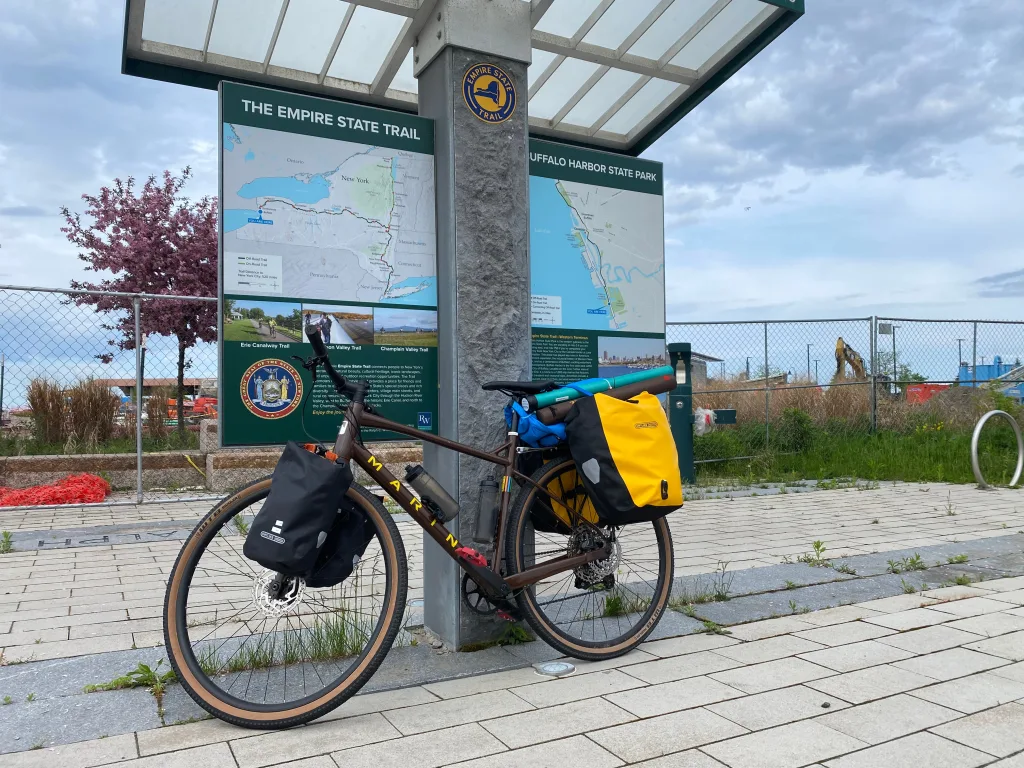
I departed Buffalo’s downtown area along the paved route hugging the shoreline of the Niagara River’s US side. Park benches, only a rod’s length from the water’s edge, were ubiquitous. Anglers bait-fished in a strikingly casual manner, perched on the outdoor seating. I stopped to chat with an older gentleman who told me he “fished this bench” often. He worked live minnows suspended six inches above a piece of lead just heavy enough to hold bottom in the choppy water. He was targeting walleye, but when the weather warms, he tweaks his tactics for bass by replacing minnows with nightcrawlers.
I also rode past boats plying the waters, many with anglers holding bowed fishing rods and others readying the nets. It appeared the walleye fishery was booming. At Tonawanda, the trail breaks from the river and veers eastward to follow the creek bearing the city’s name. I stopped at Elliot Creek County Park, one of many parks providing public access to anglers and boaters. Standing on the bank, I conversed with two guys fishing from a skiff. The water was unusually cloudy due to recent heavy rains and resultant runoff, shutting down the spot, which they told me typically gives up plenty of bass and sunfish, along with the occasional pike or carp. They’d been there for about an hour without a single bite. I toyed with the idea of assembling my spinning rod but opted to observe and see what developed. Nothing did, so I pedaled toward my next stop, Lockport.
The central fixtures and inspirations (but hardly imaginative) for the town’s name are the old canal’s lock system, known as the “Flight of Five,” and the present-day canal’s operational locks E34 and E35 (the ‘E’ is for ‘Erie’). The old locks, which have been partially restored for historical and educational significance, sit right alongside the functional locks. Pamela, who works the counter at the local tackle shop, told me that most locals fished on the lower elevation side of the locks. I watched as a group of four anglers repeatedly lowered live minnows on drop-shot rigs and pulled rock bass from the churning water at the base of the old locks. Other anglers fished bait and artificials with some success just outside of Lock E34’s chamber.
I had contemplated three potential locations to set up camp that night: two free first-come-first-served sites at municipal parks—one at mile 46, the other at mile 76—and a private RV park at mile 71. A meal prepared by a food truck parked and overlooking the canals in Lockport provided me with the fuel to shoot for my furthest target, Brockport’s free municipal site. The setting sun, darkening sky, and dropping barometer appeared to draw local anglers out of the woodwork, for just about every structure crossing the canal in the 20-mile lead up to Brockport had someone fishing it. Brockport’s Main Street bridge was no exception; I met a young man who boasted that he’d just released his eighth fish back into the canal. He invited me to fish with him, an offer I readily accepted. Unfortunately, that eighth fish turned out to be his last. The best I could do was buy some slices of pizza while waiting out a violent rainstorm before setting up and settling in my tent around 10:30 p.m.
It was commencement weekend for the State University of New York, Brockport. I drifted off to sleep to the sounds of revelry coming from freshly minted and happily inebriated alums. Rain fell intermittently through the night. I left my spinning rod assembled and rigged so I could make a few casts in the morning while I waited for the diner to open. All I caught was a darn good western omelet and several cups of coffee.
Having pedaled 88 miles on Saturday, I decided to dial it down for Sunday, aiming to camp at Clyde’s Lock E26, 72 miles in the distance. The shorter ride would allow time for me to stop along the way and wet a line. Throughout the day, I rode by anglers and stopped to strike up conversations with many of them. I spoke with two guys in a skiff working crankbaits for bass near Adams Basin, a kayaker trolling a canal basin on the outskirts of Spencerport, a woman in a lawn chair fishing for yellow perch in Henpeck Park, a gentleman tossing a paddletail for walleye under a car bridge near the Genesee River, two kids just outside the eastern edge of E33’s chamber racing Whopper Ploppers, and a father and son dropping nightcrawlers at the canal’s edge just east of Fairport, who invited me to join them.
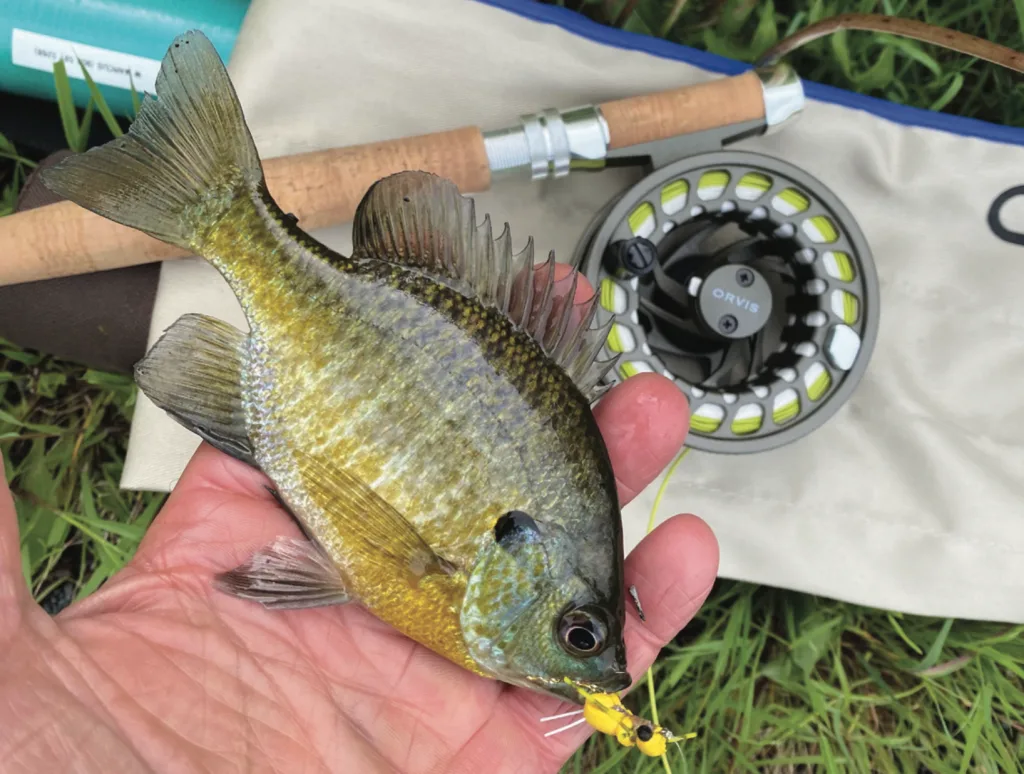
In the span of an hour, we caught our fill of bluegills and pumpkinseeds, with the son landing a white perch to provide a bit of variety. I phoned Lock E26 to check in with its operator, who informed me that they were doing tree work and recommended I crash elsewhere. I rang Lock E27 in Lyons, roughly 10 miles short of E26, and learned the lawn had been freshly cut and was awaiting its first camper of the season… me. The lock operators, Matt and Bob, were inviting, gracious, and informative. They offered me filtered water, access to a 120V outlet, and a rundown of the dining scene within several thousand pedal strokes.

Returning to the lock with a bag of take-out dangling from my handlebars, I came upon a group of anglers who had just released a 17-inch walleye back into the Canandaigua Outlet. They were heading over to E27 to close out their day. I fished with my spinning rod but came up empty, though one of the locals landed a feisty smallmouth. As I fell into a much-needed slumber, the sounds of the revelers from last night were replaced by the din of train traffic along the CSX main line, only a third of a mile away, as the walleye swims. As I’d done the night before, I was glad I deployed my tent’s rainfly, as it showered off and on while I slept.
Ten miles out of Lyons, the ECT and today’s recreational waterway diverge, though they reconnect some 80 miles down the trail. Unfortunately, in this parting of ways, travelers of the Canalway Trail initially get the short end of the stick: the first 15 miles are along the narrow shoulder of New York’s Route 31, a 55-mph state roadway, taking the interpretation of “multi-use shared” to the next level. I got a little uncomfortable riding so close to high-speed vehicle traffic; however, in the end, the ride paid off because it led to Port Byron’s Schasel Park and the start of a 20-mile span that embodies the original Erie Canal’s history and beauty. I rode through woodlands, farmlands, and small communities, ultimately arriving at the Town of Camillus’s Erie Canal Park. Here, the waterway of yore has been restored to its mid-1800s state, minus the mules and commercial traffic. Much of the water is clean and home to a vibrant fishery supporting common carp, largemouth bass, yellow perch, chain pickerel, and several varieties of sunfish. I rested my bicycle inside one of several lean-tos lining the pathway, assembled my 4-weight, and enjoyed an hour and a half of fish exploding on my version of Skip Morris’s predator fly and my take on the classic Woolly Bugger pattern. I wished I could have fished longer, but the sun had already crossed its daily zenith, and I still had 20 miles and the city of Syracuse between me and Fayetteville’s Green Lakes State Park, where I intended to spend the night.

Just west of the state park, the canal crosses over Limestone Creek via a stone aqueduct. There, I met a young angler who had just taken advantage of the brown and brook trout fishery that the cold-water creek, with the assistance of Carpenter’s Brook Fish Hatchery stocking program, supports. He showed me a picture of a large brown trout he had just caught and promptly released. I continued onward, intending to fish the park’s eponymous lake for largemouth bass and stocked rainbow trout, but I got sidetracked well past sunset helping a fellow bikepacker repair his bicycle, so I missed out on the opportunity. I pitched my tent in the dark, took my first shower in three days, and called it a day. There were no post-graduation ceremony celebrants nor rumbling CXS trains within earshot. I drifted to sleep to the sporadic hoots of a barred owl. Temperatures overnight dropped below 40°F, but at least it did not rain.


The next morning, before breaking camp, I checked the weather forecast. It predicted heavy rain accompanied by severe electrical storms beginning midafternoon the following day. Unfortunately, my crack extraction team, Deb and a black Labrador puppy named Fern, were scheduled to meet me along the Hudson River midafternoon in two days. I called an audible at the Fayetteville township line, phoning in a pickup request a day earlier to avoid cycling through and overnighting in nasty, and possibly dangerous, weather. Though the revised pace demanded longer days in the bike saddle, I was still able to carve out time testing waters and trading stories with local anglers.
At Poolsbrook Basin, just east of the state park, I bounced a Ned rig along its bottom and scored a black crappie. The ECT runs through the parking lot of the Oriskany Flats Wildlife Management Area (WMA), where I met a local angler who told me bass and bullhead fishing is “solid” in the WMA. Further down the trail, I chatted with a fisherman alongside a bridge connecting the cities of Mohawk and Herkimer. While we spoke, he rotated through three rods: one rigged with a jerkbait, another with a skirted weedless jig, and a third with a plastic worm fitted with two hooks. He told me the area was popular and regularly fished with great success.
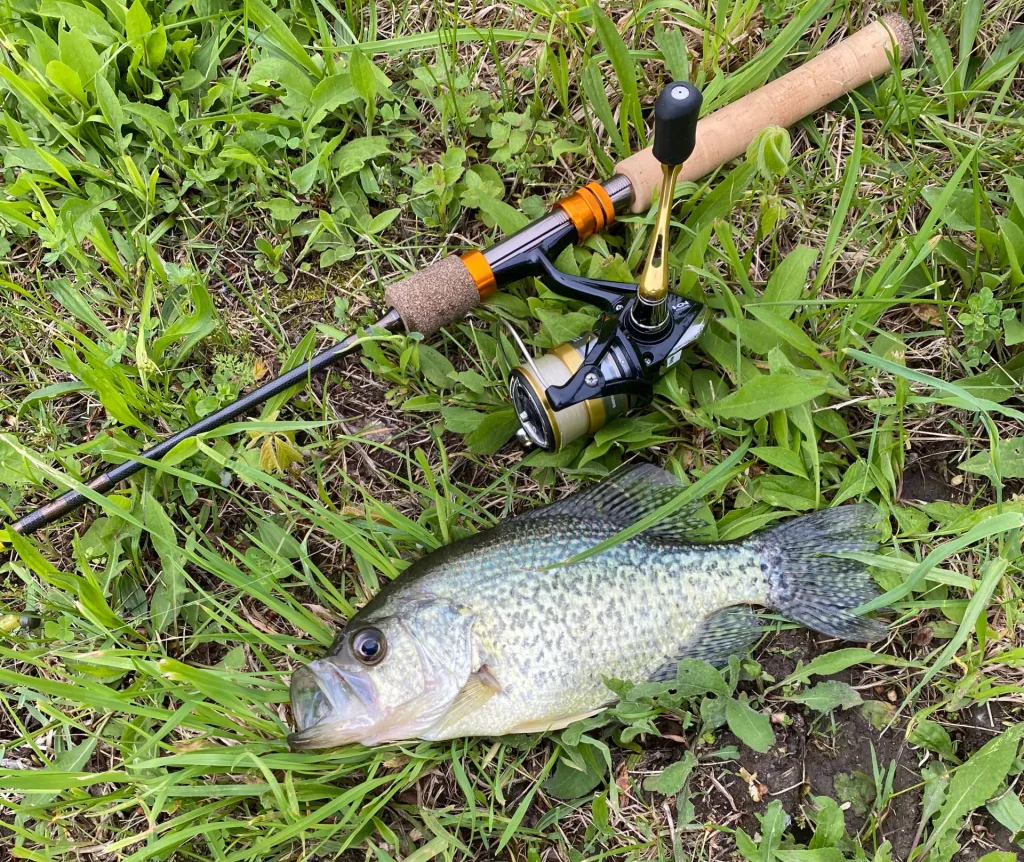
Fading sunlight and fatigued legs conspired to make E16 in Fort Plain my overnight destination. After setting up camp in the evening, I experimented with various lures at different water depths outside the western edge of the lock to see what would trigger a bite. Sadly, nothing did. I crawled into my tent long after the lock’s automatic lights came on. The New York State Thruway was within a thousand feet of my pitched tent, though its busy traffic provided white noise that serenaded me to sleep.
On my final day’s ride, I stopped several times to chat with local anglers. The messages I received were that the smart bet was to fish areas where the Mohawk River and Barge Canal split off and reunite; fortunately, this happens often along this stretch. At least half a dozen anglers proudly shared pictures of large walleye and bass they had landed around these points of transition.
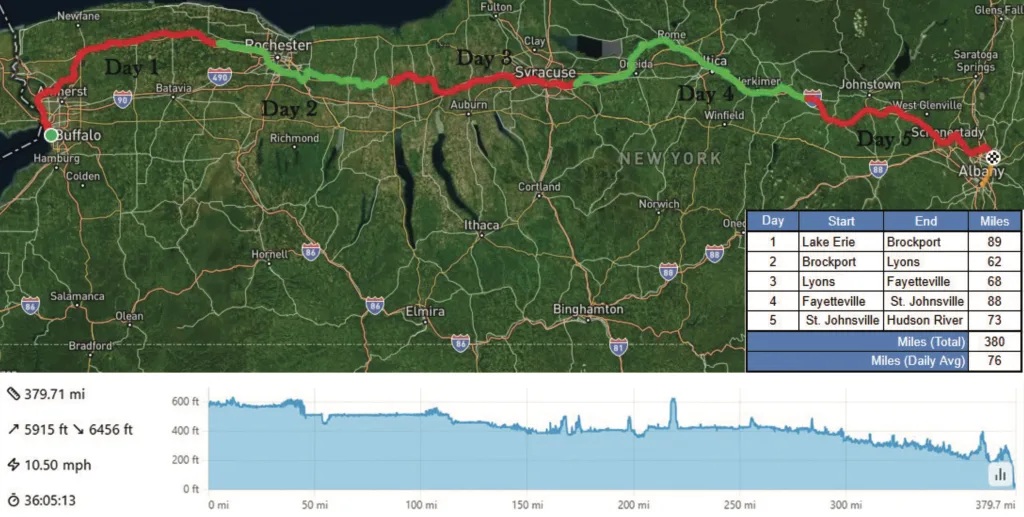
I met up with my recovery team 30 minutes later than planned, but a good two hours before the sheets of rain and fiery skies. Deb captained the station wagon southward along the New York State Thruway through the stormy night. Fern sat in the passenger-side footwell, warming my socked feet. My eyelids grew heavy, and I reflected on the preceding five days. They were equal parts exciting, exhausting, educational, and inspirational. I wished I’d had more time out on the trail, met additional interesting people, caught more fish, and encountered a wider variety of species. Still, these are sentiments true of most fishing expeditions and are what keep us coming back for more. The showbiz maxim “Always leave them wanting more” rings true for most of my fishing trips, and my Erie Canalway Trail discovery tour was no exception.
I look forward to a return visit.
READ MORE