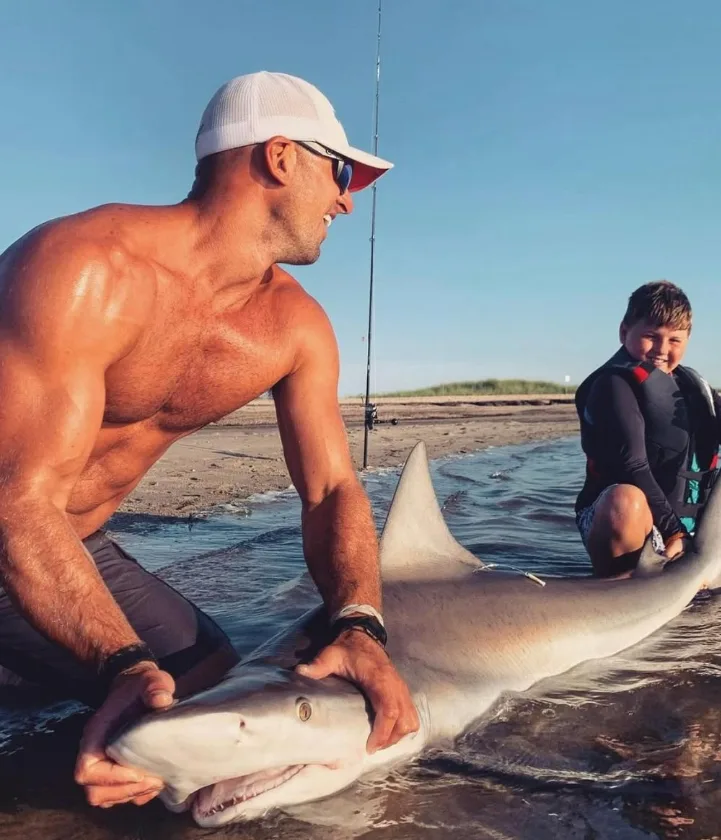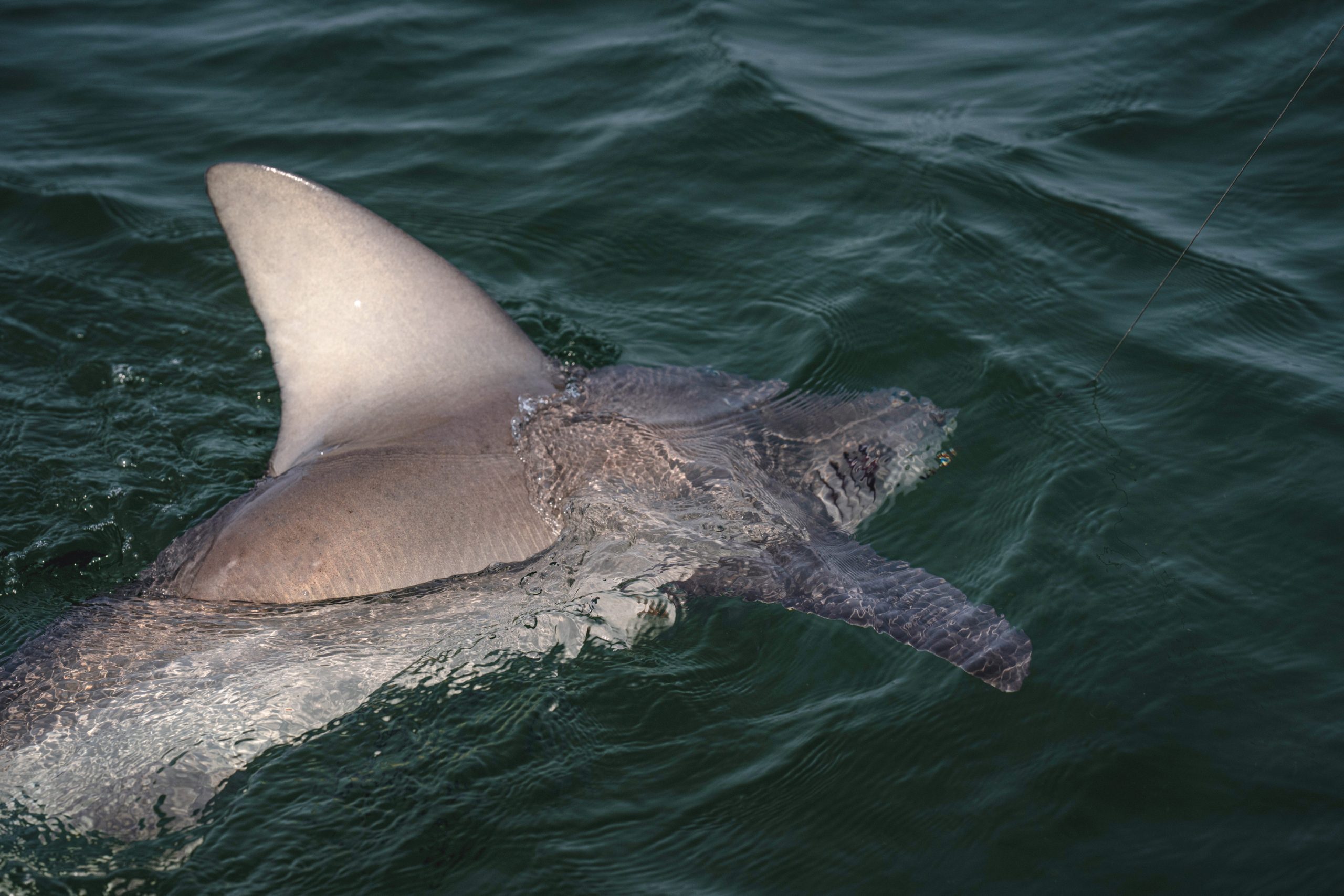


On an uncomfortably humid, early summer morning, I walked out of a quieter-than-usual Causeway Bait and Tackle with a bag of fresh bunker and continued the short drive down Wantagh Parkway to Jones Beach Island. The spring striped bass migration was coming to an end, but there were still some quality fish hanging around bunker pods on Long Island’s South Shore beaches. With a plan to stay mobile and pitch chunk baits in the wash, I intentionally left my sand spike at home. In hindsight, I wish I had brought it to partially relieve me of the grueling battle that was about to unfold with a roughtail stingray—the largest species of whip-tail stingrays in the Atlantic Ocean.
About 20 minutes after setting up shop, a fish took my first offering—a bloody bunker head. The 40-pound-test braided line slowly ticked off my Daiwa BG 4500, so I locked down the drag, leaned into the fish, and quickly discovered it was not a striper. The ray went on a long, steady, but powerful run, so I settled in for the fight. A small crowd of curious onlookers gathered as my 11-foot surf rod, better equipped to handle bass and blues, bent to the grip under the weight of the ray. An hour passed, and I had managed to pull the ray into the wash several times. However, each time it reached the shallow white water, it hunkered down on the ocean floor like an enormous cartilaginous suction cup.
More than two hours in, I was sweating profusely, my forearms were cramping, and the crowd of beachgoers had grown impatient and carried on. The ray was close enough that I could see its hulking, venomous barbed tail swinging in the wash, and when I attempted to drag it from the suds near the beach lip, my leader gave way. It was a heartbreaking outcome, but I was undergunned from the get-go with a striped bass combo, and a small part of me was happy I wouldn’t have to attempt unhooking that behemoth solo. According to the Florida Museum of Natural History, roughtail stingrays can grow to be 660 pounds and measure nearly 8 feet wide. If the ray I hooked was even half that size, there was no shot I had the strength to flip it over and remove the circle hook on my own.
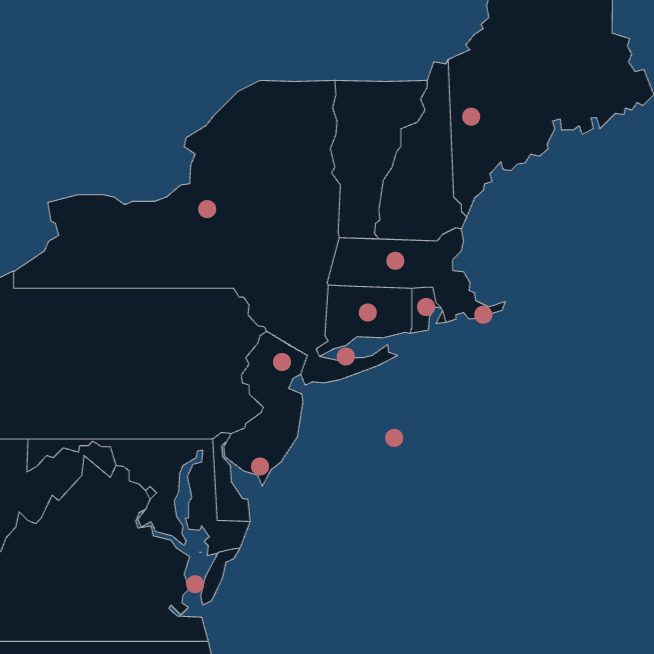
That was six years ago, and since then, I’m thankful to say that roughtails have eluded me. Other Northeast surf fishermen, particularly those who like to catch and release sharks during the summer months, have not been so lucky. The Smithsonian Tropical Research Institute states that roughtail stingrays inhabit brackish, inshore, and deep offshore waters in the western Atlantic Ocean, from Georges Bank off Massachusetts to the Bahamas, and southern Brazil to Argentina. Because of their vast range, recreational shore-based shark fishermen are no strangers to interactions with roughtails, and this year, more than a few have been successfully landed by anglers from New Jersey to Cape Cod.
View this post on Instagram

View this post on Instagram
A couple weeks back during a breezy early July evening, I ventured onto a Nantucket Sound beach to fish eels for sandbar sharks—also known as brown sharks—with my friends Noah Lamperti and Ryan Henry. As I trudged through the sand with my gear in tow, I noticed another group of anglers just east of our “base camp” that were clearly tight to a big fish.
“Looks like those guys are hooked up,” I said to Noah, pointing down the beach.
“They’ve been tight since we got here an hour and a half ago,” he replied. “It’s got to be a ray.”
I later discovered that it was Keith Porges, his wife Courtney, and Keith’s friend, Moe Parwaz, who were 90 minutes into fighting a roughtail when I arrived.
“It was my first time out shark fishing this season,” said Porges. “We had been soaking an eel for less than 30 minutes when I noticed my rod tip twitch, almost like a crab was playing with the bait,” he continued. “But I had a 6-ounce pyramid sinker on the rig, and I knew a crab couldn’t lift that off bottom.” Still, suspecting it may have been a pesky dogfish inspecting his freshly-beheaded eel, Porges decided to bring in the bait. “I raised the rod up, felt some tension, and set the hook into what felt like a brick wall.”
On the initial run, Porges said, it came up to the surface before eventually gluing itself to the bottom. “I was using a 12-foot Tsunami Trophy II rated for 6 to 10 ounces, paired with a KastKing Kapstan 8000 spinning reel spooled with 80-pound braid.” The reel, he noted, boasts over 50 pounds of maximum drag capacity, and even so, Porges was unable to get the fish to budge for the first hour. “It kept making runs, but they weren’t long; the ray just seemed to be moseying around,” he said. In need of a breather, he passed off the rod to his wife, Courtney, who kept pressure on the fish while he took a break. “Thankfully, Moe didn’t even get to rig his rod and cast a bait. We took turns just sitting on the ground, muscling the fish in together.” While one of them sat in the sand, the other would forcibly help lift the rod in order to gain some line. It was a battle of give and take that was far from over.
By the third hour, it was dark outside and the ray was running parallel to the beach toward an inlet. “At that point,” said Porges, “we were just trying to keep it away from the jetty and we were finally gaining some ground on it. The whole endeavor really put my gear to the test.”
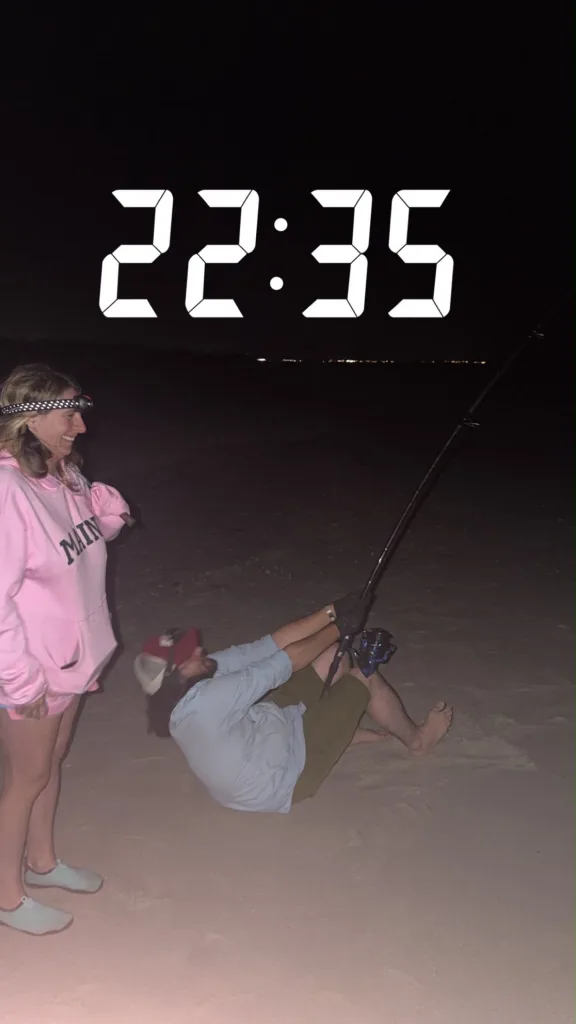
Finally, they got eyes on the 300-pound monofilament shock leader, which was punctuated by a stout steel leader and a circle hook. “I had heard of people breaking off on rays, but I was determined to land it,” Porges said. “I didn’t want that thing swimming around with a hook and a lengthy leader still in its mouth. It was my responsibility to get the ray in and remove the hook, which is the respectful thing to do. Plus, I needed to see it and touch it. I would’ve stayed all night.”
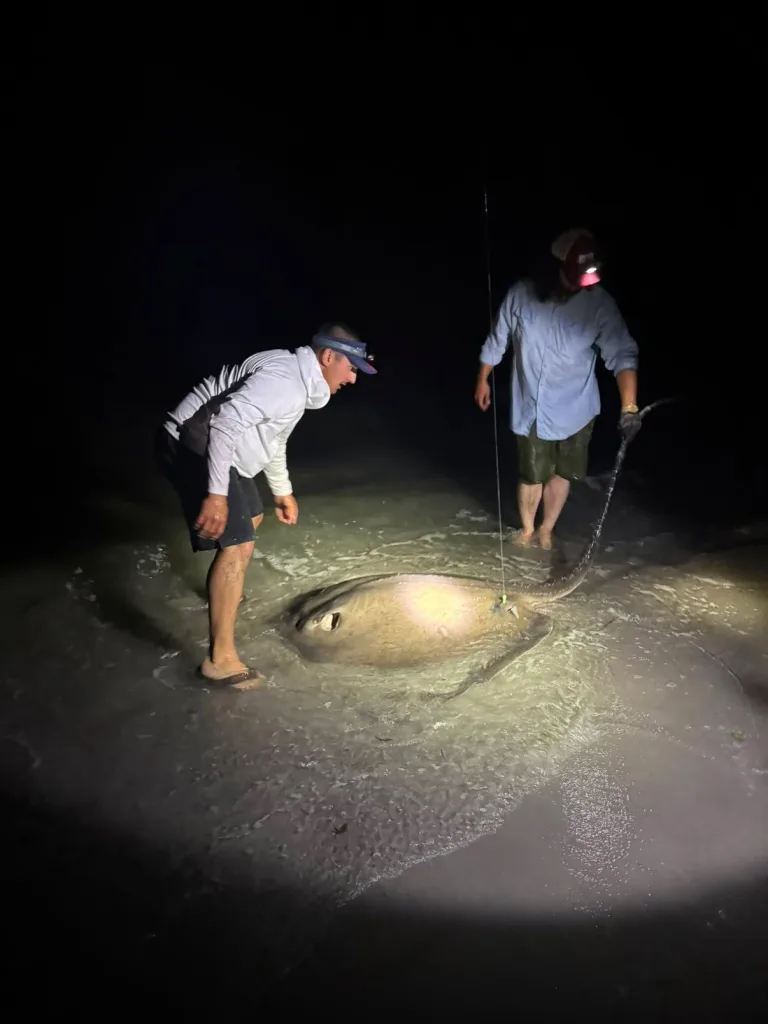
The initial hookup happened around 7:30 pm, and the time was now approaching 11:30. “It was a team effort,” said Porges, “but we stayed parallel to the fish which is why we were able to steer it in close enough to land it and get the hook out.”

Porges estimates that the roughtail stingray was roughly 5-feet wide, well over 250 pounds, and 10-feet long from the nose to the tip of its enormous, barbed tail. “I read that they grow to be almost 700 pounds, so this was probably just a middle-aged fish,” he surmised. Once the hook was removed, the trio snapped a few photos and released the ray. “It was a crazy experience, but I really hope I don’t hook another one on my next outing,” Porges chuckled.
Tips for Catching and Releasing Roughtail Stingrays
With 8 weeks remaining until summer is officially over, shore-based anglers across the Northeast are sure to encounter more roughtail rays. Here are a few things you can do to ensure a safe, incident-free catch-and-release experience for all involved:
- Fish with a group to reduce fight time and assist with landing/hook removal
- Break out your heavy surf fishing gear (and don’t skimp on the braid and leader material)
- Carry a set of long pliers and/or a pistol grip dehooker
- Use a towel to cover the poisonous barb when handling
- Keep the fish on wet sand and minimize time out of the water
- Obtain a valid saltwater fishing license (or marine registration) in your state
- Check your state’s shore-based shark fishing regulations
- Ex) In Massachusetts, shore-based shark fishing is permitted only in specific areas and there are strict gear requirements that all anglers must adhere to.
In addition to the above measures, here is a list of things you should avoid doing:
- Fishing near swimmers
- Chumming, especially between sunrise and sunset
- Using mechanized or remote-controlled devices (like drones) to deploy baits when shore fishing for sharks, rays, or any other species
- Intentionally using lighter tackle
READ MORE