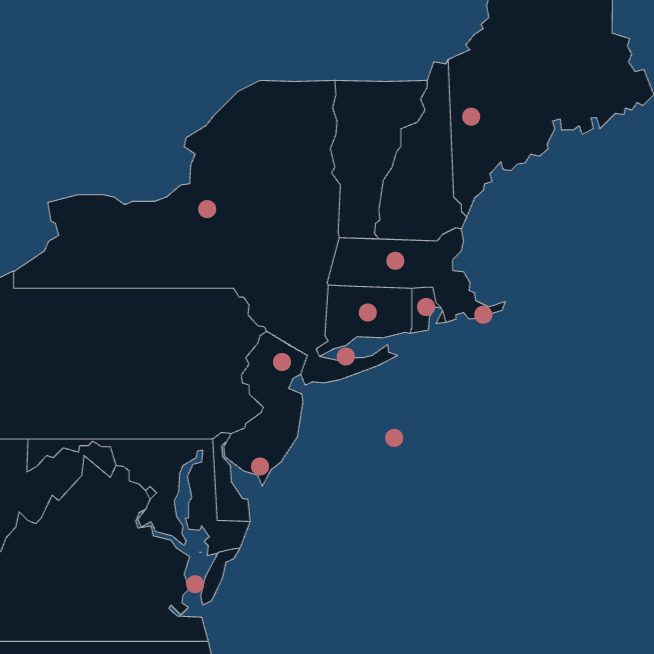

Pulling up the long dirt road, a southwest breeze swept through the scrubland, and for the first time, I could smell the ocean. My destination was Point Escuminac, a rocky peninsula speckled with jack pine, jutting out into the waters of Miramichi Bay. It had a drop-off to the east, a sandy-bottomed cove to the west, and was presided over by a 73-foot concrete lighthouse. It was the perfect spot to find my first Canadian striped bass.
My first exposure to this fishery came through a short video I found online. It was taken from a bridge spanning the tidal section of the Miramichi River in New Brunswick, and showed thousands of stripers swimming shoulder to shoulder, beating through the shallows on their journey upriver. Along the shoreline, a few anglers tossed flies at the tailing mass. The video then cuts to the bass in deeper water, where they begin their spawn—the surface boiling as the fish roll atop one another.
I was born and raised on striped bass in the New England surf, so I’m used to the visuals of a blitz or a school of stripers moving along the open beach, but this many fish swimming inches from a bank stubbled with pine and alder felt ancient. I dug deeper and learned how imperiled this fishery once was, and the borderline heroic efforts of the Canadian government to bring these striped bass back from the brink. I decided I had to see it for myself.

The beach beneath Point Escuminac Light was untrammeled. Peat moss fields stretched for acres behind me, and black cliffs ran along the water’s edge. I was alone, save for one other angler who sat beneath an umbrella with two baited rods in a V at his feet. He scanned the horizon carefully, pausing only to place a single finger on the braid to test for nibbles. I called out a friendly hello. He jumped, but greeted me with a smile. His name was Serge, and when I asked how the bite had been, he beckoned me to peer into his cooler. Beneath a bag of ice sat two stripers. Serge looked at me and said, in a thick French-Canadian accent, “It’s been very good.”
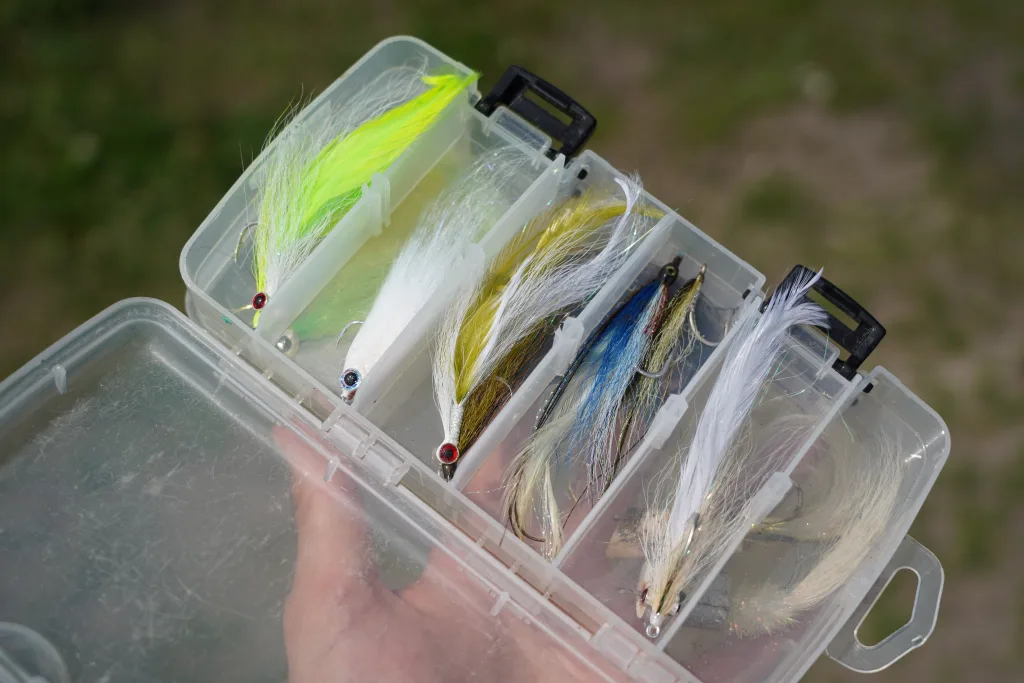
Slipping into my waders, I hastily rigged my Redington reel to my 8-weight TFO rod and tied on a chartreuse-over-white Clouser before trotting down the beach. The flats were gin-clear despite the tannin-stained rivers that fed the bay, and as I hiked farther out, no structures obscured the view. It was just me and Serge.
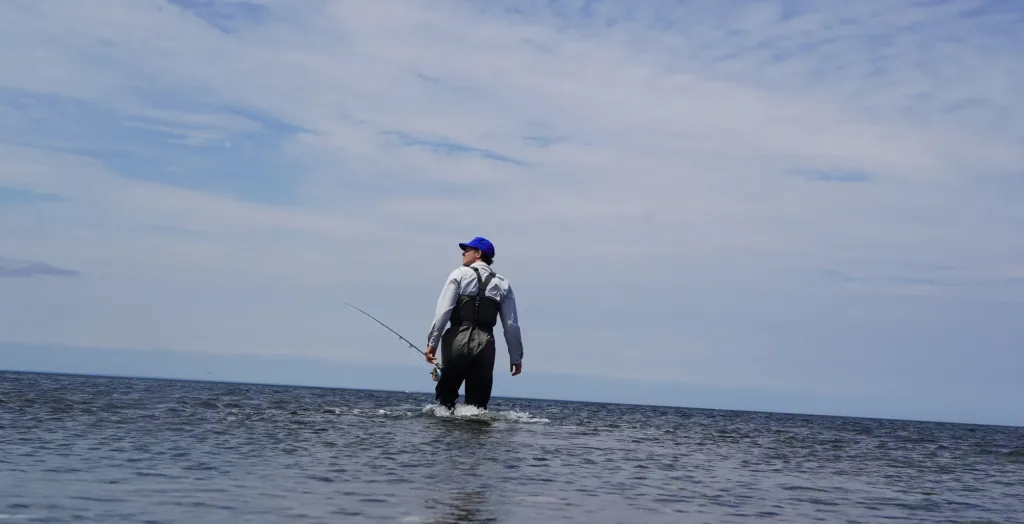
About a half mile from the lighthouse was a sandbar, and a narrow trough ran in the space between it and the beach. Climbing down into the flow, a test cast at my feet was met with a silvery flash as the line slapped the water. I cast again and felt a bump but missed the connection. I decided to make a small move and waded up to my waist within the trough before stepping onto a boulder.

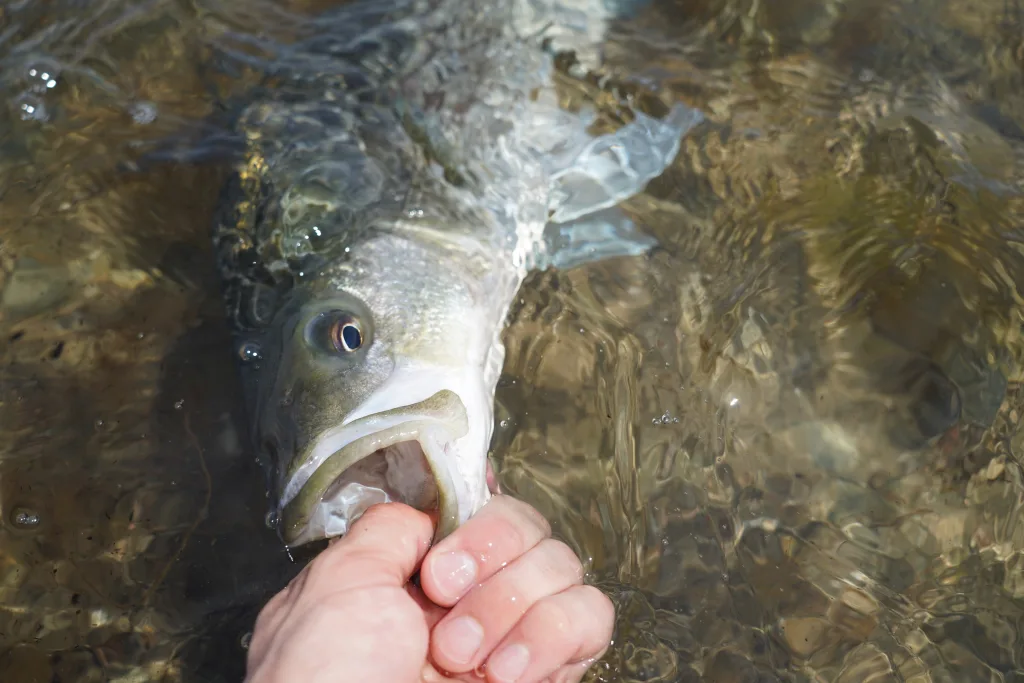
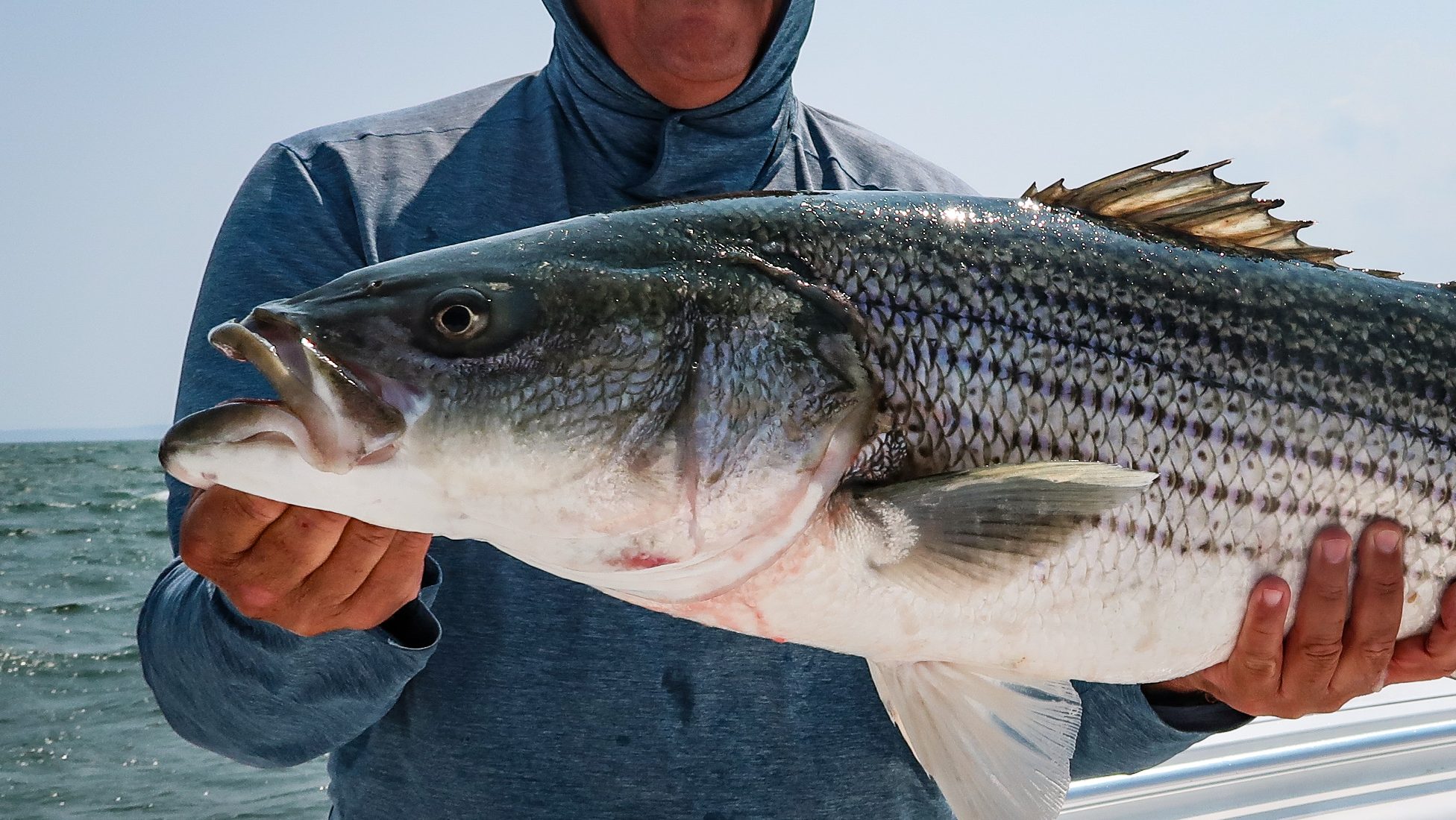
This time, I cast behind me—into the wind and against the incoming tide. As the Clouser touched down, I stripped twice before my fly was engulfed. The fish ran, pulling off drag as it fled onto the flat. It was maybe twenty-six inches, but it was green and healthy. The only marks distinguishing it from its southern brethren were the broken lateral lines, resembling notes on a piece of sheet music. I had arrived in Eden.
Canada has a long history with Morone saxatilis. Native populations have existed in the Bay of Fundy and St. Lawrence River since the pre-colonial era, with the first European mention of these striped bass coming from Samuel de Champlain during his 1604 voyage north of Bangor. While circling through the Bay of Fundy, Champlain explored the interior of Passamaquoddy Bay and the mouth of the St. John River, where he found “…so great a number of herring and bass…there that vessels could be loaded with them.”
Canadian striped bass started to experience serious decline beginning in the mid-19th century, after decades of commercial fishing obliterated the populations in the southern Gulf. One of the main culprits of this precipitous crash were hoop nets, a tactic utilized by local fishermen in New Brunswick and Quebec to target wintering striped bass through the ice by the hundreds. It came to such a critical point, that in 1849, the Canadian government announced that striped bass were all but destroyed in the Miramichi River system. What followed was decades of parliamentary squabbling about how to regulate commercial and recreational fishing, with the first piece of legislation arriving in 1873 to halt the targeting of striped bass altogether. Naturally, fishermen found loopholes to this new law, claiming they were targeting alewife instead of striped bass, and the decline continued.
From 1873 until 1909, the striped bass fluctuated, recording positive rebounds one year, leading to loosened regulations, only to have the fishery crash once again. By the end of the 1960’s, the St. Lawrence River striped bass population was officially extirpated, marking another low point for the fishery.
Canada was experiencing an existential crisis on how to handle these fish. On the one hand, striped bass were native to Canadian waters, having fattened the plates and wallets of generations of Quebecois and New Brunswickers. Still many other Canadians saw these fish as outsiders, unworthy of saving in comparison to other threatened species such as Atlantic salmon or sea-run brook trout. This sentiment remains today. Still, the government of Canada knew something had to be done, and with the help of concerned anglers, they rallied to protect their waning stocks.
In 1983, hoop nets were banned, which was a small success, but anglers were still poaching and using bycatch loopholes to target vulnerable striped bass. A few more cold winters came, and the bass fell to their deepest pit yet. Finally, in 1996, Fisheries and Oceans Canada, known as DFO, closed the recreational fishery, the bycatch, and prohibited the commercial sale of striped bass for good. A moratorium.
After running a stock assessment in 1997, DFO found there were only 3,400 spawning adult striped bass left in Canadian waters. Nearly a century-and-a-half of mismanagement led to the collapse of a once thriving gamefish population, and with no other option left, they agreed on a target number to aim for that would reflect an acceptable rebound of the Canadian striped bass. If they could reach 31,000 spawning adults in 3 out of 6 years, they would reopen the recreational fishery. Beyond striped bass, DFO also agreed to militantly observe the targeting of other species, such as alewife and smelt, not only to ensure the bass’ food sources were sustainable, but that no loophole funny business was taking place. They knew it was a tall order, but a necessary one to ensure success.
The years passed quietly, with striped bass numbers ticking up one season, falling another, and slowly, people turned their attention back to trout and salmon. In 2013, seventeen years after the moratorium was implemented, DFO reached their target of 31,000 spawning adults. Four years later, in 2017, that number peaked at over 950,000.
Part of Canada’s success in maintaining healthy populations of striped bass since their resurgence are the regulations on how and when you can target them. The following is a direct pull from the 2025 Fisheries Notice, dictating striped bass in the Southern Gulf of St. Lawrence:
Anglers can retain a maximum of four striped bass per day during the fishing season, and cannot have in their possession more than four striped bass at any given time from April 15th to October 31st. The size window for retained striped bass is a minimum length of 50 cm to a maximum length of 65 cm. The length is measured in a straight line from the tip of the nose to the tip of the tail (i.e., total length).
The use of single barbless hooks is mandatory when using lures, bait and fly fishing in tidal waters. Anglers are allowed to fish in tidal waters with a maximum of five lines and six single barbless hooks per line. In inland waters, anglers are allowed to fish with a maximum of one line and three single barbless hooks.
It is still recommended to use barbless non-offset circle hooks when using bait since this type of hook can reduce fish mortality upon the live release of the fish.
There is a closure of the Northwest Miramichi River spawning ground to all angling activities during the spawning period. The Department will issue a variation order closing all angling for a duration of up to ten days covering an area of approximately 9.8 kilometers of the Northwest Miramichi River below the Red Bank Bridge once concentrations of striped bass are observed spawning.
Tidal waters
April 15 to June 30: Angling activities can begin two hours before sunrise and must end no later than two hours after sunset of each day.
July 1 to October 31: Angling activities are permitted from 04:00 hrs to 00:00 hrs (midnight) excluding the tidal waters of the Miramichi river (including the southwest and northwest Miramichi rivers) upstream from the Centennial bridge.
Inland waters
Angling activities can begin two hours before sunrise and must end no later than two hours after sunset of each day including the tidal waters of the Miramichi River (including the southwest and northwest Miramichi rivers) upstream from the Centennial Bridge.
Today, the Canadian striped bass is still under pressure, with the entirety of the genetically distinct population spawning solely in the Miramichi River. There are a dozen rivers scattered throughout the Gulf of St. Lawrence that, in theory, should be able to host spawning populations of striped bass, but for reasons that are still not entirely clear to researchers, they are barren. Obviously, having all of the striper eggs in one ecological basket is worrisome, but for now, anglers are just happy to have their beloved gamefish back.
This triumph came at a major cost to the average Canadian fisherman, who for the better part of two decades, were forced to abandon a fish that once gave them life. However, by doing so, they ensured that their children would be able to enjoy abundance that was only possible in memory. With the fate of the American striped bass under threat, it’s hard to look at the success of our brothers to the north and not feel envy.

As Americans, I think we have this notion, both noble and foolish, that opportunity is always found in the West. We believe that each new day is given to us by Providence, and that answers appear in our hands when we wrestle with the question head on. There is no impossibility; there is only effort and determination. Still, some questions can’t be wrestled into submission, nor can they be lobbed over the horizon to be answered on another day. Maybe in order to save what is left of our striped bass, we need to look back where we started, and a little further East of that.
After snapping a few photos of my first Canadian striped bass, I released her and cast again, and was met with another schoolie, just as green and angry as the last. This bite went on for hours until the tide switched, and I gazed out toward the east. For acres in front of me, I could see tailing fish and bait, and in the openness of the coast, unburdened by industry or vacation homes, there was only the sound of water and wind.
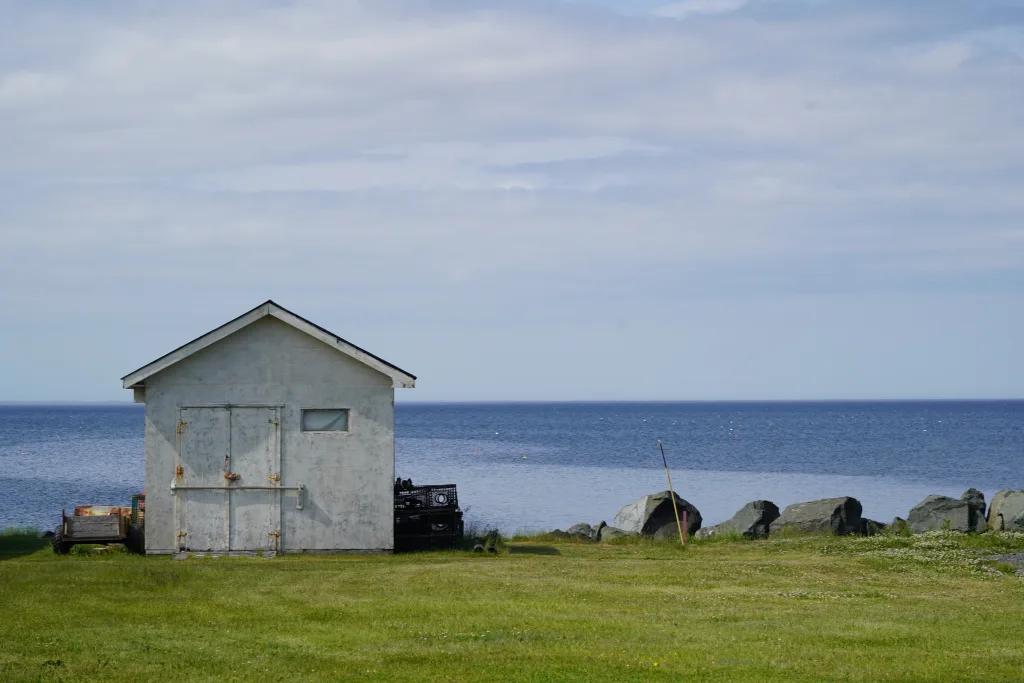
I was suddenly taken by a strange sense of guilt. I had just experienced one of the best days of striper fishing on the fly that I could remember, and I didn’t work for any of it. My time here was as a tourist, a respectful one, but an outsider nonetheless. The only way to properly express my gratitude was to take this knowledge home and work to ensure that someone in Cape Cod, Connecticut, or Long Island could experience this level of abundance in the future. It was the least I could do.
Beneath the lighthouse, I was greeted by Serge, and we briefly chatted. He told me how he loved to eat striped bass and about the old salmon runs in the Miramichi River. I told him about fly fishing in Connecticut and how hard it was to find an unmarred coastline in New England—something I was envious of. We shook hands, and he wished me a safe drive home.
As I pulled away, I called out to him one last time.
“How’d I look out there?”
“Like you were walking on water!” Serge replied.
READ MORE
Having fished the Mirrimichi from the late 80’s through the 90’s It was sad to see Global Warming bring the Stripers North to decimate Salmon Smolts leaving to spawn etc. and destroying the once incredible Atlantic Salmon fishing! I grew up in NEMass and remember Stripers were pretty much extinct from Cape Cod North I learned to fish in the Merrimack River system on the NH border and caught 0 until the 80’s. 2 years ago I spoke to a woman who owned a lodge and camp in No. Newfoundland and said Striped Bass were decimating Salmon populations there?? Global Warming? Issues? Remind Our Trumpster who insisted it’s “Fake News” Any other thoughts??